

Precision glass is not a commodity. When your application demands optical clarity within fractions of a micrometre, or structural reliability under extreme temperature and mechanical stress, the fabrication process itself becomes as critical as the final material. Defence systems, aerospace instruments, surgical devices, and automotive sensors all depend on glass components that perform without compromise. Yet a persistent misconception in procurement is that glass is glass. It is not. This guide covers the core fabrication stages, the precision metrics that matter, the technical challenges that derail programmes, and the technologies now raising the bar for what is achievable.
Table of Contents
- Understanding glass fabrication: Core processes and quality control
- Precision requirements: Tolerances, parallelism, and flatness
- Common challenges: Distortion, chipping, and the ductile-brittle transition
- Modern technology: AI inspection and advanced furnaces
- Why perfect glass doesn’t exist and what that means for procurement
- Precision glass solutions for critical applications
- Frequently asked questions
Key Takeaways
| Point | Details |
|---|---|
| Precision is essential | Extreme tolerances and flatness are vital for critical industries like defence, medical, and aerospace. |
| Challenges are technical | Distortion, chipping, and stress require expert control and advanced technology for consistent results. |
| Technology shapes quality | Modern furnaces and AI inspection drastically improve quality and compliance rates. |
| Set realistic specs | Winning procurement teams specify achievable tolerances, not perfection, to get the best results. |
Understanding glass fabrication: Core processes and quality control
With misconceptions clarified, we can now demystify what glass fabrication actually entails, especially for precision use cases. At its most fundamental, glass fabrication moves through five distinct stages: melting, forming, annealing, finishing, and inspection. Each stage introduces variables that must be tightly controlled if the finished component is to meet high-specification tolerances.
Melting establishes the fundamental material properties. Raw batch materials including silica, boron oxide, and various additives are combined and heated to temperatures exceeding 1,400°C. The homogeneity achieved at this stage directly influences optical transmission and mechanical consistency throughout the final component.
Forming shapes molten glass into its initial geometry, whether flat sheet, rod, tube, or near-net-shape blank. Techniques include float forming, precision pressing, and casting, each suited to different end applications. Float glass, for instance, produces extremely uniform flat sheet but requires subsequent finishing to reach optical-grade tolerances.
Annealing is where residual stress is addressed. As glass cools, it passes through a ductile-brittle transition, and without a controlled cooling regime, internal stresses are locked in permanently. Annealing ovens hold glass within a tightly managed temperature window, typically 520°C to 600°C, before gradually reducing heat over hours or even days for thicker substrates. Skip this step or rush it, and the glass may appear flawless but behave unpredictably under load or thermal cycling.
Finishing encompasses grinding, lapping, polishing, CNC edge work, and coating. This is where raw blanks are brought to final dimensions and surface quality. Each sub-process introduces its own risk of micro-cracking, chipping, or surface contamination if process parameters stray.
Inspection closes the loop. For precision applications, inspection is not a final gate but an integrated control throughout the process. Inline measurements using precision measurement tools catch deviations early, reducing scrap and rework.
Key quality metrics include:
- Total wavefront error (TWE) expressing transmitted wavefront distortion
- Total thickness variation (TTV) measuring thickness uniformity across the substrate
- Parallelism expressed in arcseconds
- Surface roughness (Ra) measured in nanometres
- Scratch-dig classifications per MIL-PRF-13830 or ISO 10110
| Quality metric | Typical commercial grade | Precision optical grade |
|---|---|---|
| TTV | 50 to 100 μm | Less than 1 μm |
| TWE | Lambda/4 | Lambda/10 or better |
| Parallelism | 5 to 10 arcminutes | Less than 30 arcseconds |
| Surface roughness (Ra) | 5 to 10 nm | Less than 1 nm |
| Scratch-dig | 80-50 | 10-5 |
Understanding technical glass processes in this structured way gives procurement and engineering teams a shared language with their suppliers, which directly reduces specification ambiguity.
Pro Tip: Always specify both optical and mechanical tolerances in your procurement briefs. Optical-only specifications leave surface finish, edge quality, and thickness variation undefined, which can cause failures in assembly or downstream coating processes.
Precision requirements: Tolerances, parallelism, and flatness
Once the fabrication basics are clear, attention shifts to precision and how it is achieved and quantified for top-tier industry use. The three metrics that most consistently differentiate a precision glass manufacturer from a commodity supplier are TWE, TTV, and arcsecond parallelism.
TWE (total wavefront error) measures how much a transmitted or reflected wavefront deviates from a perfect reference. For laser optics, gunsight windows, or medical imaging components, even small wavefront errors introduce image distortion or pointing errors. Values are typically expressed as a fraction of the operational wavelength.
TTV (total thickness variation) quantifies how consistently a glass substrate maintains its nominal thickness across its full surface area. A TTV below 1 μm is routinely required in semiconductor photomask substrates and high-end laser components. Achieving this demands not only precise grinding and polishing but also thermal stability throughout the finishing environment.
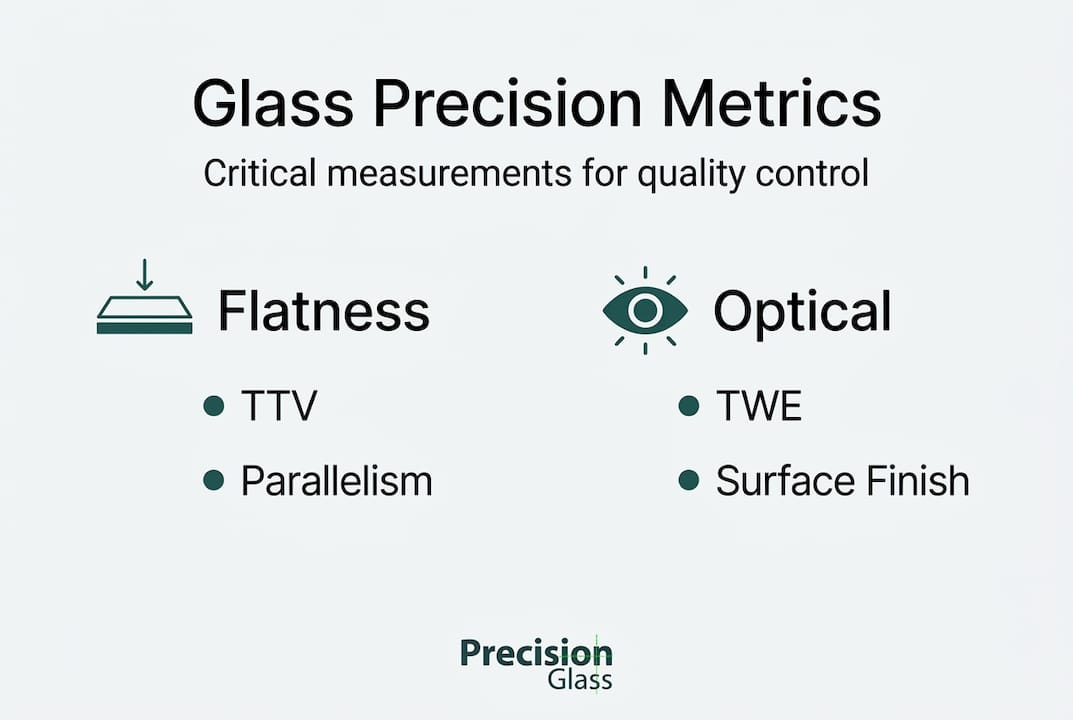
Parallelism describes how closely the two major surfaces of a flat component approach being perfectly parallel. Measured in arcseconds, it is particularly critical for etalons, beamsplitters, and windows used in interferometric systems. One arcminute of non-parallelism introduces measurable beam deviation in even modest optical path lengths.
| Industry | Typical tolerance requirement | Typical achievable standard |
|---|---|---|
| Defence optics | TWE lambda/10, TTV less than 2 μm | TWE lambda/20, TTV less than 0.5 μm |
| Aerospace windows | TTV less than 50 μm, parallelism 5 arcmin | TTV less than 10 μm, parallelism 30 arcsec |
| Medical imaging | TTV less than 5 μm, Ra less than 2 nm | TTV less than 1 μm, Ra less than 0.5 nm |
| Automotive sensors | TTV less than 20 μm | TTV less than 5 μm |
For glass used in aerospace, parallelism is not merely an optical consideration. Non-parallel windows generate unwanted aerodynamic pressure differentials at altitude, and poor flatness causes mechanical stress concentration at mounting interfaces. Both lead to premature failure.
Signals of non-compliance in fabricated glass include:
- Visible fringes or Newton’s rings when viewed under monochromatic light
- Inconsistent transmission across the aperture in optical testing
- Warping or edge lifting at assembly interfaces
- Micro-cracks detectable under polarised light inspection
- TTV variations visible as banding in transmitted laser beams
“Parallelism control is not simply a quality metric. It is a competitive differentiator for suppliers serving precision markets. Manufacturers who can hold arcsecond-level parallelism consistently across production runs command both premium pricing and long-term customer loyalty.”
Understanding medical glass terminology used in device engineering reinforces why these metrics matter equally in clinical contexts, where optical performance directly affects diagnostic accuracy.
Common challenges: Distortion, chipping, and the ductile-brittle transition
Having defined how precision is measured, it is important to address why it can be so difficult to achieve in reality. Three technical challenges recur across high-precision glass fabrication programmes: distortion, chipping, and the behaviour of glass at the ductile-brittle transition.
Distortion appears in two primary forms. Roller wave distortion is introduced during the tempering process, where glass passes over ceramic rollers in a furnace. The contact points create periodic waviness, typically characterised by a peak-to-valley measurement. Modern tempering furnaces reduce this to ±0.13 mm roller wave distortion in controlled conditions, but even this level is significant for high-acuity optical systems. Anisotropy, visible as a pattern of light and dark bands under polarised light, arises from uneven residual stress distribution and is an inherent consequence of the tempering process.
Chipping occurs during grinding, sawing, and edge finishing operations. As diamond wheels and coolant manage heat and pressure, incorrect wheel grade, insufficient coolant flow, or excessive feed rates cause micro-fractures along the cut edge. These fractures may not be immediately visible but will propagate under thermal cycling or mechanical load in service, leading to sudden, unpredictable failure. This is especially dangerous in medical or defence applications.
The ductile-brittle transition describes the temperature-dependent shift in how glass responds to stress. Above the transition temperature, glass can deform slightly in a ductile manner. Below it, any applied stress beyond the material limit causes brittle fracture without warning. This is why annealing schedules are so precise and why rapid quenching in tempering must be uniform across the entire surface.
Steps to reduce distortion and chipping:
- Select the appropriate furnace type for the glass thickness and composition being processed
- Calibrate roller pressure and spacing to minimise contact-point waviness
- Use diamond grinding wheels with grain size matched to the material hardness
- Maintain consistent coolant temperature, flow rate, and chemistry throughout finishing
- Implement staged grinding with decreasing abrasive grades before transitioning to polishing
- Conduct post-process polarised light inspection to map residual stress distribution
- Specify and verify annealing schedules through thermocouple logging at multiple points within the load
Understanding optimised glass sourcing practices helps procurement teams ask the right questions about furnace capability and finishing controls before committing to a supplier.
Pro Tip: Always specify your target roller wave distortion value in any procurement brief for toughened glass destined for critical viewing or optical applications. Without it, suppliers will optimise for throughput, not optical quality.
Modern technology: AI inspection and advanced furnaces
With the challenges outlined, it is crucial to understand how recent technological advances are reshaping what precision glass can achieve. The two most significant developments are AI-assisted inspection systems and advanced furnace technology, and together they are producing measurable improvements in yield, consistency, and traceability.
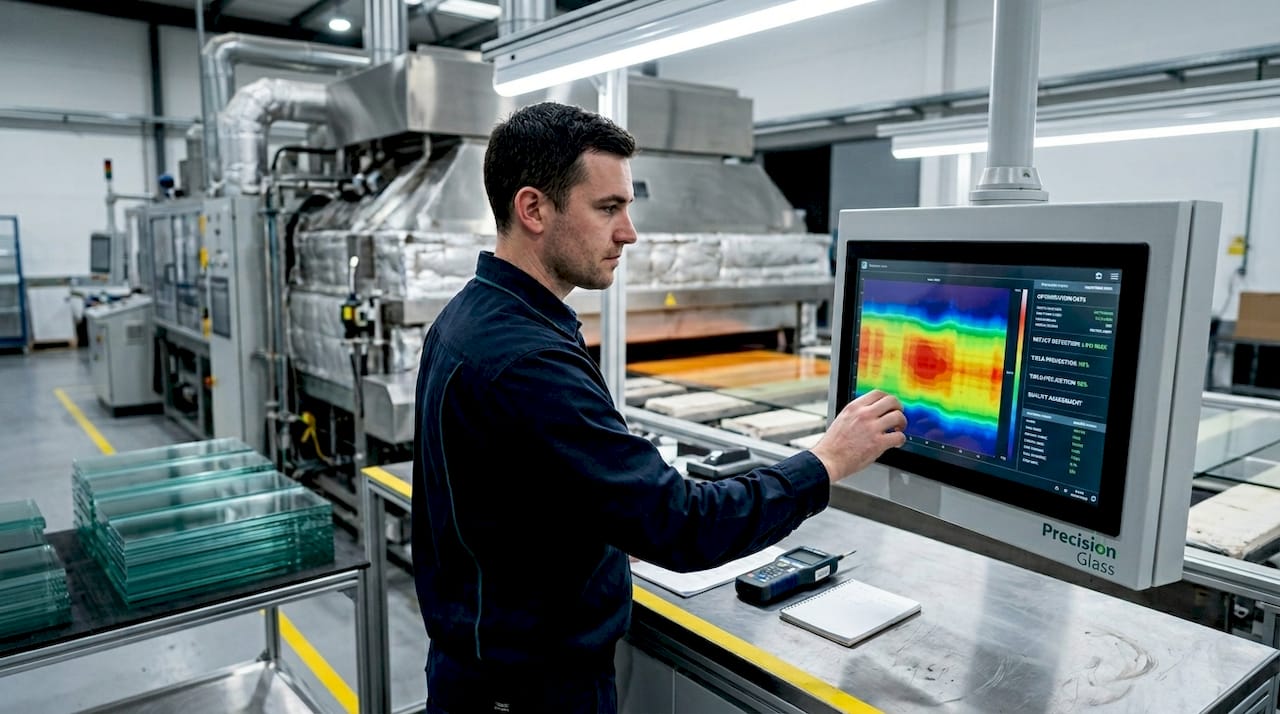
AI inspection operates in real time, analysing thousands of data points per second across a moving glass surface. Camera systems combined with machine learning models identify surface defects, inclusions, bubbles, and optical anomalies with sensitivity far beyond what human inspectors can maintain consistently over a production shift. Critically, AI systems build statistical process control data that reveals drift trends before defects reach finished components. Modern furnaces and AI inspection together have transformed what quality metrics are achievable at volume production scale.
Advanced furnace technology addresses distortion at the source. Convection-controlled tempering furnaces with independently adjustable heating zones maintain uniform temperature distribution across the glass surface during the critical heating and quenching phases. Coupled with real-time pyrometer feedback, these systems reduce the thermal gradient responsible for anisotropic stress patterns.
Immediate wins from upgrading inspection systems include:
- Reduction in escape defects reaching customers, typically by 60% to 80%
- Real-time SPC data enabling root cause analysis within the same production run
- Consistent defect classification eliminating subjective inspector variation
- Full traceability of inspection results linked to individual component serial numbers
- Earlier detection of grinding wheel wear before it affects surface roughness
| Inspection metric | Pre-AI manual inspection | Post-AI automated inspection |
|---|---|---|
| Defect detection sensitivity | 0.5 mm and above | 0.1 mm and above |
| Inspection throughput | 100 to 200 parts per hour | 500 to 1,000 parts per hour |
| False rejection rate | 8 to 12% | 1 to 3% |
| Traceability | Batch level | Individual component level |
| Consistency across shifts | Variable | Consistent |
For procurement teams writing requests for proposals, it is entirely appropriate to ask suppliers to demonstrate their modern inspection methods by providing sample inspection reports, defect escape rate data, and SPC trend charts from recent production runs. Suppliers operating advanced AI-assisted inspection systems will typically welcome this level of scrutiny and be able to supply it readily.
Why perfect glass doesn’t exist and what that means for procurement
Here is the uncomfortable reality that no amount of technology changes: no glass is truly free from internal stress, surface micro-topography variation, or some level of optical distortion. The physics of the material simply do not allow it. Procurement teams that specify perfection are not protecting their programmes. They are creating unachievable requirements that either drive costs to impractical levels or incentivise suppliers to misrepresent their actual outputs.
The most effective procurement specifications we have encountered are not the tightest ones. They are the most precise ones. There is a meaningful difference. A specification that states “TTV less than 1 μm across a 150 mm aperture, measured by interferometry at 632.8 nm, with a minimum of nine measurement points” is precise. A specification that says “flawless optical glass, zero distortion” is meaningless and unverifiable.
There is also a genuine trade-off that procurement must acknowledge. As research on glass specifications confirms, thicker glass resists warp under thermal load better but accumulates greater internal stress during tempering. Demanding both maximum thickness and minimum stress simultaneously creates a manufacturing paradox. Good specifications acknowledge this and define the priority.
The teams who get the best outcomes are those who work collaboratively with their manufacturer from early in the design process, defining which parameters are critical to function and which are desirable but flexible. Engaging a supplier’s engineering team before finalising drawings almost always produces better results than issuing a finished drawing and asking for a price. For projects requiring optical clarity and structural precision, this collaborative approach is not optional. It is essential.
Precision glass solutions for critical applications
For companies operating in defence, aerospace, medical, and automotive sectors, the gap between a capable glass manufacturer and a true precision specialist is significant, and it directly affects programme risk.

At Glass Precision, we design, fabricate, and inspect glass components to the demanding tolerances that mission-critical applications require. Our capabilities span glass solutions for aerospace transparency and optical systems, through to medical glass applications for diagnostic and surgical devices. We work with your engineering team from the earliest design stage, helping to define achievable specifications that protect performance without adding unnecessary cost. If your next programme requires a precision glass partner, we welcome the conversation.
Frequently asked questions
What is the ductile-brittle transition and why does it matter in glass fabrication?
It is the temperature-dependent point where glass shifts from slight deformation under stress to brittle fracture, making precise annealing and stress relief essential for reliable, high-quality components.
How do modern furnaces and AI improve glass quality?
They work together to reduce thermal distortion through precise zone heating and catch surface defects in real time, with AI inspection minimising distortion and defect escape rates measurably across production runs.
What are TWE and TTV, and how are they measured?
TWE measures transmitted wavefront error and TTV measures thickness uniformity, both assessed via interferometry to sub-micrometre accuracy to verify that parallel surfaces meet the required optical and mechanical tolerances.
Is distortion in toughened glass always preventable?
No. Some distortion is inherent to the tempering process, but advanced furnace technology and AI-driven inspection significantly reduce visible effects to the lowest practically achievable levels.