
Specifying the wrong glass material in a precision-engineered assembly does not simply reduce performance. It can halt an entire production line, trigger regulatory non-compliance, or introduce a latent failure mode that only surfaces under thermal cycling or chemical exposure. For engineers and procurement professionals working across medical devices, defence, electronics, and aerospace, a structured glass material selection list is not a convenience. It is a technical necessity. This article delivers exactly that: a detailed, ranked reference covering ten glass types, the criteria that distinguish them, and the decision logic that turns a shortlist into a confident specification.
Table of Contents
- Key takeaways
- The glass material selection list: criteria that drive every decision
- Top 10 glass materials: features, applications, and procurement considerations
- Glass material comparison: performance, cost, and suitability
- Decision workflows for specific high-tech scenarios
- What I have learned about glass selection that most guides miss
- How Glassprecision supports your material selection decisions
- FAQ
Key takeaways
| Point | Details |
|---|---|
| Criteria before materials | Establish thermal, chemical, mechanical, and compliance requirements before comparing material options. |
| Borosilicate as default | Start with borosilicate for moderate conditions; escalate to fused silica or sapphire only when conditions demand it. |
| Annealing and mould history matter | Pyrometer control and mould cycle records directly affect dimensional consistency and thermal performance. |
| Cost layers are predictable | Glass pricing follows clear tiers from commodity to pharmaceutical-grade; budget accordingly from the outset. |
| Compliance is non-negotiable | FDA, EU, and REACH certifications must be verified at batch level, not just at supplier level. |
The glass material selection list: criteria that drive every decision
Before comparing individual materials, you need a fixed framework of selection criteria. Without it, your glass materials checklist becomes a catalogue of options rather than a decision tool.
The criteria that matter most in high-tech procurement are as follows:
- Thermal properties. Coefficient of thermal expansion (CTE) and thermal shock resistance determine whether glass survives rapid temperature changes in autoclaves, reflow ovens, or optical assemblies. Unannealed glass fails thermal shock tests in over 85% of cases, making annealing quality a baseline procurement requirement.
- Chemical resistance. Glass in pharmaceutical or semiconductor contexts faces acids, alkalis, and solvents. Hydrolytic class (ISO 719) ratings and resistance to specific reagents must appear on your glass solutions checklist.
- Mechanical strength and abrasion resistance. Modulus of rupture, Vickers hardness, and surface quality all affect service life. Toughened glass and sapphire sit at opposite ends of this spectrum, each with distinct processing implications.
- Optical properties. Transmission range, refractive index, and homogeneity are decisive in imaging, sensing, and display applications. Not every material with high clarity offers the spectral bandwidth you need.
- Regulatory compliance. FDA 21 CFR and EU regulations are mandatory for medical and food-contact glass. REACH compliance governs lead and heavy-metal content across European supply chains.
- Manufacturing constraints. Mould tolerances, grinding and polishing requirements, and CNC compatibility all affect what you can practically specify. Variations as small as 0.15mm in glass thickness can cause failures in automated production lines.
- Cost structure. Energy costs represent 25 to 35% of total glass production pricing. Logistics and breakage allowances add a further 10 to 15%, and certification costs contribute 3 to 8% on top of that.
Pro Tip: Build your selection criteria matrix before approaching suppliers. When you hand a supplier a completed requirements sheet covering thermal class, optical bandwidth, and compliance standards, you shorten quotation cycles and reduce specification risk significantly.
Consulting a full glass specifications guide at this stage ensures your criteria align with what manufacturers can actually deliver to tolerance.
Top 10 glass materials: features, applications, and procurement considerations
## 1. Borosilicate glass
Borosilicate is the workhorse of precision glass. With a CTE of approximately 3.3 × 10⁻⁶/K and excellent hydrolytic resistance, it handles moderate chemical and thermal duty reliably. Borosilicate is the economical choice for sight glasses, laboratory ware, pharmaceutical packaging, and process vessels where extreme conditions are not present. Performance-specified borosilicate typically ranges from £4 to £12 per kilogram depending on form and certification level.
## 2. Fused silica (quartz glass)
Fused silica offers a CTE below 0.6 × 10⁻⁶/K and exceptional UV transmission, making it the specified material for semiconductor photolithography, high-power laser optics, and applications requiring rapid thermal cycling. It is significantly more costly to process than borosilicate due to its high melting point and grinding demands, so its use should be reserved for conditions that genuinely exceed borosilicate’s limits.
## 3. Sapphire (single-crystal alumina)
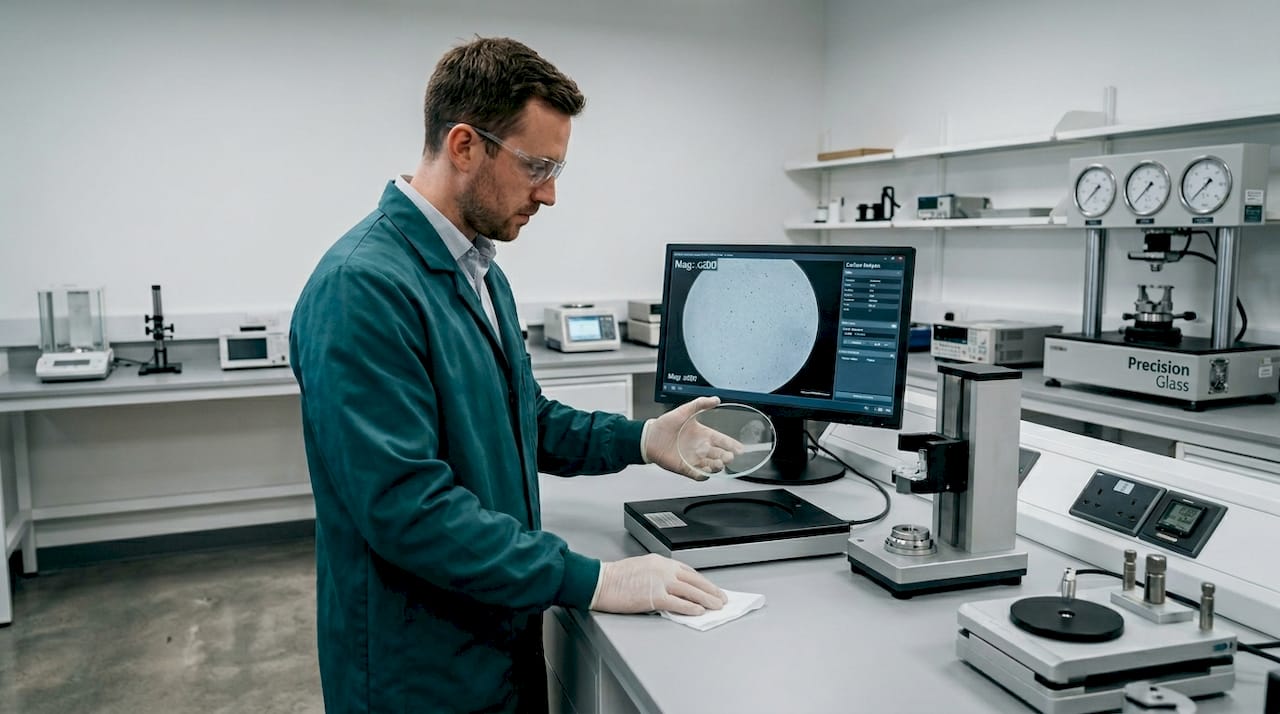
Sapphire is the premium entry on any high-precision glass checklist. With a Vickers hardness of approximately 2000 HV and resistance to most acids and alkalis at elevated temperatures, it serves in optical windows for aerospace sensors, medical endoscope lenses, and high-wear industrial viewports. The cost premium over fused silica is substantial, but for applications where abrasion or corrosive attack would destroy other materials, there is no practical substitute.
## 4. Tempered (toughened) glass
Toughening via thermal or chemical means increases surface compressive stress, typically delivering four to five times the mechanical strength of annealed equivalents. However, no glass is truly unbreakable. When toughened glass does fail, it fragments into small blunt pieces rather than sharp shards, which is the safety trade-off it offers. It cannot be cut or drilled after toughening, so final dimensions must be specified before processing.
## 5. Soda-lime glass
Soda-lime accounts for the majority of commodity glass production. It is cost-effective and widely available, but its CTE of approximately 9 × 10⁻⁶/K and limited chemical resistance disqualify it from most precision or regulated applications. In high-tech procurement, it typically appears only in non-critical protective covers or display substrates where cost dominates the specification.
## 6. Lead glass and optical crystal
Lead glass offers high refractive index and excellent optical dispersion characteristics, properties that make it historically significant in precision optics. However, REACH regulations restrict lead content in European supply chains, and procurement teams must verify compliance rigorously. Where optical performance is required without compliance risk, lanthanum-doped or rare-earth optical glasses provide an effective alternative.
## 7. Aluminosilicate glass
Aluminosilicate glass combines higher alumina content with a lower CTE than soda-lime, delivering improved mechanical toughness and temperature resistance. It is the substrate material behind chemically strengthened cover glass in consumer electronics and medical touchscreens. Its abrasion resistance and ability to undergo ion-exchange strengthening make it a strong candidate on any protective glass checklist for display applications.
## 8. Glass-ceramics
Glass-ceramics are produced by controlled crystallisation of glass, yielding near-zero CTE materials with exceptional thermal shock resistance. Zerodur and MACOR are well-known examples in precision engineering. These materials appear in astronomical mirror substrates, precision metrology plates, and high-temperature cooking surfaces. Their dimensional stability under thermal load is unmatched by conventional glass types.
## 9. Coated and chemically treated glass
Functional coatings applied via physical vapour deposition, chemical vapour deposition, or sol-gel processes extend glass performance into specialised territory. Anti-reflection, hydrophobic, electrically conductive (ITO), and hard-coat treatments all qualify a substrate for applications beyond its intrinsic material properties. When specifying coated glass, the coating adhesion specification and environmental durability testing data are as important as the substrate properties.
## 10. Specialty optical glasses and the polymer distinction
Specialty optical glasses, including Schott N-BK7, N-SF11, and similar catalogue glass types, are specified by their precise refractive index and Abbe number. These are ground and polished to tight surface figure tolerances for lenses, prisms, and beam splitters. A critical procurement note: acrylic and polycarbonate are frequently misclassified as glass. They are polymers with fundamentally different thermal stability, chemical resistance, and long-term dimensional behaviour. Substituting a polymer for glass in a regulated or high-temperature application is a specification error with serious downstream consequences.
Pro Tip: When reviewing supplier datasheets for specialty optical glass, always request the measured refractive index and Abbe number from the actual melt batch, not just the nominal catalogue values. Melt-to-melt variation is real and it matters in precision assemblies.
Glass material comparison: performance, cost, and suitability
| Material | Thermal shock resistance | Chemical resistance | Mechanical toughness | Optical clarity | Indicative cost | Typical applications |
|---|---|---|---|---|---|---|
| Borosilicate | High | High | Moderate | Good | £4–12/kg | Lab ware, pharma, process vessels |
| Fused silica | Excellent | Excellent | Moderate | Excellent (UV) | £30–80/kg | Lithography, laser optics |
| Sapphire | Very high | Excellent | Very high | Excellent | £200+/kg | Aerospace windows, endoscopes |
| Toughened glass | Moderate | Moderate | High (surface) | Good | £8–25/kg | Safety panels, displays |
| Soda-lime | Low | Low | Low | Good | £1–3/kg | Commodity covers |
| Aluminosilicate | High | Moderate | High | Good | £15–40/kg | Cover glass, touchscreens |
| Glass-ceramics | Exceptional | Good | Moderate | Variable | £50–200/kg | Metrology, telescope mirrors |
| Specialty optical | Moderate | Moderate | Moderate | Excellent | £5–50/kg | Lenses, prisms, beam splitters |
Certified pharmaceutical-grade glass ranges from approximately £0.30 to £1.20 per unit in container formats, while performance-specified borosilicate in bulk sits between £5 and £15 per kilogram. Understanding these pricing tiers prevents budget surprises when moving from prototyping to volume procurement.
Decision workflows for specific high-tech scenarios
A glass material selection guide is only useful if it connects material properties to real specification decisions. These workflows address the scenarios engineers and procurement teams encounter most often.
Moderate temperature and chemical duty (up to 200°C, standard reagents). Borosilicate is the correct starting point. Its cost, availability, and processing maturity make it the default for the majority of laboratory, pharmaceutical, and general process applications. Specifying a higher-grade material here adds cost without delivering measurable performance benefit.
Extreme thermal cycling or UV-critical applications. Escalate to fused silica when borosilicate’s CTE or UV absorption becomes a limiting factor. This typically arises in semiconductor processing, high-energy laser systems, and metrology instruments. The cost increase is significant, so document the thermal or optical requirement that drives the escalation clearly in your specification record.
Abrasion-intensive or highly corrosive environments. Sapphire is the correct choice when neither borosilicate nor fused silica provides sufficient surface hardness or chemical inertness. Aerospace sensor windows, chemical process viewports, and high-wear optical surfaces fall into this category.
The following procurement practices apply across all scenarios:
- Require batch-level Certificates of Analysis from every supplier. A supplier-level quality certificate does not confirm the performance of the specific melt you are receiving.
- Verify mould cycle records up to 500 cycles. Mould wear causes thickness variation that jams automated assembly lines and introduces stress concentrations.
- Confirm pyrometer readings at lehr exit fall within the specified annealing range. For flint glass, 520 to 560°C is the accepted window. Deviation outside this range introduces residual thermal stress that degrades mechanical performance.
- Specify automated vision inspection as a baseline for Tier-2 and above suppliers. Manual inspection cannot reliably detect sub-millimetre surface defects or dimensional variation at production volumes.
- Account for recyclability and end-of-life processing obligations under UK and EU regulations. Borosilicate and soda-lime glass cannot be recycled together; incorrect sorting at the procurement or disposal stage creates downstream waste handling liabilities.
Pro Tip: If your application sits in electronics procurement, build traceability requirements into your purchase order terms from the outset. Retrofitting batch-level traceability into an established supply chain is significantly more costly and disruptive than specifying it at contract award.
What I have learned about glass selection that most guides miss
I have reviewed a significant number of glass specifications across medical, defence, and electronics programmes. The pattern I see most often is not a failure to understand material properties. Engineers generally know their thermal coefficients. The failure is almost always in the gap between material knowledge and procurement execution.
Suppliers routinely offer nominal catalogue data. What you actually receive is a product of that supplier’s mould maintenance history, annealing line calibration, and batch sorting discipline. I have seen programmes delayed because pyrometer drift at a lehr exit introduced residual stress that nobody caught until assemblies cracked during vibration testing. The root cause was traceable to a mould that had exceeded 600 cycles against a 500-cycle replacement threshold. The certificate said compliant. The glass said otherwise.
My practical position is this: the simplest material that genuinely meets your thermal, chemical, and optical requirements is nearly always the correct choice. The impulse to over-specify, to reach for fused silica when borosilicate will do, adds cost, extends lead times, and creates processing complexity without returning measurable performance. Reserve the premium materials for the conditions that actually demand them.
The hidden compliance risk is lead glass. Legacy optical designs still call for it, and REACH restrictions are not always checked rigorously on inherited specifications. Review your optical glass catalogue against current substance restrictions before you commit to a design.
— Alexandra
How Glassprecision supports your material selection decisions
When your glass material selection list moves from research to active procurement, the supplier you choose determines whether your specification tolerances are actually met in production.

Glassprecision designs, fabricates, and supplies precision-engineered glass components across medical, defence, aerospace, automotive, electronics, and lighting sectors. From technical glass solutions to bespoke optical assemblies, the team works to your dimensional and compliance requirements, not against them. Every component is supported by meticulous quality assurance, batch-level traceability, and manufacturing processes that account for annealing parameters and mould cycle discipline from the outset. You can explore the full range of precision glass products and sectors or review Glassprecision’s quality and compliance standards to understand what a verified supply chain looks like in practice.
FAQ
What is the best glass for high-temperature precision applications?
Fused silica is the preferred choice for extreme thermal cycling and high-temperature stability, while borosilicate covers the majority of moderate-temperature applications cost-effectively.
How does a glass materials checklist differ from a standard procurement checklist?
A glass materials checklist includes material-specific criteria such as CTE, hydrolytic class, annealing records, and optical transmission range, which are absent from general procurement documents.
When should sapphire replace borosilicate on a specification?
Sapphire is warranted when surface hardness exceeds borosilicate’s capability, typically in abrasion-intensive viewports, aerospace sensor windows, or highly corrosive chemical environments.
Why does annealing quality affect my glass material selection?
Poorly annealed glass retains residual thermal stress that degrades mechanical performance and causes premature failure; pyrometer records at furnace exit confirm whether the annealing process was correctly executed.
Is polycarbonate an acceptable substitute for glass in precision assemblies?
No. Polycarbonate is a polymer with significantly lower thermal stability and different mechanical behaviour than glass; substituting it in regulated or thermally demanding applications introduces serious specification risk.