
Optical filters are frequently dismissed as simple colour selectors, yet that perception misses the vast majority of their function. The real reason to understand why use optical filters goes far beyond aesthetics. In precision optical systems, filters govern spectral control, protect sensitive detectors, suppress noise, and isolate specific wavelengths with tolerances measured in fractions of a nanometre. From fluorescence microscopy to autonomous vehicle sensors, filters are load-bearing components in system architecture. This article examines the practical benefits, technical considerations, and emerging applications that make optical filters indispensable across medical, industrial, scientific, and photonic systems.
Table of Contents
- Key takeaways
- Filter types and how they work
- Optical filter applications across key industries
- Benefits of optical filters in precision system design
- Technical challenges in optical filter use
- Emerging innovations in optical filter technology
- What I have learned from working with optical filters
- How Glassprecision supports your optical filter requirements
- FAQ
Key takeaways
| Point | Details |
|---|---|
| Filters do far more than alter colour | Optical filters control spectral bandwidth, suppress noise, and protect detectors in precision systems. |
| Filter type determines application suitability | Bandpass, notch, longpass, and shortpass filters each serve distinct functions across industries. |
| Quality directly affects system performance | High-quality filters avoid artefacts and physical damage; poor choices degrade entire optical systems. |
| Stacking carries hidden risks | Combining multiple filters without accounting for cumulative effects causes vignetting and reduced transmission. |
| Emerging technologies are reshaping the field | Liquid crystal polarisation gratings and metasurfaces are replacing bulky optical assemblies with compact, high-efficiency alternatives. |
Filter types and how they work
Understanding the purpose of optical filters begins with their physical operating principles. Two primary categories exist: absorptive filters and interference filters. Absorptive filters, typically coloured glass, attenuate unwanted wavelengths through molecular absorption. They are thermally stable and tolerant of off-axis illumination, which makes them well-suited to broadband attenuation in illumination systems.
Interference filters operate differently. They use dielectric thin-film coatings to reflect, rather than absorb, unwanted wavelengths. This approach produces far sharper spectral edges and higher transmission within the passband, but it also introduces angle-of-incidence sensitivity. As light strikes at increasing angles, the effective passband shifts towards shorter wavelengths, a characteristic that must be accounted for in collimated and focused beam systems alike.
The most common optical filter types include:
- Shortpass filters: transmit wavelengths below a defined cut-off, blocking infrared in visible imaging systems
- Longpass filters: transmit above the cut-off, used in fluorescence excitation and laser clean-up
- Bandpass filters: isolate a specific spectral band, with bandwidths ranging from fractions of a nanometre to hundreds of nanometres
- Notch filters: reject a narrow spectral band while transmitting on either side, critical for Raman spectroscopy
- Neutral density filters: attenuate uniformly across the spectrum without altering colour balance
- Polarisers: select a specific polarisation state, used in stress analysis, LCD systems, and ellipsometry
Filter performance is characterised by several key parameters. Optical density, bandwidth, and angle sensitivity directly influence how well a filter performs in a given application. A bandpass filter with a 1 nm full-width half-maximum passband is essential for atomic spectroscopy but entirely wrong for a broadband camera system. Matching these parameters to the application is where most system design decisions are won or lost.
| Filter type | Mechanism | Typical application |
|---|---|---|
| Bandpass | Thin-film interference | Fluorescence microscopy, spectroscopy |
| Longpass | Absorption or interference | Laser line clean-up, IR transmission |
| Shortpass | Absorption or interference | IR blocking, visible imaging |
| Notch | Interference | Raman spectroscopy, laser rejection |
| Neutral density | Absorption | Exposure control, laser attenuation |
| Polariser | Birefringence or wire grid | LCD panels, stress analysis, ellipsometry |
Optical filter applications across key industries
The uses of optical filters span virtually every sector that relies on controlled light interaction with matter. The breadth of application is one of the clearest answers to the question of why optical filters are important.
In medical diagnostics, filters enable fluorescence techniques that are critical to disease detection. Fluorescence microscopy requires matched excitation and emission filter sets to isolate the signal of a specific fluorophore from background autofluorescence. Without precise bandpass and longpass filters, the signal-to-noise ratio collapses, and meaningful imaging becomes impossible. Endoscopy systems use narrowband filters to enhance tissue contrast, supporting earlier identification of lesions.

Industrial machine vision is another major domain. Filters improve inspection repeatability by rejecting ambient light that would otherwise destabilise illumination conditions. A bandpass filter matched to the wavelength of an LED ring light eliminates fluorescent ceiling lighting from the image entirely, producing consistent contrast regardless of the factory environment. For surface defect detection at speed, this level of control is non-negotiable.
Scientific applications demand the most exacting specifications. In Raman spectroscopy, notch filters must reject the laser line by six to seven orders of magnitude while maintaining high transmission just nanometres away from the rejection band. Laser systems use bandpass filters for spectral clean-up to prevent off-wavelength leakage from contaminating downstream optical paths. Advanced atomic sensors rely on precisely tuned filters to isolate signal wavelengths from broadband noise sources.
Consumer electronics applications are more visible to the general public. Blue-light-filtering lenses are incorporated in displays and eyewear to reduce retinal oxidative stress, though evidence for visual fatigue reduction remains inconclusive. Computational photography in smartphones uses near-infrared cut filters to constrain sensor response to the visible band, preventing the IR sensitivity of silicon from washing out skin tones and foliage rendering.
Benefits of optical filters in precision system design
The core benefits of optical filters reduce to one principle: precise control over which wavelengths reach a detector, a sample, or a subsequent optical element. Spectral control enables system optimisation without requiring expensive hardware changes. A well-chosen filter can replace a spectrometer in applications where only a narrow band is needed, reducing system cost and complexity by an order of magnitude.
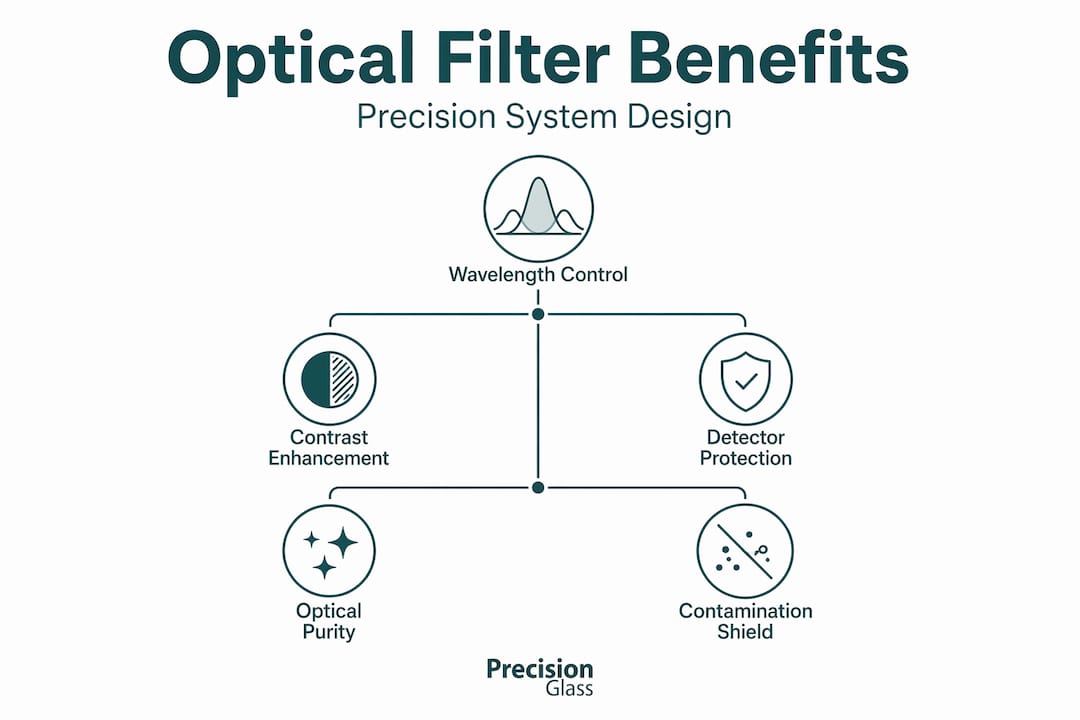
Contrast enhancement is a particularly underappreciated benefit. In machine vision and microscopy, contrast is not improved by increasing illumination power. It is improved by isolating the wavelengths at which the feature of interest differs most strongly from its background. A filter accomplishes this passively, with no moving parts, no power consumption, and no latency.
Detector protection is equally significant. High-energy laser systems can permanently damage CCD or CMOS sensors if stray light or out-of-band laser energy reaches the detector plane. A correctly specified longpass or bandpass filter placed upstream prevents this, extending detector service life and protecting capital investment.
High-quality filters are optically inert when properly specified. They protect front optical elements from contamination and physical damage without introducing measurable aberration or transmission loss. Cheap alternatives, by contrast, introduce flare, chromatic artefacts, and non-uniform transmission that degrade image quality across the full field.
Pro Tip: When specifying a filter for a collimated beam system, always confirm the filter’s angle-of-incidence specification. A bandpass filter rated for 0° incidence can shift its centre wavelength by several nanometres at just 5° to 10° of off-axis illumination, which is enough to invalidate calibration in spectroscopy or fluorescence systems.
Key advantages of optical filters in system design include:
- Passive spectral selection with no power requirement or moving parts
- Significant cost reduction compared with detector-side spectral discrimination
- Suppression of ambient light interference in field-deployed systems
- Isolation of specific fluorophore emission bands in life sciences instrumentation
- Reduction of thermal load on detectors by blocking out-of-band radiation
Technical challenges in optical filter use
Optical filters introduce specific engineering constraints that must be addressed at the design stage rather than treated as afterthoughts.
Interference filters are fragile and susceptible to humidity and temperature-driven performance drift. Thin-film coatings can delaminate under thermal cycling, and moisture ingress shifts the effective refractive index of the layer stack, displacing the passband. Sealed filter assemblies with hermetic bonding are the correct solution for instruments operating in variable or harsh environments. Periodic recalibration or filter replacement must be written into the maintenance schedule for critical systems.
Angle of incidence sensitivity, noted earlier as a physical characteristic, becomes a practical problem in systems that use converging or diverging beams. In such cases, the range of angles present across the beam cone broadens the effective passband and reduces peak transmission. For applications requiring sub-nanometre bandwidth control, this demands collimated illumination at the filter plane, which adds optical complexity.
Stacking filters without accounting for cumulative effects leads to vignetting, ghosting, and substantial transmission losses. Each additional filter surface adds reflection losses, even with anti-reflection coatings, and the combined mechanical thickness increases the risk of vignetting in wide-angle configurations. The general principle is to achieve the required spectral function with the fewest possible filter elements.
Pro Tip: Inspect filter orientation before installation. Many interference filters are designed with the coating facing the light source. Reversing the orientation places the substrate between the coating and the beam, introducing unwanted reflections and altering the effective spectral response of the assembly.
Cleaning is another area where errors are costly. Optical filters should be cleaned with filtered, reagent-grade isopropanol and lint-free optical tissue using a single-direction stroke. Circular motion and silicone-coated tissues both risk permanent scratching of the delicate dielectric surface.
Emerging innovations in optical filter technology
The field is advancing rapidly, and several developments are redefining what optical filters can achieve in compact, high-performance systems.
Liquid crystal polarisation gratings now achieve diffraction efficiencies exceeding 95%, replacing multiple conventional optical components in a single thin element. In optically pumped magnetometers and atomic sensors, these devices suppress laser power noise that would otherwise limit sensitivity. The result is a significant improvement in signal stability without increasing system volume.
Scalable photoalignment techniques are enabling the production of large-area polarisation gratings with sub-micron feature control. This replaces complex bulk optics assemblies with planar elements that can be integrated directly into miniaturised sensor packages. For the photonics and defence sectors, this translates into fielded systems with reduced weight, smaller footprint, and improved reliability.
Metasurface-based filters are attracting substantial research investment. By engineering sub-wavelength nanostructures on a flat substrate, metasurfaces achieve spectral and polarisation filtering functions that previously required centimetres of optical path length. As fabrication costs decrease, these devices are expected to move from laboratory demonstrations into commercial production for photonic device integration.
The optical coloured glass filter market is projected to reach USD 666 million by 2034, growing at a CAGR of 3.8%, driven by expanding machine vision deployment and the continued growth of medical imaging systems. This growth reflects genuine demand rather than market speculation. The volume of sensors requiring spectral discrimination, in autonomous vehicles, medical analysers, and industrial robots, is increasing faster than alternative detection technologies can displace filter-based solutions.
What I have learned from working with optical filters
I have spent years working alongside optical engineers and system integrators on filter specifications, and the single most common mistake I see is treating filters as a final-step decision rather than a foundational one. Engineers finalise their detector choice, light source, and optical path, and then ask which filter fits. That sequence almost always produces a compromise.
The filter should inform the system design, not react to it. The required spectral bandwidth determines the light source linewidth requirements. The required rejection ratio determines the detector dynamic range needed. Getting this sequence right changes everything downstream.
I have also seen significant losses caused by neglecting environmental factors. A beautifully specified interference filter installed in an uncontrolled enclosure will drift within months. The maintenance cost of recalibration or replacement far exceeds the cost of a properly sealed assembly from the outset.
My honest view on emerging filter technologies: metasurfaces and liquid crystal gratings are genuinely transformative, but they are not yet mature enough for most production environments. For the next three to five years, well-specified thin-film interference filters from reputable manufacturers will remain the reliable workhorse of most photonic systems. Invest in quality. The artefacts introduced by cheap optical components cost more to diagnose and correct than the price difference ever justified.
— Alexandra
How Glassprecision supports your optical filter requirements

At Glassprecision, we manufacture precision optical components for the most demanding environments in medical, defence, engineering, security, and photonics. Our capabilities span custom filter substrates, precision-polished optical flats, and advanced coating technologies tailored to exacting spectral specifications.
We work with engineers and procurement teams across the sectors where filter performance is non-negotiable. Whether your application requires narrow-band interference filters for fluorescence instrumentation, IR-blocking substrates for thermal imaging, or custom neutral density components for laser power management, our team has the fabrication and coating expertise to deliver to your specification.
Explore the full range of precision optical solutions we offer, or review the sectors we serve to find where our capabilities align with your project requirements. Our quality assurance processes and meticulous attention to specification compliance mean you receive components that perform exactly as designed, every time.
FAQ
What is the primary purpose of optical filters?
The purpose of optical filters is to control which wavelengths of light pass through an optical system, enabling spectral isolation, noise suppression, contrast enhancement, and detector protection. This selective transmission is fundamental to precision optical system performance.
Why use optical filters in machine vision systems?
Optical filters in machine vision reject ambient light and isolate the illumination wavelength, producing consistent image contrast regardless of environmental lighting conditions. This repeatability is critical for reliable automated defect detection.
What are the main types of optical filters?
The main optical filter types are bandpass, longpass, shortpass, notch, neutral density, and polariser filters. Each type selects or rejects specific wavelengths or polarisation states based on the requirements of the application.
How do interference filters degrade over time?
Interference filters are susceptible to humidity and temperature cycling, which can cause thin-film delamination and passband drift. Sealed, hermetically bonded assemblies and scheduled recalibration are the standard mitigation measures for critical systems.
Can you stack multiple optical filters together?
Stacking filters is possible but carries real risks. Cumulative transmission losses, vignetting, and ghosting are common outcomes when multiple filter elements are combined without accounting for their collective optical effects.