
High-transmission glass is defined as low-iron float glass engineered to achieve visible light transmittance exceeding 91.5% at 6 mm thickness, delivering near-crystal clarity and true colour rendering that standard float glass cannot match. In industrial and technological contexts, this material is more precisely termed low-iron glass or ultra-clear glass. Understanding what high-transmission glass is, how it performs, and where it applies is critical for engineers and procurement professionals specifying glass for photovoltaics, precision optics, medical devices, and architectural façades. This guide covers the material science, performance metrics, and application logic you need to make informed decisions.
What is high-transmission glass and how is it made?
High-transmission glass, recognised in industry as low-iron or ultra-clear float glass, achieves its exceptional optical performance through precise control of raw material composition. The defining characteristic is the reduction of iron oxide content to approximately one-tenth that of conventional glass, which requires meticulous selection of silica sand and other batch materials with naturally low iron levels. This level of purity demands tighter process controls throughout melting, forming, and annealing than standard float glass production.
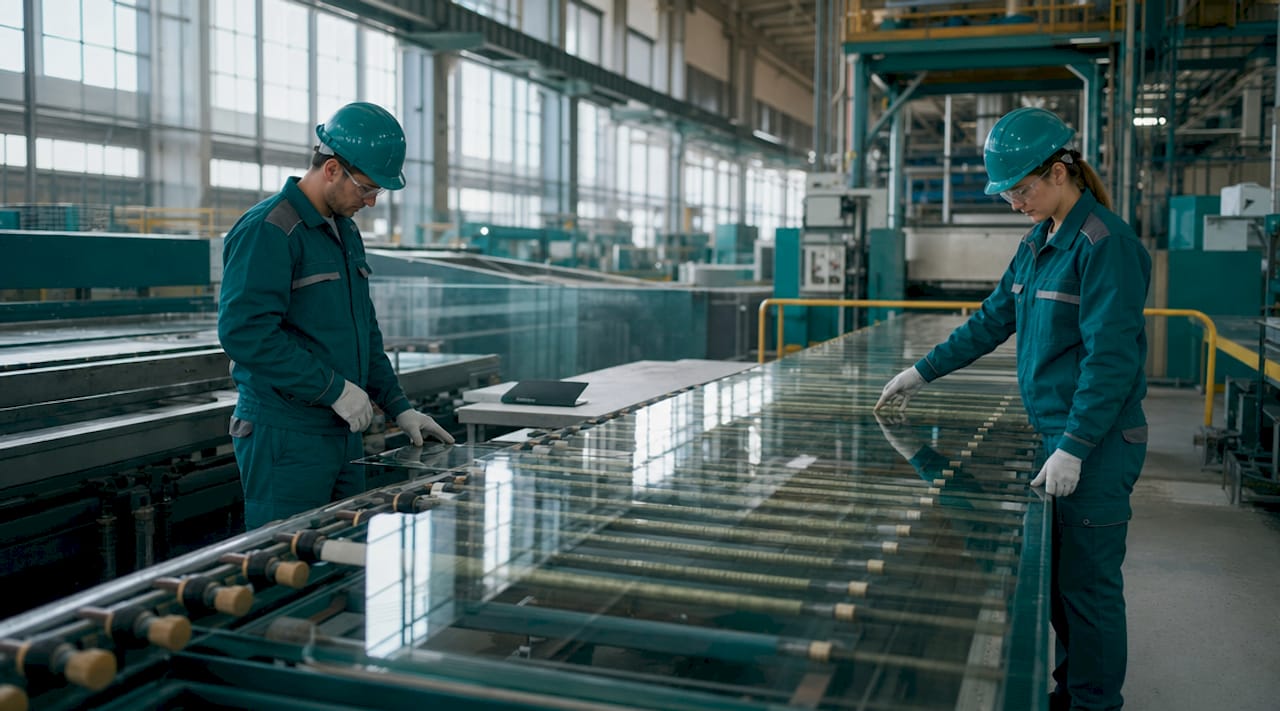
The result is a product with approximately 91.6% VLT at standard thicknesses, compared to the 80–90% range typical of conventional clear float glass. That difference is not cosmetic. For applications where colour fidelity, light throughput, or optical distortion are engineering constraints, the gap between these two product classes is significant.
Key material and manufacturing characteristics include:
- Iron oxide content: Reduced to roughly 120 ppm or lower, compared to 800–1,000 ppm in standard float glass
- Silica purity: High-purity silica sand and controlled batch chemistry are the primary levers for achieving low iron levels
- Thickness range: Commercially available from 2 mm to 19 mm, with 4 mm and 6 mm being the most common specifications in architectural and photovoltaic applications
- Surface quality: Polishing and grinding tolerances are tighter, as surface defects have a proportionally greater impact on optical performance at high transmittance levels
- Toughening and laminating compatibility: Low-iron glass can be thermally toughened or laminated without significant loss of transmittance, making it suitable for structural and safety-critical assemblies
Understanding the precision glass manufacturing workflow behind these products clarifies why raw material selection and process discipline are inseparable from the final optical specification.
Pro Tip: When reviewing supplier datasheets, check whether the quoted VLT figure refers to the base glass alone or to a finished, coated product. These values can differ by several percentage points, and conflating them leads to specification errors.
How is visible light transmittance measured and why does it matter?
Visible light transmittance (VLT) is defined as the percentage of visible light in the 380–780 nm wavelength range that passes through a glass sample relative to the incident light. It is the primary performance metric for high-transmission glass and is measured under standardised laboratory conditions using a spectrophotometer, with results referenced to a defined illuminant such as CIE Illuminant D65.
VLT is not a fixed property of a glass type. It varies with thickness, surface coatings, and the configuration of the full glazing assembly. Coatings such as Low-E, anti-reflective, or solar control films alter VLT significantly, sometimes by 5–15 percentage points depending on the coating stack. This means a base glass with 91.6% VLT may perform at 85% or lower once a functional coating is applied.
The table below illustrates typical VLT performance differences between low-iron and standard clear float glass across common thicknesses:
| Glass type | 4 mm VLT | 6 mm VLT | 10 mm VLT |
|---|---|---|---|
| Low-iron (ultra-clear) | ~92.5% | ~91.5% | ~89.5% |
| Standard clear float | ~88.0% | ~85.0% | ~81.0% |
These figures represent uncoated base glass. The practical implication is that for every additional millimetre of thickness, both glass types lose transmittance, but low-iron glass maintains a consistent advantage across the range.
Beyond VLT, two related metrics are relevant for full system specification. The solar heat gain coefficient (SHGC) quantifies how much solar energy passes through the glass as heat, and infrared rejection describes the proportion of near-infrared radiation blocked. These metrics interact with VLT but are not interchangeable with it. A glass product optimised for high VLT may still have a high SHGC unless a solar control coating is applied.
Pro Tip: Always request full glazing assembly data from your supplier, not just base glass transmittance. For photovoltaic cover glass and architectural curtain wall specifications, the coated and assembled product performance is the only figure that matters for system modelling.
High-transmission glass vs regular glass: what are the real differences?
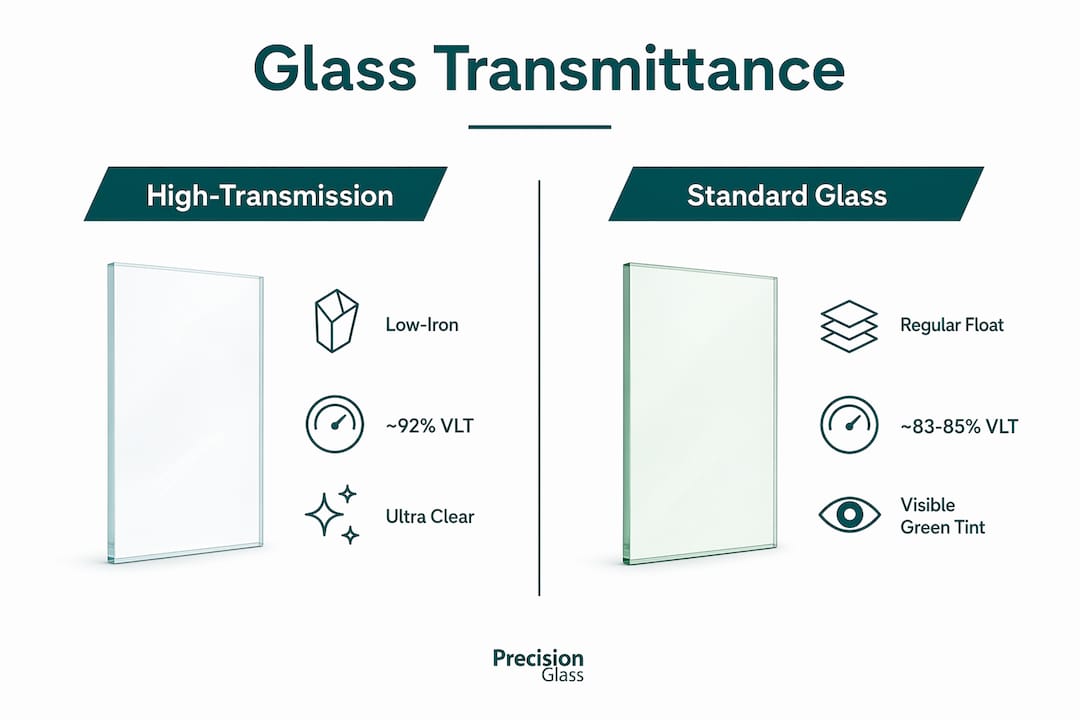
The most visible difference between low-iron glass and standard clear float glass is colour. Standard float glass contains iron oxide impurities that impart a green tint, most apparent when viewing the glass edge-on or through thick sections. Low-iron glass appears nearly colourless, which is critical in applications where the glass must not alter the perceived colour of objects behind it.
This distinction matters beyond aesthetics. In museum display cases, retail showcases, and brand-critical architectural façades, colour distortion introduced by standard glass is a genuine technical deficiency. Low-iron glass eliminates this colour distortion, making it the specified choice wherever true colour rendering is an engineering or design requirement.
The performance comparison between the two product classes can be summarised as follows:
| Property | Low-iron (high-transmission) glass | Standard clear float glass |
|---|---|---|
| Typical VLT at 6 mm | 91–92% | 83–85% |
| Edge colour | Near colourless | Visible green tint |
| Iron oxide content | ~120 ppm | ~800–1,000 ppm |
| UV transmittance | Higher | Lower |
| Cost | Higher | Lower |
| Primary applications | PV panels, optics, display, façades | General glazing, windows, partitions |
Additional distinctions worth noting for specification purposes:
- UV transmittance: Low-iron glass transmits higher UV than standard float glass due to reduced absorption. This is advantageous in UV-curing applications but requires consideration in contexts where UV exposure to contents must be controlled.
- Optical distortion: The tighter surface and composition tolerances in low-iron production result in lower optical distortion, which matters for precision optical components and instrumentation.
- Price premium: Low-iron glass carries a cost premium of typically 20–40% over standard float glass at equivalent thickness, reflecting the higher raw material and process costs.
Treating these two product classes as equivalent is a specification error. Standard clear glass and high-transmission glass are not interchangeable in any application where optical performance is a design parameter.
What are the main industrial and technological applications?
The properties of high-transmission glass make it the specified material across several demanding sectors. The following applications represent the primary industrial and technological uses where its performance characteristics are not optional but required.
Photovoltaic solar panels. Low-iron glass is the standard cover glass for crystalline silicon PV modules. Low-iron glass achieves 91–92% VLT versus 83–85% for conventional glass at equivalent thickness, translating directly into higher energy yield per module. For large-scale solar installations, this transmittance advantage compounds across thousands of panels.
Building-integrated photovoltaics (BIPV). BIPV systems require glass that functions simultaneously as a structural façade element and a photovoltaic substrate. Low-iron glass satisfies both the optical and structural requirements, and its colour neutrality ensures the building envelope maintains its intended appearance.
Architectural glazing for premium façades and showrooms. High-end commercial buildings, luxury retail environments, and automotive showrooms specify low-iron glass to avoid the green cast that standard glazing introduces. The glass component design process for these applications requires precise optical specification from the outset.
Museum and gallery display cases. Conservation-grade display cases use low-iron glass to present artefacts and artworks without colour alteration. Anti-reflective coatings are frequently applied on top of the low-iron substrate to further reduce surface reflections.
Optical components and precision instrumentation. In defence optics, medical imaging equipment, and scientific instrumentation, low-iron glass serves as a substrate for lenses, windows, and filters where minimal absorption and distortion are mandatory. The light transmission properties of the base glass directly affect system performance.
Aerospace and defence glazing. Canopy glass, sensor windows, and heads-up display substrates in aerospace applications require high transmittance combined with structural integrity. Low-iron formulations are used where optical clarity and weight efficiency are both constraints.
Electronics and display panels. Touch screens, display cover glass, and backlit panel assemblies benefit from the higher transmittance and colour neutrality of low-iron glass, particularly where display colour accuracy is a product specification.
What should professionals consider when selecting high-transmission glass?
Selecting the correct high-transmission glass product requires more than identifying the highest quoted VLT figure. Several technical nuances determine whether a product will perform as specified in a given application.
Distinguish VLT from solar transmittance. VLT covers only the visible spectrum (380–780 nm). Solar transmittance includes near-infrared and UV components. A product optimised for high VLT may still transmit significant solar heat unless a solar control coating is applied. Specify both metrics explicitly when thermal performance is a design constraint.
Assess the full glazing assembly, not the base glass. VLT ratings must reference the full product specification, including coatings, interlayers, and glass thickness. Requesting base glass data only and applying it to a coated or laminated assembly introduces error into system calculations.
Evaluate coating interactions carefully. Anti-reflective coatings can raise effective VLT above the base glass figure, while Low-E coatings typically reduce it. Self-cleaning coatings introduce minor optical effects. Each coating layer must be accounted for in the final transmittance budget.
Consider UV transmission implications. The higher UV transmittance of low-iron glass is an advantage in UV-curing and phototherapy applications but a liability in display cases where UV exposure degrades artefacts or merchandise. UV-blocking interlayers or coatings can address this without sacrificing visible transmittance.
Verify measured data, not nominal claims. Reputable manufacturers provide spectrophotometric test data for each product configuration. Nominal VLT claims without supporting measurement data should not be accepted for precision specifications.
Partner with manufacturers who understand optical tolerances. The glass fabrication processes required for high-transmission products demand quality assurance systems that go beyond standard float glass production. Supplier qualification should include review of process controls, raw material traceability, and product-specific test data.
Pro Tip: For photovoltaic and BIPV applications, request product-specific optical data for the exact coated and assembled configuration you intend to use. Generic low-iron glass data is insufficient for accurate energy yield modelling.
Key takeaways
High-transmission glass delivers superior optical performance because its iron oxide content is reduced to approximately one-tenth that of standard float glass, achieving VLT above 91% and eliminating the green tint that compromises colour-critical applications.
| Point | Details |
|---|---|
| Definition and standard term | High-transmission glass is low-iron or ultra-clear float glass, not a separate product category. |
| VLT performance | Low-iron glass exceeds 91.5% VLT at 6 mm; standard float glass typically achieves 83–85%. |
| Colour neutrality | Reduced iron oxide eliminates the green tint visible in standard glass, critical for display and façade applications. |
| Application range | Primary uses include PV panels, BIPV, precision optics, museum displays, aerospace, and electronics. |
| Specification discipline | Always evaluate full glazing assembly data, including coatings, not base glass transmittance alone. |
Why the specification detail matters more than the product name
From my experience working with engineers across defence, medical, and photovoltaic sectors, the most common mistake I see is treating “low-iron glass” as a commodity specification. It is not. Two products both labelled ultra-clear or high-transmission can differ by several percentage points of VLT once coatings and assembly configurations are factored in. I have reviewed procurement briefs where the specified VLT was achievable only with a specific anti-reflective coating that the selected supplier did not offer, creating a performance gap that was discovered only during system commissioning.
The increasing demand for high-transmission glass in tech-driven sectors, particularly BIPV and precision medical optics, is pushing manufacturers to tighten tolerances and expand coating options. This is a positive development, but it also means the specification landscape is more complex than it was five years ago. My strong recommendation is to engage your glass manufacturer at the design stage, not after the optical budget has been fixed. The interaction between base glass transmittance, coating selection, and assembly configuration is where the real performance is determined, and that conversation requires a manufacturer with genuine optical engineering capability.
— Alexandra
Precision glass solutions for high-transmission applications

Precision Glasses supplies precision-engineered low-iron and technical glass components to demanding sectors including medical devices, defence, optical instrumentation, and electronics. Every product is manufactured to verified optical specifications, with full transmittance data provided for the assembled configuration rather than base glass alone. If your application requires confirmed VLT performance, colour neutrality, or specific coating combinations, Precision Glasses has the fabrication capability and quality assurance processes to deliver. Explore the full range of technical glass products or visit Precision Glasses to discuss your specification requirements directly with our engineering team.
FAQ
What is the standard definition of high-transmission glass?
High-transmission glass is low-iron float glass engineered to achieve visible light transmittance exceeding 91.5% at 6 mm thickness, achieved by reducing iron oxide content to approximately one-tenth that of standard clear float glass.
How does high-transmission glass differ from standard clear glass?
Low-iron glass achieves 91–92% VLT compared to 83–85% for standard float glass at equivalent thickness, and it eliminates the green tint caused by iron oxide impurities, making it the correct choice for colour-critical applications.
Is high-transmission glass suitable for photovoltaic panels?
Low-iron high-transmission glass is the standard cover glass for crystalline silicon PV modules because its higher VLT directly increases energy yield, with an approximately 8% transmittance advantage over conventional glass at similar thickness.
Does coating affect the VLT of high-transmission glass?
Coatings including Low-E, anti-reflective, and solar control films alter VLT significantly. Full glazing assembly data must be used for specification purposes rather than base glass transmittance figures alone.
Where can I find high-transmission glass for precision industrial applications?
Precision Glasses manufactures and supplies engineered glass types for sectors including defence, medical, optical, and electronics, with verified optical performance data for each product configuration.