Finding a supplier for bespoke, tightly toleranced glass components with documented quality assurance is difficult when most only offer standard catalogue parts or lack the capability for advanced materials. Quotation-based pricing and opaque lead times at many vendors make budget planning and rapid prototyping a challenge for engineers and procurement teams. This comparison details the delivery, materials expertise and custom fabrication options across five precision glass component suppliers so you can select one that aligns with your technical standards and project schedule.
Table of Contents
Glassprecision
At a Glance
The vendor reports serving customers in more than 75 countries, a sign of global reach for a specialist manufacturer. Glassprecision is UK based and brings decades of Aerospace and Defence experience to bespoke glass work from prototype through to volume production.
Core Features
Custom glass components manufactured to precise drawings and client specifications using controlled process steps that track repeatability and quality.
Tight process controls across melting, grinding, polishing, toughening, laminating and CNC machining to hold narrow tolerances and repeat results between batches.
Wide material support including fused silica, borosilicate, aluminosilicate, sapphire and chalcogenide glass for optical and structural applications.
Coating, chemical strengthening and finishing services to prepare parts for harsh environments and optical systems.
Capability to support projects from single prototypes to high-volume production with documented quality assurance and testing.
Key Differentiator
Glassprecision focuses on complex, application specific glass solutions where tolerances and traceable quality matter. That aerospace and defence pedigree translates into processes and test protocols tailored to stringent environments and performance criteria.
The company couples materials expertise with manufacturing depth so design inputs, material choice and production methods align from first sample to production run.
Pros
Deep materials expertise lets engineers select appropriate substrates such as fused silica or sapphire for thermal stability and optical performance when other suppliers fall short.
Ability to produce complex geometries with tight tolerances reduces the need for downstream rework and integration fixes on assemblies.
Documented quality assurance and testing practices support regulated sectors that require traceability and performance evidence for procurement records.
Flexible volume support. Small batch prototyping and large production runs use the same controlled workflows so scale up is predictable.
Cons
- Pricing is at a premium. High quality materials and exacting manufacturing processes mean a higher unit cost compared with off the shelf glass suppliers.
Who It’s For
Engineers, product designers and procurement teams in Aerospace, Defence, Medical and high tech Electronics who need bespoke, tightly toleranced glass components. Buyers looking for a partner that supports R&D through production will find the technical collaboration useful.
Unique Value Proposition
A design to delivery offering that pairs engineering consultation with production expertise for materials such as sapphire and fused silica. That combination shortens the iteration loop between prototype and production by keeping material selection, testing and manufacturing under one technical roof.
For programmes with strict environmental and optical requirements this reduces ambiguity during handoffs and helps lock performance targets early in the schedule.
Real World Use Case
A Defence contractor worked with Glassprecision from concept to production to specify anti reflective, chemically strengthened sapphire windows for a surveillance drone. Engineering consultations and iterative prototypes validated ballistic and environmental performance before a scheduled large volume run.
Pricing
Pricing is custom and based on project scope, material choice and volume. Glassprecision typically issues prototype quotes and per unit pricing for larger batches so expect premium rates aligned with high precision manufacturing.
Website: https://glassprecision.com
PeGlass
At a Glance
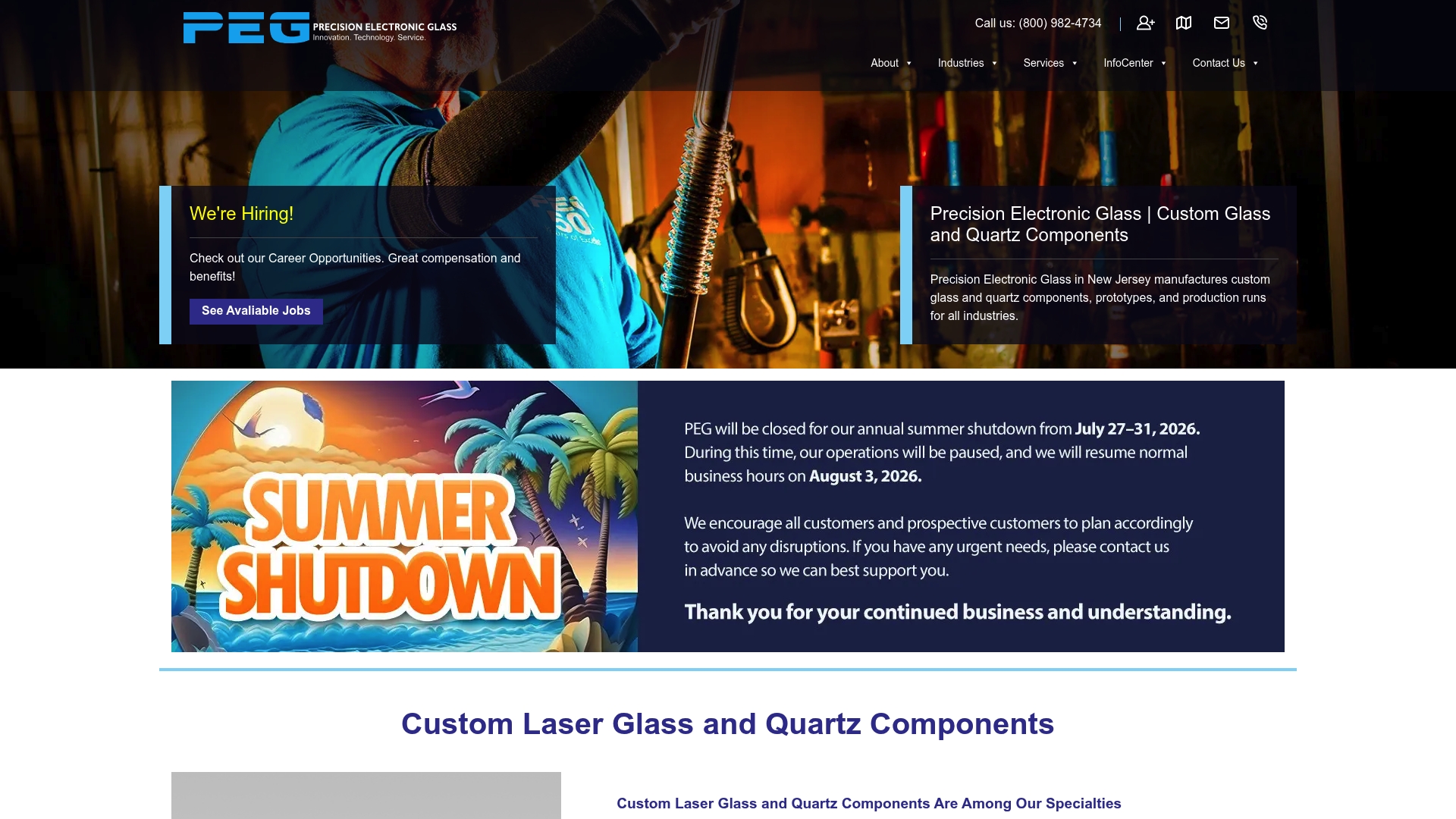
PeGlass traces its glassmaking lineage back to 1962 and combines that heritage with an ISO 9001:2015 quality system. The firm advertises a full path from prototype design through cleanroom processing and assembled deliveries for demanding technical applications.
Core Features
PeGlass offers custom glass and quartz fabrication with tight tolerances, supported by in-house prototyping and engineering consultation. Manufacturing techniques include CNC machining, laser engraving, precision grinding, polishing and finishing for optical and structural parts. Cleanroom processing and value-added assemblies are also available.
Key Differentiator
PeGlass pairs flexible engineering processes with decades of experience, making it suited to bespoke or complex component geometries other vendors avoid. That combination prioritises iterative collaboration: design feedback, rapid prototyping, then scale to production while retaining inspection traceability.
Pros
Deep sector experience dating back to 1962 gives the team practical knowledge of fragile and high‑temperature materials, which speeds problem solving for unusual specifications.
The service span from one-off prototypes to full production runs reduces vendor handoffs; you can move from a prototype sample to an assembled deliverable within a single supplier relationship.
ISO 9001:2015 certification and advanced inspection equipment support documented quality processes and traceable acceptance criteria for regulated applications.
Flexible engineering support helps with material selection and design for manufacturability when projects involve quartz, specialised glasses or tight optical tolerances.
Cleanroom processing and value-added assembly simplify procurement for clients who need parts delivered in ready-to-fit condition.
Cons
No publicly available third-party reviews makes independent evaluation of delivery performance and service responsiveness difficult.
The website offers limited pricing and lead time transparency, so initial budget and schedule estimates require a formal RFQ to confirm.
Highly customised or intricate projects can incur longer turnaround times compared with stocked components, especially at low volumes.
When It May Not Fit
PeGlass is not a good match if you need off-the-shelf glass parts with immediate dispatch; the company focuses on custom fabrication rather than commodity stock items. Clients outside regions served by international freight may face logistical complexity.
Who It’s For
OEMs, research institutions and industrial manufacturers that require precision glass or quartz components for analytical instruments, medical devices or aerospace applications. Organisations that value engineering collaboration and formal quality systems will get the most from PeGlass.
Real World Use Case
A scientific client commissioned custom quartz flow chambers for ICP-MS equipment. PeGlass handled design consultation, produced prototypes for bench validation, then scaled to production with inspection reports and assembled parts ready for integration into analytical systems.
Pricing
Pricing is project dependent. Typical prototype work often starts at a few hundred pounds for simple pieces, with costs rising by complexity and quantity for production runs. Shipping and handling vary by order size and delivery region; obtain an RFQ for accurate quotes.
Website: https://pegglass.com
IRD Glass
At a Glance
IRD Glass advertises in-house machining and polishing of sapphire and other super-hard materials alongside optical coatings and assemblies. The vendor states it holds ISO 9001:2015 certification, and it supports projects from prototype verification through to production runs.
Core Features
Custom fabrication, precision polishing, machining and optical coating for glass and ceramic parts. Support spans single prototypes to volume production, with in-house quality control and assembly under one roof.
Wide product range including flat optics, cylindrical lenses, prisms, sapphire components and optical coatings tailored to demanding specifications.
Dedicated capabilities for machining super-hard materials and polishing to tight tolerances for optical performance and durability.
Key Differentiator
IRD Glass combines early-stage engineering support with full manufacturing capability on-site, so design iterations, coating trials and final assembly happen within the same supplier ecosystem. That end-to-end path reduces supplier handoffs and centralises responsibility for meeting extreme optical and mechanical tolerances.
Pros
- Highly specialised manufacturing for precision optical and ceramic parts, which helps when drawings call for sub-micron surface finishes or tight geometric tolerances.
- Single-site service model keeps fabrication, coating and assembly under one roof, reducing coordination overhead and simplifying quality traceability.
- The certification above provides a documented quality framework for process control and record keeping across runs.
- Demonstrated experience in high-precision markets such as medical, aerospace and defence, which matters when compliance and performance evidence are part of procurement criteria.
- Equipment and staff skilled in working with sapphire and super-hard materials, useful for applications where hardness and scratch resistance are design drivers.
Cons
- Publicly available third-party reviews are sparse, so independent validation of lead times and production consistency is limited.
- Pricing is likely at a premium relative to commodity glass suppliers because of high customisation and precision processing.
- Little published detail on lead times and throughput for very large or urgent orders, which complicates schedule risk assessments for tight programmes.
- The company’s focus on OEM and industrial clients makes engagement less straightforward for small volume or consumer-oriented projects.
When It May Not Fit
If your programme is price driven and tolerances are modest, IRD Glass is probably not the most economical option. If you need guaranteed short-run turnarounds for consumer volumes, the supplier’s industrial focus and bespoke quoting model could add friction.
If you require a supplier network with transparent online pricing and documented customer reviews, look elsewhere.
Who It’s For
Manufacturers and R and D teams in aerospace, defence, medical devices and laser systems that require custom optical or ceramic components made to strict performance and traceability requirements. Best for organisations prepared to invest in engineered components rather than off-the-shelf optics.
Real World Use Case
A laser systems OEM engaged IRD Glass at the design stage to develop custom optical elements. Multiple prototype iterations were polished and coated, samples validated, and the line moved to production. The single-supplier workflow helped keep tolerance drift and coating variability under control during scale up.
Pricing
IRD Glass issues customised quotations based on part geometry, substrate material, coating specification and batch size. There are no standard catalogue prices; project based quotes cover prototypes and production runs and will reflect material and process complexity.
Website: https://irdglass.com
McDanel Glass Solutions (formerly Richland Glass)
At a Glance
A 2026 merger with McDanel Advanced Materials brought advanced ceramics and high-performance glass under one roof, creating a single supplier for precision optical windows, OEM vials and engineered ceramic parts. The company operates across North America and focuses on mission-critical aerospace, defence, medical and electronics projects.
Core Features
Custom glass and ceramic manufacturing for prototype to production runs with tight tolerances.
High-precision optical and medical components including optical windows, precision vials and custom form factors.
Manufacturing in the USA with on-site quality assurance and industry certifications, plus engineering collaboration for complex specifications.
Key Differentiator
The vendor describes a blend of advanced material science capabilities combined with long operational experience and the 2026 merger that broadened technical depth. That combination lets a single supplier handle sapphire, specialised glass formulations and engineered ceramics for integrated assemblies where matched materials and processes matter.
Pros
Extensive technical pedigree. The company traces its roots to 1960 and brings multi-decade manufacturing know-how to high-purity and high-tolerance parts.
Broad materials capability. Post-merger, teams can specify advanced ceramics alongside optical glass, reducing split-supplier coordination for assemblies.
Tailored engineering support. Buyers report hands-on collaboration during design for manufacturability, which helps shorten prototype iterations and clarify sealing or bonding requirements.
Range of product categories. From optical windows to industrial ceramics and OEM vials, the offering covers multiple component classes often needed by integrators.
Customer service orientation. The vendor emphasises responsive technical dialogue for qualifying materials and inspection criteria.
Cons
Limited visibility on international logistics. The company primarily lists North American operations and offers little published detail about global shipping or import support.
Pricing opaque. Public pricing is not provided and quotes are custom, so expect a premium procurement process rather than off-the-shelf rates.
No consumer samples. The proposition is B2B only; there are no retail or consumer-facing sample programmes for hobbyists.
When It May Not Fit
If you need immediate catalogue pricing or self-service ordering, this is not the right fit. Overseas organisations that require rapid global fulfilment may face extra lead times or need to confirm export and shipping arrangements. Low-volume hobby or retail buyers will find the sales process geared to industrial procurement.
Who It’s For
Procurement specialists and engineers at aerospace, defence, medical device and scientific equipment OEMs seeking high-performance glass and ceramic components with strict inspection standards. Best for projects that require collaborative engineering, material matching and controlled domestic manufacturing.
Real World Use Case
A university research lab worked with McDanel Glass Solutions to specify a custom optical window for a satellite sensor. Engineering sessions defined sapphire grade, coatings and sealing geometry, then the lab ordered prototypes and a production batch timed to a launch window.
Pricing
Price is quote based. The vendor provides custom quotes tailored to material, tolerances and volumes rather than published price sheets. Large-scale industrial orders can include volume discounts but expect lead discussions with engineering and procurement.
Website: https://richlandglass.com
Abrisa Technologies
At a Glance
The company reports over 80 years of combined experience across its team, a claim that crops up throughout its marketing materials. Abrisa couples that reported expertise with vertically integrated manufacturing, from small wafers to large-format glass and finished optical assemblies.
Core Features
Abrisa maintains in-house glass and coating manufacturing capabilities that cover a broad materials palette, including borosilicate, low expansion, heat-resistant and UV-transmitting glass substrates.
Precision thin film coatings are offered for optical control, including anti-reflective layers, beam splitters and conductive coatings applied to customer-specified substrates.
Custom fabrication services cover cutting, edging, printing and strengthening, which lets clients receive ready-to-install components rather than raw blanks. Vertical integration reduces touchpoints during procurement.
Key Differentiator
What defines Abrisa is the combination of materials expertise with manufacturing under one roof. By keeping coating deposition and final fabrication together, the vendor can tune process steps to meet tight optical tolerances and deliver parts that match engineering drawings.
That workflow suits projects where coating uniformity and dimensional accuracy determine whether a design passes qualification testing.
Pros
That reported longevity of experience translates into deep material knowledge that helps when choosing a substrate for thermal and optical requirements.
Wide selection of glass and coatings lets you specify both substrate and finish in a single procurement, reducing vendor coordination during assembly.
Emphasis on customisation and hands-on technical support means Abrisa will collaborate on specifications and testing steps during development cycles.
In-house fabrication reduces transfer risks between suppliers and shortens inspection and rework loops for short production runs.
The vendor’s materials reference ISO certification, which can simplify supplier qualification paperwork for regulated programmes.
Cons
Pricing and lead times for custom orders are not published; quotes are required and that opacity slows initial vendor comparison exercises.
There is little verifiable third-party feedback available publicly, which makes independent performance benchmarking difficult for procurement teams.
Custom and speciality components can carry a premium, so small projects with limited tolerance requirements may find the price point high.
Details on international shipping zones and regional service support are sparse, which complicates global sourcing for dispersed production footprints.
When It May Not Fit
If you need off-the-shelf, commodity glass in simple volumes with published list prices, Abrisa’s quotation-based model is a poor match. Organisations that require rapid price comparison across many suppliers will find the lack of list pricing a procurement friction.
Clients outside the vendor’s shipping regions or those who prioritise turnkey global logistics may prefer a distributor with established international warehousing.
Who It’s For
Product development engineers, OEM procurement teams and industrial designers in defence, aerospace, medical devices and high-tech manufacturing who need precisely specified glass and tailored coating stacks. Best where component tolerances and optical performance matter more than commodity pricing.
Real World Use Case
A navigation systems developer required a heat-resistant, anti-reflective glass window with exact curvature and coating uniformity. Abrisa worked from the engineering drawing, applied the specified coatings in-house and delivered production samples that passed optical and thermal verification for integration into the avionics bay.
Pricing
Pricing is quotation-based and varies with material, size and degree of customisation. Abrisa offers volume discounts and lead-time pricing adjustments; procurement typically requests a formal quote with batch sizes and delivery windows stated before award.
Website: https://abrisatechnologies.com
Precision Glass Component Providers Compared
Choosing the right precision glass component provider involves evaluating their material expertise, manufacturing capabilities, and ability to meet stringent tolerances. The following comparison highlights key features of leading providers:
| Provider | Key Differentiator | Best For | Pricing | Notable Limitation |
|---|---|---|---|---|
| Glassprecision | Aerospace designs, tight-tolerance processes | Engineers in aerospace and defence | Not disclosed | Premium pricing |
| PeGlass | ISO certified, cleanroom and full lifecycle services | OEMs and research institutions | Not disclosed | Limited pricing transparency |
| IRD Glass | End-to-end optical machining, polishing, and coating services | Medical and aerospace manufacturers | Not disclosed | Limited third-party review availability |
| McDanel Glass Solutions | Integrated glass and ceramic expertise due to company merger | Precision applications in aerospace and medical | Not disclosed | Opaque pricing and regional service limitations |
| Abrisa Technologies | Combination of fabrication and optical coating capabilities | Development engineers and precision manufacturing | Not disclosed | Lack of international logistics detail |
Discover Precision Glasses for Your High-Tech Glass Component Needs
When searching for reliable iglassprod.com alternatives, you need a partner that understands the demanding requirements of aerospace, defence and medical device industries. Precision Glasses specialises in custom engineered glass solutions tailored to exact specifications, ensuring tight tolerances and consistent quality. This focus addresses the challenges highlighted by iglassprod.com alternatives such as complex geometries, traceable quality assurance and production scalability.
Choose Precision Glasses for meticulous design, fabrication and delivery handled under one roof. Explore Precision Glasses capabilities today and contact us to discuss your project. Take charge by booking a consultation to receive a tailored solution that meets your precision glass needs with expert support and proven on-time delivery.
Frequently Asked Questions
How does the custom glass capabilities of Precision Glasses compare to those of PeGlass?
Precision Glasses focuses on custom glass components manufactured to precise drawings, meeting specific safety and performance standards. This is supported by controlled process steps that track repeatability and quality, which is vital for regulated sectors like Aerospace and Defence. If you need a partner offering design consultations and production from prototype to volume, Precision Glasses ensures that all phases are under one roof.
What is the difference between IRD Glass and Precision Glasses in terms of material expertise?
IRD Glass is recognised for its exceptional capability in machining super-hard materials and handling optical coatings. This speciality allows them to produce precision optical and ceramic parts suited for high-tolerance requirements. Precision Glasses, while equally high in quality, excels in providing bespoke solutions that align closely with design inputs and extensive material choices like fused silica and sapphire, making it a better fit for projects needing tight tolerances and performance traceability.
Can I expect lower unit costs from alternative vendors like Abrisa Technologies if I don’t need high customisation?
Yes, Abrisa Technologies often caters to less customised projects, which may allow for more competitive pricing. They handle a variety of glass substrates, but for cases requiring ultra-tight tolerances and extensive performance testing, Precision Glasses is advisable due to their rigorous quality controls and comprehensive engineering support. Expect to balance costs against the level of precision required for your projects.
Which alternative vendor offers the best support for high-volume orders compared to Precision Glasses?
PeGlass is noted for its in-house prototyping and engineering consultancy, which facilitates a smoother transition from prototype to larger production quantities. While Precision Glasses supports both low and high-volume production with documented quality assurance, PeGlass may provide a more flexible engineering support system for custom glass and quartz fabrication projects, making them a strong contender for bulk orders.
Do any of these alternatives, like McDanel Glass Solutions, focus on consumer-facing products?
McDanel Glass Solutions is primarily focused on the B2B sector, particularly within aerospace and medical applications, rather than retail consumers. In contrast, Precision Glasses offers extensive support for project-based needs in regulated sectors, catering specifically to engineering and procurement teams looking for high-performance glass components.