

Glass durability is defined as the capacity of a glass component to resist mechanical, chemical, and environmental degradation over its operational lifespan without structural failure. For industrial designers and engineers specifying glass for aerospace, automotive, or medical device applications, the importance of glass durability is not a secondary consideration. It is the primary determinant of whether a component performs safely under load, survives thermal cycling, and meets the certification requirements that govern high-risk sectors. Industry standards such as ASTM C1048, ISO 719, and Eurocode consequence classes exist precisely because glass failure in these environments carries consequences that extend well beyond component replacement.
Why does glass durability matter in high-performance applications?
Glass durability is not a single measurable property. Durability is a design-integrated requirement that accounts for risk class, redundancy, and failure propagation across the entire service life of a component. This distinction matters because engineers who treat durability as a post-design checklist item routinely encounter failures that could have been prevented at the specification stage.
In aerospace, a windscreen assembly must maintain optical clarity and structural integrity across temperature differentials exceeding 100°C, while resisting bird strike and pressure cycling. In automotive applications, windscreens and dashboard covers must meet both impact resistance and safe fragmentation standards. Medical device glass, including borosilicate containers and optical instrument components, must resist chemical attack from sterilisation agents and biological fluids without leaching ions that could compromise patient safety. Each of these demands a different durability profile, and each requires a different combination of composition, processing, and testing.
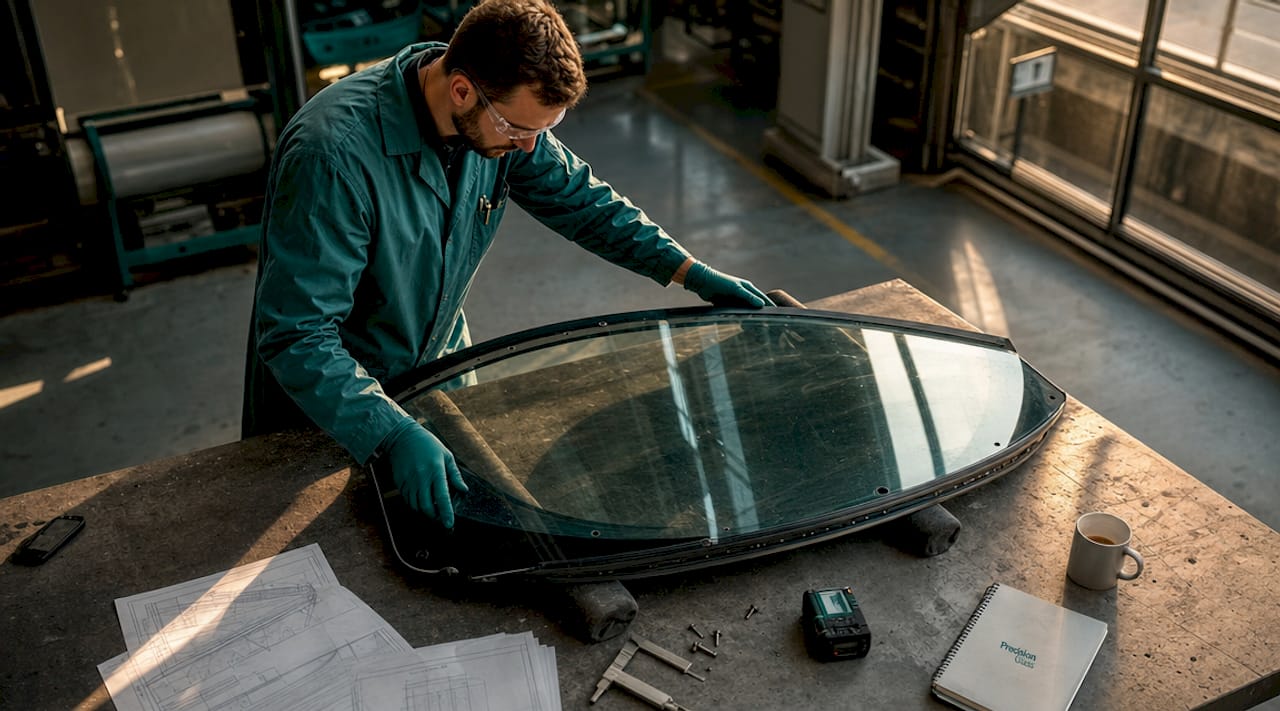
Glass also reacts with water, promoting sub-critical crack growth through a mechanism known as static fatigue. This means a component operating under sustained load in a humid environment can fail at stress levels well below its measured short-term strength. Engineers who do not account for this in their durability models are working with incomplete data.
What factors influence the durability of glass in high-performance applications?
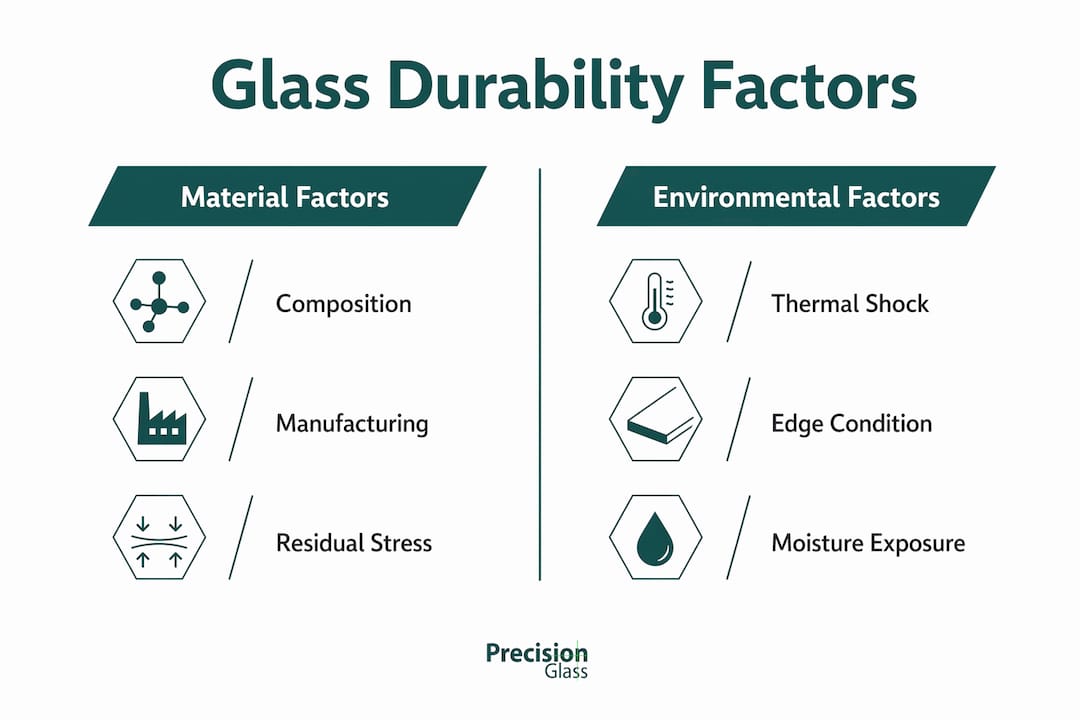
Glass durability is determined by a combination of chemical composition, manufacturing process, residual stress profile, and environmental exposure conditions. Understanding each factor allows you to specify glass that will perform reliably rather than simply pass an initial qualification test.
Chemical composition is the foundation. Higher Al₂O₃ and SiO₂ content in boroaluminosilicate glasses produces a more polymerised network structure, reducing ion leaching and improving hydrolytic resistance. This is directly relevant to medical glass containers and optical components where chemical attack from cleaning agents or biological fluids is a real service condition, not a theoretical risk.
Manufacturing and strengthening processes determine the residual stress profile that governs mechanical performance:
- Thermal tempering at 620–680°C creates compressive surface stresses above 60 MPa, strengthening glass 4–5 times over annealed equivalents. This is the standard approach for automotive safety glazing and architectural applications.
- Chemical strengthening via ion exchange at 425–475°C introduces larger potassium ions into the glass surface, generating compressive stress without the thermal distortion that limits tempering. Ion-exchanged glass also retains surface hydrophobicity and shows superior resistance to artificial weathering after extreme humidity and temperature stress.
- Annealing controls the cooling rate to relieve internal stresses, but annealed glass offers the lowest mechanical strength and is unsuitable for most high-performance applications without secondary strengthening.
Edge condition is the factor most frequently underestimated in initial designs. Glass properties depend on thermal and mechanical history, and the edge is where that history is most exposed. Grinding, polishing, and sealing edges correctly is as important as specifying the right bulk composition.
Environmental loading completes the picture. Toughened glass withstands thermal shock of up to 250°C on single panes, compared to 30–40°C for standard annealed glass. That difference is decisive in aerospace and automotive environments where thermal cycling is continuous.
Pro Tip: When specifying glass for a new application, map the full environmental load profile before selecting a composition or strengthening method. Temperature range, humidity exposure, chemical contact, and mechanical loading must all be defined before a glass type can be correctly specified.
How is glass durability assessed and tested for industrial standards?
Standardised testing is the mechanism by which durability claims are verified and certification is achieved. For engineers working in regulated sectors, understanding which tests apply to your application is not optional. It determines whether your component can be qualified and supplied.
The principal test categories are as follows:
- Flexural strength (ASTM C158): Measures the modulus of rupture under four-point or three-point bending. This is the primary mechanical qualification test for structural glass components and provides the baseline strength data used in design calculations.
- Knoop microhardness (ASTM C730): Quantifies resistance to surface deformation. Typical hardness values for silicate glasses range from 500 to 700 HV, measured by applying 100–1000 gf for 10–15 seconds. This test is particularly relevant for glass used in high-wear environments such as instrument panels and optical windows.
- Fragmentation testing (ASTM C1048): Confirms that tempered glass breaks into small, relatively harmless fragments rather than large shards. This is a mandatory qualification for automotive safety glazing and any application where human contact during failure is possible.
- Hydrolytic resistance (ISO 719): Measures alkali ion leaching from glass powder in water at 98°C. This is the standard qualification test for pharmaceutical and medical glass containers, where ion leaching can directly affect product safety.
- Chemical attack resistance (ISO 695): Assesses mass loss after exposure to alkaline solutions. This test is relevant for glass used in industrial process environments and laboratory equipment.
| Test standard | Property measured | Primary application sectors |
|---|---|---|
| ASTM C158 | Flexural strength | Aerospace, structural glazing |
| ASTM C730 | Knoop microhardness | Optical, instrument panels |
| ASTM C1048 | Fragmentation pattern | Automotive, safety glazing |
| ISO 719 | Hydrolytic resistance | Medical, pharmaceutical |
| ISO 695 | Alkali resistance | Industrial, laboratory |
Surface stress measurement via polariscopy provides a non-destructive method for verifying the compressive stress layer in tempered and chemically strengthened glass. Tests including polariscopy are used alongside flexural strength and chemical durability measurements to give a complete qualification picture. Advanced surface scanning techniques now allow non-destructive identification of surface defects, enabling certification of individual components rather than relying solely on batch testing. This is particularly relevant for high-value aerospace and medical components where batch rejection is costly.
Pro Tip: For components destined for aerospace or medical certification, specify both surface stress measurement and hydrolytic resistance testing from the outset. Discovering a composition or process does not meet ISO 719 after mechanical qualification wastes significant programme time.
What are the benefits of durable glass in aerospace, automotive, and medical devices?
The practical benefits of specifying correctly durable glass translate directly into reduced failure risk, lower maintenance costs, and compliance with sector-specific safety regulations. These are not abstract advantages. They appear on programme budgets and certification timelines.
The benefits of durable glass across these three sectors include:
- Aerospace: Borosilicate and chemically strengthened glass in cockpit windows and instrument covers maintains optical clarity and structural integrity across the full operational temperature range. Failure of an aerospace glazing component in service is a Category A safety event. Durability is not a performance enhancement. It is a safety requirement.
- Automotive: Thermally tempered windscreens and side glazing meet both impact resistance and safe fragmentation requirements under standards including ECE R43. The safe fragmentation behaviour of tempered glass, breaking into small cubes rather than large shards, directly reduces injury severity in collision events.
- Medical devices: Borosilicate glass containers and optical components in endoscopes and surgical instruments must resist repeated sterilisation cycles using steam, chemical agents, and radiation without surface degradation or ion leaching. The hydrolytic resistance conferred by high SiO₂ and Al₂O₃ content is the primary selection criterion for these applications.
- Electronics and lighting: Chemically strengthened glass in display covers and lighting envelopes must resist both mechanical impact and thermal cycling. Ion exchange strengthening is the standard process for this category because it preserves dimensional tolerances that thermal tempering cannot achieve in thin sections.
- Cross-sector benefit: Durable glass components extend service intervals and reduce unplanned maintenance. In aerospace and medical applications, where component replacement requires recertification, longevity is a direct cost driver.
How to optimise glass durability in design and engineering practice
Durability optimisation begins at the design stage, not at the qualification testing stage. Engineers who integrate durability requirements into initial specifications avoid the costly redesign cycles that result from late-stage test failures.
The two most consequential decisions are composition selection and edge treatment. Composition determines the baseline chemical and thermal resistance. Edge treatment determines whether that baseline is maintained in service. Premature failures mostly originate at glass edges due to micro-damage from handling, cutting, or improper mounting. Edge sealing and protective mounting hardware must be specified with the same rigour as the glass composition itself.
| Design decision | Lower durability outcome | Higher durability outcome |
|---|---|---|
| Glass composition | Standard soda-lime float | Borosilicate or aluminosilicate |
| Strengthening method | Annealed only | Thermally tempered or ion-exchanged |
| Edge treatment | Cut, unfinished | Ground, polished, sealed |
| Mounting hardware | Standard steel, uncoated | Corrosion-resistant alloy with isolation |
| Testing protocol | Batch sampling only | 100% non-destructive inspection |
Durability as a design requirement under Eurocode consequence classes (CC0 to CC4) means that high-risk applications require redundant design and documented risk assessment, not simply a stronger glass type. For aerospace and medical applications, this translates to formal failure mode analysis and documented justification for every material and process choice.
Non-destructive inspection protocols should be incorporated into maintenance planning from the outset. Surface scanning and polariscopy allow in-service condition monitoring without component removal, which is particularly valuable in aerospace and medical environments where access is restricted.
Pro Tip: Specify corrosion-resistant mounting hardware and isolation gaskets at the design stage. Galvanic corrosion between glass and metal fixings is a common and entirely preventable cause of edge damage in service.
Key takeaways
Glass durability is a design-integrated requirement that must be specified through composition selection, strengthening process, edge treatment, and standardised testing to ensure reliable performance across aerospace, automotive, and medical applications.
| Point | Details |
|---|---|
| Durability is design-led | Specify composition, strengthening, and edge treatment before qualification testing begins. |
| Chemical composition is decisive | Higher SiO₂ and Al₂O₃ content directly improves hydrolytic resistance and mechanical strength. |
| Edge condition drives failure risk | Most premature failures originate at edges; grinding, polishing, and sealing are non-negotiable. |
| Testing must match the application | Select ASTM C158, ISO 719, or ASTM C1048 based on the specific mechanical and chemical demands of the sector. |
| Durability reduces programme cost | Longer service life and fewer recertification events translate directly into lower lifecycle costs. |
Why edge strength is the most underestimated factor in glass durability
After working closely with engineers across aerospace, medical, and industrial sectors, the pattern I see most consistently is this: durability failures are almost never caused by the wrong bulk composition. They are caused by inadequate attention to edges, mounting, and the interaction between glass and its surrounding hardware.
The glass community has excellent data on bulk mechanical and chemical properties. ASTM and ISO standards cover flexural strength, hardness, and hydrolytic resistance thoroughly. What those standards do not automatically capture is the condition of the edge after fabrication and installation. A borosilicate component with a perfectly specified composition and a correctly executed ion exchange process can still fail prematurely if the edge is left unpolished or mounted against an uncoated steel fitting.
The move from reactive to proactive durability management is where I see the most significant gains available to engineering teams right now. Non-destructive surface scanning and in-service polariscopy are mature technologies that remain underused in many programmes, particularly in medical device development where the focus tends to stay on chemical qualification at the expense of mechanical condition monitoring.
The other area worth challenging is the assumption that a stronger glass type automatically solves a durability problem. Thermal tempering increases strength significantly, but it also introduces constraints on cutting, drilling, and dimensional tolerance that can create new failure modes if the design does not account for them. Chemical strengthening via ion exchange often gives better results for complex geometries and tight tolerances, even though it is less familiar to engineers trained primarily on architectural glazing standards.
Durability is not a material property you select from a catalogue. It is the outcome of a series of decisions made across composition, processing, edge treatment, mounting, and testing. Get those decisions right at the start, and the qualification testing becomes confirmation rather than discovery.
— Alexandra
Precision-engineered glass solutions for demanding applications

Precision Glasses designs and fabricates custom glass components for sectors where durability is a certification requirement, not a preference. From technical glass products engineered for thermal and chemical resistance to precision optical components qualified for aerospace and medical applications, every component is produced to defined mechanical and chemical specifications. Precision Glasses applies rigorous quality assurance processes including standardised mechanical testing, surface stress measurement, and hydrolytic resistance qualification. If you are specifying glass for a high-performance application and need a manufacturing partner with documented process control, contact Precision Glasses to discuss your requirements.
FAQ
What is glass durability and why does it matter in engineering?
Glass durability is the capacity of a glass component to resist mechanical, chemical, and environmental degradation throughout its service life. It matters in engineering because failure in safety-critical applications such as aerospace glazing or medical containers carries direct safety and regulatory consequences.
How do you assess glass durability to industrial standards?
Glass durability is assessed through standardised tests including ASTM C158 for flexural strength, ASTM C730 for Knoop microhardness, ISO 719 for hydrolytic resistance, and polariscopy for surface stress measurement. The correct test selection depends on the mechanical and chemical demands of the specific application.
Which glass types offer the best durability for high-performance sectors?
Borosilicate and aluminosilicate glasses offer the highest chemical durability due to their elevated SiO₂ and Al₂O₃ content. Thermally tempered or ion-exchanged versions of these compositions provide the combination of mechanical strength and chemical resistance required for aerospace, automotive, and medical applications.
Why do most glass failures originate at the edges?
Most glass failures originate at edges because cutting, grinding, and handling introduce microscopic surface damage that acts as a stress concentration point. Proper edge finishing, polishing, and protective mounting hardware are the primary controls for preventing edge-initiated failure in service.
How does chemical strengthening differ from thermal tempering for glass durability?
Chemical strengthening via ion exchange introduces compressive stress without thermal distortion, making it suitable for thin sections and complex geometries. Thermal tempering achieves higher absolute compressive stress levels but imposes constraints on post-process machining and dimensional tolerance that limit its use in precision components.