Anti-reflective coating is defined as a thin optical film applied to glass or lens surfaces to reduce reflected light and increase the amount of light transmitted through the surface. Lord Rayleigh first described the principle in 1886, and the technology now appears in everything from prescription eyewear to photovoltaic cells and aerospace optics. The American Academy of Ophthalmology recognises anti-reflective treatment as a standard recommendation for spectacle lenses. Understanding what is anti-reflective coating, how it works, and where it performs best gives engineers, procurement teams, and optical designers a clear basis for specifying the right solution.
How does anti-reflective coating work?
Anti-reflective coatings cancel reflections through engineered thin-film interference rather than by absorbing light. When light strikes a coated surface, it reflects from both the top and bottom of the coating layer. Those two reflected waves travel slightly different distances. If the coating thickness is set to one quarter of the target wavelength, the two waves arrive exactly out of phase and cancel each other out. The result is less reflected light and more transmitted light reaching the optical system or the viewer’s eye.
Single-layer vs multilayer designs
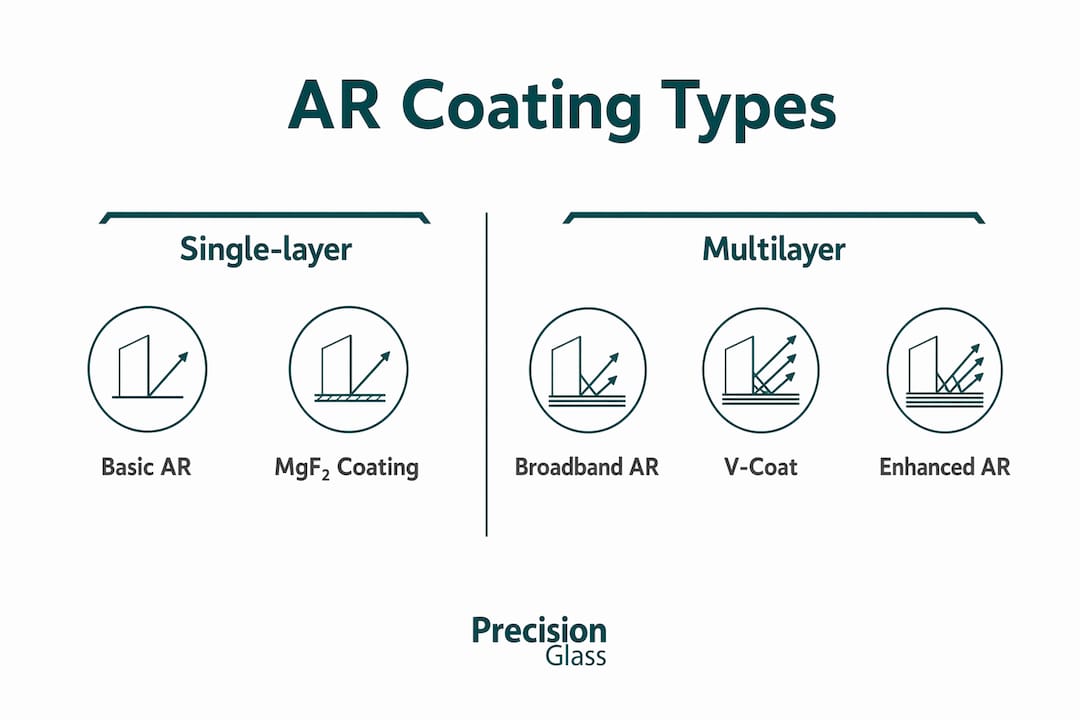
A single-layer coating uses one material, typically magnesium fluoride (MgF₂), with a refractive index close to the square root of the substrate’s refractive index. Single-layer MgF₂ coatings reduce glass reflectance from around 4% per surface to around 1%. That is a meaningful gain for a simple, low-cost process. Multilayer coatings stack several thin films with alternating refractive indices. Each interface contributes to destructive interference across a broader range of wavelengths. Sol-gel silica coatings, which are deposited as a liquid and then cured, can achieve transmittance above 99%.
Fabrication methods compared
Three main deposition methods are used in industrial production:
- Sol-gel: A liquid precursor is applied by spin or dip coating, then heat-cured. Low equipment cost, good for large surfaces, but durability can be lower than vacuum methods.
- Physical vapour deposition (PVD): Material is evaporated or sputtered in a vacuum chamber and condenses on the substrate. Produces dense, durable films with tight thickness control.
- Chemical vapour deposition (CVD): Reactive gases form the film on the substrate surface. Suited to complex geometries and high-volume production.
Different deposition techniques affect film durability, uniformity, and optical quality in distinct ways. No single method is universally superior. The right choice depends on substrate geometry, required durability, production volume, and target wavelength band.
Pro Tip: Coating thickness must be matched precisely to the target wavelength band. A coating designed for visible light (roughly 400–700 nm) will not perform well in the near-infrared. Always specify the spectral range before selecting a coating design.
What types of anti-reflective coatings exist?
Broadband AR coatings (BBAR) deliver low reflectance across a wide wavelength range, making them the standard choice for daylight imaging and general optical instruments. Other coating families serve more specific needs. The table below summarises the main types, their typical reflectance performance, and their primary application areas.
| Coating type | Typical reflectance | Primary applications |
|---|---|---|
| Basic AR (single-layer) | ~1% per surface | Low-cost optics, entry-level eyewear |
| VAR (V-coat AR) | <0.1% at one wavelength | Laser optics, single-wavelength instruments |
| WAR (wideband AR) | <0.5% across a band | Cameras, binoculars, telescopes |
| BBAR (broadband AR) | <0.3% across visible range | Daylight imaging, display glass, microscopes |
| SPAR (super-broadband AR) | <0.2% from UV to NIR | Scientific instruments, defence optics |
V-coat (VAR) coatings are optimised for a single wavelength. They deliver the lowest possible reflectance at that point but perform poorly outside it. They are the correct choice for laser systems where the operating wavelength is fixed. Wideband AR (WAR) coatings cover a broader band at the cost of slightly higher peak reflectance. BBAR coatings extend coverage further still, which is why they dominate camera lenses and scientific microscopes. SPAR coatings push coverage from the ultraviolet into the near-infrared, a requirement in defence imaging and hyperspectral sensing. Selecting the wrong type for the application is one of the most common and costly specification errors in optical system design.
What are the key benefits and limitations of AR coatings?
Uncoated lenses reflect about 4% per surface, losing roughly 8% of total light transmission across two surfaces. AR coatings reduce this to less than 0.5% reflection per surface, pushing transmission above 99%. That gain matters in every optical system where light efficiency is a performance parameter, from camera lenses to solar panels to surgical scopes.
Core benefits
- Improved image contrast: Less stray reflected light means the image formed by the optical system carries more signal and less noise.
- Reduced glare: Reflections from bright sources, such as vehicle headlights or overhead lighting, are attenuated before they reach the eye or sensor.
- Elimination of ghost images: In multi-element lenses, each uncoated surface can produce a faint secondary image. AR coatings suppress these artefacts.
- Aesthetic clarity in eyewear: AR coatings make lenses appear less shiny, improving eye contact and reducing the mirror-like appearance that uncoated lenses produce.
- Energy efficiency in photovoltaics: Solar cells coated with AR films capture more incident light, directly increasing electrical output.
Limitations to account for
AR coatings are wavelength-specific by design. A coating optimised for visible light offers no benefit in the ultraviolet or mid-infrared. Angle of incidence also matters. AR specifications must account for wavelength band, incidence angle, and reflectance limits to perform correctly in real-world conditions. Durability varies significantly by deposition method. Sol-gel coatings on eyewear can scratch more readily than PVD-deposited films on camera optics. Cleaning habits and environmental exposure accelerate degradation.
Pro Tip: Back-surface reflections are the primary source of disability glare and halo effects in spectacle lenses. Coating the back surface of a lens delivers more practical visual benefit than coating only the front. Specify both surfaces for maximum performance.
Practical applications across industry and daily life
AR coatings appear across a wider range of industries than most engineers initially expect. The numbered list below moves from consumer applications through to specialised industrial uses.
Prescription eyewear: Spectacle lenses with AR treatment reduce reflections that obscure the wearer’s eyes and cause visual fatigue under artificial lighting. The American Academy of Ophthalmology recommends AR coatings as standard for most lens prescriptions.
Photographic and scientific optics: Camera lenses, binoculars, telescopes, and microscopes all use multilayer AR coatings on every glass-to-air surface. A typical camera zoom lens contains 10–20 elements. Without AR coatings, cumulative reflection losses would make the lens unusable.
Photovoltaic cells: Silicon solar cells have a high refractive index, which causes significant reflection losses at the front surface. AR coatings, often silicon nitride deposited by CVD, reduce these losses and improve cell efficiency. This is one of the highest-volume applications of AR coating technology globally.
Automotive and aerospace: Heads-up displays (HUDs) in vehicles and aircraft use AR-coated glass to project information onto the windscreen without creating distracting reflections. Cockpit instrument covers and camera domes in aerospace applications require coatings that perform across wide temperature and humidity ranges. For teams specifying glass for aerospace applications, coating durability under thermal cycling is a primary design constraint.
Medical devices: Endoscope lenses, surgical microscopes, and diagnostic imaging optics all depend on AR coatings to maximise light throughput and image fidelity. In medical imaging, a ghost image or contrast loss is not merely an inconvenience. It can affect clinical interpretation.
Defence and security optics: Night-vision systems, targeting scopes, and surveillance cameras operate across spectral bands that extend beyond visible light. SPAR coatings covering ultraviolet to near-infrared are standard in these applications. Manufacturing quality control for defence optics requires rigorous coating performance testing at every production stage.
Electronics and display glass: Smartphone screens, laptop displays, and industrial touchscreens use AR-treated glass to reduce ambient light reflections. This improves readability in bright environments without increasing display brightness, which in turn reduces power consumption.
The practical value of AR coatings extends beyond any single surface. In complex optical systems, multiple coated surfaces must be coordinated to manage stray light effectively across the full system. This is a system-level design challenge, not simply a surface treatment decision.
Key takeaways
Anti-reflective coating is the single most effective surface treatment for improving light transmission and reducing optical noise across every major optical application.
| Point | Details |
|---|---|
| Core mechanism | Thin-film interference cancels reflected light without absorbing it, increasing transmission above 99%. |
| Coating type selection | Match the coating type (VAR, WAR, BBAR, SPAR) to the spectral band and incidence angle of the application. |
| Back-surface priority | In eyewear, coating the back surface delivers the greatest reduction in glare and halo effects. |
| Fabrication trade-offs | PVD produces durable, uniform films; sol-gel suits large surfaces but may sacrifice durability. |
| System-level design | Multiple coated surfaces in an optical system must be specified together to control stray light effectively. |
Why AR coating decisions deserve more rigour than they usually get
I have spent years working with optical glass specifications across defence, medical, and industrial sectors. The pattern I see most often is this: engineers specify an AR coating type without fully defining the spectral band, the angle of incidence range, or the environmental durability requirement. The coating is then applied, the system is assembled, and the performance shortfall only becomes visible during integration testing. At that point, recoating is expensive and delays are significant.
The misconception I find most persistent is that AR coating is a commodity finish. It is not. AR coatings must balance optical performance against manufacturing challenges including durability and production scalability. A BBAR coating that performs well on a laboratory bench may degrade rapidly in a field-deployed defence system exposed to humidity, abrasion, and thermal cycling. Specifying the coating without specifying the environmental test standard is an incomplete specification.
Consumers also tend to overestimate what AR coatings do for night driving. The coatings do reduce glare and halo effects meaningfully, particularly in layered lens setups, but they do not eliminate the fundamental optical challenges of low-light driving. Managing client expectations on this point is as important as the technical specification itself.
The trend I find genuinely encouraging is the move towards system-level optical design that treats coatings as an integrated performance variable rather than an afterthought. When coating design, substrate selection, and system geometry are developed together, the results are consistently better. That is the direction the industry is moving, and it is the right one.
— Alexandra
Precision glass solutions with advanced AR coatings
Precision Glasses designs and fabricates technical glass components with AR coatings for demanding applications across medical, defence, aerospace, automotive, and electronics sectors.

Our manufacturing process covers the full specification chain: substrate selection, deposition method, spectral band, durability testing, and quality assurance at every stage. Whether you need BBAR-coated optical components for a surgical device or SPAR-coated glass for a defence imaging system, we work to your exact performance requirements. Browse our technical glass products or contact our engineering team directly to discuss your coating specification. We deliver to the tolerances your application demands, on time and to documented quality standards.
FAQ
What is anti-reflective coating made of?
Anti-reflective coatings are typically made from materials such as magnesium fluoride (MgF₂), silicon dioxide, or titanium dioxide, deposited as thin films by PVD, CVD, or sol-gel methods. The specific material depends on the target wavelength band and required durability.
Is anti-reflective coating worth it for eyewear?
Anti-reflective coating is worth specifying for most prescription lenses. It reduces reflections from less than 0.5% per surface, eliminates ghost images, and improves the wearer’s appearance by making lenses look clearer.
How does anti-reflective glass differ from standard glass?
Anti-reflective glass has one or more thin optical films applied to its surface that use destructive interference to cancel reflected light. Standard uncoated glass reflects approximately 4% of light per surface; AR-coated glass reduces this to well below 1%.
What is the purpose of anti-reflective coating in solar panels?
In photovoltaic cells, AR coatings reduce the reflection loss at the front surface of the silicon cell, allowing more light to be absorbed and converted to electricity. Silicon nitride deposited by CVD is the most widely used material for this application.
Which AR coating type is best for industrial optical systems?
BBAR coatings are the standard choice for broadband visible applications such as cameras and microscopes. Defence and scientific instruments operating across ultraviolet to near-infrared bands require SPAR coatings. The correct choice depends on the spectral range, incidence angle, and environmental conditions of the specific system.