
The glass selection process for defence is the systematic evaluation and specification of high-performance glass materials designed to meet stringent military demands across ballistic protection, optical clarity, thermal stability, and environmental durability. Engineers and procurement specialists working in this field must navigate a complex matrix of standards, including EN 1063 and UL 752, alongside material innovations such as nanocrystalline spinel ceramics developed at the Naval Research Laboratory (NRL) and polymeric composites validated by SCHOTT. Getting this process right from the outset determines whether a glazing system survives operational conditions or becomes a critical liability. The defence glass materials available in 2026 span traditional ballistic laminates, advanced ceramics, and glass-ceramic composites, each with distinct trade-offs that demand careful specification.
What key performance criteria must defence glass meet?
Ballistic resistance is the primary criterion in any armour glass evaluation. Standards such as EN 1063 and UL 752 define protection levels by calibre, velocity, and number of shots. Ballistic performance depends heavily on the specific threat level, ammunition type, and firing distance, which means generic performance claims from suppliers are insufficient. Procurement specialists must demand independent third-party test reports matched to the exact threat profile of the application.
Optical performance is the second pillar. Defence imaging systems, targeting optics, and surveillance sensors require glass with controlled refractive index, Abbe number, and spectral transmission across visible, mid-wave infrared (MWIR), and long-wave infrared (LWIR) bands. A material that performs well in the visible spectrum may block critical infrared wavelengths needed for night-vision integration. Specifying transmission range at the outset prevents costly redesigns later.

Mechanical durability and environmental resistance round out the core criteria. Defence glass must withstand pressure differentials, thermal cycling, salt fog, humidity, and abrasion without degrading optical or structural performance. Weight and thickness are equally significant. Thicker, heavier glazing increases vehicle payload and reduces platform agility, making weight reduction a genuine operational priority rather than a cost consideration.
Key performance criteria to specify at the start of any procurement:
- Ballistic protection level: matched to EN 1063 or UL 752 threat class
- Optical transmission range: visible (380–700 nm), NIR, MWIR, or LWIR as required
- Mechanical strength: flexural strength, hardness, and impact resistance
- Thermal stability: operating temperature range and thermal shock resistance
- Environmental resistance: salt fog, humidity, UV, and abrasion ratings
- Weight and thickness limits: driven by platform integration constraints
- Certification and traceability: third-party test reports and supply chain documentation
Pro Tip: Specify the exact threat level and ammunition type before approaching any supplier. A protection rating without a defined test standard is commercially meaningless and operationally dangerous.
How do different defence glass materials compare?
No single material covers all optical bandwidths and ballistic requirements simultaneously. Material selection requires deliberate trade-offs between transmission, refractive index, hardness, and weight. The table below summarises the principal materials used in military glazing applications.
| Material | Key strength | Primary limitation | Typical application |
|---|---|---|---|
| Traditional ballistic laminate | Proven ballistic performance | Heavy and thick | Vehicle armour windows |
| Nanocrystalline spinel ceramic | 50% harder than traditional materials | Complex manufacturing | Thin armour windows |
| Sapphire | Mohs 9 hardness, UV to 5.5 µm MIR transmission | High cost, limited size | Sensor windows, optics |
| Polymeric composite (PC/PMMA) | Up to 50% weight reduction vs glass alone | Lower scratch resistance | Lightweight ballistic glazing |
| Glass-ceramic (e.g., SCHOTT) | 20% weight reduction, high IR transmission | Higher unit cost | Night-vision integrated windows |
| Germanium / ZnSe / ZnS | Excellent MWIR and LWIR transmission | Opaque in visible spectrum | Thermal imaging optics |
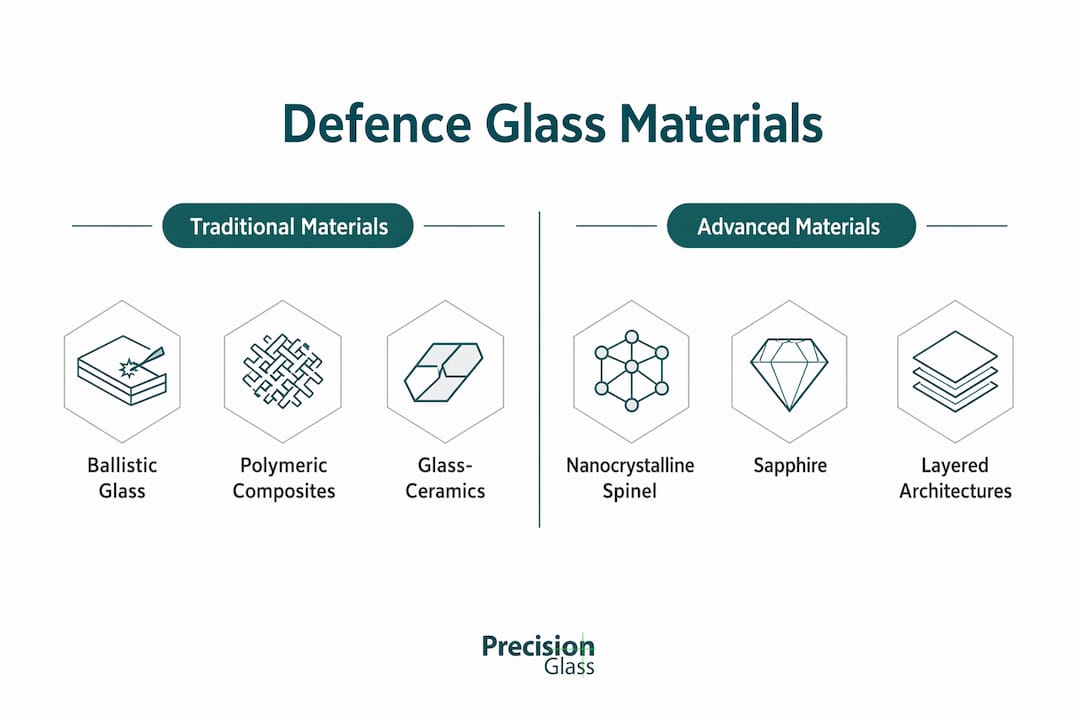
Nanocrystalline spinel ceramics represent the most significant recent advance in armour glass. NRL’s enhanced high-pressure sintering (EHPS) technique at 6 GPa achieves grain sizes down to 28 nm. That nanoscale grain structure delivers both transparency and hardness that traditional polycrystalline ceramics cannot match.
Sapphire occupies a different niche. Its Mohs 9 hardness and transmission from 150 nm UV through to 5.5 µm mid-infrared make it the preferred choice for sensor windows exposed to extreme pressures, high temperatures, or abrasive environments. The trade-off is cost and the practical difficulty of producing large-format sapphire components.
Polymeric composites using polycarbonate (PC) and polymethyl methacrylate (PMMA) interlayers have matured considerably. Tested at 15 mm thickness against EN 1063 standards, these composites achieve ballistic compliance at a fraction of the weight of all-glass constructions. The limitation is scratch resistance, which protective coatings can partially address but not fully eliminate.
Glass-ceramic systems developed by SCHOTT reduce system weight by 20% compared to traditional transparent armour and deliver more than double the infrared transmission required by US Army standards. That IR performance is critical for platforms integrating night-vision or thermal imaging directly behind the glazing.
Pro Tip: For multi-spectral sensor windows, consider a layered architecture: a hard outer face (sapphire or spinel) for abrasion and ballistic resistance, combined with an IR-transmitting glass-ceramic inner layer for sensor performance.
What are the manufacturing and quality assurance steps for defence-grade glass?
Producing glass that meets military standards requires a controlled manufacturing sequence. Each step must be documented and traceable to support certification and audit requirements.
- Raw material qualification: Verify chemical purity and batch consistency for optical glass, ceramic powders, or polymeric interlayer materials before production begins.
- Forming and sintering: For ceramic materials, EHPS techniques at high pressure reduce porosity and maintain nanoscale grain sizes without coarsening, producing transparent armour with superior strength.
- Precision cutting and shaping: CNC machining and grinding achieve dimensional tolerances required for integration into vehicle frames, sensor housings, or optical assemblies.
- Polishing: Surface finish directly affects optical transmission and scatter. Defence optics typically require surface roughness below 1 nm Ra for precision imaging applications.
- Coating application: Anti-reflective coatings maximise transmission; abrasion-resistant coatings extend service life. Protective coatings must maintain optical performance after exposure to sand, salt fog, and humidity in accordance with military standards.
- Assembly and lamination: Ballistic composites are assembled under controlled pressure and temperature. SCHOTT’s approach consolidates production from raw materials through to finished optical protective windows, ensuring process continuity and traceability.
- Ballistic and pressure testing: Finished assemblies undergo ballistic testing to the specified EN 1063 or UL 752 level. Pressure and environmental testing follows military qualification protocols.
- Quality assurance and documentation: Full material traceability, test records, and certificates of conformance must accompany every delivery. Independent third-party testing is mandatory for security-rated glazing.
Supply chain traceability deserves particular attention. Defence procurement audits frequently require evidence of material origin, process parameters, and test results at every stage. Suppliers who cannot provide this documentation create compliance risk regardless of the technical quality of their product.
Key quality assurance checks to require from any supplier:
- Material certificates with batch traceability
- Dimensional inspection reports (CMM or equivalent)
- Optical transmission test data across the specified spectral range
- Ballistic test reports from an accredited third-party laboratory
- Environmental test results (salt fog, humidity, UV, abrasion)
- Coating adhesion and durability test data
How can engineers and procurement specialists optimise their selection process?
The most effective approach to optimising glass for defence starts with a precise threat and operational assessment before any material is specified. Procurement teams that begin with supplier catalogues rather than operational requirements consistently encounter specification mismatches late in the programme.
Structuring the selection process around the following priorities produces the most reliable outcomes:
- Define the threat envelope first: Identify the specific ballistic threats, blast pressures, and forced-entry risks the glazing must resist. Match these to the correct protection class under EN 1063 or UL 752 before evaluating any material.
- Map the optical requirements to the sensor suite: If the platform integrates night-vision, thermal imaging, or laser rangefinding, specify the required transmission bands for each system. Materials like germanium cover LWIR but are opaque in visible light. Glass-ceramics cover IR while remaining transparent. The sensor suite drives the material shortlist.
- Balance protection with weight: Polymeric composites and glass-ceramic systems offer meaningful weight reductions. For airborne platforms or dismounted applications, a weight reduction of up to 50% compared to traditional ballistic glass is achievable while maintaining EN 1063 compliance.
- Assess lifecycle costs, not just unit price: Sapphire and spinel ceramics carry higher unit costs but offer significantly longer service lives in abrasive environments. A lower-cost laminate that requires replacement every 18 months may cost more over a 10-year programme than a premium material replaced once.
- Require independent test data: Supplier-provided test data is a starting point, not a conclusion. Ballistic ratings depend on specific test conditions. Independent laboratory validation against the actual threat profile is non-negotiable for mission-critical applications.
- Engage suppliers early in the design phase: Material constraints affect frame design, sealing systems, and sensor integration. Suppliers with manufacturing depth, such as those offering precision glass fabrication from raw material to finished assembly, can identify integration risks before they become programme delays.
The selection criteria for defence glass are not static. As platforms evolve and threat environments change, specifications must be revisited. Building a review cycle into the procurement programme prevents legacy specifications from constraining future capability upgrades.
Key takeaways
The glass selection process for defence requires matching material properties to a precisely defined threat envelope, optical requirement, and platform constraint before any supplier engagement begins.
| Point | Details |
|---|---|
| Define threats before materials | Specify ballistic class, blast rating, and optical bands before evaluating any glass type. |
| Material trade-offs are unavoidable | No single material covers all bandwidths and protection levels; layered architectures resolve most conflicts. |
| Weight reduction is achievable | Polymeric composites and glass-ceramics can cut weight by up to 50% while meeting EN 1063 standards. |
| Independent testing is mandatory | Supplier test data is insufficient; require third-party ballistic and environmental test reports. |
| Lifecycle cost outweighs unit price | Premium materials like sapphire and spinel ceramics often deliver lower total cost over a programme’s life. |
Why specification clarity is the most underrated factor in defence glass procurement
Having worked closely with engineers and procurement teams across defence programmes, I have seen the same mistake repeated: the glazing specification is written after the platform design is largely fixed. By that point, weight budgets are exhausted, frame tolerances are locked, and the sensor integration architecture is set. The glass becomes a constraint rather than a designed component.
The teams that get this right treat the glazing system as a primary engineering decision, not a late-stage procurement item. They define the threat envelope, optical requirements, and weight budget in the concept phase. They engage manufacturers with genuine fabrication depth early enough to influence the design. And they insist on independent test data tied to the actual threat profile, not a generic protection class.
The material innovations available in 2026, from NRL’s nanocrystalline spinel to SCHOTT’s glass-ceramic armour systems, genuinely expand what is possible. But they only deliver value when the specification is precise enough to exploit them. A procurement team that specifies “ballistic glass to EN 1063 BR4” without defining optical requirements, weight limits, or sensor integration needs will receive a compliant product that may still fail operationally.
My consistent advice: write the specification as if you are writing a test plan. Every requirement must be measurable, testable, and tied to an operational need. That discipline separates programmes that succeed from those that spend their contingency budget on late-stage redesigns.
— Alexandra
Precision Glasses: your partner for defence glass specification
Precision Glasses designs and fabricates precision-engineered glass components for defence, aerospace, and security applications, supporting engineers and procurement specialists from initial specification through to certified delivery.

Our manufacturing capabilities span optical glass, technical glass, ballistic laminates, and coated assemblies, all produced under meticulous quality assurance protocols aligned with military standards. Whether your programme requires technical glass solutions for sensor windows, armour glazing, or multi-spectral optics, we provide tailored fabrication with full material traceability and third-party test support. Explore the full range of defence and security sectors we serve, or contact our team directly to discuss your specification requirements and receive a tailored consultation.
FAQ
What is the glass selection process for defence?
The glass selection process for defence is the structured evaluation of glass materials against ballistic, optical, mechanical, and environmental requirements defined by military standards such as EN 1063 and UL 752. It begins with threat definition and ends with certified, independently tested glazing assemblies.
Which defence glass material offers the best ballistic protection?
Nanocrystalline spinel ceramics produced via EHPS techniques are currently the hardest transparent armour materials available, delivering 50% greater hardness than traditional ballistic glass at equivalent protection levels. For most vehicle applications, polymeric composites laminated with toughened glass offer a proven, lighter alternative.
How does sapphire differ from standard ballistic glass?
Sapphire carries a Mohs hardness of 9 and transmits light from 150 nm UV through to 5.5 µm mid-infrared, making it the preferred material for sensor windows in extreme environments. Standard ballistic laminates offer greater impact energy absorption but cannot match sapphire’s scratch resistance or spectral range.
Why is independent testing required for defence glazing?
Ballistic resistance ratings depend on specific test standards, threat levels, and ammunition types, meaning a rating achieved under one test condition does not guarantee performance under another. Independent third-party testing against the actual threat profile is the only reliable basis for procurement decisions.
How can weight be reduced without compromising ballistic protection?
Integrating polymeric interlayers such as polycarbonate and PMMA into glass-based composites reduces window weight by up to 50% compared to all-glass constructions while maintaining EN 1063 compliance. Glass-ceramic systems achieve a 20% weight reduction over traditional transparent armour with the added benefit of improved infrared transmission.