
An automotive glass quality checklist is a systematic framework of measurable criteria and inspection steps that verify vehicle glass meets safety, optical, and structural standards required by modern vehicles. For quality control inspectors, this checklist covers regulatory compliance markings, optical clarity thresholds, glass type classification, bonding integrity, and ADAS calibration verification. Standards such as FMVSS 205 and FMVSS 212, along with the Automotive Glass Replacement Safety Standard (AGRSS), define the benchmarks every piece of automotive glazing must meet before a vehicle returns to the road. Getting this right is not optional. Glass is a structural component, and a failed inspection has direct consequences for crash safety, driver visibility, and advanced driver assistance system reliability.
1. What belongs on an automotive glass quality checklist?
A complete vehicle glass standards checklist begins with regulatory compliance and works outward to physical condition, optical performance, and system compatibility. Each criterion must be verifiable, not assumed. The checklist functions as a formal record of inspection, not a mental walkthrough.
Core checklist items:
- DOT compliance marking: All automotive glass must carry a permanent DOT marking confirming it meets Federal Motor Vehicle Safety Standards. Absence of this mark is an automatic fail.
- FMVSS 205 and FMVSS 212 compliance: FMVSS 205 governs glazing materials; FMVSS 212 governs windshield retention in a crash. Both must be confirmed before installation.
- Glass type classification: Confirm whether the glass is laminated, tempered, or acoustic laminated. Each type has distinct structural and acoustic properties. Inspectors should reference a professional glass type guide when classification is unclear.
- Optical clarity: OEM and OEM-equivalent glass achieves 0.10–0.15 diopters of optical distortion. Economy aftermarket glass typically measures 0.20–0.25 diopters. That difference is visible to drivers and affects safety.
- Physical defect inspection: Check for delamination, chips, cracks, and thickness inconsistencies. Delamination appears as edge clouding or subtle discolouration and worsens with heat and humidity.
- Thickness consistency: Side glass that is thinner than specification by even 0.5 mm causes regulator chatter and alignment failure. Measure with a calibrated gauge, not by eye.
- ADAS camera brackets and sensor mounts: Confirm all integrated mounts are present, undamaged, and correctly positioned for the vehicle model.
- Warranty documentation: OEM glass typically carries a lifetime workmanship warranty. Verify warranty terms before accepting any aftermarket substitution.
Pro Tip: Always cross-reference the DOT code against the vehicle’s original glazing specification. Codes encode the manufacturer, glass type, and compliance standard. A mismatched code is a defect even when the glass looks correct.
2. How to assess bonding and installation quality
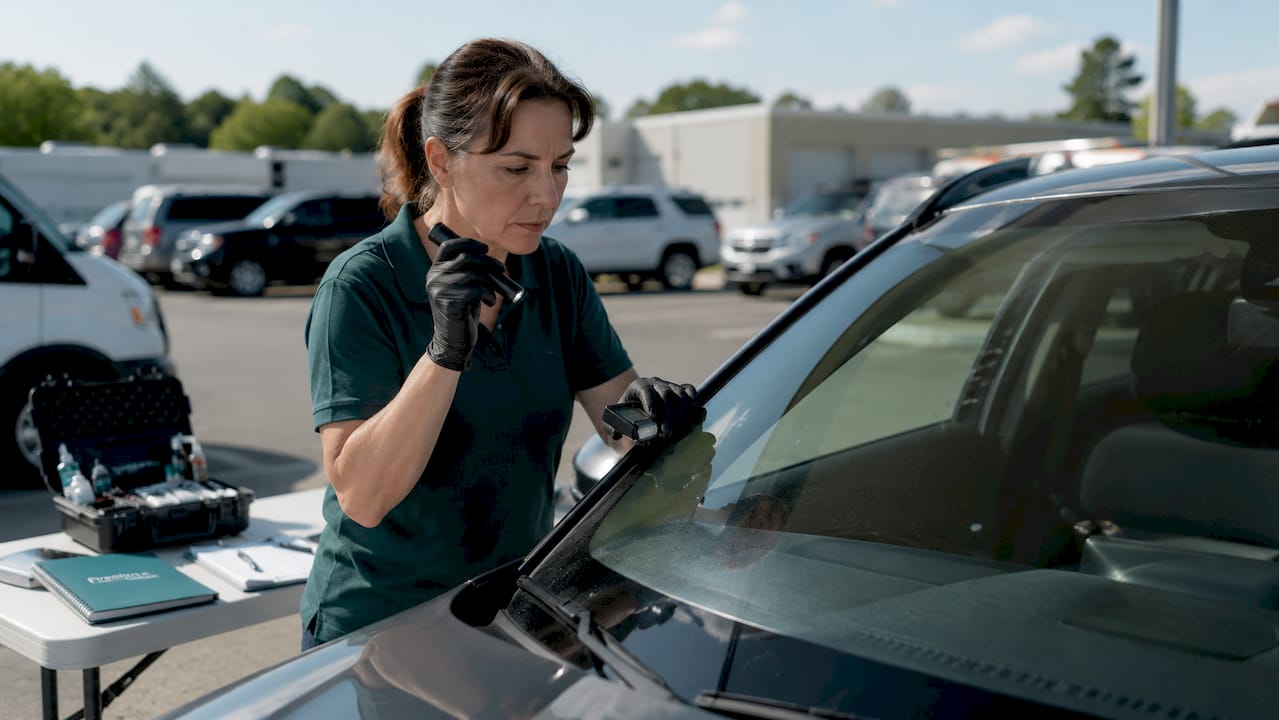
Bonding integrity between glass and vehicle frame is as critical as the glass itself for crash safety. A correctly bonded windshield contributes to roof crush resistance and airbag deployment geometry. A failed bond can cause recalls and direct safety risk.
A thorough bonding inspection follows four sequential phases:
- Substrate preparation: Inspect the pinchweld for corrosion, contamination, and old adhesive residue. Any of these conditions compromises adhesive contact and must be corrected before application.
- Adhesive application: Verify the adhesive bead profile is uniform in height and width around the full perimeter. Gaps, thin sections, or irregular profiles indicate application error.
- Curing and Safe Drive-Away Time (SDAT): Installation quality standards require cure times of up to 48 hours depending on adhesive type and ambient conditions. Confirm the correct SDAT has elapsed before releasing the vehicle.
- Non-destructive bonding verification: Experts recommend Laser Doppler Vibrometry for in-line non-destructive inspection of bonding quality. This method detects voids and weak bonds without disturbing the installation.
Pro Tip: Record the adhesive lot number and application date on every inspection sheet. Adhesive lot tracking is a required practice under AGRSS and provides traceability if a bond failure occurs later.
3. Which specifications ensure ADAS compatibility?
ADAS-equipped vehicles require a separate layer of inspection that goes beyond glass quality alone. Camera misalignment caused by incorrect glass or improper installation produces false readings that are invisible to the driver but critical to safety.
ADAS-specific checklist items:
- Camera bracket verification: Confirm the replacement glass carries the correct integrated camera bracket for the vehicle’s make, model, and year. A bracket designed for a different variant will misalign the camera field of view.
- Heating element continuity: Test embedded heating elements for continuity and even heat distribution. Damaged elements affect sensor performance in cold conditions.
- Post-installation calibration: ADAS systems require either static calibration using targets or dynamic calibration requiring 32–160 km of driving. Confirm which method applies and that it has been completed.
- Diagnostic Trouble Code (DTC) scan: After calibration, technicians must scan for camera fault codes using a compatible scan tool. Any active DTC indicates a calibration or hardware fault.
- Calibration documentation: Record calibration method, date, technician, and scan results. Undocumented calibration is treated as uncalibrated in any subsequent audit or insurance claim.
- OEM-quality glass for advanced systems: For vehicles with systems such as Tesla Autopilot or equivalent, OEM-quality glass is the only acceptable specification. Non-certified glass introduces optical distortion that defeats camera accuracy.
Pro Tip: Never release an ADAS-equipped vehicle without a printed or digitally signed calibration report. If a camera fault code reappears within 48 hours, the glass specification or bracket alignment requires re-inspection before any further calibration attempt.
4. OEM vs OEM-equivalent vs economy aftermarket glass
The three quality grades of automotive glass carry different performance profiles, cost points, and levels of insurer acceptance. Choosing the wrong grade for the application is a quality failure even when the glass physically fits.
| Criterion | OEM | OEM-equivalent | Economy aftermarket |
|---|---|---|---|
| Optical distortion | 0.10–0.15 diopters | 0.10–0.15 diopters | 0.20–0.25 diopters |
| Typical cost (windshield) | £320–£640 | £200–£400 | £120–£240 |
| FMVSS 212 compliance | Confirmed | Confirmed | Variable |
| Insurer acceptance | Universal | Typically authorised | Often declined |
| Warranty | Lifetime workmanship | Manufacturer warranty | Limited or none |
| ADAS suitability | Full | Model-dependent | Not recommended |
| Manufacturing standard | Top-tier OEM facility | Certified third-party | Variable |
OEM-equivalent glass meeting FMVSS 212 delivers 20–40% cost savings over OEM while maintaining optical and structural parity. Economy glass saves money at the point of purchase but introduces optical quality deficits and warranty gaps that create liability downstream. For any vehicle carrying ADAS, lane-keep assist, or automatic emergency braking, economy aftermarket glass is not an acceptable substitution. Inspectors should document the grade used on every job sheet and flag any deviation from the specified grade.
5. How to conduct a car window quality assessment in the field
Field inspections require structured methodology, not improvisation. A quality control inspector who relies on visual assessment alone will miss defects that only measurement tools detect.
Practical inspection steps:
- Use a calibrated optical distortion gauge to measure diopter values. Visual assessment of optical clarity is unreliable below 0.20 diopters.
- Inspect edge zones under oblique lighting to identify delamination. Moisture-induced delamination requires objective measurement tools for accurate assessment, not unaided observation.
- Check side glass thickness at multiple points using a digital calliper. A 0.5 mm undersize reading is a rejection criterion.
- Verify technician AGRSS certification before accepting any installation. The AGRSS standard requires written examination and hands-on proficiency. Certification is not self-declared.
- Confirm adhesive lot tracking records are complete and match the installation date.
- Review all documentation: DOT code, glass grade, adhesive lot, SDAT confirmation, ADAS calibration report, and technician credentials. Missing documentation is a non-conformance, not a minor omission.
Pro Tip: Carry a UV torch during field inspections. Some adhesive defects and prior repair attempts are only visible under ultraviolet light. This single tool catches failures that daylight inspection misses entirely.
Coordination with installation technicians before the job begins prevents most defects from occurring. Inspectors who review the glass specification, adhesive selection, and ADAS requirements with the technician before installation starts catch incompatibilities before they become non-conformances. Refer to advanced glass specifications when verifying technical requirements for complex vehicle models.
6. Verifying technician credentials and shop certifications
Shop and technician credentials are as important as the glass specification itself for ensuring a safe, compliant installation. An uncertified technician using correct glass still represents a quality risk. The AGRSS certification process includes written examinations and hands-on proficiency assessments. Inspectors should request the technician’s current certification card and verify it against the issuing body’s records. Shop-level certification confirms that the facility’s processes, tools, and materials meet the standard, not just the individual. Document the certification numbers on the inspection record alongside the glass and adhesive details.
Key takeaways
A complete automotive glass inspection requires verified compliance markings, measured optical clarity, confirmed bonding integrity, and documented ADAS calibration before any vehicle is released.
| Point | Details |
|---|---|
| DOT marking is mandatory | All automotive glass must carry a permanent DOT compliance mark; absence is an automatic rejection. |
| Optical clarity is measurable | OEM and OEM-equivalent glass achieves 0.10–0.15 diopters; economy glass at 0.20–0.25 diopters fails safety thresholds. |
| Bonding integrity requires verification | Non-destructive methods such as Laser Doppler Vibrometry confirm bond quality beyond what visual checks detect. |
| ADAS calibration must be documented | A DTC scan and signed calibration report are required after every ADAS windshield replacement. |
| Technician credentials are inspection criteria | AGRSS certification must be verified and recorded on every inspection sheet alongside glass and adhesive details. |
Why the checklist matters more than the glass itself
The automotive glass industry has a persistent blind spot. Most quality conversations focus on the glass product and almost none on the process surrounding it. I have reviewed installations where the glass met every specification on paper and the vehicle was still unsafe because the adhesive was applied at the wrong ambient temperature, the SDAT was ignored, or the ADAS calibration was skipped to save time.
The checklist is not a formality. It is the only mechanism that catches the gap between a product that passes specification and an installation that fails in service. The variability in aftermarket glass quality is real and measurable. Economy glass at 0.25 diopters is not a minor cosmetic issue. It is a safety deficit that compounds in low-light and high-speed driving conditions.
What concerns me most in 2026 is the pace at which ADAS systems are proliferating relative to the pace at which technician training is keeping up. Camera bracket compatibility is now a vehicle-specific specification, not a general category. An inspector who does not verify the exact bracket part number for the vehicle model is not completing the inspection. Emerging tools such as imaging analytics and laser vibrometry are making bonding verification faster and more objective. The industry should be adopting them as standard, not treating them as specialist options.
My recommendation: treat the checklist as a live document. Review it against new vehicle models and updated FMVSS guidance at least annually. A checklist written for 2022 vehicles will miss critical criteria for 2026 models with integrated sensor arrays and acoustic laminated glazing.
— Alexandra
Precision Glasses: technical glass fabrication for demanding applications

Precision Glasses designs and fabricates custom glass components for industries where specification accuracy and quality assurance are non-negotiable. The automotive sector is one of several critical areas where Precision Glasses applies its expertise in grinding, polishing, toughening, and CNC work to deliver glass that meets exacting dimensional and optical requirements. Whether you are specifying glass for automotive dashboards, sensor housings, or advanced glazing systems, Precision Glasses brings the same meticulous attention to quality that your inspection process demands. Visit Precision Glasses to review fabrication capabilities, quality certifications, and sector-specific solutions. For a deeper look at manufacturing standards relevant to automotive applications, the quality standards guide provides detailed technical reference.
FAQ
What is an automotive glass quality checklist?
An automotive glass quality checklist is a structured set of inspection criteria covering DOT compliance markings, optical clarity measurements, glass type classification, bonding integrity, and ADAS calibration verification. It serves as the formal record that a vehicle’s glazing meets safety and performance standards before it returns to service.
What optical clarity standard should automotive glass meet?
OEM and OEM-equivalent glass achieves 0.10–0.15 diopters of optical distortion. Economy aftermarket glass typically measures 0.20–0.25 diopters, which falls below the threshold recommended for safe driving conditions.
How do you check automotive glass for ADAS compatibility?
Verify that the replacement glass carries the correct integrated camera bracket for the specific vehicle model, confirm heating element continuity, complete static or dynamic calibration, and perform a DTC scan to confirm no camera fault codes are present. Document all results before releasing the vehicle.
What does AGRSS certification mean for glass installation quality?
The Automotive Glass Replacement Safety Standard requires technicians to pass written examinations and demonstrate hands-on proficiency. AGRSS certification confirms that both the technician and the shop’s processes meet rigorous safety benchmarks for installation quality.
When is OEM glass required instead of aftermarket?
OEM glass is required for vehicles with integrated ADAS systems such as Tesla Autopilot or equivalent lane-keep and emergency braking systems. Non-certified aftermarket glass introduces optical distortion that compromises camera accuracy and defeats the safety function of these systems.