

Problem-solving engineered glass issues is the process of identifying, diagnosing, and correcting defects and failures in engineered glass components to maintain safety, performance, and regulatory compliance. The two most common failure modes are spontaneous breakage caused by nickel sulfide (NiS) inclusions and seal failures in cold-bent glazing units. Both require targeted diagnostic testing rather than generic corrective measures. Standards such as EN 14179, which governs heat soak testing, and Factory Production Control (FPC) requirements set the compliance baseline for manufacturers. Fabrication flaws like poor edgework are frequently misidentified as spontaneous breakage, leading engineers down costly and ineffective remediation paths.
What causes common engineered glass problems?
Engineered glass fails for specific, identifiable reasons. Understanding the root cause before specifying a fix is the single most important step in any troubleshooting process.
Nickel sulfide inclusions and spontaneous breakage

NiS inclusions form during glass melting when nickel contaminants bond with sulphur. After toughening, these microscopic crystals continue to expand slowly at room temperature. When the expansion exceeds the surrounding glass’s tolerance, the pane shatters without warning. Heat-strengthened glass carries a surface compression of 3,500–7,500 psi, which significantly reduces this risk compared to fully tempered glass at above 10,000 psi.
Cold-bent glass seal failures
Cold-bent insulated glass units (IGUs) are bent after fabrication rather than during it. This introduces persistent geometric stress that standard flat IGU tests do not capture. Seal distortion from bending beyond IGU manufacturer tolerances is a leading cause of unit failure in façade applications. Secondary seals in cold-bent units face peel stresses that flat units never experience, which is why explicit warranty disclaimers and tailored installation confirmation are mandatory.
Surface defects and fabrication flaws
The following defects account for the majority of glass engineering challenges in production and installation:
- Scratches and chips: Caused by abrasive contact during handling, transport, or installation. Depth and location determine whether repair or replacement is required.
- Edge damage and poor edge deletion: Inadequate edgework concentrates stress at the glass perimeter. Quality edgework matters more than heat soak treatment alone for preventing breakage in large tempered panes.
- Frame-induced stress: Incorrect frame tolerances or rigid point fixings create localised stress concentrations that mimic spontaneous breakage patterns.
- Improper thermal treatment: Under-toughened or unevenly heated glass fails fragmentation tests and carries unpredictable residual stress distributions.
- Regulatory non-compliance: Recent OPSS inspections have identified widespread FPC failures across UK manufacturers, confirming that documentation gaps are as dangerous as physical defects.
Distinguishing between mechanical damage and microscopic material defects requires systematic testing. Visual inspection alone is insufficient for NiS-related failures.
How do you diagnose and test engineered glass defects?
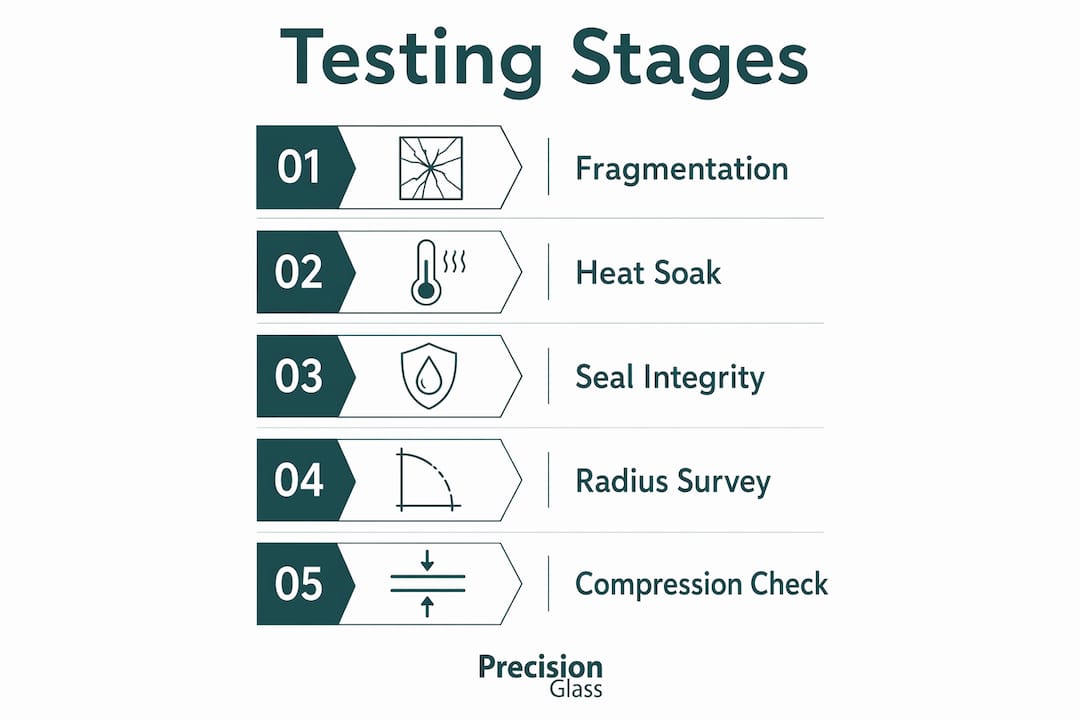
Structured testing protocols are the foundation of effective troubleshooting. The following sequence covers the most critical diagnostic steps for engineers.
Verify FPC documentation. 50% of UK manufacturers failed proper FPC testing for heat-soaked toughened glass in Q1 2026. That figure means you cannot assume compliance from a Declaration of Performance alone. Request calibration records, test logs, and batch traceability data directly from the fabricator.
Conduct fragmentation testing. Fragmentation tests confirm that toughened glass breaks into small, relatively harmless pieces. The same Q1 2026 report found 25% of manufacturers neglected this test entirely. Fragmentation failure indicates inadequate toughening and disqualifies the product from structural or safety-critical use.
Perform bow testing. Bow testing measures surface flatness after toughening. 32% of manufacturers missed bow testing in Q1 2026. Excessive bow causes optical distortion and creates uneven bearing pressure in framing systems, which accelerates seal degradation.
Apply the EN 14179 heat soak test. EN 14179 requires heat soak testing at a minimum of 290°C for at least two hours. This protocol triggers latent NiS inclusions to expand and cause breakage in the oven rather than in service. It reduces, but does not eliminate, the risk of spontaneous breakage.
Conduct mock-up testing for cold-bent glass. Standard field water penetration testing per AAMA 501.1 is insufficient for cold-bent glass due to out-of-plane loads. Mock-up testing at both design and tolerance limits is the correct approach. Sealant manufacturers must confirm bite adequacy under bent load conditions.
The table below summarises the primary tests, their standards, and what a failure indicates.
| Test | Standard / Method | Failure Indicates |
|---|---|---|
| Fragmentation | EN 12150 | Insufficient toughening |
| Bow | EN 1863 / EN 12150 | Thermal process error |
| Heat soak | EN 14179 | NiS inclusion risk |
| FPC audit | CE marking requirements | Documentation or process gap |
| Mock-up (cold-bent) | AAMA 501.1 (adapted) | Seal or framing incompatibility |
Pro Tip: Always request as-built radius surveys and gasket compression validation from framing manufacturers when specifying cold-bent glass. These documents are not part of standard IGU certification and must be obtained separately.
Step-by-step repair techniques for engineered glass
Repair is only appropriate when the defect type, size, and location fall within defined limits. Applying the wrong repair method to the wrong defect causes further damage.
When repair is viable
DIY crack repairs are limited to superficial damage under 6 inches that does not reach the glass edge. Professional resin injection repairs last 5–10 years when correctly applied. Cracks exceeding 12 inches, or any crack reaching the edge, require full pane replacement. Drilling or filling tempered glass is not permitted under any circumstances. The toughening process creates a balanced stress field throughout the pane; any penetration causes immediate, uncontrolled fracture.
Surface scratch repair
Surface scratch repair follows a progressive abrasion and polishing sequence. Polishing with cerium oxide restores surface gloss after progressive sanding with diamond pads from 400 to 1,500 grit. The grinding area must extend beyond the visible defect to avoid creating a visible depression or optical distortion. Failing to feather the repair area correctly produces a “fun-house mirror” effect that is often worse than the original scratch.
Chip repair and thermal management
Resin injection for chips requires careful temperature control. Ideal surface temperatures for resin injection range between 15°C and 27°C. Working outside this range risks thermal shock, which can propagate the crack further. Never apply resin to cold glass in direct sunlight, as rapid localised heating creates differential expansion at the repair site.
Cold-bent glass sealing fixes
Seal failures in cold-bent units require more than sealant replacement. The underlying cause is almost always geometric: the bend radius exceeds what the IGU manufacturer specified. The correct fix involves:
- Verifying the as-built bend radius against the original specification.
- Confirming gasket compression with the framing manufacturer.
- Replacing the IGU with a unit specified for the actual installed radius.
- Obtaining written confirmation from the sealant manufacturer that bite dimensions are adequate under load.
Applying new sealant without addressing the geometric root cause produces repeat failures within months.
How do you prevent engineered glass failures in design and production?
Prevention is more cost-effective than remediation at every stage of the glass supply chain. The following practices reduce defect rates across design, fabrication, and installation.
Glass type selection
Selecting the correct glass type for the application risk profile is the most impactful preventive decision. Heat-strengthened glass carries lower NiS breakage risk than fully tempered glass due to its lower surface compression. For critical applications where spontaneous breakage would be hazardous, residual NiS breakage risk remains non-zero even after heat soak testing. Laminated glass as a secondary containment layer is the correct specification response for overhead glazing, balustrades, and other safety-critical installations.
Specification and design controls
- Cold-bent glass: Clarify bend radius tolerances in the specification before fabrication. Gaps between the structural engineer’s radius and the IGU manufacturer’s tolerance are a primary cause of seal failure.
- Edgework: Specify edge quality class in accordance with EN 12150. Poor edgework is a leading cause of breakage that heat soak testing does not address.
- Handling procedures: Require written handling protocols from the installer. Glass breakage during installation is frequently caused by point loading on inadequately protected edges.
Production quality controls
Calibrated equipment and rigorous FPC testing are non-negotiable for glass fabrication in safety-critical sectors. Batch traceability, documented calibration schedules, and independent third-party audits provide the evidence base needed to identify process drift before it produces defective product. The comparison below shows how preventive controls differ by application risk level.
| Control measure | Standard application | Safety-critical application |
|---|---|---|
| Glass type | Toughened | Heat-strengthened or laminated |
| Heat soak | Optional | Mandatory per EN 14179 |
| Edge quality | Standard | Specified class per EN 12150 |
| FPC audit frequency | Annual | Continuous with batch records |
| Secondary containment | Not required | Laminated interlayer specified |
Cross-team collaboration between specifiers, fabricators, and installers closes the gaps that individual quality controls miss. A sight glass EPDM seal failure in an industrial process environment, for example, is rarely a material defect. It is almost always a specification or installation error that a pre-installation review would have caught.
Key takeaways
Effective problem-solving for engineered glass issues requires identifying the specific failure mode first, then applying the correct diagnostic test and targeted remediation rather than defaulting to heat soak treatment as a universal fix.
| Point | Details |
|---|---|
| Identify the failure mode first | NiS inclusions, fabrication flaws, and seal failures each require different corrective measures. |
| FPC compliance is not guaranteed | 50% of UK manufacturers failed FPC testing in Q1 2026; always verify documentation directly. |
| Heat soak reduces, not eliminates, risk | Residual NiS breakage risk remains after EN 14179 testing; specify laminated glass for critical installations. |
| Cold-bent glass needs specialist testing | AAMA 501.1 is insufficient; mock-up testing at design and tolerance limits is required. |
| Repair limits are strict | Cracks over 12 inches or reaching the edge require full replacement; drilling tempered glass is prohibited. |
Why I think engineers underestimate fabrication quality as a root cause
Most engineers I have worked with reach for heat soak testing as the default answer to spontaneous breakage. That instinct is understandable, but it misses the point in a significant number of cases. Heat soak testing targets only NiS inclusions. Poor edgework, frame-induced stress, and thermal process errors require entirely separate controls, and no amount of heat soaking will address them.
The cold-bent glass problem is even more underappreciated. Specifiers write a bend radius into the drawing, the fabricator produces a unit to flat IGU standards, and the installer bends it on site. Nobody checks whether the gasket compression is adequate under the actual load. The result is a seal failure that everyone attributes to a material defect. Tighter coordination between specifiers and manufacturers would prevent the majority of these failures before installation begins.
My practical advice: before authorising any corrective measure, document the failure mode in writing. If you cannot state with confidence whether the breakage originated from NiS, edgework, or frame stress, you are not ready to specify a fix. That discipline alone will save significant remediation cost and prevent repeat failures.
— Alexandra
Precision Glasses: technical glass for demanding applications
Engineers working on complex glass engineering challenges need a fabricator who understands the full failure risk picture, not just the product specification.

Precision Glasses designs and fabricates technical glass components for defence, aerospace, medical devices, automotive, and electronics applications. Every component is produced under meticulous quality assurance processes, with full batch traceability and documented FPC controls. For engineers who need precision glass component design support from specification through to delivery, Precision Glasses provides the technical depth and manufacturing rigour that safety-critical sectors require. Contact the team to discuss your application requirements.
FAQ
What is the EN 14179 heat soak test?
EN 14179 requires toughened glass to be held at a minimum of 290°C for at least two hours to trigger latent NiS inclusions. It reduces spontaneous breakage risk but does not eliminate it entirely.
Can tempered glass be drilled or repaired with resin?
Drilling tempered glass is not permitted, as it disrupts the internal stress field and causes immediate fracture. Resin injection is only suitable for superficial cracks under 6 inches that do not reach the glass edge.
Why do cold-bent glass seals fail?
Cold-bent IGU seal failures occur when the bend radius exceeds IGU manufacturer tolerances, creating peel stresses that standard flat-unit seals cannot withstand. Mock-up testing and gasket compression validation are required to prevent this.
What does FPC testing cover for toughened glass?
FPC testing covers fragmentation, bow, and dimensional compliance checks. A Q1 2026 regulatory report found 25% of UK manufacturers neglected fragmentation testing and 32% missed bow testing entirely.
When is full glass replacement necessary?
Full replacement is required when cracks exceed 12 inches, reach the glass edge, or when the pane is tempered and has been drilled or structurally compromised. Surface scratches and small chips within the pane area may be repairable by a professional.