

Sputter coated glass is defined as glass onto which ultra-thin metallic films are atomically bonded via Physical Vapor Deposition (PVD) in a vacuum chamber. The process uses metals such as silver, gold, and titanium to deliver UV rejection exceeding 99%, precise solar heat control, and exceptional optical clarity. These properties place sputter coated glass well above conventional glass coatings in performance. For engineers and designers specifying glass in defence, aerospace, medical, or automotive applications, understanding this technology is not optional. It is foundational.
What is sputter coated glass and how is it made?
Sputter coated glass is produced through magnetron sputtering, the industry-standard variant of PVD used for high-performance architectural and technical glazing. The process takes place inside a sealed vacuum chamber, where argon gas is introduced and ionised into plasma. That plasma bombards a metal target, ejecting atoms that travel across the chamber and deposit onto the glass substrate in a precisely controlled, uniform layer.
The term “sputter coated” is the common commercial descriptor. The recognised technical classification is soft-coat Low-E glass, distinguishing it from hard-coat pyrolytic glass produced through on-line chemical vapour deposition. Both terms appear in industry specifications, and engineers should be comfortable with both when reviewing glazing standards or procurement documents.
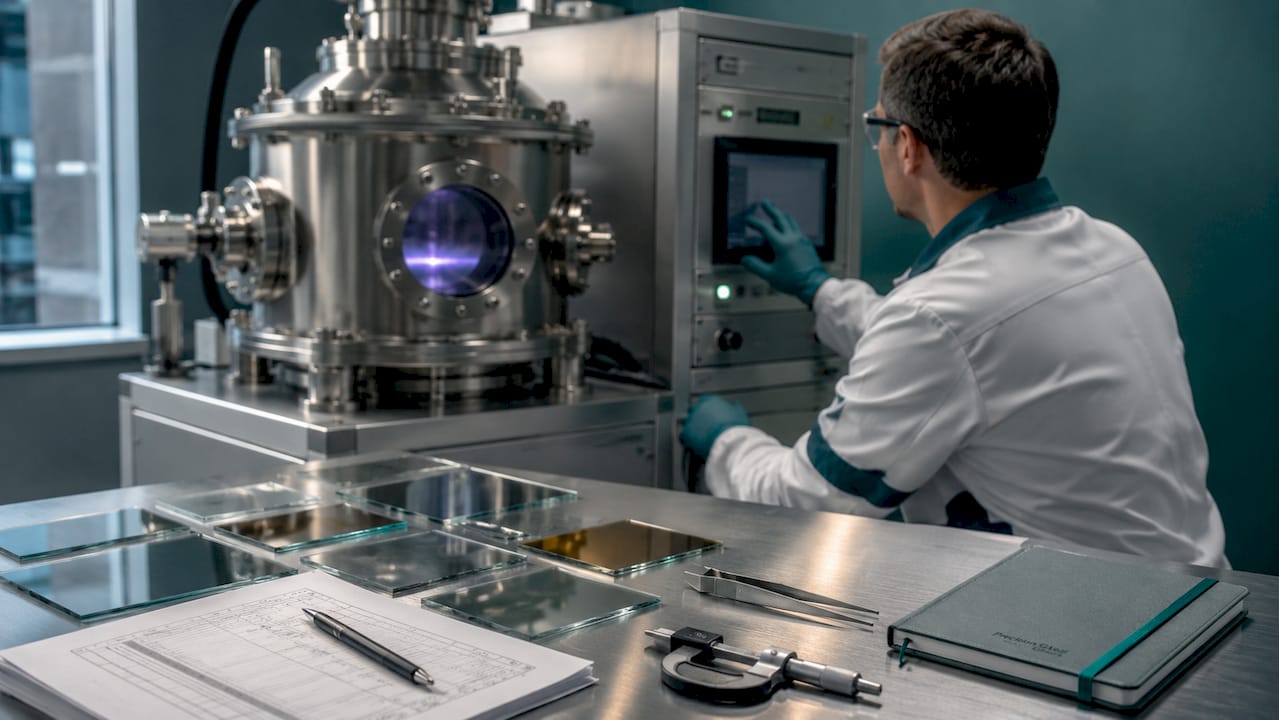
What makes this method distinctive is the atomic-level bonding between the metal film and the glass surface. The coating does not sit on top of the glass like a paint or adhesive film. It integrates at the molecular level, which is the primary reason for its durability and optical consistency.
How does the sputter coating process work?
The sputter coating process follows a defined sequence of controlled physical events. Understanding each stage helps engineers specify the right coating parameters for their application.
- Vacuum creation. The chamber is evacuated to remove atmospheric gases. This prevents contamination and extends the mean free path of ejected atoms, allowing them to reach the substrate without scattering.
- Argon plasma ignition. Argon gas is introduced at low pressure and ionised by an electric field, forming plasma. Argon incorporation during sputtering must be carefully managed, as it directly affects the electrical and optical properties of the deposited film.
- Magnetron confinement. Magnetic fields confine the plasma close to the metal target. Magnetron sputtering enhances ionisation and gives operators precise control over deposition rate by adjusting power and chamber pressure.
- Atomic ejection and transport. Ions from the plasma strike the target material, ejecting metal atoms. These atoms travel through the vacuum and condense onto the glass substrate, building up the coating layer by layer.
- Layer-by-layer deposition. Typical Low-E coatings consist of 5 to 10 discrete layers, including multiple silver layers, each serving a specific optical or protective function.
Process parameters govern final film quality. Chamber pressure affects film density and adhesion: lower pressure increases atom mean free path and produces denser, better-adhering films, while higher pressure aids uniform coverage on complex geometries. Power density must also be controlled carefully. Excessive power causes cathode overheating, which damages the target material and introduces film inconsistencies.
Pro Tip: When reviewing a supplier’s process specification, ask specifically for their chamber pressure range and power density limits. These two parameters are the clearest indicators of coating quality control.
What are the performance benefits of sputter coated glass?
Sputter coated glass delivers a combination of thermal, optical, and durability properties that conventional glass coatings cannot match. The key advantage is selectivity: the coating filters infrared radiation while transmitting visible light with minimal loss.
Sputter coatings provide superior solar heat reflection without compromising visual clarity. This resolves a long-standing trade-off in glazing design, where traditional tinted or dyed coatings reduced solar gain only by also reducing visible light transmission. Sputter coated glass achieves selective infrared filtering, preserving the daylight quality that architects and automotive designers require.
The atomic bonding of the metallic layers also produces outstanding durability. Sputter coated layers resist UV-induced degradation and colour fading over the product’s service life. This is a direct consequence of the deposition mechanism: because the metal integrates into the glass surface rather than adhering to it chemically or mechanically, it does not peel, crack, or discolour under prolonged UV exposure.
The table below summarises how sputter coated glass performs against conventional glass coating methods across the criteria that matter most to engineers.
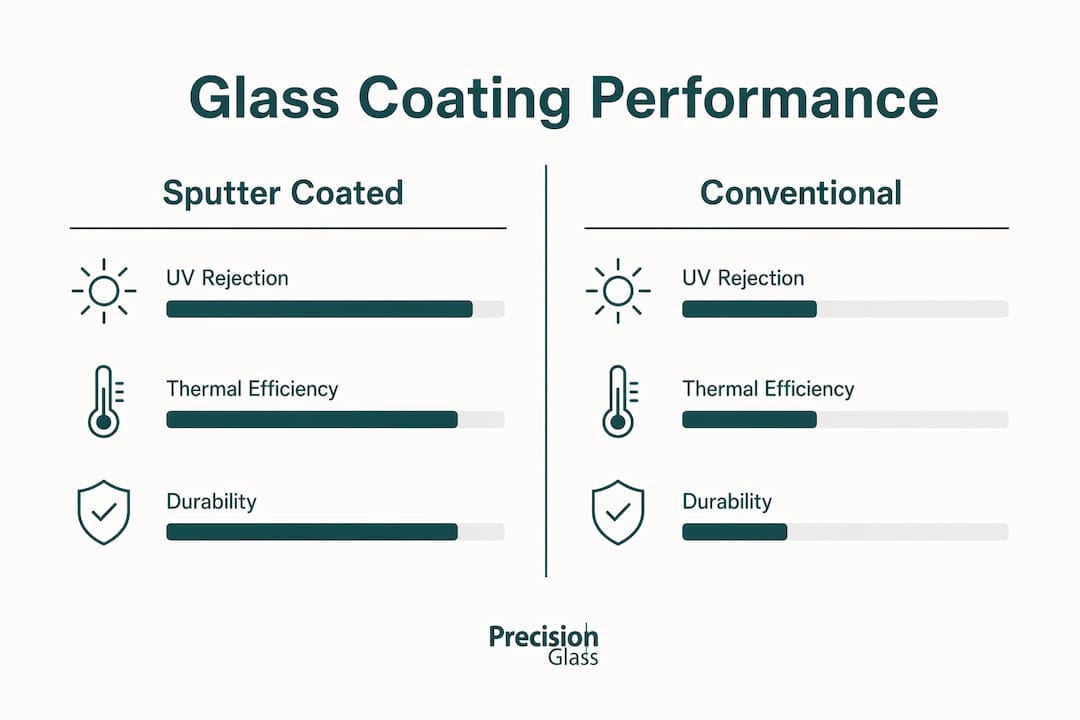
| Performance criterion | Sputter coated glass | Conventional coatings |
|---|---|---|
| UV rejection | Exceeds 99% | Typically 70–90% |
| Solar heat control | Selective IR filtering, high visible light | Broad-spectrum reduction, visible light loss |
| Optical distortion | Minimal, uniform deposition | Variable, risk of surface irregularity |
| Durability | Atomic bonding, fade-resistant | Adhesive or chemical bond, susceptible to degradation |
| Layer complexity | 5–10 tuneable layers | Limited layer options |
| Thermal performance (U-factor) | Extremely low, tailored to specification | Moderate, less adjustable |
Pro Tip: When specifying solar heat gain coefficient (SHGC) and U-factor targets, request the full layer stack specification from your coating supplier. The number and composition of silver layers directly determines both values.
How does sputter coated glass compare with other coating technologies?
The most practically significant distinction for engineers is between off-line sputter coating (soft-coat) and on-line pyrolytic coating (hard-coat). Each has a defined role in glazing design, and selecting the wrong type for an application is a common and costly error.
Off-line sputtering enables complex multilayer designs that on-line pyrolytic processes cannot replicate. The coating is applied after the glass is manufactured, giving the process engineer full control over layer composition and sequence. The trade-off is that the resulting coating is sensitive to moisture and oxidation. Silver layers degrade if exposed to air, which means sputter coated glass must be sealed inside insulating glass units (IGUs) rather than used as exposed single-pane glazing.
Hard-coat pyrolytic glass, applied during the float process at high temperature, produces a more durable exposed surface. It can be used as single-pane glazing and is easier to handle and fabricate. Its thermal performance, however, is significantly lower than a well-designed sputter coated stack.
Key factors engineers should evaluate when choosing between coating technologies:
- Thermal performance target. Soft-coat sputtered glass achieves lower U-factors and more precise SHGC values than hard-coat alternatives.
- Application environment. Hard-coat glass suits exposed or single-pane applications. Soft-coat requires IGU sealing.
- Fabrication complexity. Soft-coat glass must be cut and edged before coating, or handled with care to avoid surface damage after coating.
- Lead time and supply chain. Off-line sputtering is a specialist process. Verify your supplier’s capacity and quality controls before committing to a specification.
- Optical quality requirements. Sputter coated glass consistently delivers lower optical distortion, which matters in precision optics and high-clarity architectural glazing.
The distinction between these two coating routes is fundamental to architectural glass specification. Engineers who conflate them risk specifying a product that fails in service.
What are the primary applications of sputter coated glass?
Sputter coated glass is used across a broad range of industries wherever durability, precision, and customised optical or thermal properties are required. The applications below represent the sectors where demand is strongest and growing.
- Architectural glazing. Commercial facades, curtain walling, and high-performance windows use sputter coated Low-E glass to meet energy efficiency regulations and occupant comfort standards. The ability to tailor SHGC and U-factor to climate-specific requirements makes it the preferred choice for net-zero building projects.
- Optical components and lenses. Precision optics for scientific instruments, cameras, and laser systems rely on sputter coated glass for advanced optical coating technology with controlled reflectance and transmittance across specific wavelength ranges.
- Automotive and aerospace glazing. Windscreens, canopies, and cabin windows in both sectors demand coatings that combine solar control with structural integrity and optical clarity. Sputter coatings are thermodynamically non-equilibrium thin films, which gives them superior mechanical performance in extreme thermal and pressure conditions.
- Medical devices. Diagnostic equipment, surgical lighting, and imaging systems use sputter coated glass to manage light transmission and reflection with high repeatability. Precision Glasses supplies coated glass components for medical and aerospace applications where specification tolerances are tight and traceability is mandatory.
- Security glass. Coated glass in security applications provides both optical performance and additional functional layers, such as conductive coatings for heated or electronically switchable glazing.
- Electronics and displays. Touch panels, display covers, and sensor windows use sputter coated glass for controlled surface reflectance and electromagnetic shielding properties.
Key takeaways
Sputter coated glass delivers superior thermal, optical, and durability performance through atomic-level PVD deposition, making it the definitive choice for engineers specifying high-performance glazing in demanding applications.
| Point | Details |
|---|---|
| Definition and process | Sputter coated glass uses PVD magnetron sputtering to atomically bond metal layers onto glass in a vacuum. |
| UV and solar performance | The coating rejects over 99% of UV radiation and filters infrared selectively without reducing visible light. |
| Multilayer architecture | Typical coatings comprise 5–10 layers, including multiple silver layers, to achieve precise U-factor and SHGC values. |
| Soft-coat vs hard-coat | Sputter coated (soft-coat) glass outperforms pyrolytic (hard-coat) glass thermally but requires sealing inside IGUs. |
| Application range | Key sectors include architecture, automotive, aerospace, medical devices, precision optics, and security glazing. |
Why engineers underestimate the importance of deposition parameters
Most articles on sputter coated glass focus on the end properties: UV rejection, solar heat gain, optical clarity. Those properties matter. What gets less attention is how sensitive they are to the process conditions that produce them.
In my experience working with precision glass specifications, the single most common source of coating performance variation is inconsistent chamber pressure management during deposition. A supplier may quote the right layer stack on paper, but if their pressure control drifts between production runs, film density and adhesion vary. That variation shows up as inconsistent SHGC values across a glazing installation, which is exactly the kind of problem that is expensive to diagnose and even more expensive to remediate.
The second issue I see regularly is engineers treating soft-coat and hard-coat glass as interchangeable in early-stage design. They are not. Committing to a soft-coat specification without confirming IGU sealing requirements at the design stage leads to rework. The glass durability factors that govern long-term coating performance are not abstract. They are directly tied to how the glass is assembled and sealed after coating.
The emerging trend worth watching is multilayer coating stacks tailored for specific climate zones and building orientations. Suppliers are now offering coatings with independently tuned visible light transmittance and SHGC values, which gives facade engineers a level of control that was not commercially available five years ago. If you are specifying glazing for a project with a 2026 or later completion date, this is worth building into your early-stage performance modelling.
— Alexandra
Precision Glasses: tailored solutions for advanced coated glass
Precision Glasses designs and fabricates custom glass components for industries where coating performance and dimensional accuracy are non-negotiable. Whether you are specifying technical glass products for a medical imaging system, an aerospace canopy, or a high-performance architectural facade, we work to your exact tolerances and deliver on schedule.

Our fabrication process covers the full chain from design through to quality-assured delivery, with traceability at every stage. We serve defence, aerospace, automotive, electronics, and medical sectors, and we bring the same meticulous attention to specification compliance across all of them. Visit Precision Glasses to discuss your project requirements with our technical team.
FAQ
What is sputter coated glass used for?
Sputter coated glass is used in architectural glazing, automotive windscreens, aerospace canopies, medical devices, precision optical components, and security glass. Its primary function is to provide solar heat control, UV rejection, and optical clarity in demanding applications.
How does sputter coating differ from standard glass coating?
Sputter coating atomically bonds metal layers to glass through a PVD vacuum process, producing a more durable and thermally precise coating than conventional chemical or adhesive-based methods. The resulting film resists UV degradation and colour fading over its service life.
Does sputter coated glass require special handling?
Yes. Because the silver layers in sputter coated glass degrade on contact with air and moisture, the glass must be sealed inside insulating glass units. It cannot be used as an exposed single-pane product without protective sealing.
What metals are used in sputter coated glass?
Silver, gold, and titanium are the most common target materials. Silver is the primary functional layer in Low-E coatings due to its infrared reflectance properties. Other metals serve as barrier or adhesion layers within the multilayer stack.
How many layers does a sputter coated glass coating have?
A typical sputtered Low-E coating comprises 5 to 10 discrete layers, including multiple silver layers. The exact stack is engineered to achieve specific U-factor and solar heat gain coefficient targets for the application.