

Ballistic glass is a multi-layer glazing assembly, typically constructed from laminated glass, polycarbonate, or glass-clad polycarbonate (GCP), engineered to resist projectile penetration and control spall under ballistic impact. Unlike ordinary glazing, it does not rely on a single material but on a precisely sequenced stack of layers, each performing a distinct mechanical role. The term “bulletproof glass” is a misnomer in professional use; no glazing assembly is unconditionally impenetrable, and the correct framing is ballistic-rated or ballistic-resistant.
Key attributes at a glance:
- Typical overall thickness: 19 mm to 89 mm (approximately ¾ in to 3½ in), depending on construction and protection level
- Governing UK standards: BS EN 1063 (glazing products) and EN 1522/1523 (windows, doors and shutters); UKAS-accredited laboratory certification is the accepted evidence of compliance
- Primary limitations: designed to delay and contain, not to withstand indefinite fire; multi-hit performance degrades progressively; weight and frame loads must be engineered in from the outset
Precision Glasses engineers and supplies custom ballistic glazing assemblies to defence, security and critical-infrastructure clients across the UK, and the technical guidance in this article reflects that manufacturing and specification experience.
Table of Contents
- What types of ballistic glass are available and how is each built?
- How does ballistic glazing actually stop a projectile?
- Which UK standards and test methods should you require?
- Where is ballistic glazing used in the UK, and what does each application demand?
- What are the real limitations and how long does ballistic glazing last?
- How to specify ballistic glazing: a risk-led checklist
- How Precision Glasses engineers ballistic glazing for demanding applications
- Key takeaways
- The specification mistake that costs the most
- Work with Precision Glasses on your ballistic glazing specification
- Useful sources and further reading
What types of ballistic glass are available and how is each built?
Ballistic glazing comes in five principal constructions. Each balances hardness, energy absorption, optical clarity, and weight differently, so the right choice depends on the threat profile and the physical constraints of the installation.

| Construction | Typical thickness | Optical clarity | Weight | UV durability | Field workability |
|---|---|---|---|---|---|
| Laminated glass | varies from thin to moderately thick | Excellent | High | Excellent | Limited |
| Acrylic (monolithic) | ranges from moderate to relatively thick | Good | Medium | Good | Moderate |
| Polycarbonate | thickness varies typically in a moderate range | Good | Low | Poor (needs coating) | Good |
| Glass-clad polycarbonate (GCP) | varies from moderate to thick layers | Very good | Medium | Good | None |
| Monolithic all-glass composite | generally thick | Excellent | Very high | Excellent | None |
Laminated glass consists of two or more glass plies bonded with polyvinyl butyral (PVB) or ionoplast interlayers. The glass provides surface hardness; the interlayer holds fragments together after fracture and absorbs residual energy. It offers the best optical performance of any construction and is the standard choice for architectural façades and secure counters where distortion is unacceptable.
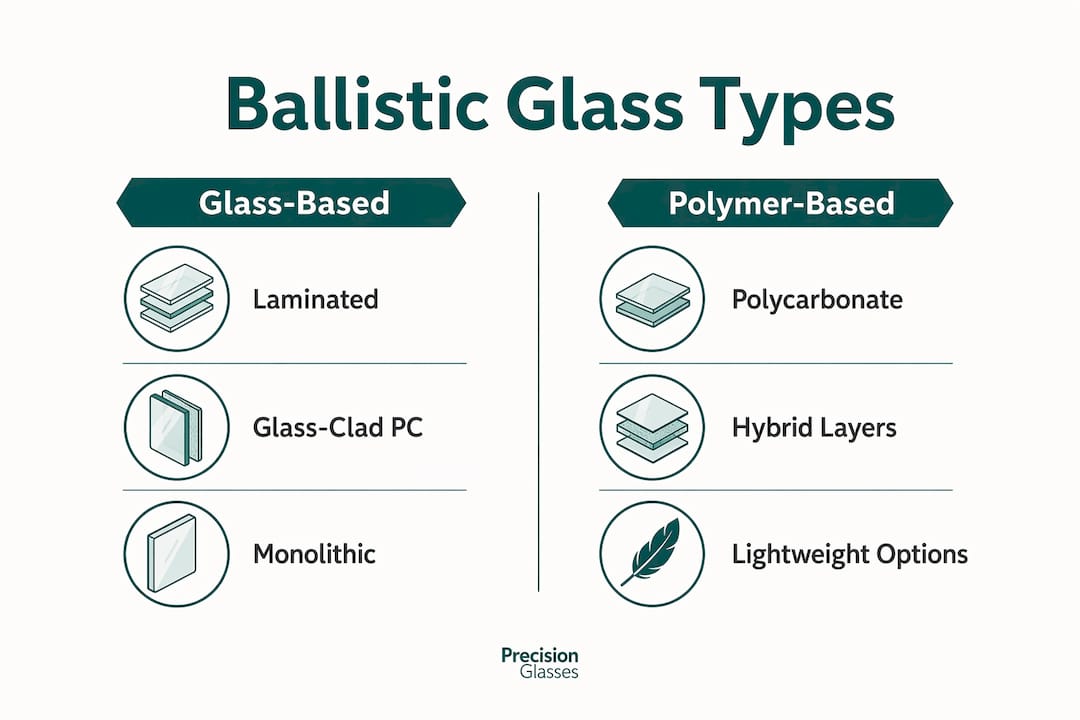
Polycarbonate is a thermoplastic with high impact resistance and low weight, but it scratches easily and degrades under UV exposure without a hard coating. It is often used as a spall-control backing layer bonded to the rear face of a glass assembly rather than as a standalone panel. The UV degradation of polymer layers is a genuine service-life concern in exposed installations.
Glass-clad polycarbonate (GCP) bonds multiple glass plies to a polycarbonate core under controlled heat and pressure in a factory environment. The result combines the surface hardness of glass with the energy-absorbing flexibility of polycarbonate, and GCP is widely regarded as the most robust choice for high-security applications, with thicknesses typically ranging from 25 mm to 64 mm depending on protection level. Critically, GCP panels cannot be cut, drilled, or modified in the field without destroying the factory lamination and voiding certification. Panels must be ordered to final dimensions. This is a procurement constraint that affects lead times and requires complete dimensional information before order placement. For a detailed account of the bonding process, see glass bonding technology.
Monolithic all-glass composites are the heaviest option and are reserved for the highest threat levels where structural depth is available. Modern fabrication trends favour thinner, multi-material assemblies that reduce weight without compromising protection, and GCP or hybrid laminates are increasingly preferred over thick monolithic glass in new installations.
Optical clarity depends on matching the refractive indices of all laminated layers. A mismatch introduces distortion and parallax errors that are unacceptable at guard stations, vehicle windows, and surveillance positions. This is not a cosmetic issue; it is a functional specification requirement.
How does ballistic glazing actually stop a projectile?
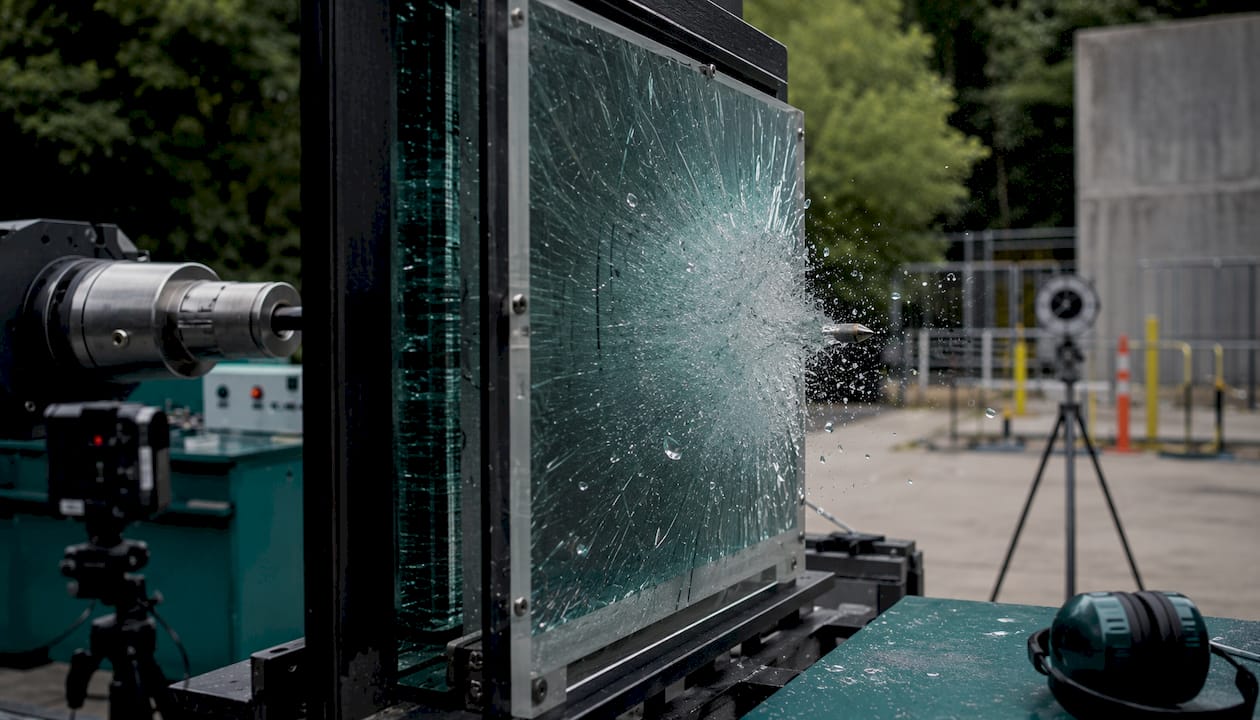
The stopping mechanism is a sequential energy-transfer process, not a single material property. Understanding the sequence helps you specify the right layer configuration for your threat profile.
- Contact and initial deformation. The projectile strikes the outer glass ply. Glass is hard and brittle; it resists penetration momentarily while simultaneously deforming and flattening the projectile tip. A round-nosed or soft-point bullet loses its penetrating geometry at this stage.
- Fracture and energy distribution. The outer ply fractures radially, distributing kinetic energy across a wider area of the assembly. This is intentional: a controlled fracture pattern spreads the load rather than concentrating it on a single point.
- Energy absorption by inner layers. The deformed projectile and fracture energy pass into the interlayer or polycarbonate core. These materials are elastic and ductile; they flex, stretch, and delaminate locally, converting kinetic energy into heat and deformation work.
- Fragment arrest. The interlayer and any rear polycarbonate ply retain glass fragments on both faces. This is spall control: the prevention of secondary fragment injury on the protected side.
- Arrest of the projectile. If the assembly is correctly rated for the threat, the projectile comes to rest within the laminate stack, typically in or just behind the polycarbonate layer.
Spall refers to glass fragments ejected from the rear face of a glazing assembly on impact. Even when a projectile is stopped, spall can cause serious injury. Polycarbonate backing plies and no-spall coatings applied to the protected face are the two standard mitigation methods. For installations where personnel stand close to the glazing (teller positions, guard booths, vehicle interiors), spall control is not optional.
Pro Tip: When specifying layer configuration, do not treat optical clarity and multi-hit resistance as mutually exclusive. A GCP assembly with a thin glass outer ply and a thicker polycarbonate core will outperform a thick laminated glass panel on multi-hit resistance while maintaining acceptable optical quality. Specify the optical distortion tolerance explicitly in the procurement brief, alongside the ballistic rating, so the manufacturer can balance both requirements.
Which UK standards and test methods should you require?
The two standards that govern ballistic glazing in the UK are BS EN 1063 and EN 1522/1523. BS EN 1063 applies specifically to glass in building applications and defines protection classes BR1 through BR7 (handgun and rifle threats) and SG1/SG2 (shotgun). EN 1522 covers windows, doors, shutters and blinds, with protection classes FB1 through FB7 and NS (no spall). The rating levels map directly: BR2/FB2 corresponds to a 9 mm handgun threat; BR6/FB6 corresponds to a 7.62 × 51 mm NATO rifle round.
Test reports from accredited laboratories should include the following as a minimum:
- Ammunition type, projectile mass, and measured velocity at impact
- Shot pattern (number of shots, spacing, and sequence)
- Distance from muzzle to specimen
- Specimen conditioning (temperature, humidity, duration)
- Witness plate results (confirming no penetration of the protected face)
- Residual dent depth or fragment data where applicable
- Multi-hit performance data if more than one shot is specified in the rating
MIL-HDBK-1013/12 provides detailed selection and evaluation methodology for glazing against ballistic, bomb, and forced-entry threats, and is a useful reference for defence and government procurement teams working alongside BS EN standards.
UKAS accreditation is the accepted mark of laboratory competence in the UK. A test report from a non-UKAS laboratory is not automatically invalid, but procurement teams should require equivalent evidence of accreditation scope, calibration records, and test fixture details before accepting it. Ambiguous test conditions, missing witness plate data, or unspecified ammunition are red flags that warrant rejection of the report.
Where is ballistic glazing used in the UK, and what does each application demand?
Common applications and their specific design constraints:
- Secure counters (banks, post offices, pharmacies): optical clarity is the primary requirement; distortion at a teller position affects both surveillance camera performance and staff comfort. Laminated glass or GCP with matched refractive indices is standard.
- Embassies and consulates: typically specified to the highest threat levels (BR6/FB6 or above); GCP or monolithic composites; full perimeter framing must be ballistic-rated to the same level as the glazing.
- Museums and cultural institutions: protection against opportunistic attack rather than sustained fire; lower-rated laminated glass (BR2–BR4) is usually sufficient; optical clarity for exhibit viewing is non-negotiable.
- Vehicle glazing: weight is the dominant constraint; GCP or polycarbonate-backed laminates are preferred; thermal cycling and vibration resistance must be specified alongside ballistic performance.
- Control rooms and critical infrastructure: multi-hit performance and spall control are prioritised; panels are often larger format, requiring careful structural assessment of the supporting frame.
- Critical public buildings (courts, government offices): threat assessment drives the rating; integration with blast-resistant framing is increasingly specified alongside ballistic performance.
Frame integration is a point that procurement teams consistently underestimate. A ballistic-rated frame is integral to system performance; a high-rated pane in an unrated frame will likely fail at the junction under impact. The system rating is only as strong as its weakest component, which means frame certification must be part of the procurement scope, not an afterthought.
What are the real limitations and how long does ballistic glazing last?
Ballistic glazing is designed to provide delay and containment, not indefinite invulnerability. Persistent or high-volume fire will eventually compromise even high-rated assemblies. The correct design assumption is that the glazing buys time for evacuation or response, not that it will hold indefinitely.
Expected service life depends heavily on construction and environment. Laminated glass in a sheltered interior installation can perform reliably for 20 years or more with proper maintenance. Polycarbonate and GCP assemblies in exposed exterior positions are more vulnerable to UV degradation, thermal cycling, and surface abrasion, which can reduce effective service life to 10–15 years without protective coatings and regular inspection. For practical guidance on extending service life, glass durability optimisation covers maintenance and environmental factors in detail.
Inspection checklist for installed ballistic glazing:
- Check for delamination, yellowing, or hazing in polycarbonate or PVB interlayers (annual minimum)
- Inspect frame seals and gaskets for cracking, shrinkage, or water ingress
- Examine glass surfaces for scratches, chips, or impact damage that could compromise the outer ply
- Verify that no field modifications (drilling, cutting, re-sealing with non-specified materials) have been made
- After any ballistic impact, treat the panel as compromised and arrange immediate replacement regardless of visible damage extent
Do not use abrasive cleaners, solvent-based products, or high-pressure washing on polycarbonate or GCP surfaces. These damage surface coatings and accelerate UV degradation. Mild soap and water with a soft cloth is the correct cleaning method.
How to specify ballistic glazing: a risk-led checklist
Ballistic glazing selection must be a risk-based engineering decision that balances threat level, optical clarity, weight constraints, and structural support. Over-specifying increases cost and weight without improving safety; under-specifying leaves a gap in protection. The specification process should follow this sequence:
- Define the threat profile. Identify the weapon type (handgun, rifle, shotgun), calibre, expected range, and number of rounds the glazing must resist. This maps directly to a BS EN 1063 or EN 1522 protection class.
- Determine the required protection level. Select the appropriate BR or FB class. Confirm whether spall control (NS designation) is required based on occupant proximity to the glazing.
- Specify optical and thermal requirements. State the maximum acceptable optical distortion (in minutes of arc or as a distortion class), any thermal insulation requirements (U-value), and solar control needs for façade applications.
- Assess weight and structural limits. Calculate the maximum panel weight the supporting structure and frame can carry. This often determines whether GCP or laminated glass is feasible at the required thickness.
- Define framing and interface requirements. Specify that framing must be ballistic-rated to the same protection class as the glazing. Include glazing bead depth, rebate dimensions, and any structural fixings.
- Set test report acceptance criteria. Require UKAS-accredited (or equivalent) test reports that include all parameters listed in the standards and testing section above.
- Account for lead times and fabrication constraints. GCP panels require factory bonding and must be ordered to final dimensions. Allow 8–16 weeks for complex assemblies; confirm this with the manufacturer at enquiry stage.
Red flags in supplier responses or test reports:
- Test conditions described in vague terms (“similar ammunition”, “approximately the specified velocity”)
- Laboratory accreditation not stated or not verifiable
- Claims that GCP panels can be modified on site after delivery
- Test reports that omit witness plate results or shot pattern diagrams
- Pricing that does not differentiate between protection levels (suggests a standard product is being re-labelled)
For defence and government projects, the glass selection process for defence provides additional procurement guidance aligned with UK defence procurement standards.
How Precision Glasses engineers ballistic glazing for demanding applications
The manufacturing process for a compliant ballistic glazing assembly begins well before glass is cut. At Precision Glasses, the process starts with a CAD-based specification review that confirms dimensional tolerances, layer sequence, optical distortion limits, and the required protection class. Only then does fabrication proceed.
Factory bonding of GCP assemblies is carried out under controlled heat and pressure, with each batch tracked for traceability from raw material to finished panel. CNC finishing ensures that edge profiles, rebate dimensions, and corner radii match the specified frame interface exactly. Optical distortion is measured against the agreed tolerance before despatch, because a panel that meets its ballistic rating but fails its optical specification is not fit for purpose at a guard station or vehicle window.
Buyers should expect the following deliverables from a qualified supplier: a full ballistic test report from a UKAS-accredited laboratory, dimensional and optical tolerance certificates, batch-level traceability records, installation guidance specific to the panel design, and a recommended maintenance schedule. Precision Glasses provides all of these as standard for ballistic glazing orders, alongside defence industry glass expertise that spans custom fabrication, tight-tolerance CNC work, and compliance documentation for UK procurement frameworks.
Key takeaways
Ballistic glass is a multi-layer engineered assembly rated to specific threat levels under BS EN 1063 or EN 1522/1523; no glazing is unconditionally bulletproof, and specification must be driven by a documented threat assessment.
| Point | Details |
|---|---|
| Construction determines performance | Laminated glass, GCP, and polycarbonate each offer different balances of weight, clarity, and multi-hit resistance. |
| Thickness ranges from 19 mm to 89 mm | The correct thickness is set by the required protection class, not by a general preference for thicker glass. |
| Frame certification is non-negotiable | A ballistic-rated pane in an unrated frame will fail at the junction; specify framing to the same protection class. |
| GCP cannot be modified in the field | Order panels to final dimensions; field cutting or drilling destroys the lamination and voids certification. |
| Precision Glasses for custom assemblies | Precision Glasses supplies custom ballistic glazing with UKAS-supported test documentation, batch traceability, and CNC-finished tolerances for UK procurement. |
The specification mistake that costs the most
The single most consistent error we see in ballistic glazing procurement is not the choice of material. It is the decision to treat the glazing panel as the entire system.
A BR6-rated GCP panel installed in a standard aluminium curtain-wall frame is not a BR6 installation. The frame will fail before the glass does, and the project team will have spent a significant budget on a panel that cannot perform to its rating. This is not a theoretical risk; it is a documented failure mode that appears in post-incident reviews with uncomfortable regularity.
The second error is misreading test reports. A test report that lists the correct ammunition and velocity but omits the witness plate results, or that specifies a conditioning regime that does not match the installation environment, is not evidence of compliance. Procurement teams without ballistic glazing experience often accept these reports at face value because the headline rating matches the specification. A qualified manufacturer will identify these gaps before the order is placed.
The practical advice is this: engage your glazing manufacturer at the threat-assessment stage, not after the architectural drawings are complete. The material selection, the layer sequence, the frame interface, and the test evidence are all interdependent. Locking in the architecture first and then trying to fit a ballistic specification around it is the most reliable way to end up with a system that is either over-engineered, under-performing, or both.
Ballistic glazing done well is meticulous, methodical work. The standards exist, the test protocols are clear, and the materials are well understood. What separates a compliant installation from a costly one is the quality of the specification process and the competence of the manufacturer involved from the start.
Work with Precision Glasses on your ballistic glazing specification
For procurement and engineering teams that need more than an off-the-shelf panel, Precision Glasses offers custom ballistic glazing fabrication with the documentation and traceability that UK defence, government, and security projects require. Every assembly is specified from CAD through to CNC-finished delivery, with optical distortion measurement, batch-level traceability, and full test certification included as standard.

The practical next step is a specification review. Bring your threat assessment, dimensional constraints, and optical requirements, and Precision Glasses will confirm the appropriate construction, protection class, and lead time. For complex or multi-panel projects, early engagement allows the layer sequence and frame interface to be optimised before fabrication begins, which avoids costly revisions later. Visit the technical glass product page to review capabilities, or contact Precision Glasses directly to begin a specification conversation.
Useful sources and further reading
| Resource | Description |
|---|---|
| BS EN 1063 (BSI) | UK standard for ballistic-resistant glazing products; defines BR1–BR7 and SG1/SG2 protection classes |
| EN 1522/1523 (BSI) | Standard for ballistic-resistant windows, doors and shutters; defines FB1–FB7 and NS (no-spall) classes |
| MIL-HDBK-1013/12 | US military handbook for evaluation and selection of security glazing; detailed threat-level analysis and selection methodology |
| Bulletproof glass — Wikipedia | Accessible technical overview of construction types, stopping mechanisms, and thickness ranges |
| UKAS accredited laboratories | Search tool for finding UK-accredited test laboratories for ballistic glazing certification |
| Precision Glasses — technical glass | Custom ballistic and protective glazing fabrication capabilities for UK defence and security projects |
| Precision Glasses — defence glass guide | Technical guidance on glass selection for defence applications, including ballistic and forced-entry requirements |