Chemically strengthened glass is glass that has undergone an ion-exchange treatment to produce a high-compressive surface layer, significantly raising its resistance to surface flaw propagation. The process immerses the glass in a molten alkali salt bath, replacing smaller host ions with larger ones to create a compressed “case” at the surface. For engineers and procurement teams, the practical implication is clear: specify chemical strengthening when you need ultra-thin substrates, complex geometries, or zero optical distortion. If your application requires safety glazing classification, lamination is mandatory in addition.
- Surface compressive stress typically ranges from ~200 to ~1,000 MPa depending on glass chemistry and process parameters.
- Case depths range from small scale for soda-lime glass to significantly deeper for specialised alkali aluminosilicate formulations.
- Precision Glasses supplies custom chemically strengthened components for defence, aerospace, medical devices, and electronics, with full batch-level traceability and UK compliance support.
Table of Contents
- What is chemically strengthened glass and how does it differ from standard glass?
- How is glass chemically strengthened? The ion-exchange process step by step
- What performance metrics should you specify for chemically strengthened glass?
- How does chemically strengthened glass break, and is it a safety glass?
- Chemically strengthened vs tempered glass: which should you specify?
- Where is chemically strengthened glass used?
- Procurement checklist: what UK engineers should ask suppliers
- How do suppliers test and demonstrate conformance?
- Maintenance, repair, and end-of-life considerations in the UK
- Key takeaways
- Why the conventional wisdom on glass strengthening misses the point
- Precision Glasses: custom chemically strengthened glass for demanding applications
- Useful sources and further reading
What is chemically strengthened glass and how does it differ from standard glass?
Chemical strengthening, formally known as ion-exchange strengthening, has been in industrial use since 1962. The principle is straightforward: the glass is immersed in a molten salt bath at a temperature below its annealing point, and ions within the glass surface are exchanged for larger ions from the bath. The resulting size mismatch forces the surface into compression, which must be overcome before any crack can propagate.
Several terms describe the same process: ion-exchange strengthening, ion-exchanged glass, and chemically toughened glass are all used interchangeably in technical literature, though “chemically strengthened” is the most widely adopted in procurement and standards contexts.
Key terms engineers need to know:
- Surface compressive stress (MPa): the magnitude of compression in the surface layer; higher values mean greater resistance to flaw growth.
- Case depth / depth of layer (DOL, µm): how deep the compressive zone extends; governs how much surface damage the glass can tolerate before strength is compromised.
- Annealing point: the temperature below which the ion exchange must occur to avoid relaxing the glass network.
- Glass chemistry suitability: only alkali-containing glasses strengthen effectively. Alkali aluminosilicate glasses respond best, followed by soda-lime; borosilicate glasses (low alkali content) strengthen poorly and are rarely specified for this process.
The discovery of practical ion-exchange strengthening in the early 1960s transformed thin-glass engineering, enabling substrates that thermal tempering simply cannot achieve.
How is glass chemically strengthened? The ion-exchange process step by step
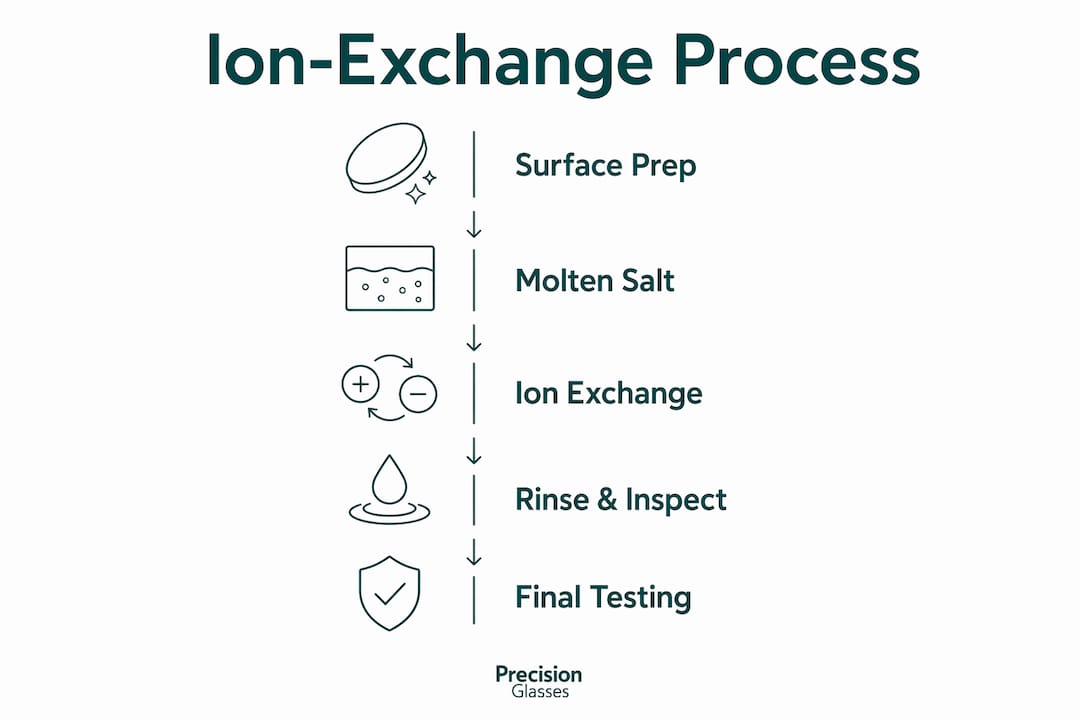
Understanding the manufacturing sequence helps engineers write tighter specifications and ask better questions of suppliers.
Surface preparation
Before immersion, the glass must be thoroughly cleaned and any surface defects from cutting or grinding addressed. Residual contamination or deep surface flaws will compromise the uniformity of the compressive layer. Edge finishing is equally important: sharp or chipped edges are stress concentrators that the ion-exchange process cannot fully compensate for.
Immersion in the molten salt bath
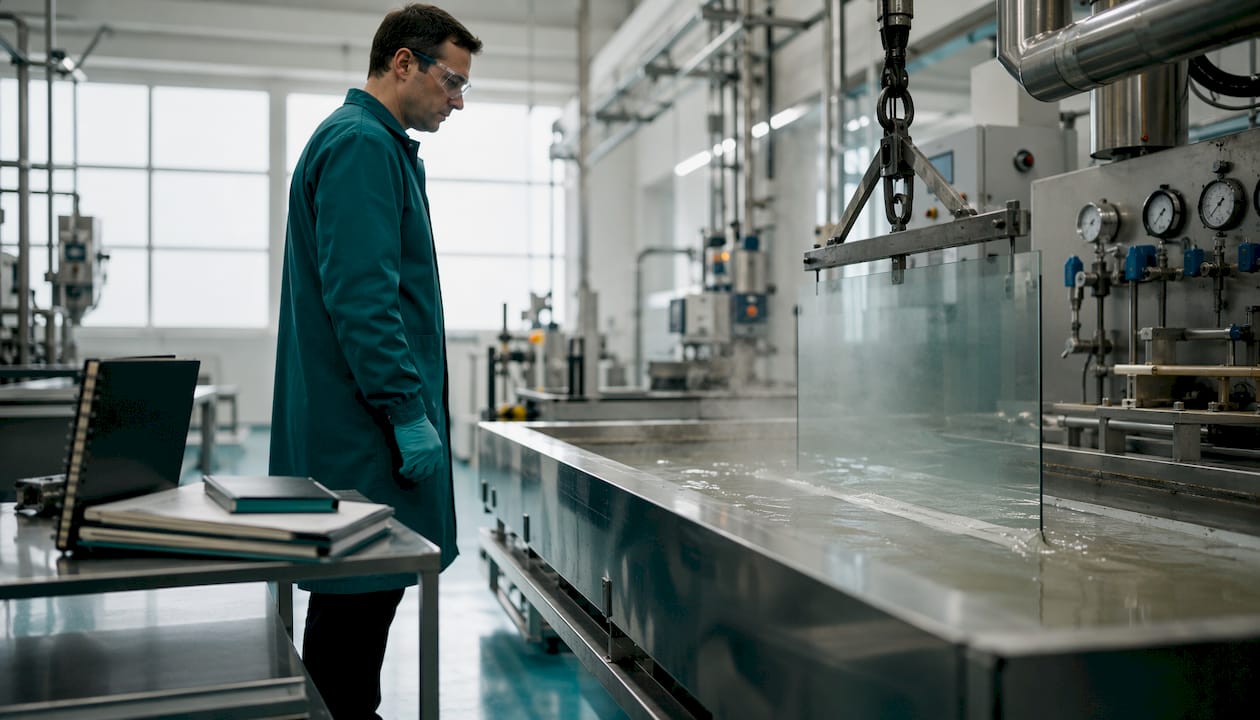
The cleaned glass is submerged in a molten alkali salt bath, most commonly potassium nitrate (KNO₃) or a KNO₃/NaNO₃ mixture. Process temperatures typically fall between 334°C and 475°C, kept below the glass annealing point to prevent stress relaxation. Immersion times range from 2 to 24 hours depending on the target case depth and glass chemistry.
The ion-exchange mechanism
During immersion, smaller sodium (Na⁺) or lithium (Li⁺) ions migrate out of the glass surface while larger potassium (K⁺) ions from the bath migrate in. The larger K⁺ ions occupy the same network sites but take up more space, placing the surface layer under compression. The glass network accommodates this mismatch, generating the compressive stress that defines the material’s strength.
Post-treatment steps
After immersion, parts are rinsed to remove residual salt, inspected for visual defects, and logged against batch records. Some processes include a mild anneal to relieve any unwanted tensile stress in the interior, though this must be carefully controlled to avoid reducing surface compression. Edge protection and final packaging are specified at this stage to preserve the compressive case during transit.
Pro Tip: Request process parameter windows from your supplier, not just single target figures. A supplier who can demonstrate consistent bath temperature control within ±5°C and immersion time tolerance within ±15 minutes is far more likely to deliver repeatable DOL and compressive stress values across production batches.
Batch versus continuous processing is a practical consideration: most precision components are processed in batch fixtures to maintain positional control and prevent contact damage between parts. Complex geometries may require bespoke fixturing to ensure uniform salt contact across all surfaces.
What performance metrics should you specify for chemically strengthened glass?
The measurable properties below are what distinguish chemically strengthened glass from annealed float glass and from thermally toughened alternatives.
| Property | Soda-lime glass | Alkali aluminosilicate | Notes |
|---|---|---|---|
| Surface compressive stress | ~400 MPa (soda-lime) to ~1,000 MPa (specialised aluminosilicate) | Up to ~1,000 MPa | Higher values for specialist processes |
| Case depth (DOL) | 25–30 µm (soda-lime) | Up to ~1 mm (aluminosilicate, specialist) | Deeper case = greater damage tolerance |
| Strength multiplier vs annealed | 6–8× | ~6–8× (some chemistries) | Multiplier depends on flaw population |
| Optical distortion | Negligible | Negligible | No measurable bow or warp |
| Minimum treatable thickness | — | — | Thinner substrates possible with specialist baths |
Surface compressive stress in chemically strengthened glass ranges from ~200 to ~1,000 MPa, with case depths from 30 µm to several hundred µm depending on glass type and treatment conditions.
The optical performance advantage is significant. Because the process operates well below the glass softening point, no measurable optical distortion is introduced. Thermally tempered glass, by contrast, generates optical anisotropy and bow that disqualify it from display and precision optics applications. For engineers specifying optical components for precision engineering, this is often the deciding factor.
The strength multiplier figures quoted in supplier datasheets (commonly 6–8× for alkali aluminosilicate) assume a controlled flaw population. In practice, handling damage, edge chips, or deep scratches can reduce effective strength considerably, which is why case depth matters as much as peak compressive stress.
How does chemically strengthened glass break, and is it a safety glass?
Chemically strengthened glass is not a safety glass. When it fractures, it breaks into long, sharp shards similar to annealed float glass, not the small, blunt-edged cubes produced by thermally toughened glass. This distinction has direct regulatory consequences.
Implications for design and specification:
- Where building regulations, automotive standards, or medical device directives require safety glazing, chemically strengthened glass must be laminated with an interlayer (typically PVB or ionoplast) to retain fragments on fracture.
- The compressive surface layer does not prevent catastrophic failure once a crack penetrates through the case depth into the tensile interior.
- Edge and cut vulnerability is a specific risk: cutting or deep machining after ion exchange removes the compressive case near the new edge, typically within ~20 mm of a new cut. Strength at that edge reverts to near-annealed levels.
Pro Tip: Always specify that cutting, drilling, or grinding must occur before ion exchange, not after. If post-strengthening machining is unavoidable, require the supplier to define the affected zone and either reprocess the part or apply edge sealing appropriate to the application.
When safety glazing is required alongside the optical and thinness benefits of chemical strengthening, the correct solution is a laminated assembly using chemically strengthened plies. This approach is common in aerospace cockpit glazing and certain medical device panels.
Chemically strengthened vs tempered glass: which should you specify?
Choosing between chemical strengthening, thermal tempering, heat strengthening, lamination, and sapphire comes down to geometry, thickness, optical requirements, and safety classification. The table below captures the critical trade-offs.
| Material | Surface compressive stress | Case depth | Break pattern | Geometry suitability | Optical distortion | Typical applications | Relative cost |
|---|---|---|---|---|---|---|---|
| Chemically strengthened | 200–1,000 MPa | — | Long sharp shards | Thin, complex, curved | Negligible | Displays, medical, aerospace, sensors | Moderate–high |
| Thermally toughened (tempered) | — | Full thickness gradient | Small blunt cubes | Flat or simple curves only | Moderate–high | Architectural, automotive side glass | Low–moderate |
| Heat-strengthened | — | Full thickness gradient | Large fragments | Flat panels | Low–moderate | Spandrel, overhead glazing | Low |
| Laminated (annealed plies) | Minimal | N/A | Retained by interlayer | Flat and curved | Low | Safety glazing, windscreens | Moderate |
| Sapphire | Very high hardness | Crystalline structure | Brittle, large shards | Limited geometry | Excellent | Watch crystals, specialist optics | Very high |
For a fuller comparison of engineered glass types for high-precision industries, the geometry constraint is the most common decision driver.
Where chemical strengthening is the right choice:
- Substrates thinner than ~2 mm, where thermal tempering is impractical.
- Complex or curved geometries that cannot tolerate the thermal gradients of a toughening furnace.
- Applications demanding zero optical distortion: display cover glass, instrument windows, precision optics.
- Ion-exchange strengthening can process plates as thin as 50 µm and irregular shapes, provided all surfaces contact the molten salt.
Gorilla Glass (Corning) is the most widely recognised commercial product in this category: an alkali aluminosilicate glass chemically strengthened to achieve compressive stresses approaching 1 GPa with deep case depths. It is not a separate process but a proprietary glass chemistry optimised for ion exchange. Sapphire, by contrast, is a crystalline aluminium oxide, not a glass at all. Its scratch resistance is exceptional, but it is brittle, geometrically constrained, and carries a cost premium that makes it viable only for the most demanding specialist optics.
Where is chemically strengthened glass used?
Chemically strengthened glass is preferred wherever optical clarity, thin profiles, and high strength are required simultaneously, and thermal tempering would introduce unacceptable distortion or is geometrically impossible.
Primary application sectors:
- Electronics and display cover glass: mobile device screens, industrial HMI panels, and touch displays rely on chemically strengthened glass for scratch resistance and thinness. The absence of optical distortion is non-negotiable for display-quality substrates. For engineers working on glass selection for electronics, chemical strengthening is the default starting point.
- Medical devices: drug delivery cartridges, autoinjector barrels, and diagnostic instrument windows. Chemical strengthening in drug delivery cartridges has reduced glass failure rates and enabled safe commercialisation of designs that would otherwise carry unacceptable fracture risk.
- Aerospace and defence: cockpit instrument windows, head-up display combiners, and sensor windows where thin, distortion-free glass is a hard requirement. Transparent armour and specialist security glazing also use chemically strengthened plies within laminated assemblies.
- Scientific instrumentation: flow-cell windows, spectrometer cells, and precision sensor covers where dimensional stability and optical transmission must be maintained under mechanical stress.
In UK procurement contexts, defence and medical device programmes typically require chain-of-custody documentation and batch-level traceability for chemically strengthened components, particularly where the glass forms part of a safety-critical assembly.
Procurement checklist: what UK engineers should ask suppliers
Treating chemically strengthened glass as a specification-driven material rather than a commodity is the single most important mindset shift for procurement teams. Failures in service most commonly trace back to under-specified process parameters or inadequate incoming inspection.
Decision criteria before issuing an RFQ:
- What is the required surface compressive stress and case depth for the application?
- Does the geometry permit post-strengthening machining, or must all cutting occur beforehand?
- Is safety glazing classification required? If so, lamination must be specified.
- What optical distortion limit applies? State birefringence limits in the specification.
- What is the minimum acceptable thickness, and does the supplier have experience with that substrate?
Supplier qualification checklist:
- Reported compressive stress values (MPa) and measurement method used.
- Measured case depth (DOL, µm) with the test technique specified (e.g. FSM, scattered light polariscopy).
- Bath chemistry, temperature range, and immersion time windows (not just nominal targets).
- Batch traceability records: process logs linked to each delivered part or batch.
- Hazardous waste handling permits and evidence of compliant disposal of spent molten salt.
- Certificates of conformity and any third-party test reports.
- Lead times for standard and expedited orders.
For advanced glass specifications, including how to structure acceptance criteria in a purchase order, the specification should define sampling plan size, flexure test method, and the minimum acceptable compressive stress for the application.
UK-specific cost note: Regulatory obligations for handling and disposing of molten potassium nitrate salt in the UK add materially to unit cost. Hazardous salt handling, disposal, and waste treatment are real line items in any UK supplier’s pricing. Budget for these explicitly in procurement evaluations rather than treating them as overhead.
Pro Tip: Ask suppliers for their process capability data (Cpk) on DOL and compressive stress, not just a single representative value. A supplier who can demonstrate Cpk ≥ 1.33 on these parameters across recent production batches is demonstrably more capable of meeting tight specifications than one who provides only a nominal figure.
How do suppliers test and demonstrate conformance?
Specifying the right tests in your purchase order is as important as specifying the glass properties themselves. The table below summarises the standard methods and what each one tells you.

| Test method | What it measures | How to interpret results |
|---|---|---|
| Ring-on-ring (ROR) flexure | Biaxial surface strength (MPa) | Compare against minimum strength threshold for the application |
| — | Uniaxial strength; edge and surface flaw sensitivity | Useful for edge-quality assessment |
| Optical birefringence / stress mapping | Surface compressive stress distribution | Identifies non-uniform stress; check for edge-to-centre variation |
| FSM (Fourier transform surface stress meter) | Compressive stress and DOL simultaneously | Standard non-destructive method; request the FSM report as standard |
| Scattered light polariscopy (SCALP) | Full stress profile through thickness | More detailed than FSM; used for thick or deep-case parts |
| Vickers hardness / indentation | Surface hardness and crack resistance | Supplementary; not a substitute for stress measurement |
Sampling and acceptance:
- For safety-critical applications (medical, aerospace, defence), a minimum AQL sampling plan should be defined in the purchase order, with 100% optical inspection as standard.
- Compressive stress and DOL measurements are typically destructive or semi-destructive; agree with the supplier whether FSM (non-destructive) is acceptable or whether destructive flexure tests are required on witness samples.
- Incoming inspection best practices for precision glass components recommend defining acceptance thresholds before the first production run, not after.
Certificates of conformity should reference the specific test method, the batch number, the measured values, and the acceptance limits. A certificate that states only “meets specification” without the underlying data is not adequate for regulated industries.
Maintenance, repair, and end-of-life considerations in the UK
The compressive surface layer that gives chemically strengthened glass its strength is also its vulnerability: anything that removes or penetrates it reduces the part to near-annealed strength at that location.
Routine care:
- Clean with non-abrasive cloths and pH-neutral solutions. Avoid abrasive pads, which introduce surface scratches that reduce effective strength.
- Inspect edges regularly in service; edge chips are the most common initiation site for in-service fracture.
- Store and handle parts with protective interleaving to prevent contact damage between surfaces.
Repair options are limited. Light surface scratches can sometimes be polished out, but only if the scratch depth is well within the compressive case. Any polishing that removes more than a few micrometres risks thinning the case and reducing strength unpredictably. For most precision applications, replacement is the correct response to surface damage. Guidance on optimising glass durability in service covers handling and packaging protocols in more detail.
End-of-life and disposal in the UK:
- Chemically treated glass that retains salt residues from the ion-exchange process may be classified as hazardous waste under UK environmental regulations, depending on the salt chemistry and residue levels.
- Spent KNO₃ bath material from the manufacturing process is a regulated waste stream; suppliers must hold appropriate Environment Agency permits.
- Specify in supplier contracts that end-of-life glass components and any associated salt residues are handled under a documented waste management plan, with disposal costs and responsibilities clearly allocated.
Pro Tip: Include a clause in your supplier contract requiring documented evidence of Environment Agency permit compliance for molten salt disposal. This protects your organisation from downstream liability if the supplier’s waste handling is later found non-compliant.
Key takeaways
Chemically strengthened glass achieves surface compressive stress of ~400 MPa (soda-lime) up to ~1,000 MPa (specialised alkali aluminosilicate), with case depths ranging from 25–30 µm in soda-lime glass to up to ~1 mm in specialist processes, making it the correct specification for thin, optically critical, or geometrically complex components where thermal tempering is impractical.
| Point | Details |
|---|---|
| Ion-exchange process | Glass is immersed in molten KNO₃ at 334–475°C for 2–24 hours; K⁺ ions replace Na⁺/Li⁺ to create surface compression. |
| Key metrics to specify | Always require compressive stress (MPa), case depth/DOL (µm), and the test method (FSM or flexure) from your supplier. |
| Not a safety glass | Chemically strengthened glass fractures into sharp shards; lamination is required when safety glazing classification applies. |
| UK cost implications | Hazardous salt handling and disposal under UK regulations add materially to unit cost; budget for these explicitly. |
| Precision Glasses | Precision Glasses supplies custom chemically strengthened components with batch traceability, testing, and UK compliance support across defence, aerospace, medical, and electronics sectors. |
Why the conventional wisdom on glass strengthening misses the point
Most articles on this subject treat chemical strengthening as simply “stronger glass.” That framing leads engineers to under-specify and procurement teams to over-simplify. The real value of the process is not raw strength in isolation; it is the combination of strength, thinness, and optical fidelity that no other single process delivers.
Thermal tempering produces a deeper compressive layer in absolute terms for thick glass, but it introduces optical anisotropy that disqualifies it from display and precision optics work. Sapphire is harder, but it is brittle, geometrically constrained, and priced at a level that makes it viable only for the narrowest applications. Lamination adds safety classification but weight and thickness. Chemical strengthening occupies a specific and irreplaceable position in the materials hierarchy for thin, optically demanding, or geometrically complex components.
The procurement failure mode we see most often is treating DOL as a secondary metric. Engineers specify compressive stress and assume a deeper case follows automatically. It does not. A high-stress, shallow-case part is vulnerable to any surface damage that penetrates the thin compressive zone, and in medical or aerospace service, that vulnerability has real consequences. Require both figures, with the test method, on every certificate of conformity.
The other underappreciated point is the edge. The compressive case at a machined edge is only as good as the process sequence: cut first, strengthen second. Reversing that order, or allowing post-strengthening rework, creates a weak zone that no amount of surface compression can compensate for. It is a simple rule, but it is violated regularly when procurement and manufacturing teams are not aligned on the process sequence.
Precision Glasses: custom chemically strengthened glass for demanding applications
When a specification calls for chemically strengthened glass with tight dimensional tolerances, full batch traceability, and documented UK compliance, the difference between a capable supplier and a commodity one is measurable in service life and regulatory risk. Precision Glasses manufactures custom technical glass components for defence, aerospace, medical devices, electronics, and scientific instrumentation, with chemical strengthening as part of a complete fabrication and quality assurance capability.
Every order is supported by process parameter records, DOL and compressive stress data, certificates of conformity, and hazardous waste handling documentation. For regulated industries, that traceability is not optional. Our engineering team works with customers during the specification phase to define process windows, acceptance criteria, and sampling plans before production begins, reducing costly late-stage rejections. Whether you need a sample run to validate a new design or a production batch for a safety-critical assembly, contact Precision Glasses to discuss your requirements and request a technical quotation.
Useful sources and further reading
The following references underpin the technical claims in this article and are recommended for engineers requiring primary-source depth.
- Chemical strengthening of glass (technical review) — American Ceramic Society. The primary reference for process parameters, compressive stress and DOL ranges, glass chemistry suitability, and UK cost drivers including hazardous salt disposal. Essential reading for anyone writing a specification.
- Introduction to chemically strengthened glasses (American Ceramic Society) — Covers applications, optical performance advantages, and the rationale for choosing chemical over thermal strengthening. Useful for justifying material selection in design reviews.
- Accelerated high-case-depth chemical strengthening of glass (Lehigh University lecture notes) — Source for the compressive stress and case depth ranges (200–1,000 MPa; 30–300 µm) cited in the properties section. Authoritative academic treatment of process kinetics.
- Chemically strengthened glass (Wikipedia) — Useful overview of break behaviour, safety classification, and the edge-cutting vulnerability (~20 mm affected zone). Good starting point for non-specialists.
- Precision Glasses: technical glass components — Product and capability overview for custom chemically strengthened glass fabrication, including traceability and certification services for UK industrial and regulated-sector buyers.
- Precision Glasses: quality and traceability — Details the batch traceability, certification, and QA processes relevant to defence, medical, and aerospace procurement.