

Low-emissivity (low-E) glass reduces transmitted radiant heat through vehicle glazing, directly lowering HVAC load, protecting cabin electronics, and extending EV range. For OEM engineering and procurement teams, specifying low-E is a system-level decision with measurable consequences for thermal management, optical performance, and manufacturing feasibility.
Key reasons to specify low-E glass in automotive applications:
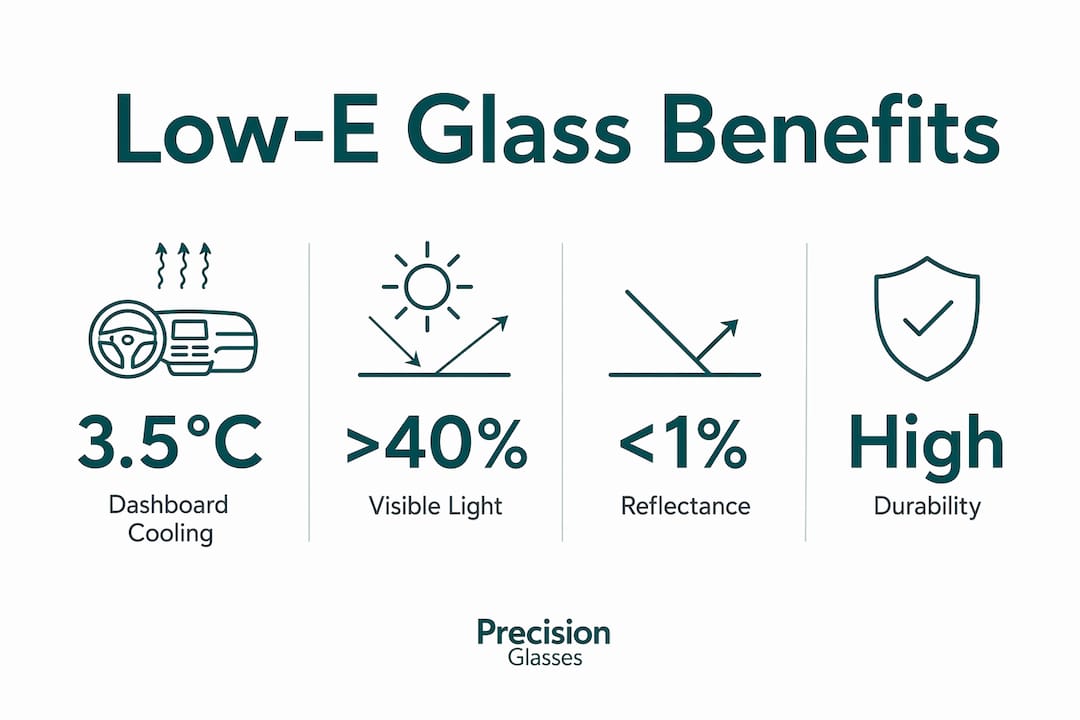
- Thermal load reduction: Solar control glazing can cut dashboard surface temperatures by approximately 3.5°C and cabin air temperatures by around 1°C in NREL soak tests.
- HVAC and range benefit: A solar-control windshield reduced A/C compressor power by roughly 4% in RadTherm analysis, translating to an EV range increase of approximately 0.6–1.5 miles per cycle.
- UV protection: Suitably specified low-E coatings can block up to 99% of UV radiation, protecting occupants and interior materials.
- Procurement relevance: Precision Glasses supplies custom low-E glass assemblies for automotive dashboards and instrument clusters, with batch-level traceability and full test documentation. Alexandra, our technical lead for precision glass in high-tech industries, provides the practitioner perspective in this guide.
Table of Contents
- How low-E glass changes vehicle thermal balance
- Optical trade-offs you must plan for
- Coating types and manufacturing constraints
- What to specify and how to test it
- Assembly and integration considerations
- When low-E is not the right choice
- Procurement checklist for low-E automotive glass
- Key takeaways
- A practitioner’s view on specifying low-E for automotive
- Precision Glasses: custom low-E glass for automotive OEMs
- Useful sources
How low-E glass changes vehicle thermal balance
Windshield glazing alone can account for more than 40% of solar heat transmitted into a parked vehicle. Low-E coatings address this by reflecting long-wave infrared radiation while allowing visible light through, reducing both solar heat gain coefficient (SHGC) and total solar energy rejection (TSER) figures that procurement teams should specify explicitly.
At system level, the consequences are tangible:
- Cabin soak temperatures fall, reducing the peak thermal load the HVAC system must overcome at start-up.
- A/C compressor power drops, which for EVs translates directly to extended range and for ICE vehicles to a small but measurable fuel economy improvement.
- Dashboard and steering wheel surface temperatures decrease, reducing thermal stress on electronics mounted behind display glass.
The magnitude of these effects depends on ambient temperature, solar angle, humidity, and drive cycle. A vehicle operating in the UK’s temperate climate will see smaller absolute gains than one in a high-solar-load environment, but the HVAC compressor benefit remains relevant year-round for EVs where every kilowatt-hour counts.
Pro Tip: When running vehicle thermal simulations, request spectral transmission and reflectance curves from your glass supplier rather than relying on single-value SHGC figures. Spectral data lets your RadTherm or TAITherm model capture wavelength-dependent behaviour accurately.
Optical trade-offs you must plan for
High-performance low-E coatings must be engineered for neutral appearance and low angular colour shift. Without careful formulation, the transparent conductive oxide (TCO) or metallic layer stack introduces specular reflection, perceived tint, and angular colour shift that can distract drivers and degrade display legibility.
Specific risks for automotive applications:
- HUD ghosting: A second reflected image from the coated surface degrades head-up display contrast, particularly at low ambient light.
- Instrument cluster contrast: Increased front-surface reflectance reduces display-to-background contrast ratios, especially under direct sunlight.
- Camera and sensor windows: Stray reflections from low-E layers can cause flare in ADAS camera modules and affect calibration.
Design responses include neutral-tone low-E formulations that minimise colour shift across the visible spectrum, anti-reflection (AR) stacks applied over the low-E layer, and textured substrates. Combining low-E coatings with textured glass can suppress specular reflection and improve HUD projection quality while preserving thermal insulation, provided the coating and texture are co-designed.
Acceptance criteria for optical performance should include maximum specular reflectance (typically below 1% for display-facing surfaces), colour rendering index, and angular reflectance measured at the viewing angles relevant to the driver’s eye position.

Pro Tip: Specify angular reflectance measurements at 0°, 15°, and 45° incidence in your RFP. A coating that meets reflectance at normal incidence can still produce visible artefacts at oblique angles typical of windshield geometry.
Coating types and manufacturing constraints
Low-E coatings fall into two process families, and the choice between them affects every downstream manufacturing step.
| Coating family | Process | Emissivity | Durability | Process compatibility |
|---|---|---|---|---|
| Hard-coat (pyrolytic) | In-line CVD on float line | Higher (~0.15) | Exposed surface capable | Compatible with bending and tempering |
| Soft-coat (sputtered/MSVD) | Post-production vacuum deposition | Lower (~0.02) | Requires protection | Must be laminated or sealed before bending |
Hard-coat is more durable in exposed applications but achieves higher emissivity; soft-coat reaches lower emissivity but requires encapsulation within a laminated assembly. For automotive dashboards and instrument clusters, soft-coat within a PVB laminate is the more common route to high thermal performance.
Key manufacturing constraints to communicate to your supplier:
- Bending and tempering: Soft-coat must be applied after bending, or the glass must be bent before coating. High-temperature forming can degrade metallic layers if sequencing is incorrect.
- Edge exclusion zones: Sputtered coatings require an uncoated border (typically 5–15 mm) for sealing and bonding; specify this in your drawing.
- Textured substrates: Larger texture features increase emissivity. Patent data cites haze ranges of 20–50% (preferably 30–40%) and adhesion layers below 10 nm to preserve bendability during high-temperature forming.
- Batch sizes: Sputtering runs are batch-constrained; small prototype quantities carry a cost premium. Plan for this in your development timeline.
Our automotive glass fabrication guide covers production sequencing in detail for engineers specifying formed and laminated assemblies.
What to specify and how to test it
Supplier-ready specifications for low-E automotive glass should capture both optical/thermal performance and durability. The table below lists the minimum parameters to include in an RFP.
| Parameter | Recommended metric | Test method |
|---|---|---|
| Visible light transmittance (VLT) | ≥40% (windshield) or per application | ISO X / ASTM Y |
| Solar heat gain coefficient (SHGC) | Per climate target; specify maximum | ISO X |
| Total solar energy rejection (TSER) | Specify minimum % | ISO X |
| Normal emissivity | ≤0.10 for high-performance soft-coat | EN X |
| Sheet resistance | Specify target range (Ω/sq) | Four-point probe |
| Haze | ≤1% for display-facing surfaces | ASTM X |
| Adhesion | Cross-cut Class 0 (ISO X) | ISO X |
| Abrasion resistance | Specify Bayer ratio or Taber cycles | ISO X |
| Thermal cycling | No delamination after 100 cycles (−40°C to +85°C) | IEC X |
| UV weathering | No coating degradation after extended exposure | ISO X |
Durability requirements matter as much as initial performance. Automotive environments expose glazing to thermal cycling, vibration, and UV loading that can degrade soft-coat layers if lamination or edge sealing is inadequate. Require suppliers to provide spectroradiometer traces and measured emissivity with each production lot, tied to batch IDs and process records.
Our quality standards guide details the inspection and certification framework that should underpin your supplier contracts.
Pro Tip: Request a pre-production sample run with full spectral data before committing to volume. Comparing the sample’s spectral curve against your simulation inputs early avoids costly re-specification mid-programme.
Assembly and integration considerations
Low-E coatings interact with every layer in a dashboard or instrument cluster stack. Bonding adhesives must be qualified for compatibility with the coated surface; some primers used with structural acrylics or silicones can attack metallic layers or degrade adhesion at the edge exclusion zone. Confirm adhesive cure temperatures do not exceed the coating’s thermal tolerance, particularly for soft-coat assemblies.
Practical integration points to address at the design stage:
- AR and anti-fingerprint stacks: Apply AR coatings over the low-E layer, not beneath it. Stacking order affects both optical performance and adhesion; validate the full stack in environmental testing before release.
- Capacitive touch: Low-E metallic layers have measurable sheet resistance that can interfere with touch sensor calibration. Characterise sheet resistance uniformity across the panel and include it in the touch controller’s calibration parameters.
- ADAS sensor windows: Refractive index uniformity and coating thickness consistency are critical for camera and LiDAR windows. Specify thickness tolerance tightly and require uniformity maps with each batch. Our guide on glass in ADAS systems covers calibration tolerance requirements in depth.
- Serviceability: Define replacement and re-calibration procedures in the service manual before SOP. Low-E assemblies that require ADAS re-calibration after replacement carry a workshop cost that should be factored into the lifecycle cost model.
Pro Tip: For sensor windows, request refractive index uniformity maps (±0.001 tolerance across the clear aperture) alongside standard optical data. Variation outside this band can shift ADAS calibration beyond the system’s self-correction range.
When low-E is not the right choice
Low-E glass is not universally appropriate. In heating-dominant climates or applications where passive solar gain is desirable, a high-SHGC glazing may reduce total energy consumption more than a low-E coating would. For vehicles operating primarily in northern Europe during winter, the HVAC heating penalty from blocking solar gain can offset the summer cooling benefit.
Optical stacks with stringent display performance requirements may also be incompatible with certain low-E formulations. If adding a low-E layer degrades contrast ratio or introduces reflectance artefacts beyond the display system’s acceptance threshold, an alternative approach is preferable.
Viable alternatives to consider:
- Solar-control PVB interlayers: Absorb IR without a surface coating, avoiding reflectance artefacts and coating adhesion constraints.
- Tinted laminated glass: Reduces solar transmission through bulk absorption; simpler manufacturing but less spectrally selective.
- Localised coatings: Apply low-E only to roof glass or rear glazing where thermal benefit is highest and optical constraints are lowest.
- Dedicated HUD projection films: Address HUD performance independently of the glazing’s thermal function.
- Neutral density or polarising options: Manage glare and display contrast without altering the thermal profile of the assembly.
Climate-appropriate selection of SHGC and emissivity targets is the key evaluation criterion. Match the coating specification to the vehicle’s primary operating climate and duty cycle, not to a generic “best performance” target.
Procurement checklist for low-E automotive glass
Use the fields below as a starting template for RFPs and supplier contracts.
| Spec field | Minimum requirement / note |
|---|---|
| Glass type and construction | Laminated / tempered / chemically strengthened; substrate thickness |
| Coating family | Hard-coat or soft-coat; position in stack |
| VLT | Minimum % per application (e.g. ≥40% windshield) |
| SHGC / TSER | Maximum SHGC or minimum TSER per climate target |
| Normal emissivity | Maximum value (e.g. ≤0.10) |
| Sheet resistance | Target range in Ω/sq; uniformity tolerance |
| Maximum reflectance | Per surface; specify angle(s) of measurement |
| Abrasion class | Bayer ratio or Taber cycle count |
| Adhesion acceptance | ISO X Class 0 |
| Batch traceability | Batch ID, process date, sputtering run record |
| Inspection sampling plan | AQL level and sample size per lot |
| Weathering / UV test | Hours and standard (e.g. 1,000 h ISO X) |
| Thermal cycling | Cycle count, temperature range, pass criterion |
| Spectral data deliverable | Spectroradiometer trace and measured emissivity per lot |
| Lead time | Prototype vs. production; MOQ and ramp schedule |
| Warranty and change control | Period, escape clauses for sample failures |
Pro Tip: Negotiate a first-article inspection (FAI) protocol that includes spectral data, emissivity measurement, and adhesion test results before approving the production run. This is the single most effective gate for catching coating process drift early.
Production and QA requirements should also include process records for each sputtering run, documented edge exclusion dimensions, and a defined procedure for handling non-conforming lots. Commercial terms should specify the warranty period, the change-control process for coating formulation updates, and escape clauses tied to sample failure rates in incoming inspection.
For volume planning, our guide on large-volume glass production outlines ramp scheduling and batch-size considerations relevant to sputtered low-E programmes.
Key takeaways
Low-E glass reduces radiative heat transfer through automotive glazing, lowering HVAC load and protecting electronics, with measurable EV range and fuel economy benefits that justify the specification effort.
| Point | Details |
|---|---|
| Thermal benefit is quantified | NREL tests show ~3.5°C dashboard temperature reduction and ~1°C cabin air reduction from solar-control glazing. |
| HVAC and range impact | A ~4% A/C compressor power reduction translates to 0.6–1.5 miles of additional EV range per cycle. |
| Optical risk requires active management | Specify maximum specular reflectance and angular colour shift; validate at oblique incidence angles relevant to driver eye position. |
| Coating choice drives manufacturing feasibility | Soft-coat achieves lower emissivity but must be laminated; hard-coat tolerates exposed applications but has higher emissivity. |
| Precision Glasses | Supplies custom low-E glass assemblies with batch traceability, spectral data, and test documentation for automotive OEM programmes. |
A practitioner’s view on specifying low-E for automotive
The most common mistake engineering teams make when specifying low-E glass is treating it as a single-parameter decision: they set a SHGC target, hand it to procurement, and assume the rest follows. It rarely does. The coating family, the substrate texture, the lamination sequence, and the edge exclusion zone all interact, and a specification that looks complete on paper can produce a part that fails adhesion testing or introduces HUD ghosting that nobody anticipated.
The more productive approach is to lock the spectral performance target first, then work backwards with your glass supplier to identify which coating family and substrate combination can actually meet it through the full manufacturing sequence, including bending and lamination. Early sample runs with full spectral traces are not a luxury; they are the fastest way to surface process incompatibilities before they become programme-critical issues.
One nuance that often gets overlooked: the acceptance criteria for emissivity and sheet resistance need to account for production variation, not just nominal performance. A coating that meets ≤0.10 emissivity at nominal can drift to 0.13 at the edge of process control. Build that tolerance into your specification from the outset, and require suppliers to demonstrate process capability data, not just sample results.
Precision Glasses: custom low-E glass for automotive OEMs
OEM programmes demand more than a datasheet. Precision Glasses manufactures custom low-E glass assemblies for automotive dashboards, instrument clusters, and sensor windows, with capabilities that span optical components and technical glass fabrication.

Our offer to automotive engineering and procurement teams includes custom low-E coatings on laminated and tempered substrates, bending and CNC machining capability, batch-level traceability with process records, and full test documentation including spectral traces and measured emissivity per lot. We work to your specification, not a catalogue.
The practical next step: contact Precision Glasses to request a technical sample with spectral data and an initial production plan. Visit glassprecision.com to confirm sector capability and submit an enquiry, or review our quality assurance framework before your next supplier evaluation.
Useful sources
- NREL: Impact of Solar Control PVB Glass on Vehicle Interior Temperatures, A/C Capacity, Fuel Consumption, and Vehicle Range — Primary vehicle soak and thermal simulation data; use for HVAC load and EV range figures in thermal simulations.
- PNNL: Energy Savings of Low-E Storm Windows and Panels across US Climate Zones — Climate-zone analysis of low-E performance; useful for lifecycle cost rationale and climate-appropriate SHGC selection.
- Automotive glazing with functional coating on textured glass (patent application) — Manufacturing detail on textured substrate and adhesion layer design; essential for HUD and reflection-control specifications.
- Colfax Glass: What Is Low-E Glass? Types, Benefits and Cost Guide — Accessible overview of hard-coat vs. soft-coat properties and UV performance data; useful for procurement teams building initial spec frameworks.
- ScienceDirect: Optical and aesthetic trade-offs in automotive low-E coatings — Peer-reviewed analysis of angular colour shift and reflectance in TCO-based coatings; use for optical acceptance criteria and display legibility requirements.