

Optical bonding adhesives are the liquid or film-based materials, mainly LOCA, OCA, silicone gels and structural epoxies, used to fill the air gap between a cover glass and a display or sensor stack. The rule of thumb: choose LOCA or silicone for curved, framed or ruggedised assemblies where gap-filling and impact resistance matter, and choose OCA film for flat, high-volume panels where speed and repeatability dominate. Precision Glasses works with both families across bonded glass assemblies for demanding sectors.
- Optical clarity: a correctly bonded interface eliminates the air gap that causes reflection losses and washes out contrast under sunlight.
- Mechanical benefit: bonding redistributes stress across the joint area rather than concentrating it at fixing points, improving fatigue life versus mechanical fixings.
- Process constraint: UV shadowing and trapped bubbles are the two failure modes that separate a good bonding line from a bad one.
Key Takeaways
Selecting the right optical bonding adhesive means matching LOCA, OCA or silicone to geometry and volume first, then verifying optical and environmental performance against explicit test thresholds.
| Point | Details |
|---|---|
| Match adhesive to geometry | Choose LOCA or silicone for curved and framed assemblies, OCA film for flat, high-volume panels. |
| Specify optical metrics precisely | Request full transmission curves, haze below 1%, and yellowness index data, not single averages. |
| Guard against UV shadowing | Use dual-cure adhesives or edge-curing stations wherever bezels or steps block direct UV exposure. |
| Test beyond day one | Require aged lap-shear, thermal cycling and humidity soak data, not just as-cured strength figures. |
| Work with a capable glass supplier | Precision Glasses supplies bonded glass assemblies with batch traceability for qualification testing. |
Table of Contents
- What are the main types of optical bonding adhesives?
- Which optical properties should you specify on a datasheet?
- How do curing and lamination processes affect quality?
- What mechanical and environmental tests should you require?
- How should you choose an optical bonding adhesive?
- Which applications suit which adhesive family?
- What does research say about adhesive bonding versus mechanical fixings?
- What health and safety precautions apply to these adhesives?
- How does storage affect adhesive shelf life and performance?
- What matters most when specifying optical bonding adhesives?
- How Precision Glasses supports bonded optical assemblies
- Sources
What are the main types of optical bonding adhesives?
Five adhesive families cover almost every optical bonding job you will specify. Each behaves differently under cure, handles geometry differently, and suits a different production volume.
LOCA (Liquid Optically Clear Adhesive) is a UV or UV/thermal dual-cure liquid dispensed into the gap between substrates before lamination. It flows into steps, ink bumps and curved surfaces, which makes it the default choice for framed or non-flat cover plates. OCA (Optical Clear Adhesive film) is a pre-cut, pressure-sensitive film laminated under vacuum. No curing step, minimal equipment, and excellent repeatability, but it cannot tolerate significant surface irregularity. Silicone gels offer high flexibility and wide operating temperature range, useful where thermal cycling would crack a stiffer adhesive. Epoxy and acrylate structural adhesives trade some optical performance for higher bond strength and are common in edge-bonding or frame-sealing roles. Hybrid adhesive-sealants combine structural bonding with environmental sealing in a single layer.
- LOCA: excels on curved glass and framed displays; requires UV curing equipment and shadow-zone management.
- OCA film: excels on flat, high-volume mobile and tablet panels; fastest cycle time, weakest gap-filling.
- Silicone gel: excels in high-vibration or wide-temperature-swing applications; softer, more expensive to dispense precisely.
- Epoxy/acrylate: excels where mechanical load-bearing matters more than optical perfection.
Vendors such as Dymax and Polytec PT supply LOCA and dispensing systems widely used in these production lines, alongside a range of generic OCA film suppliers.
Pro Tip: Don’t select an adhesive family by optical spec alone. Match it to your substrate geometry first, then narrow the shortlist by transmission and haze.
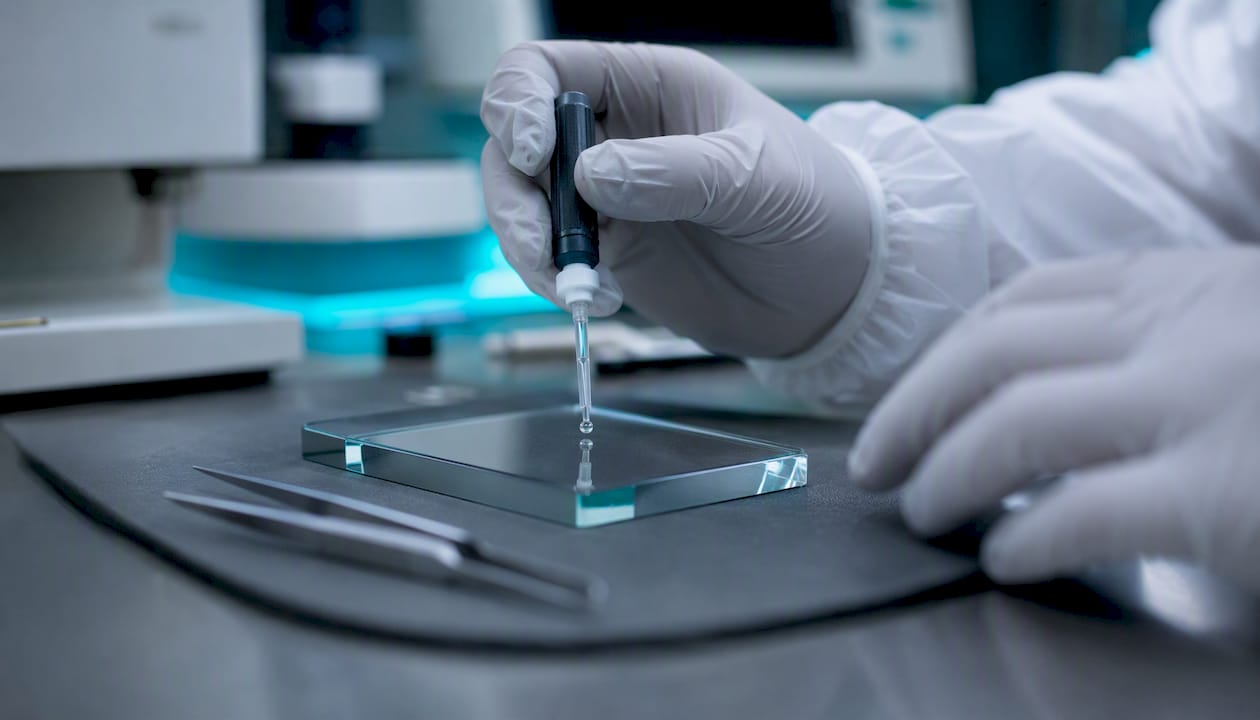
Which optical properties should you specify on a datasheet?
Every adhesive datasheet you request should quantify how the material behaves optically once cured, not just as a liquid or film. Refractive index matching between adhesive, glass and any coating layer minimises Fresnel reflection at each interface, so ask suppliers to state cured refractive index against your specific substrate stack.
- Transmission (%T): request the full spectral curve across 400 to 700nm, not a single average figure. Many engineers target above 95% transmission, though this varies by application and layer count.
- Haze: cured haze below 1% is a common request for premium optical bonds; ask for the measurement method used.
- Yellowness Index (YI) or ΔE: track pre- and post-cure values, and again after accelerated ageing, since yellowing after UV exposure is one of the most common long-term failure signatures.
- Birefringence: relevant for polarised displays or precision optics where stress-induced birefringence distorts image quality.
Ask for the ASTM or ISO test method behind each figure. A number without a method attached is close to worthless in a procurement dispute. This pairs naturally with a broader review of optical properties of glass when specifying the full assembly.
How do curing and lamination processes affect quality?
Process control, more than raw chemistry, tends to decide whether a bonding line hits acceptable yield. LOCA needs dispensing, alignment, vacuum lamination, then cure; OCA needs film placement and a vacuum press cycle; silicone and some epoxies use heat or moisture cure instead of light.
A typical LOCA lamination run follows this sequence:
- Dispense a controlled bead pattern onto the substrate, calibrated to part geometry.
- Align the cover lens or display stack under vision guidance.
- Apply vacuum lamination to remove air and spread adhesive evenly to the edges.
- Run the primary UV cure, checking irradiance uniformity across the panel.
- Perform a secondary or edge cure pass on any geometry that shadows the main UV source.
- Inspect for bubbles, edge voids and incomplete cure under polarised or UV-fluorescent light.
The single most common defect is UV shadowing, where bezels, ink steps or component stacks block light from reaching part of the bond line. Left uncured, that zone risks long-term delamination or yellowing. Dual-cure LOCA formulations and segmented or edge-curing stations solve this by finishing polymerisation thermally where light cannot reach.
Pro Tip: When qualifying a bonding supplier, ask to see an irradiance map of their UV oven, not just a spec sheet number. Uneven irradiance is invisible until parts fail in the field.
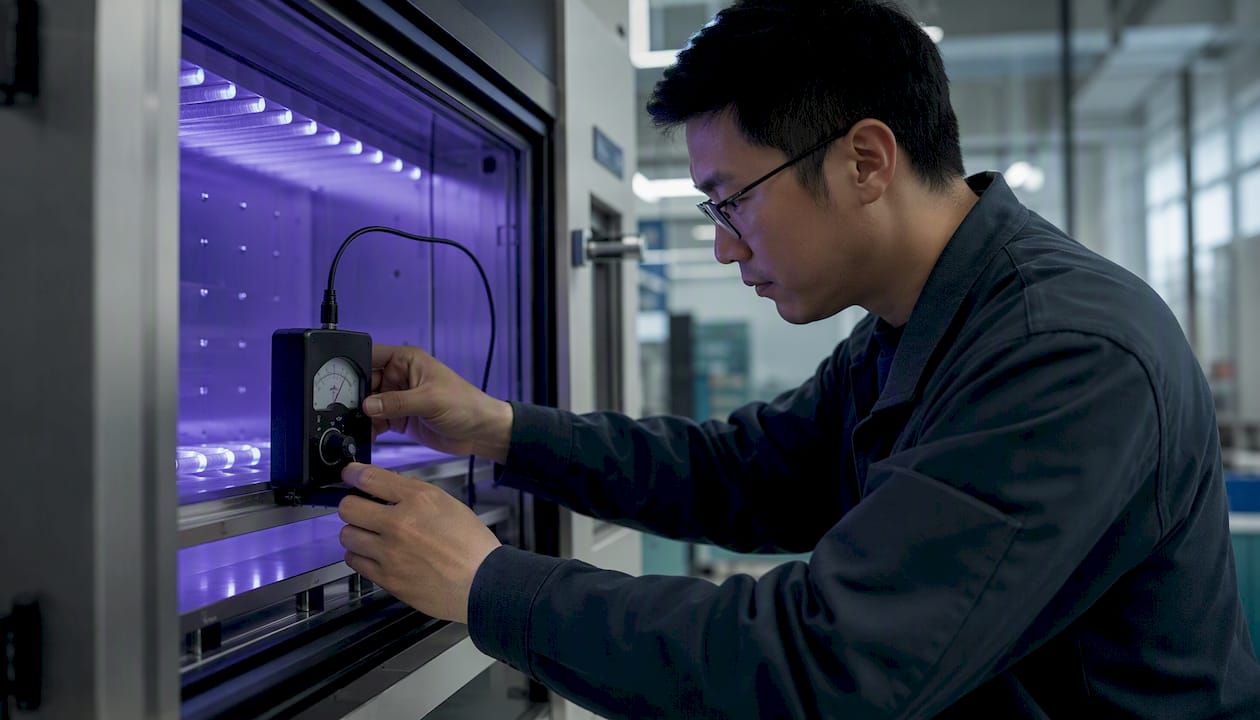
Ask suppliers about vacuum capability, cleanroom classification and dispensing robot precision before committing volume. A useful companion read is Precision Glasses’ overview of the manufacturing workflow behind bonded assemblies.
What mechanical and environmental tests should you require?
Optical performance means little if the bond fails under vibration, heat cycling or moisture ingress. Specify these parameters alongside the optical figures, not as an afterthought.
- Adhesion: lap shear and peel strength at both room temperature and operating extremes.
- Modulus and Tg: glass transition temperature tells you where the adhesive shifts from rigid to compliant, which matters for CTE mismatch between glass and plastic substrates.
- CTE compatibility: mismatched expansion rates between adhesive and substrate drive delamination over repeated thermal cycles.
- Thermal cycling: a common acceptance format is pass/fail after a defined number of cycles between temperature extremes, with no visible delamination or bubble growth.
- Humidity soak: 85°C/85% RH soak testing over an extended period, checking for haze increase or edge lift.
- Salt spray: required for automotive and marine-exposed assemblies.
- Outgassing: critical for sealed optical modules and any vacuum or aerospace application.
Write acceptance criteria as explicit thresholds, for example “no visible delamination after 1,000 thermal cycles” rather than a vague durability claim.
How should you choose an optical bonding adhesive?
Start by ranking your priority: is this bond primarily optical, primarily structural, or does it need to be reworkable for field service? That single decision eliminates half the candidate list immediately.
- Define geometry constraints: flat panel, curved glass, or 2.5D/3D shaped cover lens.
- Define production volume: prototype and low volume tolerate LOCA’s slower cycle; high-volume flat panels favour OCA.
- Define environmental exposure: outdoor, automotive and marine applications push you towards LOCA or silicone over standard OCA film.
- Shortlist two or three candidate adhesives and request full technical datasheets.
- Run qualification samples before locking the production spec.
When vetting a supplier, ask for:
- A technical data sheet (TDS) with cure profile and recommended dispensing equipment.
- Cleanroom class and irradiance maps for their UV curing stations.
- Independent test reports against ASTM or ISO methods where available.
- Batch traceability records.
Demand concrete acceptance tests before sign-off: a spectral transmission curve, lap shear results at your specified temperature range, and a pass/fail report from a 1,000-cycle thermal test.
Which applications suit which adhesive family?
Matching the adhesive to the assembly type saves rework later. The following pairings reflect where each family’s strengths line up with real production constraints.
- Touch displays (consumer, flat): OCA film, for speed and repeatability at volume.
- Ruggedised vehicle and industrial displays: LOCA or high-performance silicone, for gap-filling around bezels and resistance to vibration.
- Outdoor signage: LOCA, since larger and framed formats tolerate steps and non-flat cover plates far better than film.
- Camera modules and micro-lens stacks: LOCA or specialised low-shrinkage epoxies, for precise optical alignment at small scale.
- Fibre-optic terminations: index-matched epoxies or UV adhesives selected for refractive index continuity.
- Sensor windows: adhesive choice depends heavily on whether the window carries an AR coating, since coating durability under adhesive contact needs separate verification.
Curved glass, 2.5D and 3D shapes generally rule out OCA outright. Reworkability, where a field technician may need to separate the bond later, favours softer silicone systems over rigid epoxies.
What does research say about adhesive bonding versus mechanical fixings?
Adhesive joints spread load across the full bonded area rather than concentrating it at discrete bolt or drill points, reducing local stress peaks that drive crack initiation in glass. Their long-term strength does shift with sustained UV, humidity and temperature exposure, which is why environmental test data matters as much as day-one bond strength.
That finding, from a structural glass joints review, has a direct procurement consequence: don’t accept a supplier’s day-one lap shear figure as sufficient evidence of durability. Request fatigue data, cyclic thermal results and aged lap-shear figures alongside the initial number.
Pro Tip: Ask any adhesive supplier for test data after accelerated ageing, not just as-cured. A bond that passes on day one and fails at eighteen months is a warranty liability, not a spec pass.
Precision Glasses supplies bonded glass assemblies across defence, medical and automotive programmes and can provide samples for independent qualification testing before you commit to a production run.
What health and safety precautions apply to these adhesives?
Different adhesive chemistries carry different handling risks, and treating them all the same is how production floors end up with avoidable incidents. UV-curing LOCA formulations typically contain acrylate monomers, which can cause skin sensitisation on repeated contact, so nitrile gloves and local extraction at the dispensing station are standard precautions, not optional extras.
Uncured LOCA also requires UV-blocking eyewear near curing stations, since high-irradiance UV ovens produce output well beyond typical workplace lighting exposure. Epoxy structural adhesives introduce a different concern: two-part systems generate exothermic reactions during cure, and some formulations release fumes that require ventilation during mixing and dispensing. Silicone gels are generally the mildest of the four families to handle, though uncured silicone can still irritate skin and eyes on direct contact.
Every chemistry needs its own safety data sheet reviewed before it enters a production line, and operators need training specific to that chemistry rather than a generic “wear gloves” briefing. Cleanroom environments common in optical bonding add another layer: extraction systems must handle both particulate control and chemical fume removal simultaneously, which not every cleanroom design accounts for by default. Build this into your supplier qualification questions alongside the optical and mechanical criteria.
How does storage affect adhesive shelf life and performance?
Shelf life is not a fixed number stamped on a drum. It depends on storage temperature, exposure to light, and how much of the container’s original seal integrity has been maintained since first opening.
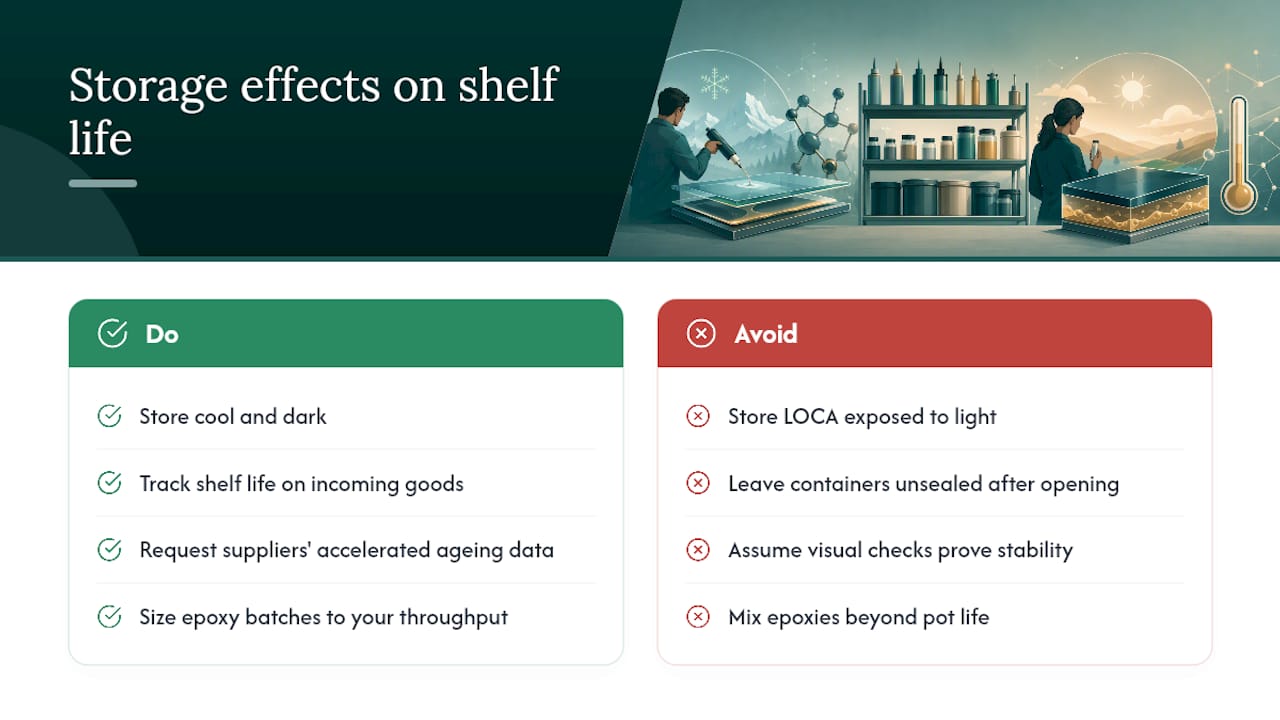
LOCA formulations are UV-sensitive by design, which means storage away from light is not a suggestion, it’s a functional requirement. Most manufacturers specify a cool, dark storage environment, often refrigerated, and a defined shelf life that shortens considerably once a container is opened and exposed to ambient light and air. Using LOCA past its stated shelf life risks incomplete cure or altered viscosity that throws off your dispensing calibration entirely.
OCA film has different failure modes in storage. Extended storage at high humidity or temperature can degrade the release liner’s adhesive properties or cause premature ageing of the film itself, leading to yield problems during lamination that trace back to a storage issue rather than a process fault. Epoxies and two-part systems face their own constraint: once mixed, pot life is measured in minutes to hours, not days, so batch sizing needs to match your actual dispensing throughput.
Build shelf-life tracking into your incoming goods process, not just your production floor. A batch that has sat in a warehouse for six months at the wrong temperature can pass a cursory visual check and still fail in the field a year later. Ask suppliers for accelerated ageing data alongside their stated shelf life figures, since the two don’t always agree.
What matters most when specifying optical bonding adhesives?
In practice, the specifications that separate a reliable bonded assembly from a warranty problem are process control, supplier testing rigour, and a genuinely clean production environment, not the marketing claims on a datasheet cover page. If a specification only demands one thing first, make it optical transmission data paired with real environmental test results, not one without the other.
How Precision Glasses supports bonded optical assemblies
Precision Glasses fabricates the cover glass, sensor windows and display panels that go into bonded assemblies across medical devices, defence, aerospace, automotive and electronics programmes, with batch-level traceability and tight tolerances built into every run.

Where other routes leave you sourcing substrate glass, adhesive and lamination separately from three different vendors, Precision Glasses works from the same drawing through fabrication, coating and delivery, which cuts the coordination overhead out of your qualification timeline entirely. If you’re specifying a bonded assembly for a display, sensor or optical module, request a technical consultation or a bonded-sample trial to validate transmission, haze and environmental performance against your own acceptance criteria before committing to production volume.
Sources
- Comparison of Mechanical and Adhesive Joints for Structural Glass – A review
- OCA film adhesive (solid) vs LOCA water-based adhesive (liquid OCR) – LCD Screen Technology Center
- Selecting the right optics adhesive: A guide to what sticks