
Pyrex borosilicate (Corning code 7740) softens at roughly 820–821°C, reaches working viscosity around 1,250–1,252°C, anneals near 560°C, and hits its strain point at approximately 510°C. These are the four numbers to have in front of you before you specify, machine, or thermally process a borosilicate component.
Here’s the catch that trips up a lot of specification sheets: glass doesn’t melt the way metal or ice does. There’s no single sharp threshold where it flips from solid to liquid. Instead, borosilicate softens gradually across a viscosity curve, and engineers pick the point on that curve relevant to their task, forming, annealing, or dimensional stability, rather than chasing a mythical “melting point.”
- Softening point: ≈820–821°C
- Working point: ≈1,250–1,252°C
- Annealing point: ≈560°C
- Strain point: ≈510°C
One more thing worth flagging early: continuous safe-use temperatures sit well below these figures, and cookware branded “Pyrex” on supermarket shelves may not be the same material at all.
Pro Tip: Never quote a single “melting point” figure on a drawing or purchase order. Specify the metric your process actually depends on, softening, working, or annealing, and reference the ASTM standard behind it.
Key Takeaways
Borosilicate glass has no single melting point, so specifying softening, working, annealing, or strain temperature correctly, and verifying it against ASTM E438, determines whether a component performs.
| Point | Details |
|---|---|
| Four temperature metrics, not one | Softening (≈820°C), working (≈1,250°C), annealing (≈560°C), and strain (≈510°C) each serve a different engineering purpose. |
| Continuous use is more conservative | Typical safe continuous operation sits around 500°C, well below softening point. |
| CTE separates true borosilicate | A low, documented coefficient of thermal expansion is the clearest fingerprint distinguishing lab-grade material from soda-lime substitutes. |
| ASTM E438 is the verification standard | Request Type I, Class A compliance and batch certificates before accepting critical parts. |
| Precision Glasses supplies full traceability | Material certificates, process logs, and inspection reports accompany each custom borosilicate order. |
Where to verify these figures further
- Borosilicate glass overview — background on composition, thermal shock resistance, and the ASTM E438 reference.
- Corning Pyrex 7740 property data — the core numeric table for softening, working, annealing, and strain points.
- Camlab’s Pyrex temperature guidance — practical continuous-use temperature guidance for laboratory settings.
- Allrecipes on Pyrex brand differences — clarifies why consumer cookware and lab-grade borosilicate aren’t interchangeable.
Table of Contents
- Softening point vs working point vs annealing point: what’s the difference?
- Pyrex thermal properties: a datasheet-style reference table
- What temperature is actually safe for Pyrex in daily use?
- How do you verify a supplier actually delivered true borosilicate?
- When does borosilicate glass actually behave like a liquid?
- How does Precision Glasses support thermally critical borosilicate specifications?
- Get Datasheet-Verified Borosilicate for Your Next Build
- Sources
Softening point vs working point vs annealing point: what’s the difference?
Borosilicate glass moves through a spectrum of viscosity states as it heats, and each named “point” marks a specific viscosity value on that spectrum, not a phase change. This is the single biggest source of confusion when non-specialists try to read a glass datasheet.
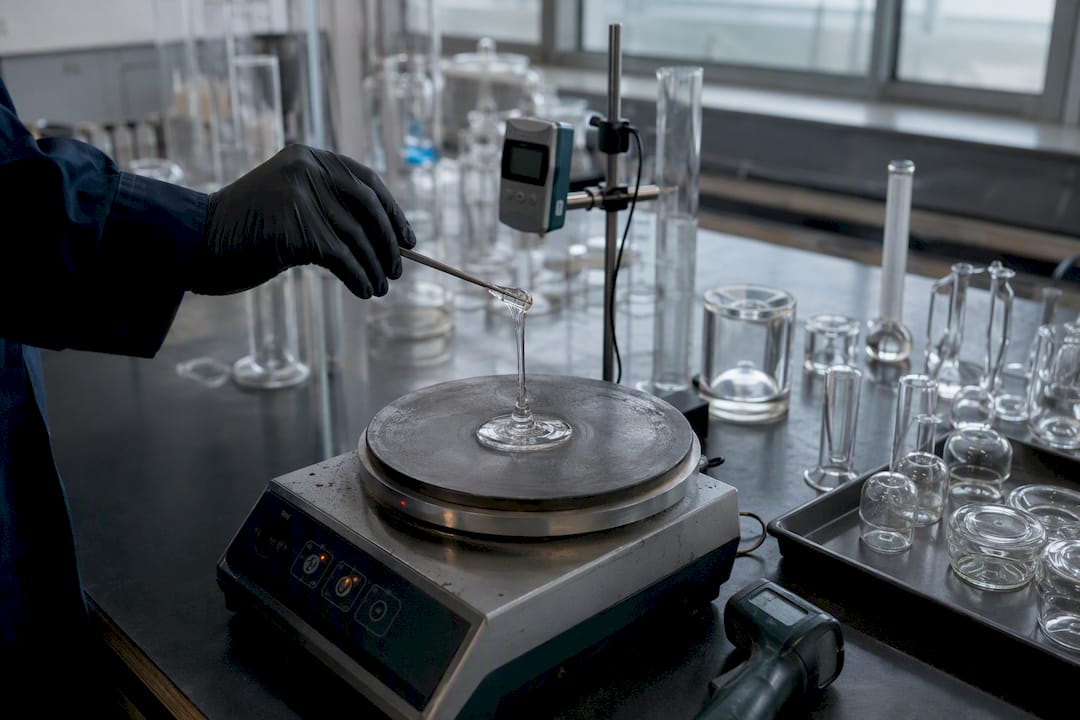
The softening point is defined at a viscosity of roughly 10^7.6 poise. At this stage the glass will deform under its own weight if unsupported, but it isn’t flowing like a liquid. It’s the figure most often (and most loosely) quoted as a “melting point” in consumer contexts, which is part of why the terminology gets muddled.
The working point, by contrast, sits at a viscosity of around 10^4 poise, the regime where glass behaves fluidly enough to be blown, drawn, pressed, or sealed. Furnace operators and glassblowers live in this range. It’s roughly 430°C hotter than the softening point for borosilicate, which tells you how wide the transition zone actually is.
The annealing point marks where internal stress relaxes within a few minutes, typically used to set the target hold temperature in a stress-relief cycle. The strain point, lower still, is where residual stress becomes effectively locked in place, cooling below it risks freezing in stress rather than releasing it. Between strain point and annealing point is where controlled cooling rates matter most.
Viscosity is the real variable throughout. Solid-state mechanics stop being a useful model once borosilicate crosses into the softening range, and from there it behaves as an extremely viscous fluid whose flow rate depends entirely on temperature.
Which number should go on your specification?
- Designing for high-temperature dimensional stability? Reference the softening point.
- Forming, sealing, or fusing components? Reference the working point.
- Relieving stress after machining or fusing? Reference the annealing point.
- Setting a cooling schedule to avoid locked-in stress? Reference the strain point.
Pro Tip: If a supplier’s spec sheet lists only one temperature figure without naming which point it refers to, ask. A vague “melting point” of 1,250°C could mean working point, could mean something else entirely, and the ambiguity is exactly the kind of gap that causes field failures.
Pyrex thermal properties: a datasheet-style reference table
The figures below reflect Corning Pyrex 7740 borosilicate as reported across manufacturer and materials-property sources. Treat them as reference values rather than guaranteed specification limits, individual batches carry manufacturer tolerances.
| Property | Value | Notes |
|---|---|---|
| Softening point | ≈820–821°C | Viscosity reference ≈10^7.6 poise |
| Working point | ≈1,250–1,252°C | Viscosity reference ≈10^4 poise, used for forming/sealing |
| Annealing point | ≈560°C | Stress relaxation onset |
| Strain point | ≈510°C | Residual stress becomes immobile below this |
| Coefficient of thermal expansion (CTE) | ≈3.3×10⁻⁶ /°C | Low CTE is what gives borosilicate its shock resistance |
| Density | ≈2.23 g/cm³ | Standard for code 7740 |
| Refractive index | ≈1.475 | Across visible wavelengths |
These numbers come from Corning Pyrex 7740 property data and corroborating figures from Corning Pyrex borosilicate optical datasheets, both of which agree within a degree or two on softening point and within tight tolerance on density.
Expect minor variance between suppliers. Composition tolerances (silica, boron trioxide, and alkali oxide ratios shift slightly batch to batch) and differing measurement methodologies both nudge published figures by a few degrees. A softening point quoted as 820°C by one datasheet and 821°C by another isn’t a red flag, it’s normal manufacturing variance. What should raise concern is a datasheet that can’t produce a coefficient of thermal expansion figure at all, since that number is the clearest fingerprint distinguishing true borosilicate from soda-lime substitutes.
What temperature is actually safe for Pyrex in daily use?
Datasheet figures describe material behaviour under controlled, often brief, laboratory conditions. Continuous operating limits in real equipment are considerably more conservative, and that gap catches out more procurement decisions than the raw softening point ever does.
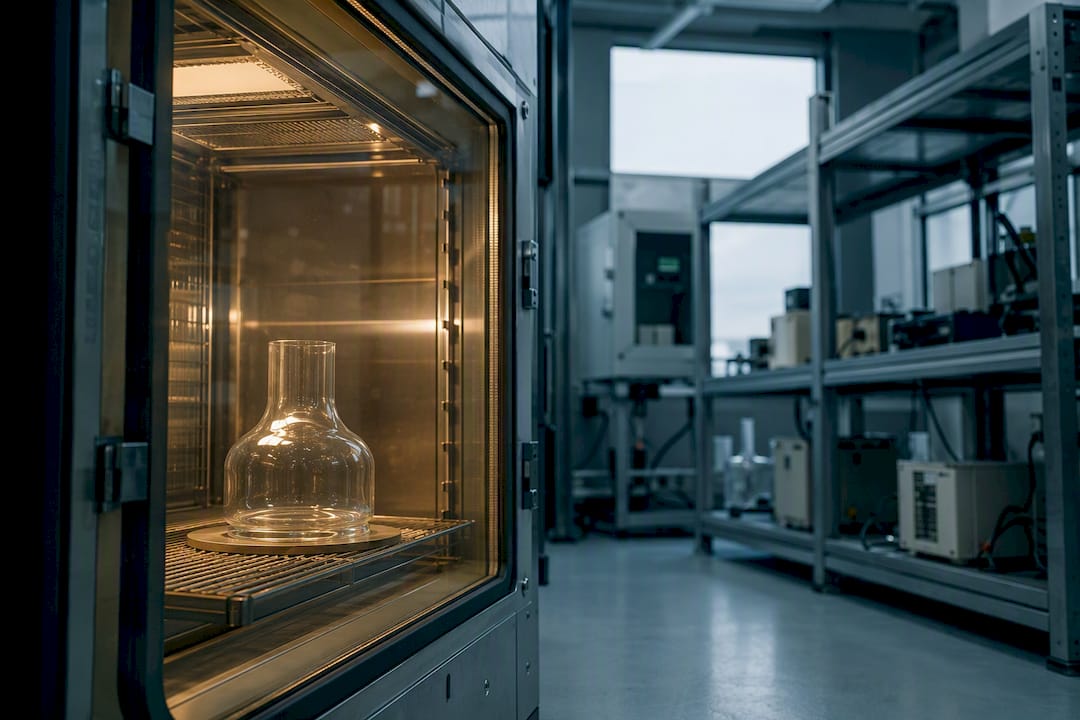
Common laboratory guidance places safe continuous use for borosilicate glassware over a very wide temperature range, provided both heating and cooling happen gradually rather than as a shock. That 500°C ceiling sits more than 300 degrees below the softening point, and the margin exists precisely because sustained thermal stress, uneven heating, or contact with a naked flame behaves very differently to the brief exposure used in standardised viscosity testing. Camlab’s temperature guidance sets out this range clearly for lab operations.
Thermal shock resistance is where borosilicate genuinely separates itself from ordinary soda-lime glass. Its low coefficient of thermal expansion means it tolerates far larger sudden temperature swings without cracking, a property well documented for borosilicate compositions generally. That’s why a borosilicate flask can go from a hotplate into a cold water bath and survive, where a soda-lime equivalent would likely fracture.
A few practical rules follow from this:
- Heat and cool gradually wherever possible; avoid direct flame contact on unsupported thin sections.
- Furnace annealing cycles should follow a controlled ramp both up to the annealing point and back down through the strain point, not a rapid quench.
- Immersion in cryogens such as liquid nitrogen is generally tolerated by borosilicate, but sudden reintroduction to room temperature or heat immediately afterwards is where failures happen.
- Inspect components for surface chips or scratches before reuse in thermal-cycling applications, stress concentrates at flaws and that’s usually where cracks originate.
Pro Tip: If a process design calls for anything approaching the softening point on a recurring basis, don’t rely on datasheet figures alone. Commission a thermal-cycling test on actual production parts, because fixture geometry and support points influence real-world failure temperature more than the bulk material spec does.
How do you verify a supplier actually delivered true borosilicate?
The most reliable safeguard in procurement is a single reference: ASTM E438 Type I, Class A. This is the specification that defines true laboratory-grade borosilicate glass, and any supplier claiming to deliver Pyrex-equivalent material for thermal or chemical-resistant applications should be able to certify against it without hesitation.
Datasheets worth trusting will include a composition breakdown (silica typically around 80%, boron trioxide around 13%, with the balance made up of sodium oxide and minor stabilisers), a stated coefficient of thermal expansion, and the four thermal reference points covered above. A technical properties reference for code 7740 lists exactly this kind of composition and CTE data, and it’s the level of detail a buyer should expect as standard, not as a special request.
A short procurement checklist:
- Request the full datasheet, not a summary sheet, including CTE and all four thermal reference points.
- Confirm ASTM E438 Type I, Class A compliance in writing.
- Ask for batch traceability documentation tied to the specific delivered lot.
- Request a test certificate covering composition and thermal expansion for that batch.
- Flag any consumer-grade markings or absent batch data as a reason to pause the order.
- For thermally critical parts, commission independent lab verification on a sample before accepting the full run.
Reviewing glass tolerance documentation alongside the thermal datasheet helps confirm dimensional and thermal specifications weren’t treated as separate concerns during fabrication.
Pro Tip: Keep a copy of every batch certificate on file for the life of the component, not just the delivery. If a thermal-cycling failure turns up eighteen months into service, that certificate is what lets you determine whether the material or the application design was at fault.
When does borosilicate glass actually behave like a liquid?
Above the working point, borosilicate stops behaving like a solid in any meaningful engineering sense and starts behaving as a highly viscous fluid, this is the regime furnace operators call “truly molten” in practical shop-floor language, even though no sharp phase boundary exists. Forming, sealing, and fusion operations on code 7740 typically happen somewhere in the 1,200–1,300°C range, where viscosity is low enough for material to flow into a mould or fuse against another piece without collapsing entirely.
Process control matters enormously here. Furnace atmosphere, support fixture design, and even how a piece is oriented during the heat cycle all affect outcome quality. Overheat a piece past its working point without adequate support and it slumps unpredictably; underheat it and fusion joints stay weak or incompletely bonded.
- Support fixtures need to account for gravity-driven deformation once softening point is exceeded.
- Atmosphere control prevents surface devitrification during extended high-temperature holds.
- The practical definition process engineers use: once viscosity drops below the working point threshold, treat the piece as a fluid for handling purposes, not a rigid solid.
How does Precision Glasses support thermally critical borosilicate specifications?
Delivering a borosilicate component that performs correctly at 500°C in continuous service, or survives repeated thermal cycling in a sensor housing, depends on more than sourcing the right raw material. It depends on process discipline through fabrication, annealing, and final inspection.
Precision Glasses builds that discipline into every custom order through batch-level traceability, annealing cycles run to documented specification rather than rule-of-thumb timing, and inspection reports that accompany each delivered lot. For engineers working with tight tolerances, that documentation isn’t paperwork for its own sake, it’s what lets a component be defended in a design review or an audit years later.
What Precision Glasses supplies with each order:
- Material certificates confirming composition and compliance with relevant standards.
- Process logs documenting the specific thermal cycle each batch underwent.
- Inspection reports covering dimensional tolerance and surface quality.
Pro Tip: When briefing a supplier on a thermal-critical part, hand over more than a drawing. Specify the required softening, annealing, and strain point tolerances explicitly, state the expected service temperature range, and name any testing you want performed before shipment. Vague briefs produce vague material.
Why the wrong temperature metric costs more than a spec revision
The most expensive procurement mistakes I’ve seen in this space rarely stem from bad glass. They stem from someone quoting “melting point” on a drawing when what the design actually needed was an annealing temperature, and nobody catching the mismatch until a batch of parts started failing in service. Borosilicate’s forgiving thermal-shock resistance masks a lot of specification sloppiness right up until it doesn’t.
The single habit that prevents this: always request the datasheet and batch certificate before signing off on a critical order, and confirm which viscosity point every quoted figure actually refers to.
Get Datasheet-Verified Borosilicate for Your Next Build
If you’ve been comparing datasheets from multiple suppliers and finding the numbers don’t quite line up, you already know the frustration of trying to specify against inconsistent documentation. Precision Glasses closes that gap by supplying full material certification, annealing process logs, and ASTM E438 Type I, Class A compliance with every custom borosilicate order, so the numbers on your drawing match the numbers on the part you receive.

For engineers ready to move from datasheet research to an actual order, the next steps are straightforward:
- Request the full technical datasheet for the specific borosilicate grade your application needs.
- Send your drawing and thermal specification, including the exact softening, working, or annealing tolerances required.
- Request a quotation with lead-time estimate for your production volume.
Explore technical glass capabilities or review quality and traceability standards before submitting a specification through the main enquiry page.
Sources
- Borosilicate glass
- Corning Pyrex 7740 Borosilicate Glass properties (lookpolymers)
- What are the temperature limits for Pyrex glassware? (Camlab)
- What is the difference between two Pyrex types? (Allrecipes)