
For most product regulations, CE marking remains valid in Great Britain indefinitely, so UKCA marking is not automatically required for your product. UKCA is mandatory only in a smaller set of sectors, so your first task is to classify the product against the Gov rather than assume either mark applies.
Three actions come next, in order:
- Classify the product and confirm which regulation governs it, then check whether CE recognition covers that regulation in Great Britain.
- Keep or prepare a technical file and UK declaration of conformity regardless of which mark you use, since market surveillance officers can request either.
- If you already hold EU conformity-assessment evidence, look at Fast-Track UKCA before commissioning new testing.
One exception cuts across all of this: Northern Ireland does not recognise UKCA alone. If any part of your supply chain touches NI, plan for CE from the outset.
Key Takeaways
Manufacturers achieve GB market compliance by classifying products against the sector table first, then choosing CE, UKCA, or both based on recognition status and Northern Ireland exposure.
| Point | Details |
|---|---|
| Classify before certifying | Check the GOV.UK sector table to confirm which regulation and mark actually apply to your product. |
| CE often still works | Many product regulations recognise CE indefinitely in Great Britain, so UKCA is not automatically required. |
| Reuse EU evidence | Fast-Track UKCA lets manufacturers apply UKCA using existing EU Notified Body certificates where requirements align. |
| Northern Ireland needs CE | UKCA alone is invalid in NI; CE, or CE plus UKNI, is generally required there under the Windsor Framework. |
| REACH runs separately | Substances manufactured or imported at 1 tonne per year or more need UK REACH registration regardless of marking status. |
Building this evidence trail is easier with components engineered to documented tolerances from the outset. Precision Glasses supplies technical glass components for medical device, defence, and aerospace applications with batch-level traceability and supplier declarations built into the fabrication process, so your own technical file starts with solid material-level evidence rather than a gap you have to fill later. Explore the sectors we serve or review our quality systems to see how that evidence is structured before your next procurement cycle begins.
For manufacturers managing document control across multiple regulations and suppliers, a structured digital approach to record-keeping pays for itself quickly; this IT compliance guide for manufacturing businesses covers practical systems for exactly that problem.
Table of Contents
- What UKCA marking is and how it sits alongside CE marking in GB
- Which products need UKCA, which accept CE, and where Northern Ireland differs
- Conformity assessment routes and Fast-Track UKCA: when and how to use each route
- Technical documentation and the UK declaration of conformity: what to prepare
- Marking, labelling and placing goods on the GB market
- Northern Ireland and UKNI: differences and practical consequences
- UK REACH and other compliance areas that apply regardless of marking
- Practical decision checklist: choose CE, UKCA, or both
- How a GB precision manufacturer organises conformity evidence
- A GB manufacturer’s playbook for UKCA marking decisions
- Frequently asked questions
- Sources
What UKCA marking is and how it sits alongside CE marking in GB
UKCA marking, the UK Conformity Assessed mark, replaced CE marking in Great Britain’s own product-safety framework after the UK left the EU single market. It sits on retained EU law that Parliament converted into domestic regulation, then amended through instruments such as the Product Safety and Metrology (Amendment) Regulations. The mark exists so the UK can set its own standards and approve its own conformity-assessment bodies, independent of the EU system, even though most of the underlying technical requirements still look familiar to anyone who has worked with CE marking.
What has changed the practical picture is GOV.UK’s guidance confirming that CE marking is recognised indefinitely for many product regulations. That is not a short grace period. It means a manufacturer supplying, say, general electrical equipment or most machinery can continue placing CE-marked goods on the GB market without ever applying UKCA, provided the relevant EU requirements remain aligned with GB law.
So why would a compliance manager choose UKCA anyway when CE still works?
- Procurement requirements: some public-sector or defence contracts specify UKCA regardless of the general recognition rules.
- Divergence insurance: standards can diverge over time, and a business already holding UKCA avoids a scramble if recognition narrows later.
- Sector mandates: a handful of regulations require UKCA outright, with no CE route at all in GB.
Pro Tip: Even where CE recognition is indefinite for your sector, audit your technical file against GB-designated standards once a year. Recognition covers the CE mark’s legal standing, not the underlying standard, and GB standards can move independently of their EU counterparts.
Which products need UKCA, which accept CE, and where Northern Ireland differs
The sector table published by the Department for Business and Trade is the single most useful document a GB compliance manager can bookmark, because it settles the question by product type rather than by argument. Medical devices, construction products, and several other regulated categories each have their own rules, and lumping them together is where most classification errors happen.
Exact scope and any sector-specific conditions sit in the government’s product-regulation table, which is updated as individual regulations change, so treat this table as a starting point, not a final answer.
Northern Ireland breaks the pattern entirely. UKCA marking on its own does not entitle a product to be placed on the Northern Ireland market, because NI continues to follow EU product rules under the Windsor Framework, according to background on UKCA marking. Three practical consequences follow for anyone selling across the UK and Ireland:
- A product sold in GB, NI, and the EU is usually simplest to certify once under CE and use it everywhere.
- A GB-only product can use UKCA without complication, but the moment NI enters the distribution plan, CE returns to the checklist.
- Mixed shipments need separate labelling runs, not a single “one mark fits all” batch.
Conformity assessment routes and Fast-Track UKCA: when and how to use each route
Two broad conformity-assessment paths exist for UKCA: self-declaration and third-party assessment. Low-risk products under most regulations allow the manufacturer to test against the applicable standards, compile evidence, and self-declare conformity. Higher-risk categories, including many medical devices, certain machinery, and some PPE, require an independent approved body to examine the design or production process before you can apply the mark.

Finding a UK approved body is now a straightforward lookup rather than a networking exercise. The conformity assessment body finder run by GOV.UK, alongside UKAS accreditation records, lists which bodies are approved for which regulations. A certificate from one of these bodies gives you the third-party evidence a self-declaration route cannot provide, and it is what market surveillance authorities will ask to see if a query is raised.
Fast-Track UKCA is the route most GB manufacturers underuse. It allows you to apply UKCA marking by relying on evidence already generated through EU conformity assessment, including EU Notified Body certificates, wherever the relevant EU requirements are recognised in GB law, according to Fast-Track UKCA guidance. That means no duplicate testing and no second certification cycle for the same physical product, which matters enormously for firms already holding EU paperwork built at real cost.
Follow this sequence if Fast-Track applies to you:
- Confirm the specific EU requirement your existing certificate covers is recognised under the equivalent GB regulation.
- Check whether your product spans multiple regulations, since Fast-Track allows mixed routes, with some sub-regulations satisfied under UK requirements and others under recognised EU requirements, provided each is documented separately.
- Request that your EU Notified Body issue supporting evidence in a form your UK approved body (or your own technical file, for self-declaration) can reference directly.
- Update your technical file to show, regulation by regulation, which evidence route was used.
- Reissue your declaration of conformity to reflect UKCA marking rather than CE, once every applicable regulation is covered.
Pro Tip: If your product is a complex assembly touching more than one regulation, don’t assume Fast-Track is all-or-nothing. Document each regulation’s route separately in the technical file, because a market surveillance officer will check regulation-by-regulation, not certificate-by-certificate.
Technical documentation and the UK declaration of conformity: what to prepare
A technical file that would survive an EU audit is a good starting point for GB, but it is not automatically sufficient. At minimum, it needs the product design and specification, a documented risk assessment, test reports against the standards actually applied, a list of which standards were used and their versions, batch or serial traceability records, and manufacturing process records showing consistent production.
Where a harmonised EU standard and a GB-designated standard have diverged, additional test evidence or a targeted risk assessment may be needed to show the product still meets GB essential requirements, since following harmonised standards does not guarantee the same presumption of conformity that following a GB-designated standard does.
Your UK declaration of conformity needs to name the manufacturer or authorised representative with a full GB address, describe the product precisely enough to link it to the technical file, list the regulations and standards claimed, and carry a signature with date and place of issue. Missing the address detail is one of the most common reasons a DoC gets queried.
- Keep records for at least as long as your sector’s regulation specifies, and treat any revision to the design or standards used as a trigger to reissue the DoC.
- Version-control the technical file itself, not just the certificate, so a market surveillance request doesn’t uncover conflicting document dates.
- Expect a market surveillance enquiry to ask for the DoC first, then the test reports, then traceability records, roughly in that order.
Pro Tip: Store your technical file with the same discipline you’d apply to a quality management system audit. A well-organised quality standards framework makes a market surveillance enquiry a formality rather than a fire drill.
Marking, labelling and placing goods on the GB market
Where you physically put the mark matters as much as which mark you use. The rules give you options, but each comes with conditions.
- Affix the UKCA or CE mark directly to the product wherever the surface allows it, in a visible, legible, and permanent form.
- If direct marking isn’t possible because of the product’s size or nature, place it on a data plate or the packaging instead.
- Where neither is practical, accompanying documents may carry the mark, though this route has time-limited easements rather than permanent status, and manufacturers should check current dates on GOV.UK’s placing-on-the-market guidance before relying on it long-term.
- Include the manufacturer’s or authorised representative’s name and GB address alongside the mark, either on the product or in accompanying paperwork, with special provision for components too small to carry full details themselves.
- If you import or distribute rather than manufacture, verify before making goods available that the correct mark and documentation are already in place. You are legally on the hook if you place non-conforming goods on the market, even if you didn’t manufacture them.
Small components present a genuine practical headache. A sensor window or optical element too small for a printed mark can carry the required information on packaging or in a document that travels with the batch, but that document needs to survive the supply chain intact, not get separated at a distributor’s warehouse.
Northern Ireland and UKNI: differences and practical consequences
Northern Ireland follows EU product rules under the Windsor Framework, so CE marking is generally required there, not UKCA. This is the single most consequential fact for any GB manufacturer selling across the UK.
Where a manufacturer uses a UK-based approved body for conformity assessment, the product carries CE plus the UKNI mark, showing GB-based certification for an NI-bound product. Critically, CE+UKNI is not valid for placing that product on the EU market, only for NI, so it solves one problem while creating another if EU sales are also on your roadmap.
- If you sell into GB, NI, and the EU, certifying once under CE through an EU Notified Body typically covers all three with the least duplication.
- If you sell GB-only, UKCA alone is simpler and avoids EU body fees entirely.
- If you serve GB and NI but not the EU, decide upfront whether CE via a UK body (with UKNI) or CE via an EU body suits your supply chain better.
UK REACH and other compliance areas that apply regardless of marking
Chemical safety rules run entirely separately from UKCA or CE marking, and no amount of conformity paperwork substitutes for them. Under UK REACH, any GB-based entity manufacturing or importing a substance at or above 1 tonne per year must register it with the Health and Safety Executive, whether or not that substance ends up in a marked product.
Marking and REACH are legally distinct duties. A fully compliant UKCA-marked product can still trigger enforcement action if the manufacturer or importer has failed a REACH registration or downstream-user obligation. Treat the two as parallel programmes, not one dependent on the other.
- Start with the HSE’s Comply with UK REACH service to check whether your substances already have a registration.
- Prepare or commission an IUCLID dossier for any substance that needs new registration.
- Consider appointing an Only Representative if you import from outside GB and want to centralise REACH duties rather than push them onto every distributor.
Practical decision checklist: choose CE, UKCA, or both
- Classify the product against the GOV.UK sector table to identify the governing regulation.
- Confirm whether CE recognition already covers that regulation in GB; if it does, decide whether you still want UKCA for procurement or divergence reasons.
- If UKCA is needed, determine your conformity-assessment module and check Fast-Track eligibility against existing EU evidence.
- Prepare the technical file and UK declaration of conformity, update labelling and packaging, and confirm importer or distributor verification duties are documented.
- Schedule a periodic review, at least annually, to catch standards divergence before it becomes a market surveillance problem.
Pro Tip: Build the review date into your quality calendar now, not after your first enquiry letter arrives. Divergence between GB and EU standards moves quietly, and the manufacturers who get caught out are usually the ones who assumed “indefinite” meant “permanent and unchanging.”
How a GB precision manufacturer organises conformity evidence
A workable conformity workflow for complex components generally runs from specification, through standards selection, to testing or approved-body engagement, then technical file assembly, and finally the declaration of conformity and labelling.
For precision-engineered glass components destined for medical devices, defence, or aerospace assemblies, batch-level traceability and documented tolerances do much of the evidentiary work a technical file needs. Supplier declarations covering material composition and process control give a manufacturer’s own DoC something concrete to reference rather than a generic claim of conformity. Precision Glasses builds this traceability into its manufacturing workflow and design process, so component-level evidence is available before a customer’s own conformity assessment even begins.
A GB manufacturer’s playbook for UKCA marking decisions
The conventional advice on UKCA marking treats it as a binary switch: either you’ve “moved to UKCA” or you haven’t. That framing gets manufacturers into trouble, because the honest answer for most GB businesses is regulation-specific, not company-wide. One product line might sit happily on indefinite CE recognition while another, sold into a defence contract with explicit UKCA requirements, needs the domestic mark entirely separately.
What gets underestimated is Fast-Track UKCA. Too many compliance teams assume any UK-specific mark means starting evidence-gathering from zero, when the guidance explicitly allows reuse of EU Notified Body certificates. That single fact should reshape how a manufacturer budgets for compliance, because duplicate testing is often the largest avoidable cost in this entire process.
If there’s one habit worth building now, it’s treating the technical file as a living document reviewed annually against GB-designated standards, not a certificate you file away once and forget. Divergence between GB and EU standards will widen over time, and the manufacturers who review early are the ones who won’t be caught rebuilding evidence under deadline pressure.
Frequently asked questions
Is UKCA marking mandatory for all products sold in Great Britain?
No. CE marking remains valid indefinitely for many product regulations in GB, so UKCA is only mandatory where a specific regulation requires it or where CE recognition doesn’t apply.
Can I use both UKCA and CE marking on the same product?
Yes, provided you can demonstrate conformity under both regimes’ requirements and document each route separately in your technical file, this is common for manufacturers selling into GB, NI, and the EU.
Does UKCA marking work in Northern Ireland?
No. UKCA alone is not valid for placing products on the Northern Ireland market. NI generally requires CE marking, or CE plus UKNI where a UK-based approved body carried out the assessment.
What is Fast-Track UKCA and who can use it?
Fast-Track UKCA lets manufacturers apply UKCA marking using existing EU conformity-assessment evidence, including EU Notified Body certificates, where the relevant EU requirements are recognised in GB law.
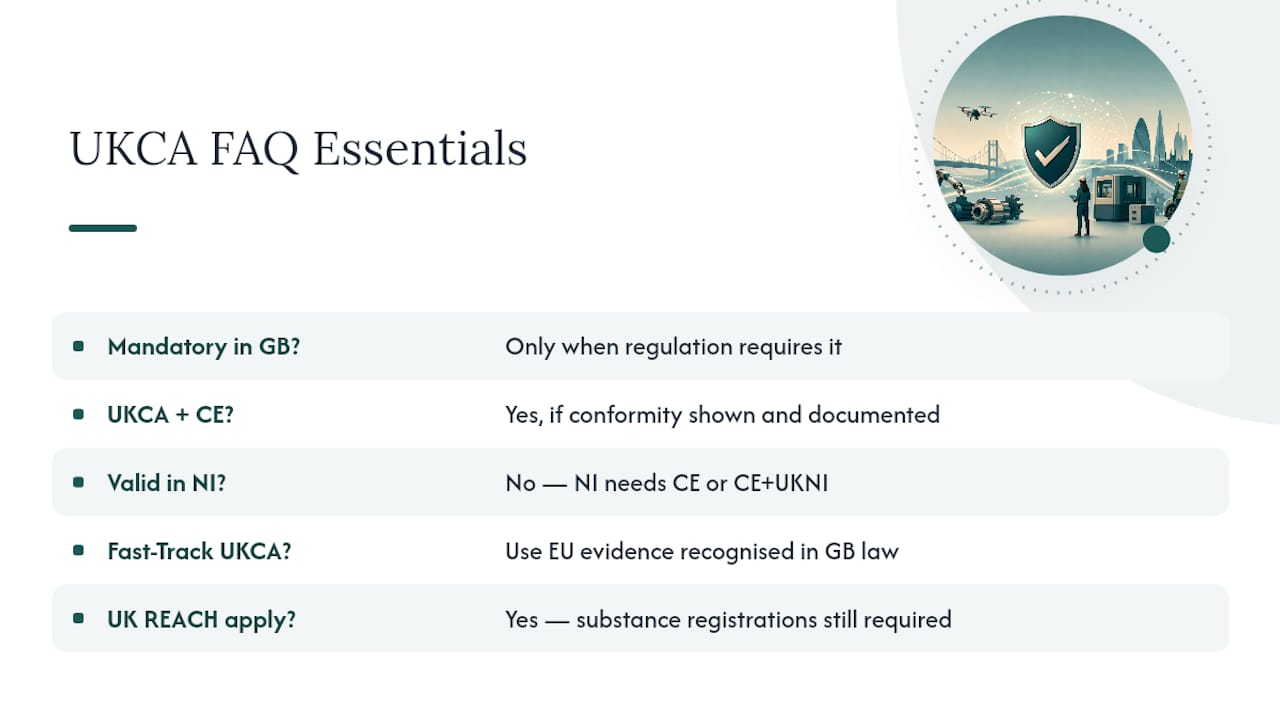
Does UK REACH apply even if my product carries UKCA marking?
Yes. UK REACH registration obligations for substances manufactured or imported at 1 tonne per year or more apply independently of any conformity marking on the finished product.
Sources
- Product regulations by sector and current approaches to product marking: UKCA and CE regimes
- UK registration, evaluation, authorisation and restriction of chemicals (REACH) – HSE
Recommended
- AS9100 requirements for UK aerospace suppliers: practical guide – Precision Glasses
- Quality standards in glass manufacturing: 2026 guide – Precision Glass
- Precision cover glass: the OEM specification and procurement guide – Precision Glasses
- Custom glass products for electronics: UK procurement guide – Precision Glasses