
Specifying the wrong glass type does not just affect performance. It can cause catastrophic failure in the field. S-glass delivers 35% higher tensile strength than E-glass, yet many procurement teams still treat them as interchangeable. Across defence, aerospace, medical, automotive, and electronics sectors, the difference between a compliant specification and a precisely matched one can mean the difference between mission success and component failure. This guide clarifies the standards, compares the critical glass types, and gives engineers and procurement managers an actionable framework for making confident specification decisions.
Table of Contents
- Why glass specifications matter for high-stakes industries
- Key standards and testing methods for precision glass
- Comparing advanced glass types for critical applications
- Specification pitfalls, edge cases, and practical selection tips
- What most specification guides miss: The nuanced reality
- Expert solutions for precision glass specification and sourcing
- Frequently asked questions
Key Takeaways
| Point | Details |
|---|---|
| Specification directly impacts performance | Choosing the right glass type and standard ensures reliability in critical projects. |
| Industry standards guide quality | Following ASTM, DoD, and specialised standards guarantees compliance and safety. |
| Advanced glass offers unique advantages | S-glass, Sapphire, and Chalcogenide enable superior strength, transparency, or IR transmission. |
| Selection is context-driven | Engineers must tailor specifications to project needs, not just default choices or minimums. |
| Expert support avoids costly errors | Consulting technical advice and testing methodologies saves time and budget in complex applications. |
Why glass specifications matter for high-stakes industries
Glass is rarely a passive material in precision applications. Its mechanical, optical, and thermal properties directly govern whether a system functions under load, radiation, or repeated vibration. A single incorrect assumption about thickness tolerances or surface flatness can compromise an entire assembly.

Consider avionics. S-glass is preferred for high strength-to-weight ratio and fatigue resistance in military electronics and avionics boards. This is not simply a performance preference. In environments where vibration cycles number in the billions over a system’s service life, glass that fatigues prematurely introduces failure modes that no amount of redundancy can reliably compensate for. The material selection happens at specification stage, not at repair.
Medical applications present a different but equally demanding challenge. Implant-grade glass-to-metal seals must be RF-transparent, hermetically sealed, and under 0.5mm in thickness. These are not arbitrary constraints. They reflect the reality that RF telemetry from active implants must pass cleanly through the seal, and any compromise in hermeticity risks device failure inside the human body.
Across industries, the critical glass properties that require deliberate specification include:
- Tensile and flexural strength for structural and fatigue loading
- Optical transmission range for imaging, sensing, and display applications
- Thermal expansion coefficient for hermetic sealing compatibility
- Surface flatness and thickness tolerance for precision optical assemblies
- Blast and fragmentation behaviour for defence and security glazing
Pro Tip: When drafting a specification, do not start with material type. Start with the failure mode you cannot afford. That single question will filter your options faster than any catalogue.
You can explore the range of technical glass options suited to these demanding environments, and our medical glass terminology resource is worth reviewing for device engineers navigating implant or diagnostic specifications.
Now that we have defined the critical nature of glass specifications, let us examine the standards and tests that guide these decisions.
Key standards and testing methods for precision glass
Standards exist to create a common language between designers, manufacturers, and end users. For glass, three ASTM standards are particularly relevant to procurement and engineering teams operating in high-performance sectors.
ASTM C1048 governs flat glass, including heat-strengthened and fully tempered types. ASTM C1048 defines fragmentation requirements for tempered glass, along with thickness tolerances, bow, warp, and surface and edge quality criteria. It is the baseline for quality assurance in any glazing specification.
ASTM E1300 addresses load resistance. ASTM E1300 uses probability models and charts to evaluate glass breakage resistance, setting a design probability of breakage below 8 in 1,000 for wind and snow loads based on glass thickness, aspect ratio, and support conditions.
ASTM F1642 is the standard specifically referenced for blast resistance. DoD UFGS 08 56 53 cites ASTM F1642 for airblast loading criteria in defence and government facilities.
| Standard | Scope | Key test | Industry relevance |
|---|---|---|---|
| ASTM C1048 | Flat and tempered glass | Fragmentation, bow, warp | Glazing, defence, transport |
| ASTM E1300 | Load resistance | Breakage probability charts | Architecture, blast design |
| ASTM F1642 | Blast resistance | Shock-tube dynamic loading | Defence, government facilities |
“Glass load design is inherently probabilistic. Specifying to ASTM E1300 does not guarantee a pane will not break. It sets an acceptable risk threshold. That distinction matters in every procurement decision.”
For procurement managers, these standards shape supplier qualification criteria, acceptance testing protocols, and contractual performance thresholds. Understanding what each standard actually tests, rather than simply citing it in a specification, is what separates a robust procurement process from one that passes audit but fails in service.
Our glass sourcing steps resource provides further guidance on aligning standards compliance with supplier evaluation.
With a clear view of the standards, let us break down the specification choices that drive performance in demanding environments.
Comparing advanced glass types for critical applications
Not all advanced glass is created equal, and cost is not always the deciding factor. The right choice depends on the performance envelope your application demands.
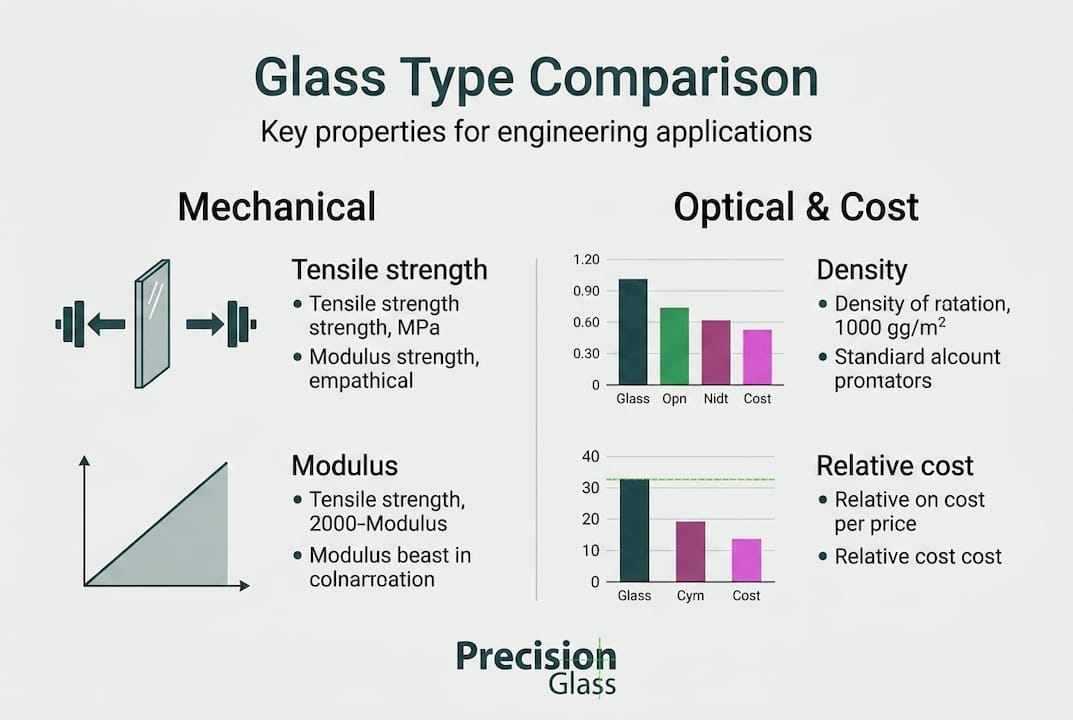
S-glass versus E-glass is the most common comparison in electronics and structural composites. S-glass tensile strength reaches 4.89 GPa with a modulus of 89 to 91 GPa and a density of 2.48 g/cm³. E-glass sits at 3.45 GPa tensile strength, 72 to 76 GPa modulus, and 2.54 g/cm³ density. S-glass costs three to five times more than E-glass, which makes material justification essential at specification stage rather than value engineering later.
| Glass type | Tensile strength | Modulus (GPa) | Density (g/cm³) | Relative cost |
|---|---|---|---|---|
| E-glass | 3.45 GPa | 72 to 76 | 2.54 | Baseline |
| S-glass | 4.89 GPa | 89 to 91 | 2.48 | 3 to 5 times higher |
| Sapphire | Very high | Very high | 3.95 to 4.03 | Premium |
For defence optics and infrared sensing, the comparison shifts to optical materials. Sapphire transmits from 0.15 to 5.5µm with a Mohs hardness of 9, making it ideal for sensor windows and targeting optics where scratch resistance is critical. Germanium serves long-wave infrared (LWIR) applications in the 8 to 12µm range with a high refractive index. Chalcogenide glass covers both mid-wave and long-wave infrared, has a low thermo-optic coefficient, and can be moulded into complex geometries, offering a cost advantage over crystalline alternatives.
Key selection criteria by application:
- Avionics and military electronics: S-glass for fatigue resistance and weight savings
- Defence sensor windows: Sapphire for hardness and broadband transmission
- Infrared imaging systems: Germanium or Chalcogenide depending on waveband
- Medical devices: RF-transparent, low-expansion glass for hermetic seals
- Automotive foldable displays: Ultra-thin chemically strengthened glass
Pro Tip: Specify transmission range as a functional requirement rather than a material name. This keeps your specification supplier-neutral while ensuring the material selected genuinely meets your optical system’s needs.
Our full technical glass comparison resource provides side-by-side data across optical, mechanical, and thermal parameters.
Having compared the technical glass types, let us look at real-world considerations and practical approaches to glass specification selection.
Specification pitfalls, edge cases, and practical selection tips
Even experienced engineers encounter blind spots when specifying glass for demanding environments. The most common errors are not material mix-ups. They are process and assumption failures.
Blast specifications are frequently underspecified. Blast scenarios require shock-tube testing and dynamic analysis per DoD UFC 4-010-01 and ASTM F2912. Static load ratings from E1300 do not translate to dynamic blast performance. A pane that passes wind load testing can shatter dangerously under an equivalent static equivalent blast load, because the loading rate changes the failure mode entirely.
Automotive thin glass presents a different challenge. Chemically strengthened thin glass achieves over 800 MPa compressive surface strength for foldable display applications. However, that strength is highly sensitive to surface flaws introduced during handling and cutting. Specifying the glass without specifying the handling and edge finishing process leaves a significant performance variable uncontrolled.
Medical device glass is often specified to hermeticity standards without considering long-term RF transmission degradation. Moisture ingress at the glass-to-metal interface changes dielectric properties over time. This is a failure mode that typically appears years after implantation, not during acceptance testing.
Common mistakes to avoid:
- Assuming ASTM E1300 is deterministic rather than probability-based, which leads to overconfidence in fixed strength claims
- Specifying glass type without defining edge quality, cutting method, and surface treatment
- Neglecting fatigue effects in cyclic load environments, particularly in medical and aerospace applications
- Overlooking aspect ratio and support conditions, which dramatically affect real-world load capacity
Pro Tip: Request material certifications and traceability documentation at the order stage, not during inspection. For regulated applications, retrospective certification is rarely compliant and always costly.
For further guidance on sourcing decisions that account for these risks, review our technical glass best practices documentation.
With these pitfalls and practical tips covered, it is time for a fresh perspective on what truly drives specification choices.
What most specification guides miss: The nuanced reality
Most specification guides present glass selection as a lookup exercise. Match the property to the application, cite the standard, and move on. That approach is adequate for low-stakes procurement. It is not adequate for defence, medical, or aerospace applications where unknown surface flaws, residual stress gradients, and vibration-induced fatigue can undermine even a correctly specified material.
ASTM E1300 design charts are conservative because they account for unknown flaw populations in manufactured glass. Practical design requires calculating aspect ratio and support condition effects, not just reading a chart value. We have seen projects where over-specification driven by chart conservatism added significant cost without adding real performance margin, while under-specification in a different dimension created genuine field failures.
True reliability comes from testing in context. That means shock-tube validation for blast, accelerated fatigue cycling for implants, and real-environment thermal cycling for optical assemblies. Probability-driven design, combined with contextual testing, is what separates glass that passes specification from glass that performs in service. Focus on the performance requirement you cannot compromise, then work backwards to material and process. Visit our optimising glass reliability resource for practical frameworks on achieving exactly this.
Expert solutions for precision glass specification and sourcing
Navigating glass specifications across defence, aerospace, medical, and automotive applications demands more than a catalogue search. It requires technical dialogue, material expertise, and sourcing rigour.
At Glassprecision, we support engineers and procurement managers with access to a curated range of advanced technical glass types, from S-glass composites to infrared optical materials and chemically strengthened thin glass. Our technical team is available to review your specification requirements and identify the right material, process, and quality assurance approach for your application. Whether you are optimising a sourcing programme or specifying a new component, our glass sourcing advice resource and medical glass terminology guide provide the detail you need to move forward with confidence.
Frequently asked questions
What is the difference between S-glass and E-glass?
S-glass tensile strength is 4.89 GPa compared to 3.45 GPa for E-glass, with a higher modulus and lower density, making S-glass the preferred choice for fatigue-critical and high-vibration environments. The trade-off is a cost premium of three to five times over E-glass.
How does ASTM E1300 affect glass specification for building safety?
ASTM E1300 uses probability-based charts to evaluate breakage resistance under wind and snow loads, targeting a failure probability below 8 in 1,000. This produces conservative designs but does not eliminate breakage risk entirely.
Why is fragmentation testing important in tempered glass?
ASTM C1048 fragmentation tests verify that fully tempered glass breaks into small, relatively harmless particles rather than sharp shards, which is essential for safety compliance in transport, defence, and architectural applications.
What glass types are preferred in defence optics?
Sapphire with Mohs 9 hardness and transmission from 0.15 to 5.5µm is favoured for visible and near-infrared defence optics, while Germanium is selected for LWIR imaging and Chalcogenide for mouldable MWIR and LWIR applications.
How can engineers optimise glass sourcing for complex projects?
Engineers should match glass properties to functional performance requirements, consult probability-based load charts, and engage specialist suppliers early to validate material selection against both standards compliance and real-world testing outcomes.
Recommended
- Medical glass terminology explained for device engineers – Precision Glass
- Technical Glass – Precision Glass
- How to optimise glass sourcing for precision: 5 key steps – Precision Glass
- Precision Glass – Medical – Defense – Engineering – Security – Optical – Automotive – Electronic
- Window Frosting Wood Green | Glass Manifestations & Graphics