
Glass is not a generic commodity, and in defence, aerospace, and medical engineering, treating it as one is a serious technical risk. Optical glass and protective glass are built on entirely different engineering principles, serve distinct performance objectives, and carry very different consequences when misspecified. Choose the wrong type for a medical imaging window or a defence targeting optic, and you face either field failure or an expensive over-specification that erodes programme budgets. This article sets out precise definitions, property comparisons, manufacturing distinctions, and real-world selection guidance so you can specify with confidence.
Table of Contents
- What is optical glass and what is protective glass?
- Property comparison: How optical and protective glass differ
- How each type is engineered: Manufacturing and processing
- Choosing the right glass: Use cases and industry scenarios
- The real cost of misunderstanding glass differences
- Explore precision glass solutions for your next project
- Frequently asked questions
Key Takeaways
| Point | Details |
|---|---|
| Define before choosing | Optical and protective glass serve different industrial roles: know the difference to avoid performance issues. |
| Key properties | Optical glass delivers clarity and low distortion; protective glass provides enhanced impact and safety. |
| Manufacturing impacts | Precision processing yields consistent optics or increased toughness—specify what your application demands. |
| Application matters | Real-world scenarios in defence, aerospace, and medical contexts require informed selection, not assumptions. |
What is optical glass and what is protective glass?
These two categories are frequently conflated, yet they originate from fundamentally different engineering intentions.
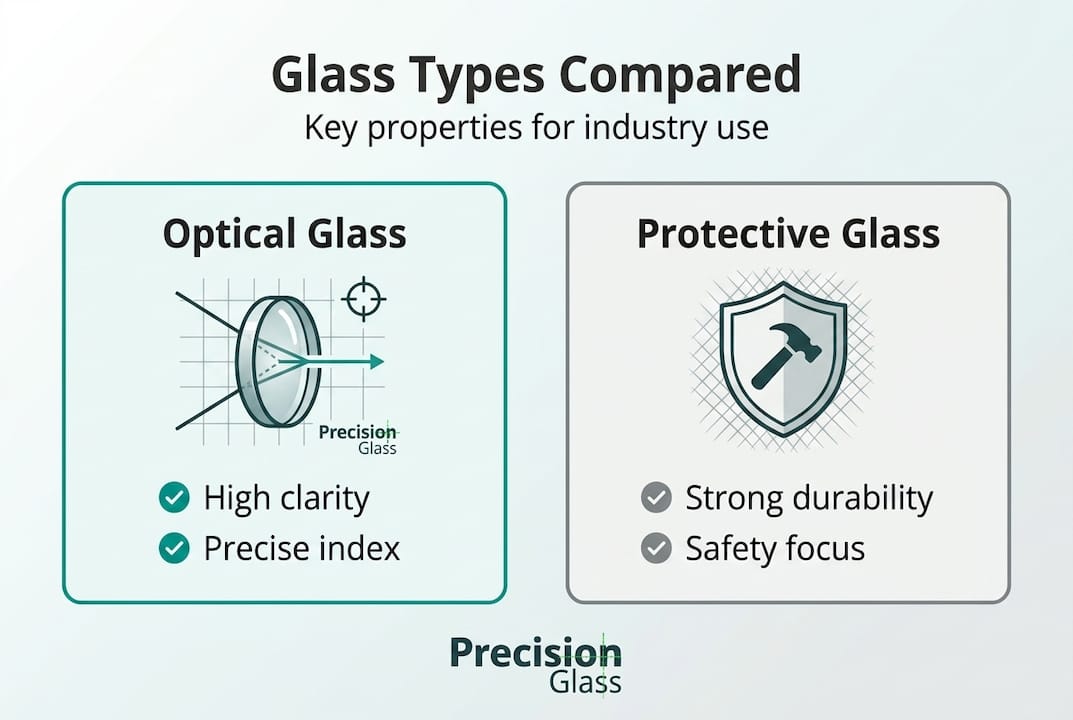
Optical glass is a high-purity material engineered for maximum light transmission, precise refractive index control, and low dispersion. Common types include BK7 (borosilicate crown), flint glass, and fused silica. As types of optical glass confirm, optical glass is high-purity, engineered for transmittance, refractive index control, and low dispersion. The Abbe number is a key metric, describing how much a glass disperses different wavelengths of light. High Abbe numbers mean less chromatic aberration, which is critical for lenses, prisms, and diagnostic imaging systems.
Protective glass, by contrast, is mechanically enhanced for impact resistance and safety rather than optical precision. Common forms include thermally tempered glass, laminated glass, and sapphire. As industry analysis confirms, protective glass is mechanically enhanced for impact resistance and safety, not primarily optical precision. Laminated constructions use interlayers such as polyvinyl butyral to hold fragments together after fracture, an essential characteristic for crew safety in armoured vehicles or aircraft.
Key applications for each type:
- Optical glass: Microscopy lenses, laser optics, camera systems, spectrometer windows, endoscope prism assemblies
- Protective glass: Cockpit transparency panels, ballistic visors, armoured vehicle vision blocks, industrial machine guards, medical device enclosures
For medical device engineers seeking precise definitions aligned with regulatory frameworks, our medical glass definitions resource provides sector-specific clarity.
The core trade-off is this: maximising optical clarity typically means a glass that is homogeneous, pure, and therefore more brittle under sudden impact. Maximising mechanical toughness usually introduces stress profiles or composite structures that can compromise transmission quality.
“The critical error in glass specification is assuming that transparency equals optical suitability. A tempered panel may transmit 88% of visible light, yet introduce optical distortion that renders it unsuitable for precision imaging.”
Pro Tip: Never rely on a supplier’s catalogue description alone. Request full material datasheets including refractive index nd, Abbe number Vd, and Knoop hardness HK for any glass intended for optical or precision protective use.
Property comparison: How optical and protective glass differ
Once you understand the engineering intent behind each material, the property differences become logical rather than arbitrary.
Optical glass achieves transmittance over 91% in the visible spectrum, with tightly controlled refractive indices (typically nd between 1.45 and 2.00) and high Abbe numbers (Vd of 25 to 90). These figures are not incidental. They are the result of meticulous melt chemistry and controlled cooling over days or weeks. Optical homogeneity is graded to tolerances as tight as ±1×10⁻⁶ in refractive index across the blank. This is what makes precision imaging possible.
Protective glass trades some of these optical metrics for mechanical resilience. Thermally tempered glass can be twice as impact resistant as annealed glass and exhibits ductile-style failure patterns under extreme load, whereas optical glass fails in a brittle manner. This distinction matters enormously in safety-critical environments. In protective applications, controlled fragmentation is a design feature, not a flaw.
| Property | Optical glass | Protective glass |
|---|---|---|
| Visible transmittance | >91% | 85 to 90% typical |
| Refractive index control | ±0.0001 or finer | Not controlled |
| Abbe number (Vd) | 25 to 90 | Not specified |
| Impact resistance | Low (brittle) | High (2× annealed) |
| Fragment behaviour | Brittle fracture | Contained/ductile |
| Scratch resistance | Moderate | High (especially sapphire) |
| Typical forms | Blanks, prisms, lenses | Panels, laminates, domes |
Scratch resistance deserves attention. Sapphire, rated 9 on the Mohs scale, is increasingly specified in both optical and protective roles where abrasion is a daily concern. Standard borosilicate optical glass sits at around 6 to 7 on the Mohs scale, adequate for controlled laboratory conditions but insufficient for harsh field environments.
For up-to-date performance benchmarks relevant to your sector, our technical glass benchmarks page lists tested values across multiple product families, and our optical glass components catalogue includes full spectral transmission data for each material.
“In high-stakes applications, the difference between 91% and 87% transmittance is not cosmetic. For a long-range targeting system, that 4% gap can affect detection range in low-light conditions.”
How each type is engineered: Manufacturing and processing
The properties discussed above do not emerge by chance. They are the direct result of specific manufacturing processes, and understanding these processes helps you assess supplier capability and cost drivers.
Optical glass manufacturing follows a rigorous sequence:
- Raw material selection: High-purity silica, borate, or phosphate compounds are blended to precise formulations.
- Precision melting: Glass is melted in platinum or ceramic crucibles at controlled temperatures to ensure homogeneous chemistry.
- Controlled annealing: The melt is cooled extremely slowly, sometimes over several days, to eliminate internal stress and achieve refractive index uniformity.
- Grinding and polishing: Blanks are shaped and surfaced to tight tolerances, often to surface flatness of λ/10 or better.
- Quality assurance: Each batch is tested for transmittance, refractive index, and homogeneity before release.
Protective glass manufacturing takes a different path. As confirmed in materials analysis, optical glass is refined by precision melting and cooling, whilst protective glass is made tougher by tempering, lamination, or sapphire growth. Tempering involves heating glass to approximately 620°C and then rapidly quenching it with air jets, creating compressive surface stresses. Lamination bonds multiple glass or polymer layers with interlayers, engineered for progressive energy absorption on impact.
| Process stage | Optical glass | Protective glass |
|---|---|---|
| Melting environment | Platinum crucibles, ultra-pure | Standard or float process |
| Cooling rate | Very slow (days) | Standard or rapid quench |
| Surface finishing | Sub-micron polishing | Cut and edge-worked |
| Post-processing | Coating, AR treatment | Tempering, lamination |
| Lead times | Longer (high precision) | Shorter (volume-ready) |
These differences translate directly into cost and lead time. Optical glass components carry higher unit costs because of lower yields, longer processing cycles, and tighter quality gates. Protective glass, particularly in laminated panel formats, is more amenable to volume production.
Pro Tip: When issuing an enquiry for precision glass, always request the manufacturing process record, including melt batch traceability, annealing cycle data, and inspection certificates. For defence and aerospace programmes, this documentation is often a contractual requirement and a genuine indicator of supplier maturity. Our optimising glass sourcing guide details precisely what to ask suppliers.
Choosing the right glass: Use cases and industry scenarios
With property and manufacturing knowledge in place, let us examine how selection decisions play out in practice across defence, aerospace, and medical sectors.
In medical diagnostics, a rigid endoscope relay lens assembly demands optical glass with exceptional homogeneity and transmittance. Any birefringence or refractive index variation introduces image artefacts that compromise clinical accuracy. As industry data confirms, optical glass is used for imaging and sensing, whilst protective glass is appropriate for high-impact windows and shielded enclosures. A device enclosure window, conversely, may need only good visible transmittance and resistance to repeated autoclave sterilisation cycles, making chemically strengthened protective glass the more appropriate and cost-effective choice.
In aerospace, cockpit transparency panels are a prime example of competing demands. Pilots require undistorted vision, especially for night vision goggle compatibility. Yet the panel must also withstand bird strike, pressure differentials, and UV exposure. The solution is typically a multi-layer laminate combining an optically refined outer glass with tough interlayers, a genuine engineering compromise rather than a clean choice of one type over the other.
In defence targeting optics, transmittance across specific wavebands (visible, near-IR, or mid-IR) is paramount. A targeting optic that attenuates the wrong wavelength simply does not function as intended. Sapphire is increasingly used here because it spans UV to mid-IR and offers superior scratch resistance for field-deployed systems.
Matching glass type to environment:
- High-precision imaging system: specify optical glass (BK7 or equivalent) with full spectral data
- Ballistic or impact protection: specify tempered or laminated protective glass to relevant MIL or EN standards
- Field-deployed optic with abrasion risk: consider sapphire or coated protective glass
- Sterilisable medical device window: specify chemically strengthened glass with documented biocompatibility
- High-pressure sensor window: sapphire or fused silica, with pressure rating certification
Pro Tip: When briefing a supplier, always state your primary performance priority first, whether optical, mechanical, or thermal. A supplier who asks clarifying questions before proposing a material is demonstrating genuine engineering engagement, not uncertainty.
The real cost of misunderstanding glass differences
In our experience working across defence and medical programmes, the most damaging specification errors do not arise from ignorance of exotic materials. They arise from assuming that a glass that looks right will perform right.
We have seen programmes where protective glass was selected for a sensor window because it offered acceptable visible transmittance on paper. The optical distortion introduced by the tempering stress profile was not assessed. The result was a system that failed field acceptance testing, requiring costly redesign and re-procurement. The original saving on material cost was erased many times over.
The converse also occurs. Optical glass specified in an enclosure role because “it is the best glass” offers no mechanical advantage and, as empirical impact testing confirms, protective glass is twice as impact resistant, meaning optical glass shatters in conditions where a tempered panel would survive. Over-specifying optical glass in a non-optical role wastes budget and introduces fragility.
Cross-functional review between optical, mechanical, and procurement engineering at the specification stage is not bureaucratic overhead. It is the single most effective intervention to prevent these failures. Our technical glass selection resource supports exactly this kind of structured review.
Explore precision glass solutions for your next project
If this article has clarified the distinction between optical and protective glass, the next step is matching that understanding to your specific application and procurement requirements.
At Glass Precision, we support engineers and procurement teams with material selection advice, full technical datasheets, and custom fabrication across both optical and protective glass families. Whether you are specifying precision optical components for a medical imaging system or sourcing advanced technical glass for a defence enclosure, our team provides specification-stage support to reduce programme risk. Browse our full range at glassprecision.com or contact us directly to discuss your requirements with an engineer who understands your sector.
Frequently asked questions
Can protective glass provide the same optical clarity as optical glass?
No. Protective glass prioritises mechanical strength; the tempering or lamination process introduces stress profiles and interlayer effects that reduce homogeneity. As material classification data confirms, optical glass is engineered specifically for transmittance and homogeneity that protective glass cannot replicate.
Is sapphire used more for optical or protective applications?
Sapphire serves both roles effectively. It offers broad-spectrum optical performance spanning UV to mid-IR alongside Mohs 9 hardness, making it equally valuable for precision optics and field-hardened protective windows.
What is the best way to decide between optical and protective glass for an application?
Begin by identifying whether optical performance or mechanical protection is the primary requirement, then map this to relevant standards such as MIL-G-174 for optical glass or EN 356 for protective glazing. Specification must align with the specific use case before a material is selected.
Can you combine optical and protective properties in one glass product?
Yes, but with trade-offs. Sapphire and multi-layer optical-protective laminates are feasible, yet as impact resistance analysis indicates, hybrid approaches increase complexity and unit cost substantially and require careful validation before deployment.