
When an imaging system fails to meet its performance specification, the instinct is to investigate the sensor, the processing pipeline, or the software algorithms. Rarely does attention turn immediately to the glass. Yet in the most demanding optical systems across defence, aerospace, medical imaging, and automotive sensing, the glass component is frequently the decisive factor. Its refractive index, dispersion characteristics, and homogeneity determine whether a design delivers on paper or in the field. Understanding glass selection is not a secondary concern for engineering leaders; it is a primary design driver.
Table of Contents
- How glass shapes optical system performance
- Critical factors in glass selection across sectors
- Real-world challenges: optical distortion and processing effects
- Integrating glass: system-level optimisation and innovation
- The real driver of optical innovation: why system-level thinking beats material hype
- Your next step: accessing advanced glass solutions for optical systems
- Frequently asked questions
Key Takeaways
| Point | Details |
|---|---|
| Glass properties define optics | System-level optical performance relies on the right choice of refractive index, dispersion, and transmission. |
| Sector needs drive glass choice | Defence, medical, automotive, and aerospace engineers must tailor glass selection to both optical and environmental demands. |
| Manufacturing affects performance | Flaws induced during processing can limit reliability, regardless of the glass’ catalogue properties. |
| System integration is key | Success in optical design comes from seeing glass as part of an integrated engineering solution, not just a material. |
How glass shapes optical system performance
Now that we have moved past the myth of electronics as the bottleneck, let us examine how glass truly underpins system performance.
Glass is not a passive element in an optical system. As optical material properties such as refractive index, dispersion, and transmission show, glass actively shapes and controls light at every stage of propagation. Designers select specific glasses to achieve target wavelength coverage and to minimise aberrations such as chromatic aberration, which blurs images when different wavelengths focus at different points. The Abbe number, a dimensionless figure that quantifies dispersion, is as important a design parameter as aperture or focal length.
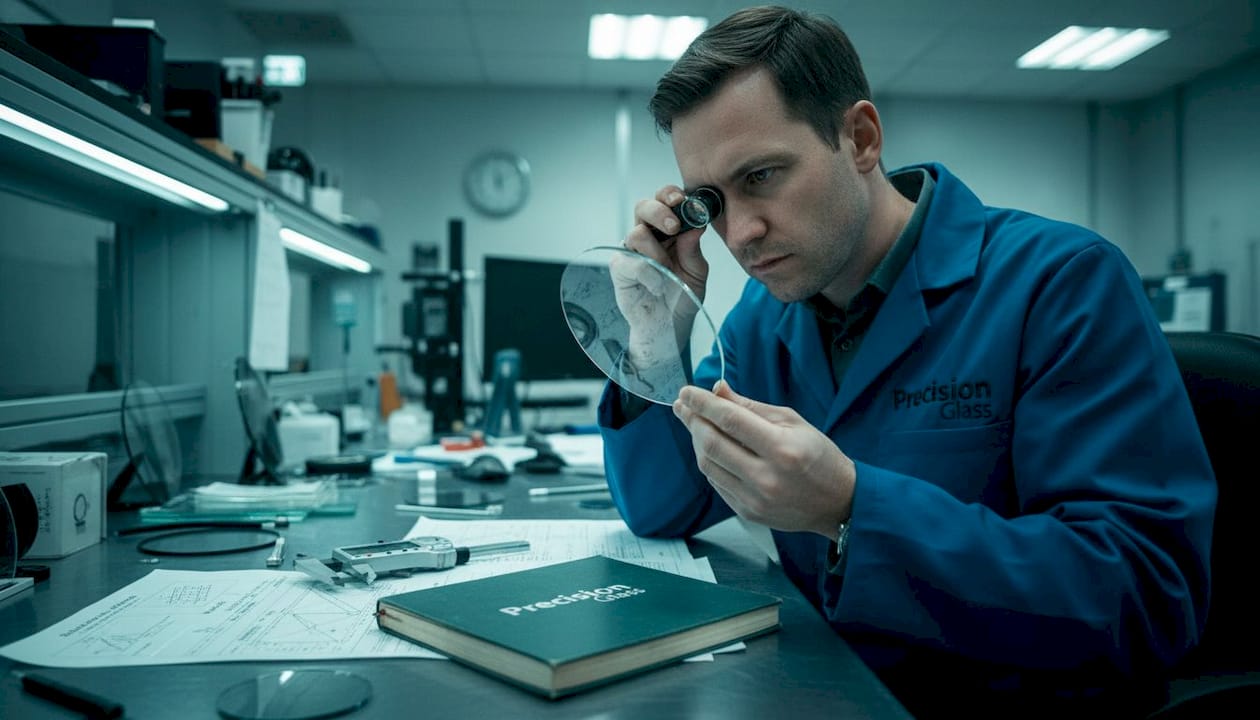
The interplay between these properties is not straightforward. Understanding the optical vs protective glass distinction is essential: optical-grade material demands far tighter tolerances on homogeneity, bubble content, and stress birefringence than protective glazing, even when both components share an enclosure. Once you appreciate that distinction, the selection process becomes considerably more structured.
The table below compares the defining optical characteristics of the glass families most relevant to engineered systems:
| Glass family | Refractive index range | Abbe number (Vd) | Transmission range | Typical application |
|---|---|---|---|---|
| Crown (borosilicate) | 1.48 to 1.53 | 60 to 70 | Visible to near-IR | Camera lenses, instrument windows |
| Flint (lead-free) | 1.60 to 1.90 | 25 to 45 | Visible | Achromatic doublets, beam splitters |
| Fused silica | 1.46 | 67.8 | UV to near-IR | Laser optics, UV imaging, metrology |
| Chalcogenide | 2.40 to 2.80 | 10 to 30 | Mid to long-wave IR | Thermal imaging, FLIR systems |
Key applications sorted by property requirement include:
- High refractive index: Compact telephoto and miniaturised medical endoscope lenses where physical length is constrained
- Low dispersion (high Abbe number): Long-range surveillance and airborne reconnaissance systems requiring sharp colour correction
- UV transmission: Semiconductor lithography, fluorescence microscopy, and sterilisation monitoring equipment
- Broad IR transmission: Automotive night-vision sensors, missile seekers, and industrial thermal cameras
“Selecting the wrong glass family at the specification stage is not recoverable through software correction alone. Aberration control is a material decision first, and an algorithmic decision second.” This is a well-established principle in precision optical engineering, and one that separates robust system designs from those that require constant field compensation.
Reviewing advanced glass specifications early in the design cycle allows engineers to map glass catalogue properties directly to system-level performance budgets, rather than retrofitting choices made under time pressure.
Critical factors in glass selection across sectors
With a grasp on fundamental properties, let us see how these play out when engineers select glass under real-world constraints.
No optical system exists in a controlled laboratory environment for its entire service life. Defence imaging platforms must balance optical performance with mechanical durability and thermal stability, because the vehicles and platforms they are mounted on experience shock, vibration, and temperature excursions that would shift optical alignment in any inadequately specified glass. An airborne electro-optical pod operates at altitude temperatures well below zero before descending rapidly into desert heat. A surgical imaging system must withstand autoclave sterilisation cycles without any degradation in surface figure or transmission.
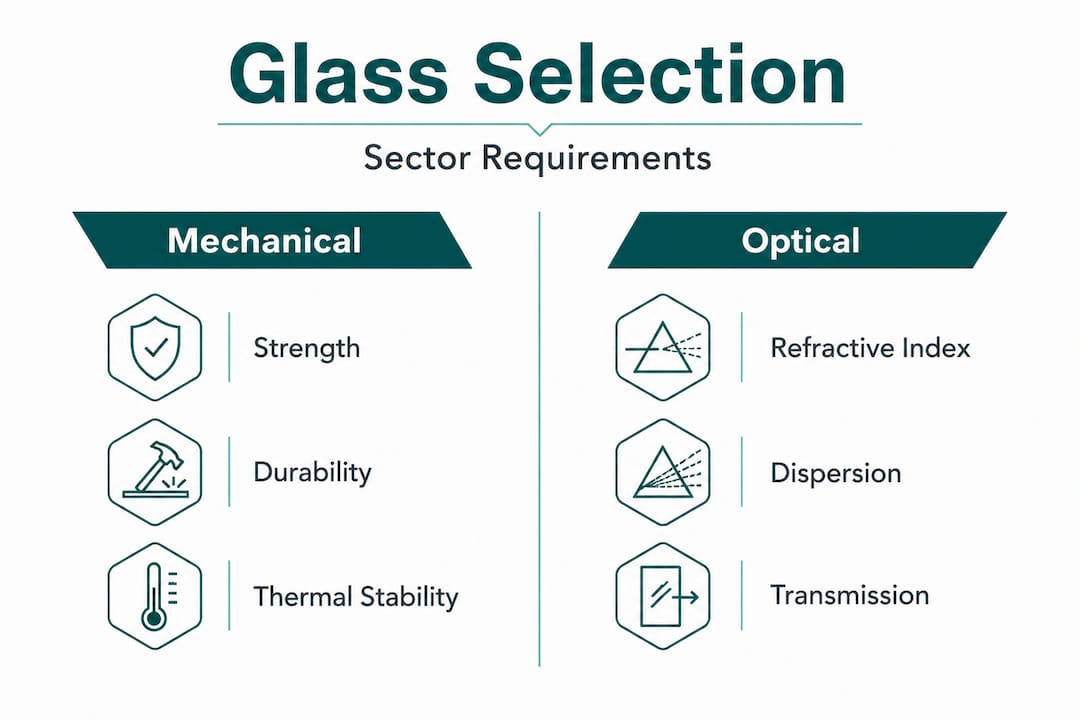
The following table maps sector-specific priorities in concrete terms:
| Sector | Mechanical requirements | Optical requirements | Thermal demands | Example glass types |
|---|---|---|---|---|
| Defence | High fracture toughness, blast resistance | Precision figure, high transmission | Wide range stability (minus 55°C to plus 125°C) | Spinel, fused silica, ALON |
| Aerospace | Low density, vibration resistance | Wide spectral coverage | Low CTE, no outgassing | Borosilicate, fused silica |
| Medical | Biocompatibility, sterilisation resistance | High resolution, colour fidelity | Autoclave stable | Crown, borosilicate, sapphire |
| Automotive | Impact resistance, scratch hardness | Visible and IR transmission | Thermal shock resistance | Chalcogenide, Ge-based, tempered glass |
The trade-offs are genuine and often uncomfortable. A chalcogenide glass that provides excellent IR transmission for specialist applications is brittle and difficult to polish to tight surface figure tolerances. Sapphire offers extraordinary scratch resistance and thermal stability, but its birefringence can introduce unwanted polarisation effects in precision imaging channels. There is no universally optimal material. Every selection involves deliberate compromise.
When beginning a new project, these are the key questions to define glass requirements clearly:
- What is the operational wavelength range, and does it extend into UV, visible, near-IR, or thermal IR bands?
- What are the environmental conditions: temperature range, humidity, vibration levels, and shock events?
- What mechanical loads will the component sustain, and is fracture toughness or surface hardness the primary concern?
- Is manufacturability at production volumes a constraint, or is this a low-volume, high-precision application?
- Are there regulatory, biocompatibility, or export control requirements that narrow the material catalogue?
- What coating systems will be applied, and are they compatible with the substrate’s thermal expansion coefficient?
Pro Tip: In environments combining mechanical stress with optical precision requirements, such as aerospace glass solutions, consider specifying a compound optical assembly rather than a single-element solution. Using a tougher protective outer window paired with a precision optical element behind it allows each component to be optimised independently, rather than forcing a single material to satisfy conflicting constraints simultaneously.
Real-world challenges: optical distortion and processing effects
While theory guides specification, it is manufacturing realities that so often dictate actual performance in the field.
Selecting the correct glass family from a catalogue is necessary, but it is not sufficient. The transformation from raw material to finished optical component introduces variables that can undermine even the most carefully considered specification. Optical distortion and anisotropy can arise from internal stresses and inhomogeneities introduced during melting, annealing, or subsequent processing. Standards exist for measuring these effects, but measurement methodology itself requires adaptation depending on glass type, geometry, and the mode of use in the system.
The most common manufacturing and integration problems engineers encounter include:
- Residual stress birefringence: Arises from uneven cooling during annealing; causes wavefront error and polarisation-dependent phase shifts in polarimetric systems
- Subsurface damage: Introduced during grinding and lapping; acts as a stress concentration site and reduces fatigue life, particularly under thermal cycling
- Wedge and surface figure errors: Result from non-uniform material removal during polishing; directly affect wavefront quality and point-spread function
- Coating adhesion failure: Occurs when the glass surface is not adequately cleaned or when the coating’s thermal expansion coefficient is mismatched to the substrate
- Edge micro-cracking: Cutting parameters such as wheel type, cutting pressure, and fluid application significantly influence edge strength; poorly managed micro-cracks reduce long-term reliability and can propagate under thermal or mechanical load
Edge strength is typically characterised by four-point bend testing or ring-on-ring methods, with results expressed as a Weibull modulus. A low Weibull modulus indicates high variability in fracture strength, which is a serious concern for components in safety-critical or high-reliability applications. Design managers should request Weibull data from suppliers rather than accepting a single mean strength value.
Pro Tip: When qualifying a new glass supplier or a new processing route for an existing material, specify a process validation protocol that includes birefringence mapping across the full aperture, edge strength sampling across multiple lots, and surface figure measurement before and after coating deposition. These three checks catch the vast majority of processing-induced failures before they reach integration.
For those managing glass sourcing and quality assurance, insisting on full traceability from melt batch to finished component is not excessive caution. It is the minimum standard for any system operating in a safety-critical environment.
Integrating glass: system-level optimisation and innovation
Once the manufacturing pitfalls are managed, system-level integration and innovation are where glass delivers its highest value.
The most significant performance gains in modern optical systems rarely come from switching to a different glass type in isolation. They come from a coordinated approach in which glass properties, coating systems, mechanical mounting, and sensor integration are all considered together. Engineered glass performance depends as much on manufacturing quality, homogeneity, stress state, and coatings as on the nominal refractive index. This is a truth that separates experienced optical system engineers from those who treat glass as a commodity input.
At the system level, the primary levers for extracting maximum benefit from optimised glass include:
- Advanced anti-reflection coatings: Broadband coatings on fused silica or crown glass substrates can reduce surface reflection losses to below 0.1% per surface across a specified waveband, critical for high-sensitivity medical fluorescence imaging
- Hybrid glass and crystalline assemblies: Combining glass elements with crystalline components such as calcium fluoride or zinc selenide extends wavelength coverage into regions no single glass family can serve
- Athermally designed lens groups: Using glasses with matched but opposing thermal properties in a compound design maintains focal length stability across temperature without active compensation mechanisms
- Integration with MEMS and sensor arrays: Precision glass substrates provide the dimensional stability and surface planarity required for reliable bonding of micro-electromechanical sensor arrays in automotive and medical diagnostics
- Sustainable and lightweight glazing: Modern glass for displays and structural optical elements in aerospace now incorporate thin glass laminates that reduce mass while maintaining pressure and impact resistance
Cross-sector innovation is accelerating. Chalcogenide glass lenses designed for military thermal imaging are now being adapted for automotive long-range night-vision systems in autonomous vehicles. Bio-compatible borosilicate and sapphire optics developed for surgical endoscopes are finding application in capsule cameras and implantable diagnostic devices. Sustainable low-density borosilicate glazing developed for next-generation aircraft transparencies is informing structural optical designs in satellite platforms.
These advances are accessible through our technical glass product range, which spans the full breadth of engineering glass families discussed above.
“Engineering glass is not principally a chemistry problem. It is a process control and systems integration problem. The best material in the catalogue, processed carelessly or integrated without regard for thermal or mechanical coupling, will deliver mediocre results. The right material, rigorously processed and thoughtfully integrated, enables capabilities that define the performance ceiling of the system.”
The real driver of optical innovation: why system-level thinking beats material hype
We have examined glass properties, sector requirements, manufacturing realities, and integration strategies. So what is the hidden variable that consistently separates enduring optical systems from those that appear promising on paper but disappoint in service?
It is not access to exotic materials. It is not the refractive index of the latest catalogue entry. It is system-level engineering discipline applied at every stage, from the initial material specification through to final quality assurance.
We have seen programmes where engineers specified optically superior glass that performed beautifully in isolation, only to fail in service because the mounting design created stress concentrations that induced birefringence under thermal cycling. We have observed procurement decisions made on unit price alone, sourcing glass from a supplier unable to provide consistent melt homogeneity across production lots, leading to field-by-field variation in resolution. In both cases, the glass catalogue was not the problem. The failure to integrate material requirements with process validation and system design was the problem.
The glass specification guide we offer to engineering teams is structured precisely around this philosophy. It leads with system requirements, not material properties, because the sequence matters. Start with what the system must do under operational conditions. Derive material properties from those requirements. Then validate that the manufacturing and supply chain can consistently deliver those properties at the required quality level.
Chasing the material with the highest refractive index or the most impressive IR transmission figure is a distraction if the supply chain cannot deliver it with consistent homogeneity, or if the processing route introduces stress states that degrade wavefront quality. In our experience, the teams that deliver the most reliable advanced optical systems are those who treat glass as part of an integrated engineering system, not as a catalogue selection made once and forgotten.
Your next step: accessing advanced glass solutions for optical systems
If you are ready to put this guidance into practice, accessing the right resources and support is your logical next step.
The properties, trade-offs, and integration strategies covered in this article represent the foundation of what we address with engineering teams every day. At Precision Glass, we work with design managers and engineers across defence, aerospace, medical, and automotive programmes to translate system-level requirements into precisely manufactured glass components.

Our optical components portfolio covers windows, lenses, prisms, and custom optical assemblies across the full spectrum from UV to thermal IR. Whether you are specifying a compound achromatic lens assembly for a medical imaging platform or a ruggedised window for an airborne sensor pod, our engineering team is ready to support you from initial specification through to production-volume delivery. Explore our full technical glass products range or contact our engineers directly to begin a specification discussion tailored to your programme requirements.
Frequently asked questions
What is the most important property of optical glass for system designers?
Refractive index is critical for optical design, but system reliability often depends equally on manufacturing homogeneity and stress control across the full component aperture.
How do engineers minimise chromatic aberration in glass lenses?
They combine crown and flint glasses with different Abbe numbers in compound lens designs, allowing colour errors introduced by one element to be corrected by the other.
Why is thermal stability important for glass in aerospace and defence systems?
Thermal stability maintains optical alignment and consistent focal performance when platforms experience wide temperature excursions and continuous vibration throughout their operational life.
What glass types are used for infrared optical systems?
Chalcogenide glasses for IR are the primary choice for mid and long-wave thermal imaging, as no single conventional glass family transmits usefully across both visible and infrared bands.
How can processing affect the reliability of glass components?
Cutting parameters and edge micro-cracks induced during fabrication reduce edge strength and can propagate under thermal or mechanical load, compromising long-term component reliability in service.
Recommended
- Advanced glass specifications: Guide for engineers and buyers – Precision Glass
- Optical vs protective glass: key differences for industry – Precision Glass
- Top glass solutions for aerospace: strength, clarity, precision – Precision Glass
- Medical glass terminology explained for device engineers – Precision Glass