Optical coatings are frequently described as thin surface layers applied to glass. That description is accurate but dangerously incomplete. In high-consequence applications, whether a sensor window on an unmanned aerial vehicle, a beamsplitter in surgical imaging, or a laser optic in defence systems, these coatings are precisely engineered, physics-driven systems that determine whether a component performs or fails. Understanding their underlying principles, manufacturing methods, and qualification requirements is not optional for procurement and engineering professionals in sectors where performance margins are tight and failure is not an acceptable outcome.
Table of Contents
- What is an optical coating? Fundamentals and functions
- How optical coatings are made: Deposition methods and their impact
- Performance testing and specification: What matters most for high-precision glass
- Application challenges: Angular performance and real-world limitations
- A practitioner’s perspective: What matters most in high-stakes optical coating selection
- Partnering for optimal optical coating performance
- Frequently asked questions
Key Takeaways
| Point | Details |
|---|---|
| Physics-driven layers | Optical coatings use thin-film interference and require nanometre-scale precision to control light. |
| Deposition method matters | The chosen coating process affects adhesion, durability, and suitability for demanding uses. |
| Testing is critical | Environmental durability and damage growth must be verified—not just assumed from datasheets. |
| Angle and polarisation limits | Performance often changes with viewing angle or polarisation, so design accordingly. |
| Treat as a system | Successful coatings require holistic thinking across optics, mechanics, and real-world use cases. |
What is an optical coating? Fundamentals and functions
An optical coating is a multilayer functional film deposited onto a glass or optical substrate to control how light interacts with its surface. That control is not cosmetic. It determines how much light is transmitted, reflected, absorbed, or selectively filtered at specific wavelengths. The distinction between a standard surface finish and a precision optical coating sits firmly in the physics, and understanding that distinction informs every downstream decision, from substrate selection to procurement qualification.
The core physics behind many optical coatings is thin-film interference: controlled constructive and destructive interference arising from multiple layers with different refractive indices and precise thicknesses. Each layer causes incoming light to reflect partially at each interface, and the phase relationship between those reflected waves determines the net result. Get the thickness wrong by even a few nanometres and the interference condition shifts, degrading performance in ways that a simple visual inspection will never reveal.
The principal coating types found in high-precision glass applications are:
- Antireflective (AR) coatings: Reduce surface reflection to maximise light transmission, critical in lenses, windows, and sensor optics.
- High-reflective (HR) coatings: Maximise reflection at specified wavelengths, used in laser cavities and precision mirrors.
- Beamsplitter coatings: Divide incident light into transmitted and reflected portions at controlled ratios, used in interferometers and imaging systems.
- Bandpass and notch filters: Transmit or block specific spectral bands, used in medical imaging, flame sensors, and spectroscopy.
“The distinction between coating types is not merely functional—it reflects fundamentally different multilayer architectures, each optimised for a specific interaction between light and matter.”
The relevance to mission-critical glass is direct. A poorly specified AR coating on an aerospace sensor window can reduce signal-to-noise ratio under high-angle illumination. An inadequate HR coating in a surgical laser system can allow stray reflections that compromise treatment accuracy. Understanding the functional layer, not just the glass substrate itself, is essential. Our guide on optical vs protective glass provides a useful reference for understanding where coating requirements diverge from structural ones.
How optical coatings are made: Deposition methods and their impact
With the fundamentals of coating function established, the next logical step is to understand how the method of application, known as deposition, directly shapes performance. The deposition process does not merely place material on a surface; it determines the microstructure, density, adhesion, and stress state of every layer in the stack. These properties, in turn, govern durability under thermal cycling, laser exposure, humidity, and mechanical handling.
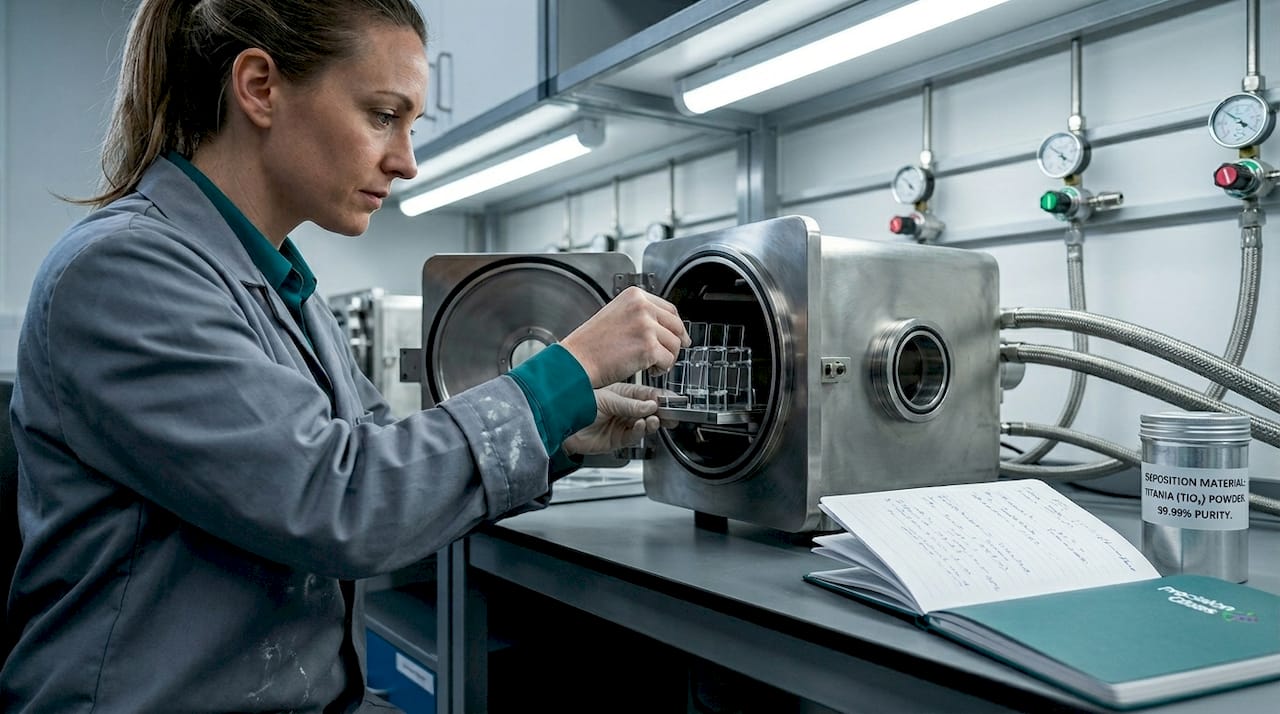
Optical coatings are deposited using vacuum thin-film manufacturing methods such as evaporation and physical vapour deposition (PVD), among others; deposition process strongly affects stress, adhesion, uniformity, and durability. The choice of method is therefore a specification decision, not a manufacturing convenience.
| Deposition method | Film density | Adhesion | Durability | Typical applications |
|---|---|---|---|---|
| Thermal evaporation | Low to moderate | Moderate | Limited | Low-cost AR coatings, visible spectrum |
| E-beam evaporation | Moderate | Moderate to good | Good | General optical components |
| Magnetron sputtering | High | Good | Very good | Broadband AR, filters |
| Ion beam sputtering (IBS) | Very high | Excellent | Excellent | Laser optics, space-qualified mirrors |
| Atomic layer deposition (ALD) | Highest | Excellent | Excellent | Ultra-thin, conformal, high-uniformity coatings |
The practical implication for procurement is significant. Specifying “AR coated” without defining the deposition method invites variability. Ion beam sputtering, for example, produces films with superior density and far lower scatter than thermal evaporation, which matters enormously when you are qualifying optical components for laser damage resistance or low-scatter requirements in defence applications.
A typical sequence for specifying and verifying a deposition process includes:
- Define the operating wavelength range, angle of incidence, and polarisation state.
- Specify the required optical performance targets (transmission, reflectance, extinction ratio).
- Identify the environmental conditions: temperature range, humidity, vibration, UV exposure.
- Select a deposition method compatible with those performance and durability requirements.
- Request process documentation including layer count, material selection, and deposition conditions.
- Validate with qualification test coupons before committing to full-batch production.
Understanding how each step feeds into the next is part of designing optical glass for demanding applications, and it demands early engagement with your fabricator. The glass fabrication processes used upstream also influence coating adhesion, particularly surface roughness and substrate cleanliness prior to deposition.
Pro Tip: Choosing the right deposition process upfront is one of the most effective ways to prevent adhesion failures and long-term mechanical stress in final assemblies. Requesting a process data sheet, not just a coating performance datasheet, gives you significantly more assurance over the product’s lifecycle.
Performance testing and specification: What matters most for high-precision glass
Knowing how coatings are built is vital, but ensuring they can survive real-world use is essential, especially for high-consequence applications. Spectral performance data alone, as measured under idealised laboratory conditions, does not tell you what will happen to your coating after 200 thermal cycles, exposure to high-humidity environments, or repeated laser pulses at operating fluence.
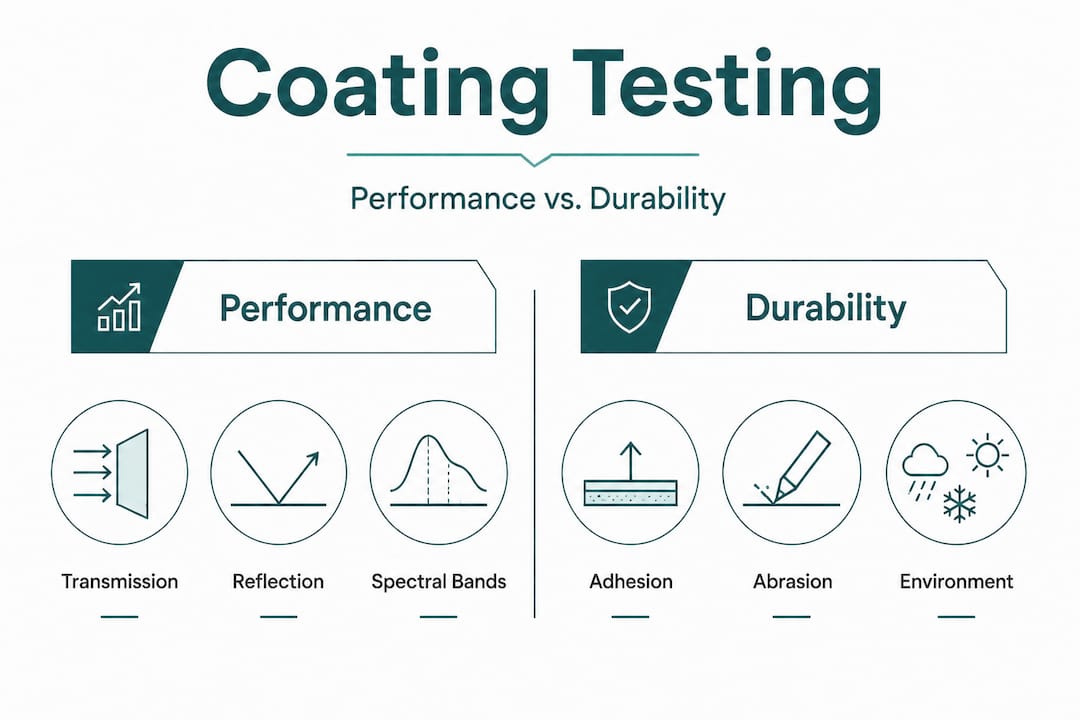
For high-precision procurement contexts such as aerospace, defence, and medical applications, optical coating qualification commonly includes durability and environmental testing as well as laser-damage evaluation. Critically, coating damage-growth behaviour may differ substantially from simple initiation thresholds, meaning a coating that survives initial laser exposure may still degrade rapidly under repeated use.
| Test type | What it measures | Relevant standards |
|---|---|---|
| Adhesion (tape test) | Bond strength between coating and substrate | MIL-C-48497, ISO 9022 |
| Abrasion resistance | Surface durability under mechanical contact | MIL-C-675, ISO 9211 |
| Humidity/moisture resistance | Coating stability under high-humidity conditions | MIL-STD-810, ISO 9022-2 |
| Thermal cycling | Dimensional and adhesion stability across temperatures | MIL-STD-810G |
| Laser-damage threshold (LIDT) | Energy density at which coating initiates damage | ISO 21254 |
| Environmental cycling | Combined temperature/humidity/vibration exposure | RTCA DO-160 (aerospace) |
One particularly instructive data point: studies have demonstrated a twofold improvement in damage-growth threshold for Al2O3/SiO2 mirror coatings compared to HfO2/SiO2 at 351 nm. That is not a marginal gain. In a high-repetition-rate laser system, the difference between those two material combinations determines whether a mirror survives a qualification programme or fails during final acceptance testing. Specifying the material system, not just the performance target, matters.
Common procurement pitfalls when specifying optical coatings include:
- Assuming datasheet specs cover all risks. Supplier datasheets typically present idealised, normal-incidence performance. Real-world conditions, including oblique angles and varied polarisation states, can shift performance significantly.
- Neglecting angular and polarisation factors. Transmittance and reflectance both depend on angle of incidence and polarisation. A coating optimised for 0° incidence can perform very differently at 15° or 30°.
- Ignoring substrate to coating interactions. The substrate’s surface finish, thermal expansion coefficient, and chemical compatibility with the coating materials all affect long-term adhesion and durability.
Addressing these gaps systematically is part of developing advanced glass specifications that hold up under scrutiny during qualification and acceptance testing. Understanding glass performance and procurement from a systems perspective, rather than a component-by-component view, is increasingly important as applications grow more demanding. Even in markets such as display glass where environmental exposure is less extreme, the same principles of systematic qualification apply.
Application challenges: Angular performance and real-world limitations
Even the best verified coatings face real-world operating challenges, especially when applications push the limits of angle and polarisation. This is one of the less-discussed constraints in standard procurement processes, and it is responsible for a significant proportion of in-service coating performance issues.
AR coatings designed for normal incidence operate on a specific interference condition. As the angle of incidence increases, the effective optical path length through each layer changes. The interference condition shifts. Reflectance rises, and the spectral performance window narrows. For systems that operate with wide fields of view, off-axis illumination, or non-collimated beams, a standard quarter-wave AR design may simply not meet performance requirements across the operating envelope.
If you need wide-angle or off-axis AR performance, expect fundamental angular and polarisation constraints. Meeting them often requires specialised multilayer designs or alternative strategies beyond a simple quarter-wave AR at normal incidence.
The practical steps for engineering or procurement teams to manage these constraints effectively are:
- Define the full operating angular range, not just the nominal incidence angle, before issuing a specification.
- State polarisation requirements explicitly, particularly for systems using polarised laser sources or polarisation-sensitive detectors.
- Request simulated or measured performance data at the extremes of your operational angular range, not just at 0° incidence.
- Validate coating performance under the actual operating conditions of your system, including illumination geometry and environmental state.
- Consider bespoke multilayer designs if standard catalogue coatings cannot meet your angular and polarisation requirements across the full spectral band.
Pro Tip: Involve your coating supplier at the earliest stage of the optical design process if wide-angle performance is critical. A bespoke multilayer stack specified correctly from the outset is far less expensive than a late-stage redesign after qualification testing reveals off-axis performance failures. This principle applies directly when working to optimise precision sourcing for complex optical assemblies.
A practitioner’s perspective: What matters most in high-stakes optical coating selection
The technical framework outlined above gives a solid foundation, but experience in high-reliability optical systems reveals something that datasheets and standards cannot fully capture. The professionals who consistently achieve reliable outcomes treat optical coatings not as an add-on to be specified late in the design cycle, but as a coupled system that is integral from the first concept review.
We have observed a recurring tendency, even among experienced teams, to validate optical and mechanical specifications independently. Spectral performance is confirmed at the optical bench, and adhesion or thermal stability is tested separately on environmental test coupons. The problem is that real operating conditions combine these stresses simultaneously. A coating that passes individual tests may still degrade under combined thermal and mechanical loading in service, particularly if the substrate’s thermal expansion coefficient is poorly matched to the coating material system.
Treating optical coatings as coupled systems, where spectral performance, stress and adhesion, environmental robustness, and laser damage-growth behaviour must all be verified for the specific substrate and operating conditions, is not an academic recommendation. It is the operational standard in programmes where failure is not recoverable.
Catalogue data has its place. It supports initial selection and conceptual feasibility assessments. But real assurance comes from process oversight, material traceability, and scenario-based testing that reflects the conditions your component will actually encounter. This is particularly true for novel deployments, where neither you nor your supplier has historical data to draw on.
Greater supplier collaboration at the design stage also changes the outcome. When Precision Glasses engages with clients early, we can advise on substrate preparation, coating material selection, and deposition method before the design is locked. That conversation, held early, avoids the far more costly one that happens after qualification testing reveals an incompatibility. Understanding the distinctions covered in our guide to optical vs protective glass differences is a practical starting point for structuring those early discussions effectively.
The most durable lesson from high-stakes optical coating projects is this: coatings are not static solutions applied once and forgotten. They are dynamic, engineered systems whose performance must be managed across the full operational lifecycle of the component they protect.
Partnering for optimal optical coating performance
For those ready to move beyond the basics and secure performance in their next project, the following resources and solutions are tailored to help.
At Precision Glasses, we design, fabricate, and supply precision glass components with optical coatings specified for the most demanding applications in aerospace, defence, and medical devices. Our team works with engineering and procurement professionals from the earliest stages of a project to ensure that substrate selection, coating specification, and qualification testing are aligned with real operational requirements. Whether you need glass solutions for aerospace, bespoke optical components, or access to rigorously controlled glass fabrication services, we are ready to support your next project with the precision and reliability your application demands. Contact us to discuss your requirements.
Frequently asked questions
Why does layer thickness matter in optical coatings?
Even nanometre-scale thickness variations can shift the interference condition within the coating stack, altering transmittance, reflectance, and spectral bandwidth in ways that affect system performance, particularly under angular or polarisation-sensitive conditions.
What is the difference between AR coatings and mirror coatings?
Antireflective coatings use thin-film interference to minimise surface reflection and maximise transmission, while mirror coatings are designed with high-reflectance multilayer stacks to return the maximum proportion of light at specified wavelengths.
Which deposition method should I specify for high-durability coatings?
Ion beam sputtering and atomic layer deposition deliver the highest film density, adhesion, and laser-damage resistance, making them the preferred choices for harsh environments in defence, aerospace, and medical laser applications.
How do I test optical coating durability for my application?
Durability is verified through a combination of environmental and laser-damage testing, including humidity cycling, abrasion resistance, thermal cycling, and measurement of laser-induced damage threshold and damage-growth behaviour on representative substrate and coating samples.
Recommended
- Optical vs protective glass: key differences for industry – Precision Glass
- How to design optical glass: expert steps for precision results – Precision Glass
- Display glass explained: precision, performance and industry solutions – Precision Glass
- Glass in electronics: Performance, reliability and procurement insights – Precision Glass
- Maximize paint quality: why innovative protective films work