

Selecting the wrong protective glass type is not merely a specification error — it is a liability. Across defence, aerospace, medical device manufacturing, automotive, and electronics sectors, protective glass types must satisfy simultaneous demands: resisting defined threat levels, meeting certified standards, maintaining optical clarity, and integrating reliably into broader system assemblies. This guide is structured to give design and procurement professionals a clear, technically grounded framework for evaluating options, understanding the distinctions between types, and making confident specification decisions that hold up under scrutiny and in the field.
Table of Contents
- How to evaluate protective glass for critical applications
- Tempered and laminated glass: the foundational safety options
- Security, forced-entry and bullet-resistant protective glass
- Blast-resistant glass: specifications and system considerations
- Protective glass for electronic displays and lighting applications
- Comparing protective glass types: key features and suitability
- Rethinking protective glass selection: insights from industry experts
- Trusted protective glass solutions tailored for your industry needs
- Frequently asked questions
Key Takeaways
| Point | Details |
|---|---|
| Know your threat scenario | Select protective glass based on specific threats such as blast, ballistic, burglary or environmental exposure. |
| Certification matters most | Insist on independent testing and adherence to standards like ANSI Z97.1 and related ASTM specifications. |
| Interlayer specification is critical | The type and thickness of interlayers in laminated glass govern its post-breakage retention and strength. |
| System design affects performance | Protective glazing must be considered as a complete system including framing and anchoring for true effectiveness. |
| Tailor glass to application | Protective glass for electronics prioritises optical and touch performance, requiring specialised materials and coatings. |
How to evaluate protective glass for critical applications
Before examining individual protective glass types, your evaluation framework must be sound. The single most common procurement mistake we observe is selecting a glass type based on thickness alone. Thickness is a starting point, not a specification.
Start with the threat scenario. The protective function required determines everything else. Your evaluation criteria fall into five principal categories:
- Blast resistance: Overpressure events from explosive detonations, requiring laminated constructions with specified interlayer thickness and certified framing systems.
- Ballistic resistance: Defined by calibre and projectile type, demanding multi-layer laminates validated to recognised threat levels.
- Forced entry: Resistance to manual attack using improvised tools, typically rated by attack duration and implement type.
- Environmental and mechanical loads: Wind, hail, thermal cycling, and UV exposure relevant to outdoor or aerospace-facing applications.
- Optical and functional performance: Critical for display, medical, and instrumentation applications where clarity, transmission, and reflectance are primary parameters.
Certification is not optional. A compliance mindset is essential: procurement must require ANSI Z97.1 certification validated by an independent laboratory, not just a manufacturer’s data sheet. Certification to ASTM standards confirms that the glass assembly — not merely the material — has been tested against defined performance criteria. This distinction matters enormously in regulated industries.
Interlayer specification is a first-order variable. In laminated constructions, the interlayer type and thickness alter fragment retention, structural post-fracture performance, and load distribution. Treat it as a primary parameter, not an afterthought. Our advanced glass specifications guide provides detailed interlayer selection criteria for procurement teams working across complex application requirements.
Consider system-level factors from the outset. Framing, anchoring, and installation method all influence how protective glazing performs in practice. A glass assembly that passes testing in isolation can fail in service if the supporting system is inadequately specified.
- Define the threat scenario and regulatory context for your application.
- Identify required certifications and independent testing standards.
- Specify interlayer type and minimum thickness based on application demands.
- Evaluate framing and anchoring requirements alongside glass specifications.
- Confirm optical, durability, and mechanical load requirements as co-equal parameters.
Pro Tip: Request full assembly test reports from suppliers, not glass-only data sheets. Performance certification applies to the tested configuration, and substituting components invalidates it.
Having established the evaluation framework, we now examine the principal protective glass types relevant to critical industry applications.
Tempered and laminated glass: the foundational safety options
These two types form the basis of most protective glazing specifications. Understanding their distinct failure behaviours is essential before moving to more specialised constructions.
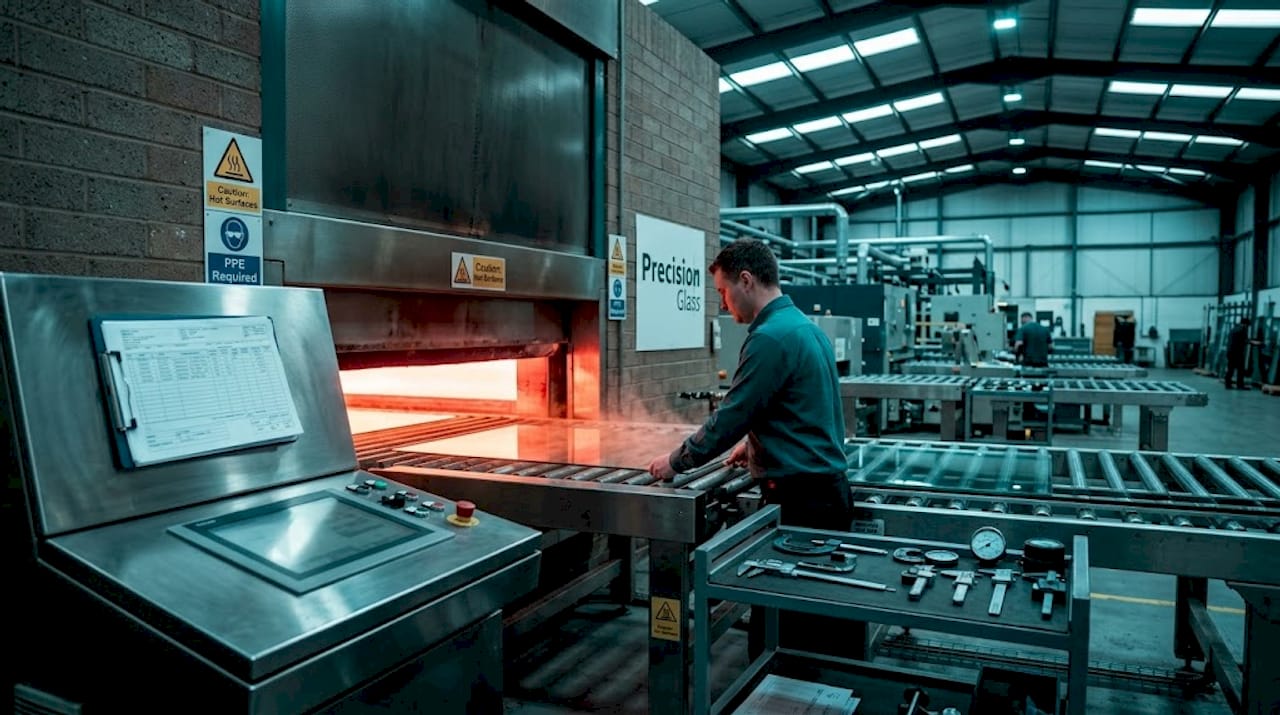
Tempered glass is produced by heating glass to approximately 620°C and then rapidly cooling it, inducing surface compression. This process increases its strength by a factor of four to five compared with annealed glass. Critically, tempered glass breaks into small blunt pieces rather than sharp shards, which is why it is classified as a safety material. Automotive side and rear windows, shower enclosures, and oven doors are common applications. For critical environments, tempered glass provides monolithic impact resistance but offers no post-breakage barrier function — once broken, the opening is unprotected.
Laminated glass operates on an entirely different principle. Two or more glass plies are bonded with a polymeric interlayer under heat and pressure. When fractured, laminated glass retains fragments, maintaining both its structural envelope and a degree of barrier function. This is why laminated glass is specified for windshields, skylights, security glazing, and any application where post-breakage containment is required. It also provides meaningful attenuation of noise and UV radiation.
Key comparison points for procurement decisions:
- Tempered glass: higher monolithic strength, no interlayer cost, but zero post-fracture retention.
- Laminated glass: post-fracture barrier maintained, noise and UV reduction, but more complex construction and higher material cost.
- Laminated glass also offers acoustic performance often valuable in aircraft cabins and medical environments.
The optical vs protective glass differences between these two foundational types become particularly significant when both clarity and safety are specified simultaneously.
Pro Tip: Interlayer selection within laminated glass is not fixed. Polyvinyl butyral (PVB) offers flexibility and is standard for most applications, whilst ionoplast interlayers such as SentryGlas provide significantly higher stiffness and structural post-fracture strength for blast and ballistic constructions.
Security, forced-entry and bullet-resistant protective glass
Moving beyond foundational safety glass, this tier addresses deliberate human threat. These types of protective glass are specified for government facilities, detention centres, financial institutions, and military infrastructure.
Burglary-resistant glass typically employs two substantial glass plies bonded with an interlayer of at least 0.060 inches thickness. The construction is designed to defeat smash-and-grab attacks within a defined time window. The interlayer absorbs energy and resists penetration even as the glass fractures.
Forced-entry-resistant glass is validated against attacks using hammers, crowbars, and bladed instruments. Testing measures both the number of blows required to create a penetrable opening and the time taken. This type of protective glass is critical in secure facilities where delay is as important as denial.
Bullet-resistant glass involves the most complex constructions in this category. Security glazing uses thick interlayers and multi-layer constructions configured specifically to the rated ballistic threat level. Constructions typically combine multiple glass plies with polycarbonate backing layers, with total thicknesses ranging from approximately 20 mm for handgun threats to over 70 mm for rifle-rated assemblies.
Procurement teams specifying any of these glass types for critical projects should require validation against the following, as applicable:
- UL 972 for burglary-resistant glazing.
- ASTM F3038 for forced-entry resistance by manual attack.
- NIJ 0108.01 for bullet-resistant material classification.
- UL 752 for bullet-resisting equipment.
- EN 356 (European standard) for attack-resistant glass, relevant for internationally sourced assemblies.
Bullet-resistant glazing must be tested against rated ballistic threats and validated by an independent laboratory. Multi-assault constructions combining ballistic and forced-entry resistance are available and frequently specified for high-risk government and military facilities. Our glass specifications guide covers construction parameters for each threat category in detail.
Blast-resistant glass: specifications and system considerations
Blast-resistant glazing represents one of the most technically demanding specifications in the protective glass selection guide. It is the default choice for government buildings, embassy facilities, military installations, and any structure identified as a high-value target.
Blast-resistant glazing is specified per DoD UFC guidelines requiring ANSI Z97.1 certification and ASTM testing to simulated blast-load equivalency. Laminated glass with interlayer thickness of at least 0.030 inches is the standard starting point for low-level blast mitigation. Higher threat levels demand additional plies, thicker interlayers, or hybrid constructions incorporating polycarbonate.
Blast-resistant laminated glass with thick interlayers reduces flying glass injuries and preserves envelope integrity — but only when properly framed and anchored. This is the point where many specifications fail. The glass may be entirely compliant in isolation, yet the glazing system as a whole can under-perform if framing bite depth, glazing bite, and anchoring capacity have not been engineered to transfer blast loads into the building structure.
| Property | Laminated glass (blast-rated) | Tempered glass |
|---|---|---|
| Post-fracture retention | Yes, interlayer holds fragments | No, collapses on fracture |
| Interlayer minimum thickness | 0.030 in (low threat), up to 0.090 in+ (high threat) | Not applicable |
| ANSI Z97.1 certification | Required and standard | Available but less common in blast applications |
| Blast load resistance | Engineered per ASTM F1642 / UFC | Not appropriate for blast-rated use |
| Optical clarity | High, depending on interlayer selection | High |
| Typical application | Military, embassy, government facilities | Industrial, automotive, general safety |
“A complete system is only as strong as its weakest element — in protective glazing, that element might not be the glass itself.”
Pro Tip: When evaluating suppliers for blast-resistant glazing, ask specifically for framed assembly test reports. Glazing tested without representative framing conditions does not validate real-world performance. Our precision glass fabrication processes are designed with full system integration in mind from the outset.
Protective glass for electronic displays and lighting applications
Protective glass options for displays and lighting differ substantially from security and blast-rated types. The threat here is not deliberate attack but environmental exposure, mechanical contact, and optical degradation. Performance parameters shift accordingly.
Material families in common use:
- Soda-lime glass: The most widely used and economical option. Appropriate for many display cover applications where operating temperatures are moderate and chemical resistance is not a primary concern.
- Borosilicate glass: Offers significantly higher thermal resistance and lower thermal expansion, making it the preferred choice for lighting covers, scientific instruments, and applications involving thermal cycling.
- Aluminosilicate glass: Provides high mechanical strength and chemical durability, frequently used in demanding display and medical device cover glass applications.
Cover glass materials include soda-lime, borosilicate, and aluminosilicate, with thickness tailored from 0.2 mm for lightweight touchscreens to over 10 mm for outdoor public kiosks exposed to vandalism and environmental stress. Chemical tempering is the preferred strengthening process for thin display glass, as it achieves high surface compression without the minimum thickness constraints of thermal tempering.
Procurement specifications must define optical transmission, surface reflectance, and haze alongside mechanical parameters. Anti-reflective coatings, anti-fingerprint treatments, and oleophobic surfaces are frequently integrated at the fabrication stage. For more detail on how glass selection affects product reliability, our resource on glass in electronics performance provides application-level guidance.
Pro Tip: Custom geometries for display glass, including cutouts for sensors, cameras, and connectors, must be specified early in supplier discussions. Geometry affects stress distribution, and post-processing of strengthened glass requires careful planning to avoid compromising surface compression layers.
Comparing protective glass types: key features and suitability
With the principal types examined individually, a structured comparison supports your final selection. Protective performance is defined through construction and validated testing for defined threat levels, not by glass type alone.
| Glass type | Impact resistance | Fragment retention | Key certifications | Typical interlayer | Optical quality | Primary applications |
|---|---|---|---|---|---|---|
| Tempered | High (monolithic) | None | ANSI Z97.1, ASTM C1048 | None | Excellent | Automotive, industrial, appliances |
| Laminated (standard) | Moderate to high | Yes | ANSI Z97.1, ASTM C1172 | PVB (0.030 in+) | Good to excellent | Windshields, skylights, security |
| Security laminate | High | Yes | UL 972, ASTM F3038, UL 752 | PVB/ionoplast (0.060 in+) | Good | Government, finance, detention |
| Blast-resistant laminate | High (system-rated) | Yes | ANSI Z97.1, ASTM F1642, UFC | Ionoplast (0.030 to 0.090 in+) | Good | Military, embassy, critical infrastructure |
| Electronic cover glass | Moderate | Yes (chemically tempered) | Application-specific | Not applicable | Excellent | Displays, medical devices, instruments |
Selection guidance by industry segment:
- Defence and government: Specify blast-resistant or multi-threat laminates with full system certification, including framing and anchoring.
- Aerospace: Prioritise optical clarity, low weight, and thermal resistance; borosilicate and aluminosilicate constructions with anti-reflective coatings are typical.
- Medical devices: Aluminosilicate or borosilicate cover glass with chemical tempering, verified biocompatibility, and cleanroom-compatible fabrication.
- Automotive: Tempered glass for side and rear windows; laminated for windshields and advanced driver assistance system (ADAS) optical windows. See our engineered glass types comparison for automotive-specific guidance.
- Electronics and lighting: Match material family to thermal and mechanical environment; specify optical parameters alongside dimensional tolerances.
Rethinking protective glass selection: insights from industry experts
Here is the perspective we bring from years of working with procurement and design teams across regulated, high-stakes industries: the conversation about protective glass types too often starts and ends with material choice. That framing is wrong, and it leads to costly mistakes.
We have seen specifications that correctly identified laminated glass, selected an appropriate interlayer, and still resulted in glazing that failed performance validation. The reason, in most cases, was insufficient attention to system-level design. Procurement should prioritise standards-based qualification and system design compatibility rather than assuming thickness or glass type alone ensures performance. This is not a nuanced point — it is a fundamental shift in how protective glazing should be procured.
The second misconception we encounter regularly is that certification is transferable. A tested assembly at one glazing bite depth does not validate the same glass in a different frame. Framing, anchoring and installation often determine protective glazing effectiveness more than the glass specification alone. When a supplier cannot provide framed assembly test data, that is a clear signal.
Interlayer selection is where specification accuracy is most frequently lost. PVB and ionoplast are not interchangeable. Their stiffness, adhesion strength at elevated temperatures, and post-fracture behaviour differ substantially. Treating interlayer selection as a secondary decision — something to finalise later — compromises the integrity of the entire specification.
Our position, grounded in experience with defence, medical, and aerospace clients: integrate optical and mechanical requirements from the first design meeting. The programmes that succeed are those where the glass manufacturer is involved before the system design is fixed, not after. Our glass fabrication expertise is structured precisely to support that early-stage collaboration.
Pro Tip: When issuing an RFQ for protective glass, include system-level performance requirements alongside material specifications. Suppliers who respond only to the material specification are telling you something important about their capability.
“A complete system is only as strong as its weakest element — in protective glazing, that element might not be the glass itself.”
Trusted protective glass solutions tailored for your industry needs
At Precision Glasses, we supply and fabricate protective glass across the full range of types discussed in this guide — from tempered and laminated safety glass through to blast-rated laminates, security glazing, and precision cover glass for electronic displays and medical devices. We manage certification requirements as part of our standard service, working to ANSI, ASTM, UL, and sector-specific standards so your procurement team has the documentation needed for compliance sign-off.

Our fabrication capabilities include interlayer selection and bonding, chemical and thermal tempering, CNC edge working, anti-reflective and functional coating integration, and full dimensional inspection. We collaborate closely with teams across the industries we serve — defence, aerospace, medical, automotive, lighting, and electronics — to ensure that every assembly is specified, fabricated, and delivered to perform. Browse our technical glass products or access our glass specifications resources to begin your specification process with confidence.
Frequently asked questions
What are the main differences between tempered and laminated protective glass?
Tempered glass is heat-treated for strength and breaks into small blunt pieces, prioritising impact resistance without post-fracture barrier function; laminated glass bonds multiple plies with an interlayer that retains fragments after breakage, maintaining envelope integrity and barrier performance.
Why is certification to standards like ANSI Z97.1 important for protective glass procurement?
ANSI Z97.1 certification by an independent laboratory confirms that the glass assembly has been tested against defined safety and performance criteria, providing reliable, auditable evidence of compliance for regulated procurement.
How does the interlayer type affect laminated glass performance?
The interlayer’s type and thickness directly govern fragment retention, load distribution, and post-fracture structural behaviour; interlayer specification is a first-order variable, with PVB offering flexibility and ionoplast providing enhanced stiffness and higher temperature performance.
What factors beyond glass type determine blast-resistant glazing effectiveness?
Blast-resistant glazing effectiveness depends on the complete system: glass construction and interlayer thickness are necessary but insufficient without properly engineered framing and anchoring systems tested and certified as a complete assembly.
Which glass types are used as protective covers in electronic display applications?
Electronic display cover glass commonly uses soda-lime, borosilicate, or aluminosilicate glass, with thickness ranging from 0.2 mm for thin touchscreens to over 10 mm for ruggedised outdoor displays, typically strengthened by chemical tempering.
Recommended
- Advanced glass specifications: Guide for engineers and buyers – Precision Glass
- Optical vs protective glass: key differences for industry – Precision Glass
- Glass in electronics: Performance, reliability and procurement insights – Precision Glass
- How to optimise glass sourcing for precision: 5 key steps – Precision Glass