
Selecting the right types of medical glass is one of the more consequential decisions a procurement manager or engineer makes in the medical device or pharmaceutical supply chain. Choose incorrectly and you risk drug-glass interactions, regulatory rejection, or catastrophic container failure under sterilisation. The variables are numerous: chemical resistance, hydrolytic stability, thermal performance, mechanical strength, and compliance with USP, EP, and ISO standards all demand careful evaluation. This article gives you a clear, technically grounded framework for understanding the principal medical glass types, their properties, and how to match them to your specific application requirements.
Table of Contents
- Key criteria for selecting medical glass
- High borosilicate glass (Type I)
- Boron-free aluminosilicate glass: the biologics specialist
- Soda-lime glass: cost-effective option for low-risk applications
- Comparing medical glass types: properties and applications
- Our perspective: the specification conversation most procurement teams skip
- Precision Glasses: custom medical glass fabrication for demanding applications
- Frequently asked questions
Key Takeaways
| Point | Details |
|---|---|
| Identify key criteria | Understand chemical, thermal, and mechanical properties needed for your drug or device to guide glass selection. |
| Type I superiority | Borosilicate and boron-free aluminosilicate (Type I) offer highest resistance and compliance for injectables and biologics. |
| Boron-free benefits | Boron-free aluminosilicate glass reduces leachables risk for sensitive biologic formulations. |
| Soda-lime limitations | Soda-lime glass is cost-effective but only suited for non-sterile, low-risk products due to lower stability. |
| Compliance testing | Ensure medical glass meets USP/EP standards including hydrolytic resistance tests for regulatory approval. |
Key criteria for selecting medical glass
Having set the stage, we start by exploring the core criteria needed for selecting the ideal medical glass. For procurement managers and engineers working across medical devices, pharmaceuticals, and defence-adjacent life sciences, these criteria form the foundation of every specification decision.
Chemical resistance sits at the top of the list. Glass that reacts with its contents can compromise drug efficacy, generate extractables, and trigger adverse patient outcomes. This is non-negotiable for parenteral products. Understanding glass specifications for engineers in this context is essential before committing to any container format.
Hydrolytic resistance is a closely related but distinct criterion. It measures the glass’s stability against water-induced leaching. Parenteral formulations, in particular, require Class 1 hydrolytic resistance to prevent ion migration into solution over shelf life.
Thermal shock resistance determines whether glass survives autoclaving, lyophilisation (freeze-drying), and depyrogenation cycles intact. Cracking or delamination during sterilisation is both a safety risk and a manufacturing loss event.
Mechanical strength affects breakage rates across filling lines, transport, and end-use handling. This matters significantly for prefilled syringes and cartridges, where even minor surface damage creates sterility risks.
Regulatory compliance is the gate every product must pass. USP standards classify medical glass by chemical resistance and suitability for injectables versus oral drugs, establishing the Type I, II, and III framework that governs global pharmaceutical packaging decisions. Familiarity with medical glass terminology specific to device engineering is equally important for cross-functional teams.
Key selection criteria at a glance:
- Chemical resistance to prevent drug-glass interaction
- Hydrolytic resistance to maintain solution purity over shelf life
- Thermal shock resistance for sterilisation and lyophilisation cycles
- Mechanical strength for filling line and transport integrity
- USP, EP, and ISO compliance for regulatory acceptance
- Total cost of ownership balanced against application risk
High borosilicate glass (Type I)
With the key criteria understood, let’s examine the first major glass type that meets these demanding standards: high borosilicate glass. It is the most widely specified material across injectable drugs, vaccines, and biologics, and with good reason.
Borosilicate glass combines silicon dioxide with boron oxide, typically around 80% SiO₂ and 13% B₂O₃. This composition delivers a low coefficient of thermal expansion of approximately 3.3 × 10⁻⁶/K, which allows it to survive autoclaving at 121°C and lyophilisation cycles without cracking or dimensional distortion. For any application involving heat sterilisation, this property is fundamental.
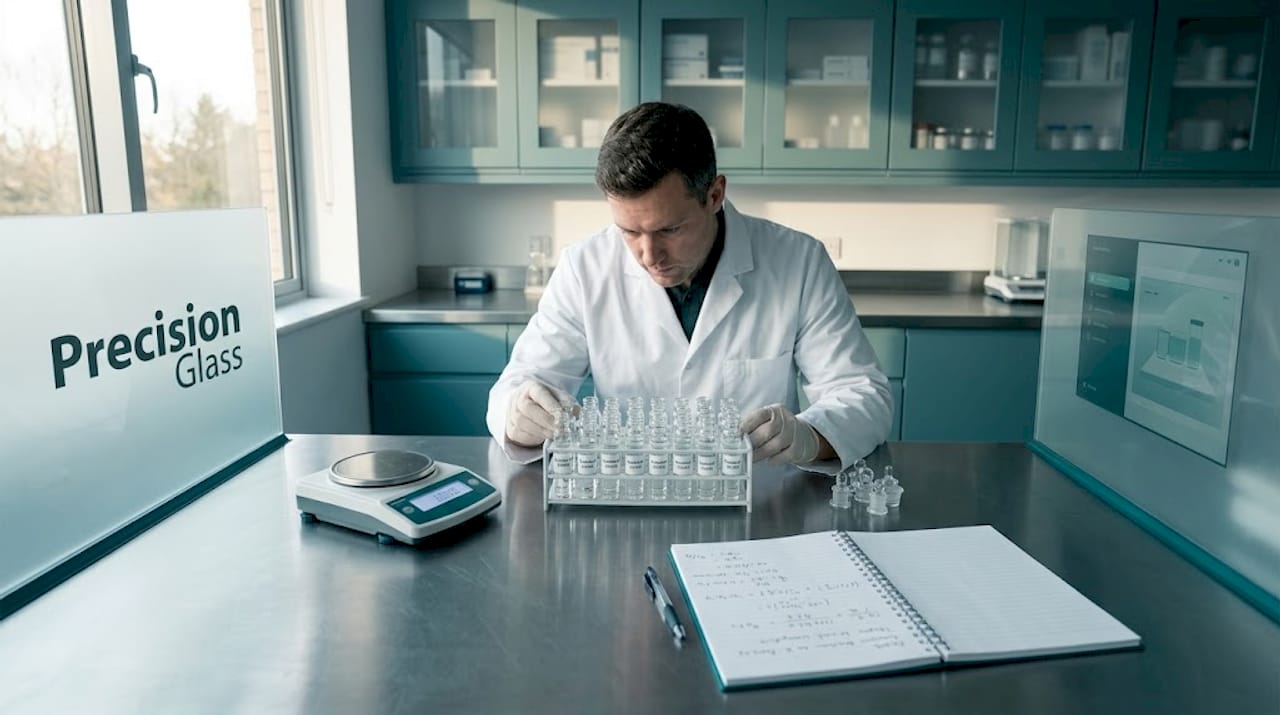
Its USP and EP Type I compliance makes it acceptable globally for injectables and vaccines. High clarity is a further practical benefit: it supports visual inspection on filling lines and in quality control protocols, allowing operators and automated systems to detect particulates effectively.
Key properties and applications:
- Superior chemical inertness across a broad pH range
- Thermal stability enabling autoclaving and lyophilisation
- High optical clarity for visual inspection
- USP/EP Type I compliant for injectables, biologics, and vaccines
- Available in vials, ampoules, cartridges, and prefilled syringe formats
- Well-established manufacturing workflow for high-volume pharmaceutical production
Pro Tip: Despite its strong track record, borosilicate glass can release trace boron ions under extreme pH or elevated temperature conditions. If your formulation is highly alkaline or involves extended high-temperature exposure, consider boron-free aluminosilicate glass to eliminate this risk entirely.
Boron-free aluminosilicate glass: the biologics specialist
We have looked at traditional borosilicate glass. The next category, boron-free aluminosilicate, offers enhanced performance specifically for biologics and other sensitive high-value formulations where even trace extractables are unacceptable.
As its name indicates, this glass eliminates boron from the composition entirely, replacing it with aluminium oxide. The result is a material with no boron leaching potential. Experts recommend this material over conventional borosilicate for biologics where pH-extreme conditions or sensitive protein formulations create leaching risks that could affect stability or regulatory acceptance.
Mechanical strength is a further advantage. Boron-free aluminosilicate glass demonstrates superior surface hardness and resistance to delamination compared to standard borosilicate. In prefilled syringe and cartridge formats, where container integrity during automated filling is critical, this translates to measurably lower breakage rates and fewer line stoppages.
SCHOTT Pharma’s FIOLAX Pro uses boron-free aluminosilicate tubing specifically for its enhanced leachables control and regulatory compliance in complex biologic applications. This is not a future-looking material. It is already in commercial use for some of the most demanding formulations on the market.
Key advantages for biologic and sensitive applications:
- Zero boron in composition, eliminating trace leaching at any pH
- Enhanced mechanical strength reducing breakage in automated filling
- Superior hydrolytic resistance extending biologic shelf life
- USP/EP Type I compliant for full market access
- Suited to monoclonal antibodies, gene therapies, and complex injectables
- Lower extractables profile supporting regulatory submissions
For teams working at the intersection of emerging medical glass technologies and demanding biologic pipelines, aluminosilicate is a material worth specifying as a default for high-value parenteral programmes.
Soda-lime glass: cost-effective option for low-risk applications
Having examined high-performance glasses, let’s consider soda-lime glass. It is the most widely produced glass material in the world and, in pharmaceutical contexts, it occupies a clearly defined but limited role.
Soda-lime glass is composed primarily of silica, sodium oxide, and calcium oxide. Type II is surface-treated soda-lime with moderate chemical resistance achieved through a sulphur dioxide treatment that neutralises alkali ions at the interior surface. Type III is untreated and offers the lowest chemical resistance of any classified medical glass. Thermal resistance is limited to approximately 40 to 60°C, making autoclave sterilisation unsuitable for either type.
What it does offer is cost. Soda-lime glass costs considerably less than borosilicate, making it attractive for high-volume, low-risk applications where chemical and thermal demands are modest. Oral tablets, capsules, and non-sensitive liquid formulations packaged in bottles represent the primary pharmaceutical use cases.
Pro Tip: If you are specifying Type II soda-lime for a formulation near the pH boundary of its validated range, always request hydrolytic Class A certification from your supplier. Without this confirmation, accelerated delamination failure is a genuine risk, particularly for formulations stored at elevated temperatures.
Key properties and limitations:
- Lower cost than borosilicate, favourable for budget-sensitive projects
- Type II (surface-treated) suitable for non-injectable, moderate-pH drugs
- Type III (untreated) limited to oral or external-use packaging
- Thermal resistance ceiling of approximately 40 to 60°C
- Not suitable for autoclaving or parenteral products
- Requires hydrolytic validation when used near pH limits
Comparing medical glass types: properties and applications
To conclude the technical overview, here is a clear comparative table summarising the main attributes of each glass type. Comparison data confirms that borosilicate glass offers a low thermal expansion coefficient and high chemical resistance, while soda-lime glass shows moderate resistance and a considerably higher expansion rate.
| Property | High borosilicate (Type I) | Aluminosilicate (Type I) | Soda-lime Type II | Soda-lime Type III |
|---|---|---|---|---|
| Chemical resistance | Excellent | Excellent | Moderate | Low |
| Hydrolytic resistance | Class 1 | Class 1 | Class 2 | Class 3 |
| Thermal expansion (×10⁻⁶/K) | ~3.3 | ~3.5 | ~8.0 | ~9.0 |
| Autoclave compatible | Yes | Yes | No | No |
| Mechanical strength | Good | Superior | Moderate | Moderate |
| Relative cost | Medium | High | Low | Low |
| Primary applications | Injectables, vaccines, vials | Biologics, prefilled syringes | Oral drugs, bottles | Oral medications |
This table supports the manufacturing workflow comparison needed when evaluating supplier capabilities against product requirements.
Quick reference: pros and cons summary
- High borosilicate: proven regulatory track record, broadly available, slight boron leaching risk at extreme conditions
- Boron-free aluminosilicate: best-in-class for biologics, minimal extractables, higher unit cost
- Soda-lime Type II: economical, adequate for non-sterile applications, limited thermal range
- Soda-lime Type III: lowest cost, lowest performance, suitable only for basic oral packaging
The selection logic is straightforward once the application is defined. Parenterals require Type I glass, full stop. The choice between borosilicate and aluminosilicate then depends on formulation sensitivity, extractables targets, and budget. Oral and non-sterile applications can move down to soda-lime when validation data supports it.
Our perspective: the specification conversation most procurement teams skip
Here is what we observe consistently across projects: procurement teams focus heavily on material classification and cost, but rarely ask the right questions about manufacturing tolerances and surface quality at the point of specification. Glass type is necessary but not sufficient.
The same borosilicate tubing, processed by two different fabricators, can yield containers with meaningfully different delamination susceptibility depending on thermal history during forming. Surface defects introduced by poor annealing practices create stress concentrations that fail precisely when it matters most, during filling line impact or autoclave cycling. The glass type tells you the chemical composition. It does not tell you about the forming process, the annealing protocol, or the surface treatment quality.
Our recommendation: when evaluating suppliers for custom medical glass components, require process data alongside material certification. Ask for thermal history documentation, annealing records, and surface inspection protocols. A Type I certification from a supplier without documented process controls is less reliable than you might assume.
There is also a broader point about the biologics pipeline. The industry is moving towards increasingly sensitive formulations, smaller batch sizes, and more complex drug-device combinations. Aluminosilicate glass is not a premium option for niche applications. It is the direction the sector is heading. Specifying it now, even where borosilicate would technically pass, reduces risk across product lifecycle and simplifies regulatory submissions. That is a decision with long-term value that does not always appear in a line-item cost comparison.
Precision Glasses: custom medical glass fabrication for demanding applications
Whether you are specifying vials for a biologic injectable, cartridges for a prefilled delivery system, or components for a complex medical device, the glass type is only part of the equation. Fabrication quality, dimensional accuracy, and process validation determine whether the final component performs to specification in your application.

At Precision Glasses, we design, fabricate, and supply custom medical glass components for medical device, defence, and aerospace clients requiring exact specifications and full traceability. Our team works with borosilicate, aluminosilicate, and specialist glass materials, applying meticulous quality assurance at every stage from forming through to final inspection. If you are at the specification stage or reviewing an existing supply chain, we welcome the technical dialogue. Contact our engineering team to discuss your requirements in detail.
Frequently asked questions
What is the difference between Type I, Type II, and Type III medical glass?
USP standards classify pharmaceutical glass into Type I (highly resistant borosilicate or aluminosilicate for injectables), Type II (surface-treated soda-lime for certain non-sensitive formulations), and Type III (untreated soda-lime for oral medications). Each type has defined hydrolytic resistance limits that govern its approved applications.
Why is boron-free aluminosilicate glass preferred for biologics?
It eliminates boron from the glass composition entirely, removing the risk of trace boron leaching that can occur with standard borosilicate under extreme pH or temperature conditions, ensuring better stability and a lower extractables profile for sensitive biologic drugs.
Can soda-lime glass be used for injectable drugs?
No. Soda-lime glass is classified as Type II or Type III, and neither offers sufficient chemical or thermal resistance for parenteral products. Its use is limited to oral and non-injectable pharmaceutical packaging.
What tests ensure medical glass compliance?
Medical glass must satisfy USP <660> and EP 2.2.40 requirements, which assess hydrolytic resistance and chemical durability to confirm suitability for pharmaceutical use at the appropriate classification level.