

High-performance glass explained in a single sentence is nearly impossible. That is the point. Engineers and product developers who treat it as a single material with a single property miss the full picture. In practice, the term spans everything from thermally insulated architectural glazing to ultra-flat substrates carrying redistribution layers in AI chip packaging. This article covers the core properties and metrics you need to evaluate it properly, the configurations and types used across industries, the genuine benefits and trade-offs, and the emerging technologies reshaping what glass can do in your next project.
Table of Contents
- Key takeaways
- Core properties: how high-performance glass is measured
- Types and configurations in use
- Applications and benefits across high-tech sectors
- Trade-offs and design considerations
- Future directions in high-performance glass
- My perspective on what actually defines performance
- How Glassprecision supports your high-performance glass projects
- FAQ
Key takeaways
| Point | Details |
|---|---|
| Performance is multi-dimensional | No single metric defines high-performance glass; U-value, SHGC, transmittance, and acoustic ratings must be assessed together. |
| Configuration drives outcome | The combination of pane count, gas fill, coatings, and spacer technology determines real-world thermal and optical performance. |
| Electronics applications demand flatness | Ultra-flat glass substrates are replacing organic laminates in AI and HPC chip packaging due to superior dimensional stability. |
| Trade-offs require engineering judgement | Gains in thermal resistance from additional panes come with penalties in weight, thickness, and cost that must be justified by application. |
| MOF glass opens new territory | Chemical tuning of metal-organic framework glasses is expanding their use into gas separation, catalysis, and specialised coatings. |
Core properties: how high-performance glass is measured
Most specification errors begin with treating a single number as the whole story. Performance arises from the combination of materials, coatings, gas fills, and construction. You need to work across several property dimensions simultaneously.
Thermal performance centres on two metrics. The U-value (or U-factor) measures the rate of heat transfer through the glazing assembly; lower is better. The Solar Heat Gain Coefficient (SHGC) measures how much solar radiation passes through; the right value depends on climate and orientation, not a universal preference. Double-pane U-factors typically fall between 0.25 and 0.50 W/m²K, while triple-pane units can reach 0.10 to 0.20 W/m²K.

Optical properties include visible light transmittance (VLT), which determines how much daylight passes through, and luminous efficacy, which relates useful daylight to total solar energy admitted. For applications where daylighting and solar control must coexist, such as glazed facades or instrument enclosures, these two values must be optimised together rather than individually.
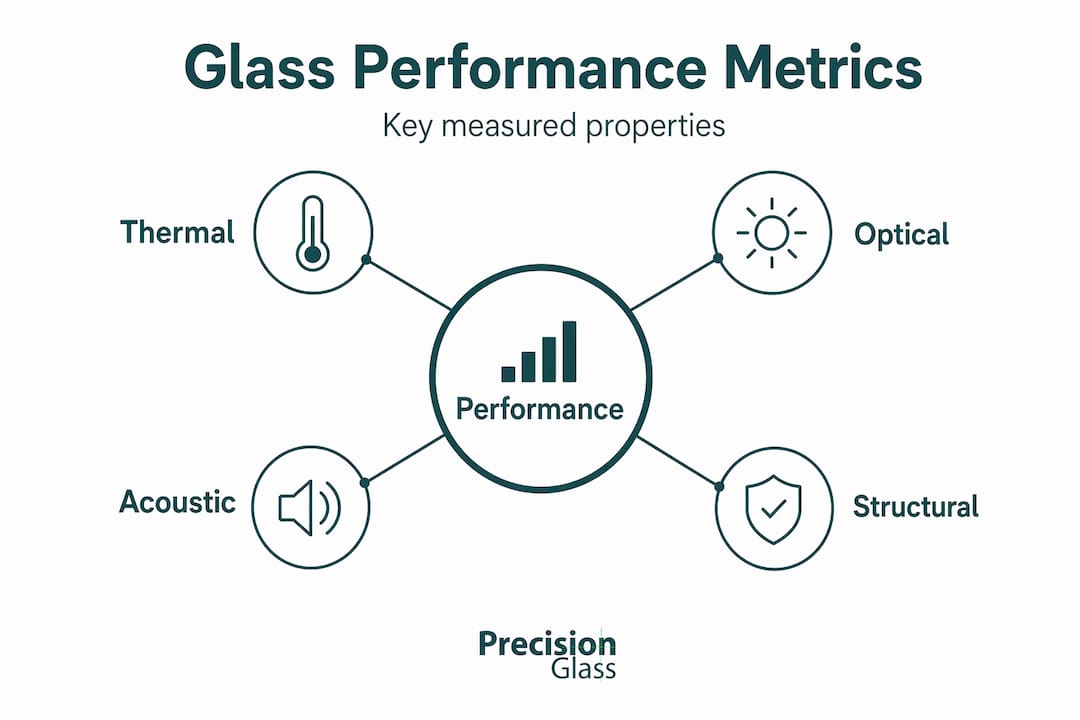
Acoustic performance is quantified by the sound reduction index (Rw), measured in decibels. Laminated interlayers and asymmetric pane thicknesses are the primary tools for improving this without adding excessive mass.
Structural and dimensional properties matter most in precision engineering applications. Flatness tolerances, thermal stability across operating temperature ranges, and resistance to thermal shock all determine whether a glass component survives and functions in service.
- U-value and SHGC govern thermal conditioning loads in buildings
- VLT and luminous efficacy govern daylighting and glare control
- Rw governs acoustic separation
- Flatness and thermal stability govern electronics and optical applications
- Coating type and gas fill determine how well a unit reaches its theoretical performance
Pro Tip: When specifying glazing for a new project, request the full performance data sheet rather than headline figures. Products like LowE Eco publish U-values around 1.4 W/m²K combined with visible light transmittance of 78 to 80% and Rw ratings from 32 to 41 dB depending on configuration. That level of coupled data lets you model trade-offs before committing to a specification.
Types and configurations in use
The range of available configurations is wide, and matching the right one to your application requires understanding what each offers.
Single glazing provides minimal thermal resistance and is largely restricted to heritage projects, internal screens, and applications where thermal performance is irrelevant. Double glazing remains the standard for most commercial and residential buildings. Triple glazing extends thermal performance further, with the third pane adding both insulation and acoustic mass.
The choice of interpane gas is not a footnote. Krypton is nearly 47% less thermally conductive than argon, with conductivity values of 0.0095 W/mK versus 0.018 W/mK for argon. Krypton’s advantage is most pronounced in narrow cavities of 6 to 9 mm, where argon underperforms due to convective losses. The cost premium for krypton is significant, so it is typically justified only when cavity width is constrained by frame or structural requirements.
| Configuration | Typical U-value (W/m²K) | Gas fill | Unit thickness (approx.) |
|---|---|---|---|
| Double glazed, argon | 0.25–0.50 | Argon | ~24 mm |
| Triple glazed, argon | 0.10–0.20 | Argon | ~44 mm |
| Quadruple glazed, krypton | <0.10 | Krypton | ~56 mm |
| Low-e double glazed | ~1.4 | Air or argon | ~24 mm |
Low-emissivity (low-e) coatings represent one of the most cost-effective performance upgrades available. Applied to internal pane surfaces, they reflect long-wave infrared radiation back into the room in winter and reject solar heat in summer. Solar control coatings go further, targeting the near-infrared portion of the solar spectrum to limit heat admission without substantially reducing visible transmittance.
Beyond conventional architectural glazing, a newer category of engineered glasses is attracting serious attention. Metal-organic framework (MOF) glasses are structurally distinct from conventional silicate glasses. Chemical tuning using sodium additives can lower their softening temperature and improve manufacturability, opening up applications in gas separation and catalysis that conventional glasses cannot address.
Applications and benefits across high-tech sectors
The benefits of high-performance glass are most visible when you examine specific sectors rather than making general claims.
Building energy performance. Windows comprise 15 to 40% of building envelope surface area. Poor thermal performance raises heating and cooling energy demand by 30 to 50%. Upgrading glazing is one of the highest-leverage interventions available to building engineers. Beyond energy cost reduction, improved glazing reduces emissions of CO₂, methane, and fine particulates by lowering fossil fuel consumption for climate control.
Electronics packaging. Ultra-flat glass substrates are now competing directly with organic laminates in advanced chip packaging. Glass core substrates provide dimensional stability and flatness that support high-density redistribution layers and maintain signal integrity at very high data rates. For AI and HPC applications, this matters because organic substrates expand and contract non-uniformly under thermal cycling, degrading fine-pitch interconnects over time.
Medical and defence optics. Precision-ground and polished glass components in imaging systems, endoscopes, targeting optics, and sensor windows demand tightly controlled refractive indices, transmission profiles, and surface flatness. The glass in advanced optical systems used in these applications is specified to tolerances measured in nanometres, not millimetres.
Automotive. Heads-up displays and advanced driver assistance system (ADAS) camera cover glasses require optical flatness, controlled distortion, and resistance to thermal and mechanical stress across a wide operating range.
Occupant comfort in buildings. Beyond energy metrics, high-performance glazing controls UV transmission to protect interior finishes, improves acoustic comfort through laminated constructions, and reduces radiant asymmetry near windows that causes localised thermal discomfort even when mean air temperature is controlled.
Pro Tip: When evaluating glass for electronics packaging applications, flatness is not just a surface quality issue. It directly affects photolithographic patterning accuracy during redistribution layer fabrication. Always request flatness data expressed as total thickness variation (TTV) rather than surface roughness alone. Learn more about glass substrate design challenges before finalising specifications.
Trade-offs and design considerations
High-performance glass does not exist in isolation from the system it serves. Every upgrade to one property comes with a cost elsewhere.
- Pane count versus weight and cost. Each additional pane improves thermal resistance but adds weight, thickness, and cost. A quadruple-glazed unit at approximately 56 mm requires frame designs and structural support not needed for standard double glazing.
- Gas selection versus cavity geometry. Argon is cost-effective in standard 12 to 16 mm cavities. In narrower cavities under 9 mm, its thermal advantage collapses due to convective transport. Krypton fills this gap but at a significantly higher material cost.
- Acoustic versus optical performance. Thicker laminates and heavier panes improve sound reduction but can reduce visible transmittance and increase solar heat gain if not carefully specified. An asymmetric laminate with different pane thicknesses on each side breaks the coincidence dip in the sound reduction curve, improving Rw without sacrificing light transmission.
- MOF glass manufacturing challenges. While chemically tunable MOF glasses offer extraordinary functional properties, they currently soften near 300°C, which is close to the degradation temperature of their organic linkers. Scaling production beyond laboratory quantities remains an active research challenge.
- Regulatory and code compliance. Building codes vary substantially by climate zone and region. Triple glazing is standard specification in northern European and Scandinavian climates, while in warmer climates, SHGC optimisation matters more than U-value reduction. Safety glazing requirements apply regardless of pane count and must be verified independently of thermal performance specifications.
The most effective approach is to optimise across all coupled metrics simultaneously, modelling the target climate, orientation, occupancy pattern, and structural constraints before fixing a glazing specification. This is not conservative engineering; it is how you avoid costly substitutions late in a project.
Future directions in high-performance glass
The next generation of high-performance glass applications will not look like today’s incremental improvements to double-glazing U-values. Several distinct research threads are converging.
Passive daytime radiative cooling glass is one of the more technically striking recent developments. Using microporous glass frameworks and photonic composite coatings, researchers have achieved surface temperature reductions of 3.5 to 4°C below ambient in hot and humid climates, without any power input. The coatings maintain high solar reflectance under outdoor exposure conditions and can be applied to existing glazing substrates.
MOF glass chemistry is advancing quickly. Research published in Nature Chemistry in 2026 demonstrates that sodium and lithium additives can lower the softening temperature of MOF glasses to manufacturable ranges while preserving their tunable porosity. The implication for engineers is access to glass with programmable gas selectivity, useful in sensor windows, separation membranes, and catalytic substrates.
“In electronic packaging, glass substrates provide dimensional stability and flatness to support advanced interconnect architectures and signal integrity, crucial for next-generation AI and HPC chips.”
Ultra-flat glass for electronics is progressing in parallel. As routing densities in chip packages increase and line widths fall below 2 microns, the flatness and thermal expansion characteristics of the substrate become the limiting factor. Glass, with its lower and more predictable coefficient of thermal expansion compared to organic materials, is well positioned to serve this need. The performance requirements for electronics glass are likely to drive manufacturing advances that feed back into optical and medical sectors.
Photovoltaic integration into glazing is also progressing, with transparent conductive oxides and thin-film cells embedded into insulated glass units, generating power while maintaining acceptable visible transmittance.
My perspective on what actually defines performance
I have worked with glass specifications across building, electronics, and defence projects, and the single most common mistake I see is selecting a material by one headline number. A glazing unit with an excellent U-value but a mismatched SHGC for a south-facing facade will increase cooling loads in summer while doing exactly what it was specified to do in winter. That is not a product failure. It is a specification failure.
What I find underappreciated is how much the assembly matters relative to the glass itself. Two units using identical panes and coatings can deliver substantially different in-service performance depending on edge seal quality, spacer thermal conductivity, and installation workmanship. In electronics, the same logic applies: a glass substrate with excellent intrinsic flatness can be compromised by poor handling during lamination or bonding.
The future innovations in MOF glasses and passive cooling coatings are genuinely exciting, but most product developers I speak with are not yet constrained by material limits. They are constrained by insufficient knowledge of what current glass technology can already deliver when properly specified and manufactured. Start there. The engineered glass types available today for precision industries are more capable than many engineers realise.
— Alexandra
How Glassprecision supports your high-performance glass projects
Whether you are developing precision optical components for defence systems, specifying glass substrates for electronics packaging, or sourcing cover glass for medical instrumentation, Glassprecision brings meticulous manufacturing discipline to every project.

Glassprecision designs, fabricates, and delivers custom glass components tailored to the demanding specifications of aerospace, medical, automotive, lighting, and electronics sectors. Our quality assurance processes are built around your performance requirements, not generic standards. Explore our full range of technical glass products or review our sector-specific capabilities to find the right starting point for your application. If you are ready to discuss a component design, our team is available to work through your specification requirements directly.
FAQ
What is high-performance glass?
High-performance glass refers to glass products engineered to deliver superior thermal, optical, acoustic, or structural properties beyond standard float glass, achieved through coatings, gas fills, lamination, or advanced material chemistry.
How does low-e coating improve glass performance?
Low-emissivity coatings reflect long-wave infrared radiation, reducing heat transfer through the glazing unit. Combined with argon or krypton gas fills, they enable U-values as low as 1.4 W/m²K while maintaining high visible light transmittance.
What are the main uses of high-performance glass in electronics?
Ultra-flat glass substrates are used in AI and HPC chip packaging to replace organic laminates, providing dimensional stability, flatness, and consistent thermal expansion properties that protect fine-pitch interconnects during thermal cycling.
Why is krypton gas used instead of argon in some glazing units?
Krypton is 47% less conductive than argon, making it the preferred fill gas when cavity width is restricted to below 9 mm. Its cost is higher, so it is specified only where argon’s convective performance is inadequate.
What are MOF glasses and why do they matter?
Metal-organic framework glasses are a class of engineered glass with tunable chemical properties, including selective porosity. Chemical tuning using sodium additives makes them manufacturable at lower temperatures, opening applications in gas separation, catalysis, and advanced sensor windows.