

Technical glass is not simply a stronger version of the glass in your windows. The term describes a category of engineered materials where composition, microstructure, and manufacturing process are all deliberately controlled to meet specific performance demands. Understanding what is technical glass matters because selecting the wrong material in a pressure vessel, medical sensor, or optical assembly does not just reduce performance. It causes failure. This guide covers the definition, types, properties, and applications of technical glass, with a focus on what engineers, product developers, and researchers actually need to know before specifying or sourcing it.
Table of Contents
- Key takeaways
- Defining technical glass
- Types of technical glass and their properties
- Applications of technical glass across industries
- Manufacturing and quality considerations
- Technical glass vs regular glass
- My perspective on choosing technical glass
- How Glassprecision supports your technical glass requirements
- FAQ
Key takeaways
| Point | Details |
|---|---|
| Technical glass is engineered | Composition and microstructure are deliberately controlled to achieve specific thermal, optical, or mechanical performance. |
| Multiple distinct types exist | Borosilicate, fused quartz, chalcogenide, and rare earth oxide blends each serve different application demands. |
| Compatibility matters as much as strength | Thermal expansion mismatch between glass and seals or mounting materials is a leading cause of premature failure. |
| Applications span critical sectors | Defence, aerospace, medical devices, electronics, and energy all depend on tailored technical glass solutions. |
| Manufacturing precision is non-negotiable | Controlled melting, precision polishing, and validated coating processes determine whether a component meets specification. |
Defining technical glass
Technical glass refers to glass materials engineered beyond the standard silicate composition to achieve defined performance criteria. Where common soda-lime glass prioritises low cost and ease of manufacture, technical glass prioritises function. That function might be thermal stability across extreme temperature ranges, chemical resistance in aggressive process environments, or precise optical transmission at specific wavelengths.
The material constituents tell you a great deal about the purpose. Borosilicate glass introduces boron trioxide into the silica network, which reduces thermal expansion and increases resistance to thermal shock. Fused quartz, made from nearly pure silicon dioxide, offers exceptional transmission across ultraviolet and infrared wavelengths alongside extremely low thermal expansion. Chalcogenide glasses replace oxygen with sulphur, selenium, or tellurium, producing materials transparent in the infrared by a mechanism that conventional oxide glasses cannot replicate. Rare earth oxide modifications introduce lanthanide elements to alter refractive index or improve mechanical strength.
The performance standards that define a glass as “technical” vary by sector, but several criteria appear consistently:
- Thermal stability: Resistance to cracking or deformation over a defined temperature range
- Chemical durability: Resistance to acids, alkalis, or solvents without surface degradation
- Mechanical strength: Compressive and tensile performance appropriate to the application
- Optical precision: Controlled refractive index, transmission spectrum, and surface flatness
Microstructure engineering is what separates technical glass from commodity glass at the atomic level. The spatial arrangement of the glass network, the presence or absence of crystalline phases, and the distribution of modifier ions all determine macroscopic properties. This is not incidental. It is designed.
Pro Tip: When reviewing a technical glass specification, check whether the quoted properties reflect annealed or toughened condition. The difference in tensile strength can exceed a factor of four, and specifying the wrong condition is a surprisingly common error in procurement.
Types of technical glass and their properties
The global technical glass market was valued at USD 33.1 billion in 2025 and is projected to reach USD 45.9 billion by 2033, with borosilicate glass holding a 35.4% revenue share. That dominance reflects genuine engineering utility, not marketing. Borosilicate remains the workhorse of the technical glass family because its properties sit at a practical intersection of cost, availability, and performance.
The major types of technical glass can be assessed against four core parameters: temperature tolerance, chemical resistance, optical characteristics, and mechanical strength.
| Glass type | Max service temperature | Chemical resistance | Optical transmission | Relative mechanical strength |
|---|---|---|---|---|
| Borosilicate | ~500°C continuous | High | Visible to near-IR | Moderate |
| Fused quartz | ~1,000°C continuous | Very high | UV to mid-IR | Moderate |
| Chalcogenide | ~300°C | Moderate | Mid to far-IR | Lower |
| Rare earth oxide blends | Up to 600°C | High | Application-specific | High |
Rare earth oxide blends deserve particular attention. High-performance variants incorporating these modifiers withstand pressures up to 70 MPa and operate across temperature ranges from −273°C to +600°C. This makes them the material of choice for cryogenic viewports and high-pressure industrial sight glasses where standard borosilicate would fail.
The key properties distinguishing each type include:
- Borosilicate: Low coefficient of thermal expansion (~3.3 × 10⁻⁶/K), excellent hydrolytic resistance, widely available in rod, tube, and sheet form
- Fused quartz: Near-zero thermal expansion (~0.55 × 10⁻⁶/K), exceptional UV transmission, used in semiconductor lithography and precision optics
- Chalcogenide: Transparent from approximately 1 µm to 20 µm in wavelength, critical for thermal imaging and infrared spectroscopy; oxygen exclusion from the glass network is what enables this property
- Rare earth oxide blends: Elevated refractive index, high density, and improved radiation resistance for defence and nuclear applications
Pro Tip: Do not assume that higher temperature tolerance automatically means better overall performance. Chalcogenide glass handles cryogenic conditions adequately but has lower fracture toughness than borosilicate. For each application, rank your performance criteria before selecting a glass type.
You can find a detailed breakdown of engineered glass types and their industrial applications in Glassprecision’s dedicated resource.
Applications of technical glass across industries
The uses of technical glass span virtually every sector that operates at the boundary of what materials can withstand. The following areas represent the most significant current applications.
Industrial process monitoring. Pressure vessels, chemical reactors, and cryogenic storage systems require sight glasses and viewports that maintain integrity under extreme conditions. Rare earth oxide blends and borosilicate variants are standard here. The ability to observe process conditions directly, without compromising containment, is a safety-critical function.
Precision optics. Fused quartz and specialised borosilicate formulations underpin telescope mirrors, laser optics, and beam-shaping components. Surface flatness tolerances are measured in nanometres. Any deviation introduces wavefront error that degrades system performance.
Defence and aerospace. Optical protective windows in military platforms must resist ballistic impact, thermal shock, and environmental degradation simultaneously. Military-grade optical windows require fully integrated production from melt to final assembly, including coating and mechanical integration, to meet the required standards. Glassprecision supplies components across the sectors served by these demanding specifications.
Medical devices. Endoscopes, imaging sensors, and diagnostic equipment depend on glass that transmits specific wavelength ranges without distortion and resists sterilisation processes including autoclave cycles and chemical disinfectants. Borosilicate and fused quartz are the dominant choices.
Electronics and displays. Display glass for smartphones, AR/VR headsets, and automotive dashboards must meet tight surface quality, thickness uniformity, and touch durability requirements. Chemically strengthened aluminosilicate glass is the industry standard for consumer-facing displays, while specialised formulations serve sensor and semiconductor applications.
Energy efficiency in buildings. Low-emissivity and electrochromic glass, driven by environmental regulations and urbanisation, now represent a growing segment of the technical glass market. Electrochromic glass changes transmission dynamically in response to electrical input, reducing solar heat gain without sacrificing daylight.
Infrared imaging and spectroscopy. Chalcogenide glass is the enabling material for thermal cameras, night vision systems, and process gas analysers. Optical transmission differences between silicate and chalcogenide glasses are not marginal. Silicate glasses are largely opaque beyond 4 µm, while chalcogenide formulations transmit to 20 µm or beyond.
Manufacturing and quality considerations
Producing technical glass to specification requires control at every stage, from raw material purity through to final inspection. The properties that make technical glass valuable are also what make it difficult to produce consistently.
The critical stages and their associated quality requirements include:
- Raw material purity: Trace contaminants in the batch alter optical, thermal, and mechanical properties in ways that are difficult to reverse after melting. Suppliers of technical glass for optical or medical applications typically work to parts-per-million impurity specifications.
- Controlled melting and forming: Temperature profiles during melting and forming determine the homogeneity of the final glass. Streaks or inclusions in the melt translate directly into optical defects or structural weak points.
- Precision polishing: Surface flatness and roughness tolerances for optical components are typically specified in fractions of a wavelength of light. CNC grinding followed by pitch polishing or magnetorheological finishing achieves these tolerances. You can review the glass fabrication processes that Glassprecision applies across critical industries.
- Thermal expansion compatibility: This is the factor engineers most frequently underestimate. Expansion mismatch between glass and seals causes failures that the glass itself would never have experienced in isolation. Pairing with EPDM-sealed sight glass assemblies requires matching the glass coefficient of thermal expansion to the seal and housing materials precisely.
- Coating and toughening: Anti-reflection coatings, hard coatings, and mirror coatings must adhere to the glass surface consistently across the operating temperature range. Toughening by thermal or chemical methods increases surface compressive stress and improves resistance to mechanical damage.
| Quality parameter | Typical specification | Consequence of non-conformance |
|---|---|---|
| Surface flatness | λ/10 to λ/4 | Wavefront error, imaging degradation |
| Thermal expansion match | ±0.5 × 10⁻⁶/K | Seal failure, component fracture |
| Bubble and inclusion class | ISO 10110 Class 1 | Scattering, structural weakness |
| Chemical durability class | DIN ISO 719 Class HGB 1 | Surface degradation in service |
Proprietary calculation methods enable engineers to determine precise glass thickness and tempering parameters for pressure-rated viewport applications. This is not guesswork. It is a validated engineering process that Glassprecision applies to every custom component.
Technical glass vs regular glass
The distinction between technical glass and regular glass is not simply one of quality. It is a difference in design intent, material science, and manufacturing approach. Understanding technical glass characteristics relative to conventional glass clarifies why one cannot substitute for the other in demanding applications.
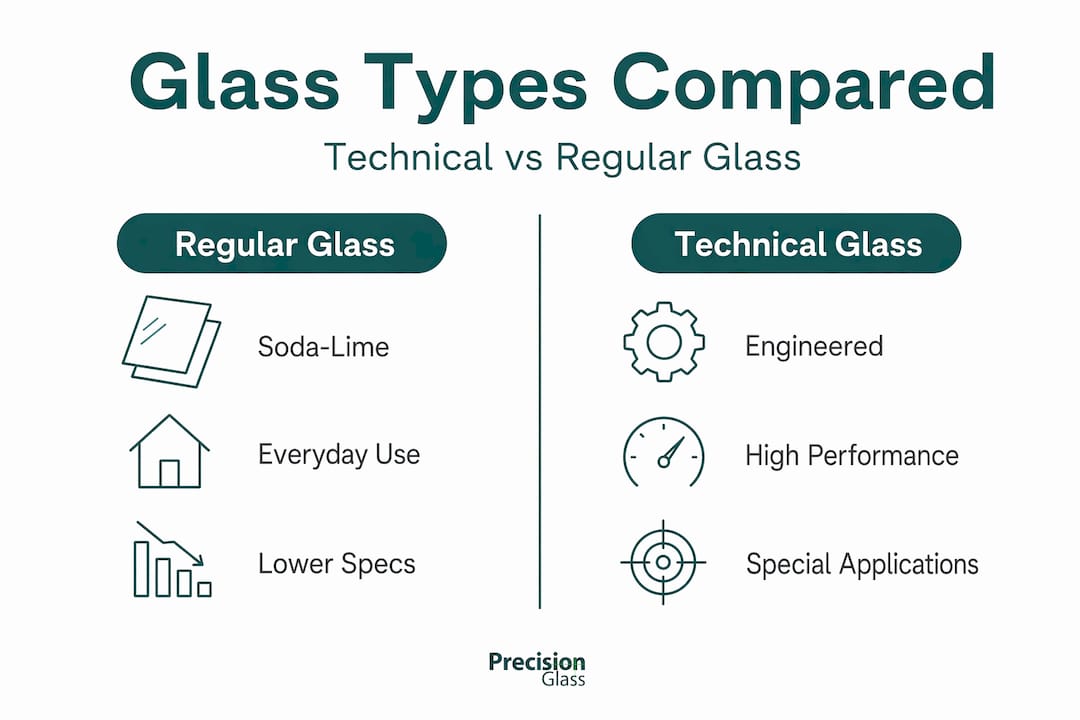
| Property | Regular (soda-lime) glass | Technical glass |
|---|---|---|
| Thermal expansion coefficient | ~9 × 10⁻⁶/K | 0.55 to 3.3 × 10⁻⁶/K |
| Maximum service temperature | ~250°C | Up to 1,000°C (fused quartz) |
| Chemical resistance | Low to moderate | High to very high |
| Optical precision | Not controlled | Specified and validated |
| Custom engineering | Not available | Standard practice |
The benefits of technical glass over regular glass become clearest under stress. Borosilicate and soda-lime glasses fail in ultra-low temperature environments due to brittleness, while rare earth oxide blends maintain structural integrity down to −273°C.
The practical reasons engineers specify technical glass over regular glass include:
- Predictable, consistent properties batch to batch
- Compatibility with precision seals and mounting systems
- Defined performance across the full operating envelope
- Traceability and certification for regulated industries
For a thorough comparison of advanced glass specifications, Glassprecision provides dedicated guidance for engineers and procurement teams.
My perspective on choosing technical glass
I’ve worked closely with engineers specifying glass components for years, and one pattern repeats itself more than any other. Teams spend considerable effort selecting the right glass type, then specify a mounting or seal material without checking expansion coefficients. The assembly fails at temperature, and the investigation almost always concludes that the glass was fine. The interface was the problem.
What I’ve learned is that understanding the microstructural differences between glass types is necessary but not sufficient. The chalcogenide glasses are a good example. Their infrared transparency is a direct consequence of excluding oxygen from the network structure, but that same structural decision reduces fracture toughness. Selecting them for an infrared imaging application is correct. Expecting them to handle the same mechanical loads as borosilicate is not.
The direction I find most interesting right now is glass with tailored spectral properties. Combinations of rare earth oxides and specialised coatings are producing components that transmit, block, or modify specific wavelength bands with a precision that was not commercially accessible five years ago. For product developers working in medical imaging, defence sensing, or spectroscopy, this is where the most significant material science progress is happening.
The role of technical glass in advanced applications is expanding, not contracting. The engineers who understand material selection at the level of composition and microstructure will make better decisions than those who rely on generic datasheets.
— Alexandra
How Glassprecision supports your technical glass requirements
Glassprecision designs, fabricates, and supplies precision glass components for engineers and researchers who cannot accept approximations. Whether your project demands optical windows for aerospace, sight glasses for chemical processing, or display components for medical devices, Glassprecision’s manufacturing capabilities cover melting, grinding, polishing, toughening, CNC work, and quality assurance to the standards your application demands.

Glassprecision serves defence, aerospace, medical, electronics, automotive, and lighting sectors with equal rigour. Every component is produced to your precise specifications, with full documentation and traceability. If you are developing a new product or upgrading an existing assembly, Glassprecision’s team is available to discuss technical glass solutions tailored to your exact requirements. Contact Glassprecision directly through glassprecision.com to begin the conversation.
FAQ
What is technical glass?
Technical glass is a category of engineered glass materials where composition, microstructure, and manufacturing process are deliberately controlled to meet defined performance criteria including thermal stability, chemical resistance, and optical precision. It differs fundamentally from common soda-lime glass in both material science and intended application.
What are the main types of technical glass?
The principal types of technical glass are borosilicate, fused quartz, chalcogenide, and rare earth oxide blends. Each type offers a distinct combination of thermal, optical, mechanical, and chemical properties suited to specific industrial and scientific applications.
How is technical glass made?
Technical glass is produced through precisely controlled melting of high-purity raw materials, followed by forming, annealing, grinding, polishing, and coating processes. Proprietary calculations determine thickness and tempering parameters for pressure-rated and optically critical components.
What are the benefits of technical glass over regular glass?
Technical glass provides predictable, validated properties across extreme temperature ranges, chemical environments, and mechanical loads that regular soda-lime glass cannot withstand. It also offers batch-to-batch consistency, precision surface quality, and compatibility with certified mounting and sealing systems.
Where is technical glass used?
Technical glass is used in defence optics, aerospace viewports, medical imaging devices, semiconductor manufacturing equipment, infrared cameras, AR/VR displays, automotive dashboards, chemical processing sight glasses, and energy-efficient building glazing.