
Toughened glass is defined as a thermally processed safety glass that is 4 to 5 times stronger than standard annealed glass of the same thickness, engineered to shatter into small, blunt fragments rather than dangerous shards upon failure. Also known as tempered glass in North American markets, the term “toughened glass” is the standard British industry designation recognised under BS EN 12150. Its defining characteristic is not merely strength but a controlled fragmentation pattern that stores internal energy and releases it safely, making it the material of choice for doors, balustrades, shower enclosures, automotive glazing, and a growing range of precision industrial applications.
What is toughened glass and how does it differ from ordinary glass?
Toughened glass is produced by subjecting standard float glass to a controlled thermal tempering process that permanently alters its internal stress profile. The result is a pane with a surface under high compression and a core under tension, a configuration that gives the material its characteristic strength and safety behaviour. Ordinary annealed glass, by contrast, has no such stress profile and breaks into long, sharp shards that cause serious lacerations.
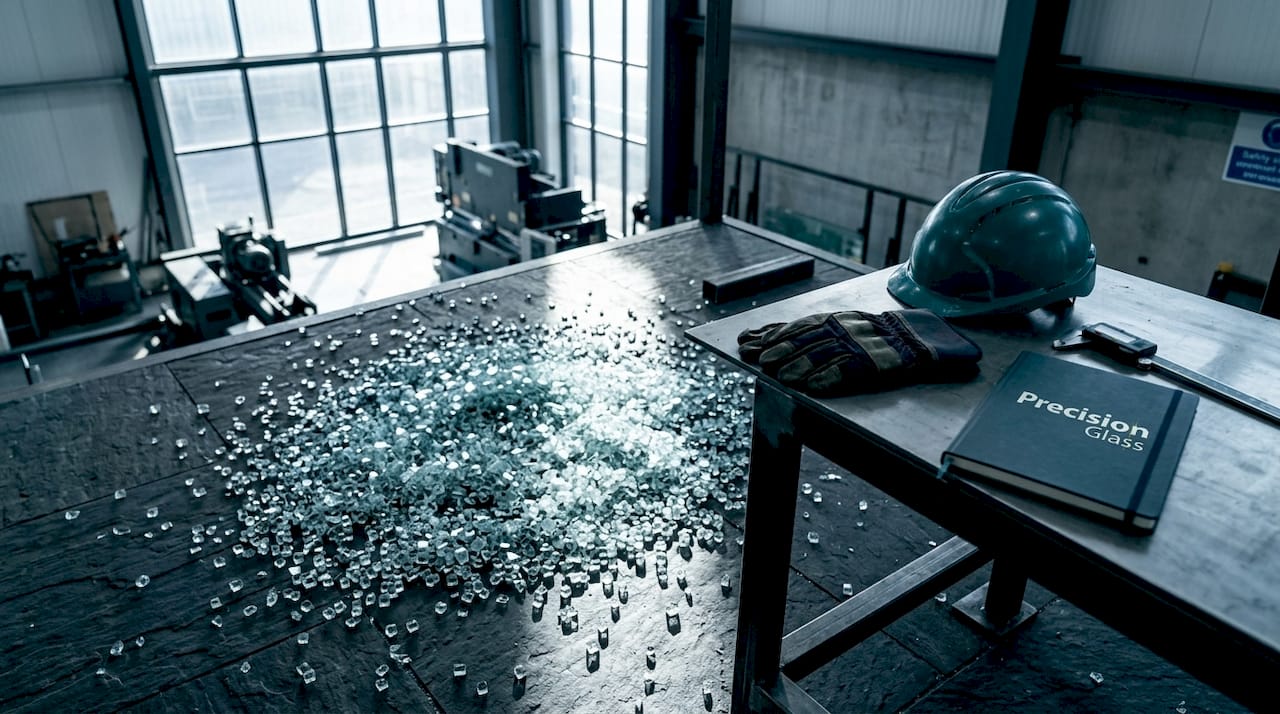
The safety fragmentation pattern of toughened glass is its most consequential property. When the surface compression is overcome, the stored energy releases simultaneously across the entire pane, producing hundreds of small, relatively blunt fragments. This behaviour is what qualifies it as safety glazing under UK regulations and international standards including BS EN 12600.
Toughened glass also carries a permanent kite mark etched into a corner, verifying compliance with BS EN 12150. This marking is the primary means of identification on site and cannot be removed or transferred, making specification verification straightforward for procurement teams and building inspectors alike.
How is toughened glass made?
The manufacturing sequence for toughened glass follows a strict, irreversible order. Every dimension, hole, notch, and edge profile must be finalised before the glass enters the tempering furnace. The process itself proceeds as follows:
- Cutting and sizing. The glass is cut to its final dimensions from float glass stock. Any deviation at this stage cannot be corrected later.
- Edge processing. Edges are ground and polished to remove micro-fractures that could initiate breakage during heating. CNC work for holes and cutouts is completed at this stage.
- Washing and inspection. The prepared pane is cleaned thoroughly and inspected for surface defects before entering the furnace.
- Thermal heating. The glass is heated to above 600°C in a tempering furnace, bringing it close to its softening point and allowing internal stresses to equalise.
- Rapid quenching. High-pressure air jets cool the surfaces rapidly while the core remains hot for a brief period. This differential cooling locks the surface into compression and the core into tension, creating the characteristic stress profile that defines toughened glass.
- Quality control. Finished panes are inspected for optical distortion, surface compression levels, and dimensional accuracy before despatch.
The irreversibility of this process has a direct consequence for design and procurement. All sizing and drilling must be completed prior to tempering. Any attempt to cut, drill, or grind a toughened pane after heat treatment will disturb the stress profile and cause the entire pane to shatter instantly.
Pro Tip: When specifying toughened glass for a project, submit fully dimensioned drawings with all hole positions and edge profiles confirmed before fabrication begins. Late design changes after tempering mean a complete remake, adding cost and lead time.
Quality assurance in toughened glass manufacturing is governed by standards such as BS EN 12150 in the UK and ASTM C1048 in the United States. Manufacturers operating to these standards conduct surface stress measurement using polariscopy and verify fragmentation counts against defined thresholds. For procurement teams sourcing glass for critical applications, understanding these quality standards is as important as understanding the product itself.
What are the key properties and benefits of toughened glass?
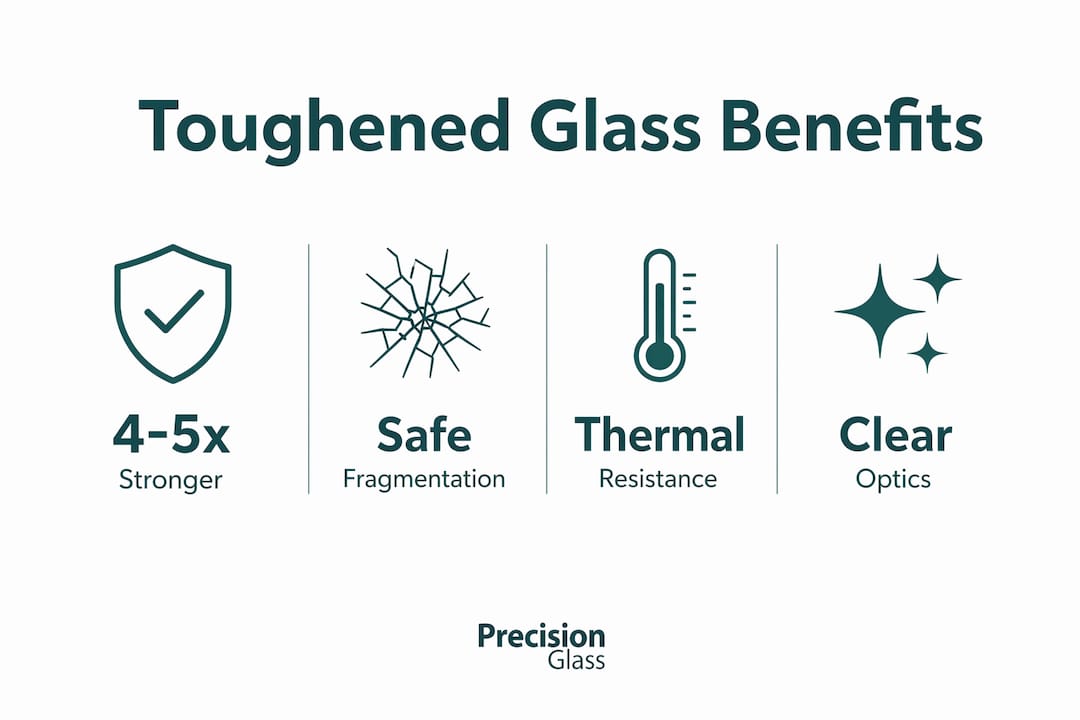
Toughened glass delivers four distinct performance advantages over standard glass, each relevant to different application requirements.
Mechanical strength. Toughened glass is 4 to 5 times stronger than annealed glass of equivalent thickness. This means a 6mm toughened pane resists blunt impact loads that would fracture a 6mm annealed pane outright. The strength gain comes entirely from the surface compression layer, not from any change in the glass composition itself.
Safety fragmentation. Upon failure, toughened glass releases its stored energy in a single event, producing small, blunt fragments across the entire pane. This behaviour is fundamentally different from annealed glass, which breaks into large, sharp shards, and from laminated glass, which cracks but remains bonded to its interlayer. The fragmentation pattern of toughened glass reduces the risk of serious laceration injuries significantly.
Thermal resistance. Toughened glass withstands thermal gradients considerably better than annealed glass, making it suitable for applications involving rapid temperature changes, such as oven doors, fire-rated screens, and automotive rear windows.
Optical clarity. The tempering process introduces minor optical distortion, visible as a faint roller wave pattern under certain lighting conditions. For most architectural and industrial applications this is acceptable, but for precision optical components, alternative processing routes may be required.
| Property | Toughened glass | Annealed glass | Heat-strengthened glass |
|---|---|---|---|
| Relative strength | 4 to 5× annealed | Baseline | 2× annealed |
| Fragmentation pattern | Small blunt pieces | Large sharp shards | Large pieces, similar to annealed |
| Safety glazing compliant | Yes (BS EN 12150) | No | Generally no |
| Post-processing possible | No | Yes | No |
| Thermal resistance | High | Low | Moderate |
Pro Tip: Do not substitute heat-strengthened glass for toughened glass in safety-critical locations. The two products look identical but perform very differently upon breakage, and the substitution will fail regulatory inspection.
Where is toughened glass required by UK regulations?
UK building regulations specify precise locations where safety glazing is mandatory. Approved Document K and the associated glazing standard BS EN 12600 define these critical safety locations where toughened or other compliant safety glass must be installed.
The key locations where toughened glass is legally required include:
- Doors and door side panels. All glazing within doors and within 300mm of a door edge, up to a height of 1,500mm from floor level.
- Low-level glazing. Any glazed panel with its lowest edge below 800mm from floor level in a domestic or public building.
- Balustrades and guarding. Glass used as a structural balustrade or infill panel in staircases, mezzanines, and external terraces.
- Shower enclosures and wet rooms. All glazing in shower cubicles and bath screens, where thermal shock and impact risk are elevated.
- Overhead glazing. Rooflights and overhead glazed panels where breakage could result in falling glass.
The rationale behind these requirements is straightforward. Building Regulation Part K identifies locations where accidental human impact is foreseeable and where the consequences of standard glass breakage would be severe. Toughened glass in these locations does not prevent breakage but controls the outcome of breakage in a way that protects occupants.
Compliance is verified by the kite mark etched onto each pane. Building control officers and insurers treat the absence of this marking as non-compliance, regardless of the glass type claimed by the installer.
| Location | Minimum standard | Relevant regulation |
|---|---|---|
| Doors and adjacent panels | Safety glazing BS EN 12600 | Approved Document K |
| Low-level panels below 800mm | Safety glazing BS EN 12600 | Approved Document K |
| Balustrades | Structural safety glazing | BS 6180 / Approved Document K |
| Shower enclosures | Safety glazing BS EN 12600 | Building Regulations Part N |
How does toughened glass compare to heat-strengthened and laminated glass?
Not all heat-treated glass is toughened glass. This distinction matters significantly in specification, and confusing the two is a common and costly error in procurement.
Heat-strengthened glass undergoes a similar heating and cooling process to toughened glass, but the quenching rate is slower. The result is a surface compression of roughly half that achieved in full tempering, giving approximately twice the strength of annealed glass rather than four to five times. Critically, heat-strengthened glass does not meet safety glazing requirements under BS EN 12600, ANSI Z97.1, or CPSC 16 CFR 1201. Its fragmentation pattern produces large pieces similar to annealed glass, which cause serious injury. Heat-strengthened glass is appropriate for applications requiring improved thermal resistance or wind load performance where safety glazing compliance is not required, such as spandrel panels and certain curtain wall infills.
Laminated glass takes a different approach entirely. Two or more glass plies are bonded with a polyvinyl butyral (PVB) or resin interlayer. When laminated glass breaks, the fragments remain bonded to the interlayer and the pane stays in the frame. This characteristic makes laminated glass the preferred choice for overhead glazing, security applications, and acoustic attenuation, where retaining the broken pane in position is more important than the fragmentation pattern. Laminated glass can also be produced using toughened plies, combining the strength of tempering with the retention properties of the interlayer.
One important limitation of fully toughened glass that is rarely discussed in standard specifications is the risk of spontaneous breakage from nickel sulphide inclusions. Nickel sulphide particles present in the raw glass batch can expand after tempering, eventually overcoming the surface compression and causing the pane to shatter without external impact. Heat soaking, a secondary process in which toughened glass is held at elevated temperature for several hours, accelerates this expansion and causes susceptible panes to break in the factory rather than in service. For safety-critical or high-value installations, specifying heat-soaked toughened glass is a recognised risk mitigation measure.
For a detailed comparison of protective glass types relevant to industrial and construction procurement, the distinctions between these three product families are worth examining in full before finalising specifications.
Key takeaways
Toughened glass is the only heat-treated glass type that meets safety glazing requirements, combining 4 to 5 times the strength of annealed glass with a controlled fragmentation pattern that reduces serious injury risk.
| Point | Details |
|---|---|
| Definition and strength | Toughened glass is thermally processed safety glass, 4 to 5 times stronger than annealed glass. |
| Manufacturing constraint | All cutting, drilling, and edge work must be completed before tempering; post-process modification is impossible. |
| Safety compliance | Only fully toughened glass meets BS EN 12150 and BS EN 12600 safety glazing requirements, not heat-strengthened glass. |
| Regulatory locations | UK Approved Document K mandates toughened glass in doors, low-level panels, balustrades, and shower enclosures. |
| Spontaneous breakage risk | Nickel sulphide inclusions can cause post-installation failure; heat soaking mitigates this risk for critical applications. |
Why the manufacturing constraint matters more than the strength figure
Alexandra’s perspective
Most articles about toughened glass focus on the strength comparison with annealed glass, and that number is genuinely useful. What gets far less attention is the manufacturing constraint, and in my experience, this is where specification errors actually occur.
The fact that toughened glass cannot be modified after tempering means that upfront precision in design is not a preference but a technical requirement. I have seen projects delayed significantly because a hole position was revised after fabrication had begun, or because a contractor attempted to trim a toughened pane on site. The pane shatters, the project stalls, and the cost of the remake is compounded by programme delay.
There is also a subtler issue with the strength claim itself. Toughened glass is stronger than annealed glass under uniform load and blunt impact. It is not indestructible. A sharp point impact, such as a corner strike from a hard object, can initiate breakage even in a fully toughened pane. Professionals who understand this select appropriate glass thickness and edge protection details for their specific load cases rather than relying on the strength multiplier alone.
The nickel sulphide spontaneous breakage risk is the third area where I see professionals caught off guard. For most standard applications, the probability is low enough to accept. For overhead glazing, structural balustrades, or any installation where a spontaneous failure would have serious consequences, heat soaking is not optional. It should be written into the specification from the outset, not added as an afterthought when the risk is eventually recognised.
Selecting the right glass type for a given application requires understanding all three of these dimensions: strength, manufacturing constraints, and failure mode. The strength figure alone is not sufficient.
— Alexandra
Precision glass solutions for toughened and technical glass
Glassprecision supplies precision-engineered glass components for defence, aerospace, medical devices, automotive, and industrial applications where dimensional accuracy and material compliance are non-negotiable.

Our fabrication workflow covers the complete sequence from raw material selection through cutting, CNC edge processing, drilling, and quality-assured tempering, with full traceability at every stage. We work to customer-supplied drawings and specifications, completing all geometry before heat treatment to meet the irreversible nature of the tempering process. For applications requiring toughened or technical glass components with precise tolerances, our team provides technical consultation from design through to delivery. Explore our glass fabrication processes or contact us directly to discuss your specification requirements.
FAQ
What is the toughened glass definition in UK standards?
Toughened glass is defined under BS EN 12150 as thermally toughened soda lime silicate safety glass, produced by heating float glass above 600°C and rapidly quenching it to create a surface compression layer. It is classified as safety glazing under BS EN 12600.
Is toughened glass the same as tempered glass?
Yes. Toughened glass and tempered glass describe the same product. “Toughened” is the standard British English term; “tempered” is the equivalent North American designation. Both refer to glass that has undergone thermal tempering to achieve increased strength and safety fragmentation behaviour.
Can toughened glass be cut or drilled after manufacture?
No. Any post-tempering modification will disturb the internal stress profile and cause the entire pane to shatter. All cutting, drilling, and edge processing must be completed before the glass enters the tempering furnace.
Where is toughened glass required by law in the UK?
UK Approved Document K requires safety glazing in doors, panels within 300mm of door edges, glazing below 800mm from floor level, balustrades, and shower enclosures. Compliance is verified by the BS EN 12150 kite mark etched onto each pane.
What is the difference between toughened and heat-strengthened glass?
Heat-strengthened glass is approximately twice as strong as annealed glass, whereas toughened glass is four to five times stronger. Heat-strengthened glass does not meet safety glazing requirements and breaks into large fragments similar to annealed glass, making it unsuitable for safety-critical locations.