

Glass thickness is defined as the nominal measurement of a glass pane or assembly that directly governs its structural capacity, deflection behaviour, safety performance, and integration with framing systems. For engineers and designers working across construction, manufacturing, and specialist sectors, thickness is not a secondary detail. It is the primary specification that determines whether a glazing system passes or fails under load, meets regulatory requirements, and performs reliably over its service life. This guide covers the engineering principles behind thickness selection, practical measurement methods, common assembly benchmarks, and the safety implications that every specification must address.
How is glass thickness determined for different applications?
Glass thickness selection is driven by engineering checks for wind load and deflection limits, not by convention or aesthetic preference. The two primary checks are strength under design pressure and serviceability under deflection limits. Both must be satisfied independently before a thickness is confirmed.
The L/175 rule is the standard serviceability benchmark in commercial glazing. A 2,100 mm tall window, for example, should deflect no more than 12 mm under maximum design load. If a 6 mm monolithic pane deflects beyond that limit, the engineer moves to 8 mm or considers a laminated build-up. The rule ties thickness directly to panel height, meaning taller or wider panes demand proportionally greater thickness regardless of the load magnitude alone.

Support conditions alter the calculation significantly. Thickness selection must consider support conditions such as four-sided framing, two-sided framing, or point-fixing, because each model produces different bending stress distributions across the pane. A point-supported glass fin in a frameless shopfront carries stress concentrations at the fixing locations that a fully framed panel of the same size does not experience. Specifying the same thickness for both is an engineering error.
Key factors that govern thickness selection include:
- Wind load and design pressure: Calculated from building height, exposure category, and local climate data. Higher wind zones require greater thickness or laminated assemblies.
- Panel dimensions: Larger unsupported spans increase bending moments. A 3,000 mm x 1,500 mm pane requires a fundamentally different thickness than a 900 mm x 600 mm unit.
- Support configuration: Four-sided framing distributes load most efficiently. Two-sided and point-supported systems concentrate stress and typically require thicker or laminated glass.
- Installation height: Glazing above 9 metres is subject to stricter deflection and safety requirements in most building codes, directly influencing minimum thickness.
- Thermal and acoustic performance: Thicker panes and laminated interlayers improve both, though these are secondary to structural compliance in most specifications.
Pro Tip: Never select glass thickness from a catalogue without running the deflection check for your specific panel size and support model. A thickness that passes the strength check can still fail serviceability, and that mismatch causes visible bowing and seal failures in IGUs.
Glass thickness comparison: common assemblies and use cases
Understanding lite versus assembly thickness is the single most common source of specification errors in commercial glazing projects. The nominal thickness on a drawing often refers to the full assembly, not the individual pane. A 9/16 inch laminated unit, for instance, comprises two 1/4 inch lites bonded with a PVB or ionoplast interlayer. The framing rabbet must accommodate the full assembly depth, not just one lite.
The table below summarises typical glass thickness assemblies, their composition, and primary applications in commercial and structural contexts.
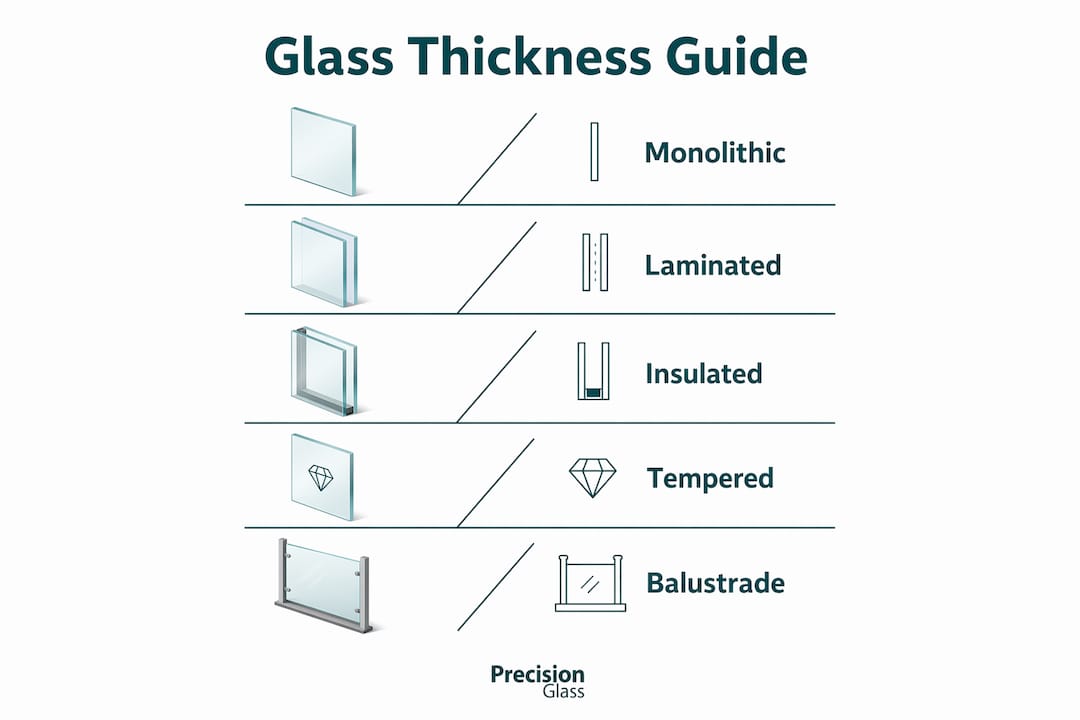
| Assembly type | Nominal thickness | Composition | Typical application |
|---|---|---|---|
| Monolithic annealed | 6 mm | Single pane | Internal partitions, low-load screens |
| Monolithic tempered | 10 mm | Single toughened pane | Shopfronts, doors, low balustrades |
| Laminated safety glass | 17.5 mm | Two 8 mm lites + PVB | Structural balustrades, overhead glazing |
| Laminated (high-rise) | 25.5 mm | Two 12 mm lites + ionoplast | High-rise facades, frameless fins |
| Standard IGU | 28 mm | 6 mm + 16 mm spacer + 6 mm | Commercial windows, curtain walling |
| Structural IGU | 42 mm | 10 mm lam + 16 mm spacer + 10 mm | High-performance facades, acoustic zones |
Typical laminated glass for structural balustrades ranges from 17.5 mm to 25.5 mm depending on application load and post-breakage requirements. This range reflects the engineering demand for residual barrier capacity after one lite fractures, a requirement that monolithic tempered glass cannot meet because it shatters entirely on failure.
Cost implications are significant and often underestimated. Specifying 9/16 inch instead of 7/16 inch glass can add between $60,000 and $100,000 to a 20,000 square foot commercial project without delivering any measurable performance benefit if the thinner option already satisfies the engineering checks. Weight also increases with thickness, affecting dead load on framing, anchor sizing, and handling logistics on site. Designers working on advanced glass specifications must treat thickness as a cost driver, not merely a safety margin.
How to measure glass thickness accurately on site
Accurate measurement of glass thickness on site is a distinct skill from specification work, and errors at this stage cause more field failures than material deficiencies. The process differs between single panes and sealed insulated glass units, and the tools used must match the assembly type.
Follow these steps for reliable on-site measurement:
- Identify the assembly type. Determine whether you are measuring a monolithic pane, a laminated unit, or a sealed IGU before selecting your tool. Each has a different measurement target.
- Select the correct gauge. Glass thickness gauges with jaws opening up to 104 mm and steel frames are the standard tool for on-site measurement. They provide direct contact readings without requiring access to both faces simultaneously, which is critical for installed glazing.
- Measure the overall IGU thickness. For sealed units, measure the full assembly depth including both glass lites and the spacer bar. This is the dimension that must fit within the glazing pocket or rabbet.
- Record individual lite thickness separately. If the unit is being replaced, you need both the overall assembly thickness and the individual pane thickness to specify the correct replacement. These are not interchangeable values.
- Check the rabbet depth. Measuring overall IGU thickness and fitting it correctly within rabbet depth is the step most frequently skipped on site. Tolerance and seating errors cause more installation failures than material strength issues.
- Verify metric and imperial equivalence. Converting between imperial and metric thickness is a common source of procurement errors. Confirm that the measured dimension matches the specified nominal thickness in the units used on the drawing.
Pro Tip: When replacing IGUs in existing framing, always measure the rabbet depth as well as the unit thickness. A replacement unit that is 1 mm thicker than the original will not seat correctly and will compromise the edge seal within months.
Engineering considerations and safety implications of glass thickness
Glass thickness in safety-critical applications is governed by minimum standards that exist independently of structural calculations. The International Building Code (IBC) sets a minimum nominal thickness of 6.4 mm laminated glass for guards and balustrades to maintain barrier function after breakage. This requirement reflects the fundamental difference between laminated and monolithic glass behaviour under impact.
The key safety and engineering considerations for thickness specification are:
- Post-breakage barrier integrity: Laminated glass retains fragments and maintains a physical barrier after fracture. Monolithic tempered glass does not. For any application where a person could fall through a broken pane, laminated construction is the only compliant choice.
- Interlayer selection: Ionoplast interlayers such as SGP provide greater residual stiffness and post-break load resistance than standard PVB. They are the preferred specification for high-rise frameless applications and structural fins where the glass must carry load even after one lite has fractured.
- Acoustic performance: Each additional millimetre of glass thickness increases the mass of the pane and improves sound attenuation. Laminated assemblies with viscoelastic interlayers outperform monolithic glass of equivalent thickness because the interlayer dissipates vibrational energy.
- Thermal performance: Thickness alone has a minor effect on U-value. The spacer width and gas fill in an IGU dominate thermal performance. However, thicker outer lites in a triple-glazed unit improve edge-of-glass performance and reduce condensation risk.
- Regulatory compliance: Building codes in the United Kingdom, including BS 6180 for barriers and BS 6262 for glazing, set minimum thickness requirements by application. These are floors, not targets. The structural calculation may demand greater thickness than the code minimum.
The most common specification error is treating the code minimum as the design target. Code minimums define the threshold of acceptable risk, not the threshold of good engineering. Always run the full calculation and let the result determine the thickness.
Thickness also affects the glass selection process for precision industries, where optical clarity, flatness tolerance, and thermal stability interact with mechanical thickness requirements in ways that standard construction glazing does not encounter.
Key takeaways
Glass thickness is an engineering parameter that must be calculated for each application, verified on site, and specified with full awareness of assembly composition, support conditions, and regulatory minimums.
| Point | Details |
|---|---|
| Thickness is calculated, not assumed | Apply the L/175 deflection rule and wind load checks for every panel size and support condition. |
| Assembly thickness differs from lite thickness | A 28 mm IGU contains two 6 mm lites; specify both dimensions to avoid framing and procurement errors. |
| Laminated glass is mandatory for safety barriers | IBC and BS 6180 require laminated construction for guards and balustrades to retain post-breakage barrier function. |
| On-site measurement determines fit | Measure rabbet depth and full IGU thickness before ordering replacements; seating errors cause more failures than material defects. |
| Over-specification carries real cost | Increasing thickness beyond what calculations require can add tens of thousands of pounds to a commercial project with no performance gain. |
Why thickness specification deserves more rigour than it typically receives
Having worked across structural glazing projects in commercial construction and precision manufacturing, I have seen the same mistake repeated at both ends of the specification scale. Some engineers over-specify thickness as a safety margin, adding 2 mm or 4 mm beyond what the calculation demands because it feels conservative. Others under-specify by defaulting to the code minimum without running the deflection check for their actual panel geometry.
Both approaches are wrong, and both are expensive. Over-specification adds dead load, increases framing depth requirements, and drives up procurement cost without improving performance. Under-specification produces visible deflection, seal failures in IGUs, and in safety-critical applications, genuine risk of post-breakage barrier failure.
The discipline that separates good glass specification from poor practice is treating thickness as the output of a calculation, not the input to one. You start with the load, the panel size, the support model, and the performance requirement. The thickness follows from those inputs. If the result surprises you, check your inputs before you adjust the thickness.
One area where I see consistent gaps is the coordination between glass specification and frame design. A thickness that passes every engineering check can still fail in service if the glazing pocket is too shallow, the setting blocks are incorrectly positioned, or the edge cover is insufficient. Thickness specification and frame design are one integrated decision, not two separate ones. Treating them as separate is where projects accumulate avoidable risk.
— Alexandra
How Precision Glasses supports your thickness specification

Precision Glasses works with engineers and designers across defence, aerospace, medical devices, and construction to deliver glass assemblies built to exact thickness specifications. Whether you are sourcing laminated structural glass for a high-rise balustrade, a precision optical component with tight flatness tolerances, or a custom IGU for a demanding facade application, our fabrication and quality assurance processes are built around your specification, not a standard catalogue. We provide consultation at the design stage to confirm that thickness, interlayer selection, and framing integration are coordinated from the outset. Explore our engineered glass solutions or review our technical glass product range to discuss your project requirements with our team.
FAQ
What does glass thickness actually determine in a structural application?
Glass thickness determines bending strength, deflection under load, post-breakage behaviour, and compatibility with framing systems. It is the primary variable in both strength and serviceability calculations for any glazed assembly.
What is the minimum thickness for a safety glass balustrade?
The IBC sets a minimum nominal thickness of 6.4 mm laminated glass for guards and balustrades. In practice, structural balustrades typically require between 17.5 mm and 25.5 mm laminated glass to meet post-breakage load requirements.
How do I measure the thickness of an installed IGU?
Use a glass thickness gauge with jaws that open to at least 104 mm to measure the full assembly depth from the outer face of one lite to the outer face of the other. Record this figure alongside the individual lite thickness and the rabbet depth before specifying a replacement.
What is the difference between lite thickness and assembly thickness?
Lite thickness refers to a single pane within a laminated or IGU assembly. Assembly thickness is the full nominal dimension including all lites, interlayers, and spacers. A 28 mm IGU, for example, contains two 6 mm lites and a 16 mm spacer, not a single 28 mm pane.
Does increasing glass thickness always improve thermal performance?
No. Thermal performance in an IGU is dominated by spacer width, gas fill, and low-emissivity coatings rather than glass thickness alone. Increasing lite thickness adds mass and improves acoustic performance but has a negligible effect on U-value in most commercial glazing configurations.