Glass durability optimisation is defined as the systematic application of compositional tuning, thermal or chemical strengthening, lamination, and protective coatings to extend the mechanical and functional lifespan of glass components in demanding industrial environments. For engineers in aerospace, automotive, and medical devices, getting this right is not optional. A windshield that delaminates under pressure or an optical window that micro-scratches during sterilisation represents a failure of specification, not just material. This article covers the leading glass durability techniques in 2026, from borate network modifications and ion-exchange parameters to SentryGlas Plus interlayers and hydrophobic surface treatments, so you can select and implement the right approach for your application.
How to optimise glass durability: composition as the foundation
The most direct route to improving glass strength begins at the formulation stage. Compositional tuning allows engineers to target specific mechanical, optical, or radiation-shielding properties before any post-processing takes place. For aerospace and medical applications in particular, multifunctional glass optimisation has moved well beyond simple hardness targets.
Borate network glasses modified with B2O3 and Bi2O3 demonstrate a measurable shift in both photonic behaviour and gamma-ray attenuation. This matters for applications such as nuclear medicine imaging equipment or satellite sensor windows, where a single material must perform across optical and radiation-shielding requirements simultaneously. The ability to tune these properties without compromising structural integrity is what makes borate glass systems a serious option for high-precision industries.

Aluminosilicate glass remains the preferred base for chemical strengthening because of its aluminium oxide content, which facilitates deeper ion exchange. Borosilicate glass, by contrast, offers superior chemical durability and thermal stability, making it the standard choice for laboratory and medical device applications where mechanical impact is a secondary concern. Selecting the right base composition is the first decision, and it constrains every subsequent process.
| Glass type | Primary strength | Typical application | Durability feature |
|---|---|---|---|
| Aluminosilicate | High surface compressive stress | Touchscreens, optics, aerospace | Ion-exchange compatible, high CS |
| Borosilicate | Chemical and thermal resistance | Medical devices, lab equipment | Stable under sterilisation cycles |
| Borate (modified) | Multifunctional tuning | Radiation shielding, photonics | Optical and shielding properties combined |
| Soda-lime | Cost-effective structural use | Automotive, architectural | Thermal tempering compatible |
Pro Tip: When specifying a glass composition for a new application, start from the hazard profile rather than material preference. A reverse-engineering approach from performance target to composition to manufacturability consistently produces better durability outcomes and reduces late-stage redesign.
How do thermal and chemical strengthening methods compare?
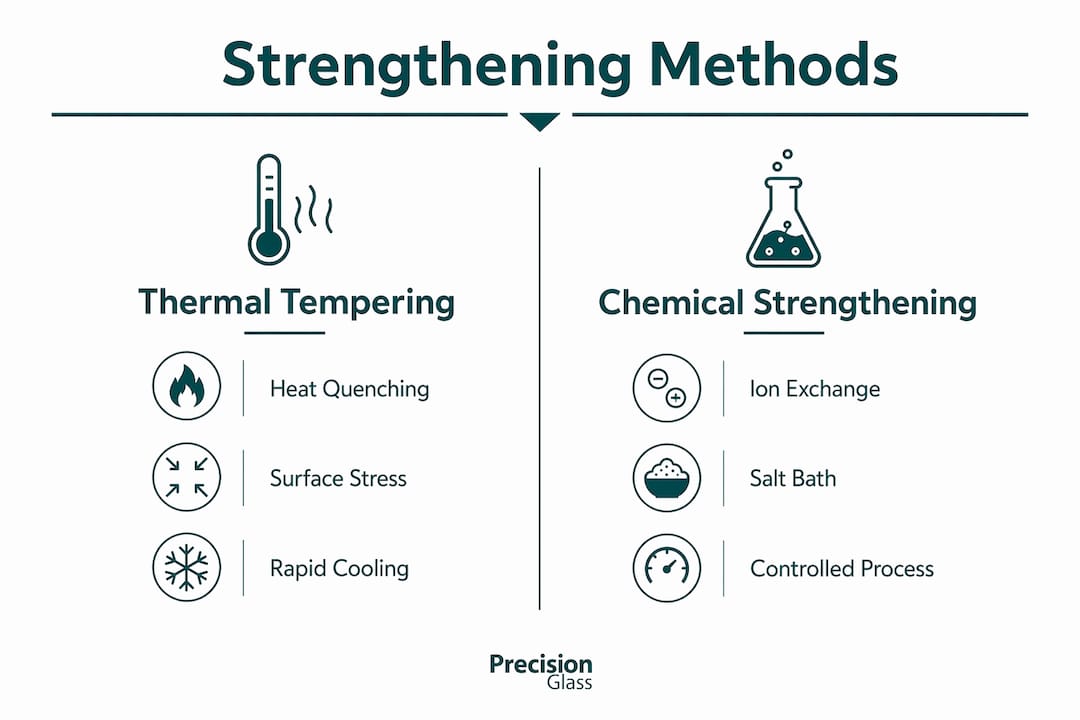
Thermal tempering and chemical strengthening are the two principal methods for improving glass strength after forming, and they operate through fundamentally different mechanisms. Choosing between them depends on geometry, thickness, optical requirements, and the nature of the mechanical hazard.
Thermal tempering heats glass to above its transition temperature and then quenches it rapidly with air. The surface cools and contracts faster than the core, placing the surface in compression and the interior in tension. This process is well-suited to large architectural and structural glass panels where standardisation and production throughput are priorities. However, thermal tempering introduces optical distortions and is sensitive to edge quality, which makes it unsuitable for precision optics or thin substrates. Once tempered, the glass cannot be cut or drilled without shattering.
Chemical strengthening via ion exchange works by immersing glass in a molten salt bath, typically sodium nitrate (NaNO3), where smaller sodium ions in the glass surface are replaced by larger potassium ions. This substitution creates a compressive stress layer without heating the glass above its transition temperature. Aluminosilicate glass achieves surface compressive stress of up to 1,200 MPa through this process, while borosilicate glass achieves approximately 55% lower compressive stress with a depth of layer roughly 89% shallower. That gap in performance is significant when specifying for impact resistance.
Process control is where chemical strengthening most often fails in production. Central tension must remain below 40 to 50 MPa to avoid spontaneous fracture, and NaNO3 bath concentration above 0.5 wt% reduces surface compressive stress by approximately 25%. These are not theoretical concerns. Bath contamination and inadequate monitoring are the most common causes of field failures in chemically strengthened components.
Chemical tempering suits thin, optics-critical glass, such as endoscope windows or heads-up display substrates, while thermal tempering is preferred for large structural panels where size capability and cost efficiency take precedence.
| Parameter | Thermal tempering | Chemical strengthening |
|---|---|---|
| Surface compressive stress | 70 to 150 MPa (typical) | Up to 1,200 MPa (aluminosilicate) |
| Depth of compressive layer | 20 to 25% of thickness | 10 to 50 µm (process-dependent) |
| Minimum thickness | ~4 mm | <1 mm possible |
| Post-process cutting | Not possible | Possible before strengthening only |
| Optical distortion risk | Moderate to high | Low |
| Best application | Large structural panels | Thin optics, precision components |
Pro Tip: Monitor salt bath purity continuously during ion exchange. Contamination from dissolved glass constituents accumulates over production runs and silently degrades compressive stress values. Scheduled bath replacement and inline conductivity monitoring are non-negotiable for consistent output.
What role do lamination and interlayers play in enhancing glass durability?
Laminated glass is defined as two or more glass plies bonded by a polymeric interlayer, and its primary contribution to durability is post-breakage performance rather than pre-breakage strength. When one ply fractures, the interlayer retains fragments, maintains residual load capacity, and prevents penetration. This makes lamination the standard approach for automotive windscreens, blast-resistant glazing, and structural overhead applications.
The choice of interlayer material has a direct and measurable effect on structural performance. SentryGlas Plus (SGP) interlayers are approximately five times stronger and 100 times stiffer than standard polyvinyl butyral (PVB), and this difference roughly doubles the design pressure rating of a window system. For aerospace cabin windows or medical imaging enclosures subject to pressure differentials, that margin is not a luxury. PVB remains appropriate for standard automotive applications where cost and acoustic performance are the primary drivers, but SGP is the correct specification wherever structural load sharing matters.
Structural laminate design must account for load safety with one broken ply, use temperature-specific shear modulus values for the interlayer, and address edge polish quality to prevent delamination initiation. These requirements are frequently underspecified in procurement documents, leading to premature failures that are attributed to the glass rather than the design.
Key design and inspection considerations for laminated glass durability:
- Specify edge polish grade to the relevant standard (EN ISO 12543 or equivalent) and inspect edges before assembly, not after.
- Use heat-strengthened rather than annealed glass plies in structural laminates to improve post-breakage behaviour and residual load capacity.
- Apply temperature-specific shear modulus values for the interlayer when calculating deflection and stress under service loads.
- Verify that the laminate specification complies with the relevant application standard (EN 14449 for structural use, ANSI Z97.1 for safety glazing).
- Inspect for delamination, bubbles, and edge seal integrity at incoming goods inspection and at defined service intervals.
For guidance on fabrication tolerances and laminated glass specifications, working with a manufacturer who understands structural laminate design from the outset avoids costly redesign later.
How can protective coatings improve glass lifespan and performance?
Protective coatings represent one of the most cost-effective glass optimisation methods available, yet they are frequently treated as an afterthought rather than a design decision. Coatings bond directly to the glass surface, filling microscopic pores and creating hydrophobic and oleophobic layers that reduce scratch risk and dirt adhesion. The practical result is a surface that maintains optical clarity over a longer service life and requires less aggressive cleaning, which itself is a source of micro-abrasion damage.
For medical device glass, hydrophobic coatings reduce protein adhesion and simplify decontamination protocols. For automotive heads-up display glass, oleophobic treatments prevent fingerprint contamination that degrades optical transmission. In aerospace sensor windows, hard coatings based on diamond-like carbon (DLC) or silicon dioxide (SiO2) provide abrasion resistance in environments where particulate impact is a routine hazard. Each of these is a distinct coating chemistry selected for a specific degradation mechanism.
The maintenance benefit compounds over time. A coated surface that resists micro-scratching retains its original surface roughness, which directly preserves optical performance metrics such as haze and transmittance. An uncoated surface that accumulates micro-scratches over cleaning cycles will eventually require polishing or replacement, both of which carry cost and downtime implications.
Pro Tip: Match the coating chemistry to the cleaning regime, not just the application. A hydrophobic coating that degrades under isopropyl alcohol will fail in a medical environment regardless of its initial performance. Request compatibility data for your specific cleaning agents before specifying any surface treatment.
Key takeaways
Optimising glass durability requires aligning composition, strengthening method, laminate design, and surface coating to the specific mechanical and environmental hazards of the application.
| Point | Details |
|---|---|
| Start with composition | Select aluminosilicate, borosilicate, or modified borate glass based on the primary performance requirement before specifying any post-processing. |
| Match strengthening to application | Use chemical ion exchange for thin optics-critical components and thermal tempering for large structural panels. |
| Specify interlayer carefully | SGP interlayers provide five times the strength of PVB and are the correct choice wherever structural load sharing is required. |
| Control process parameters | Monitor central tension and salt bath purity in chemical strengthening to prevent spontaneous fracture in production. |
| Treat coatings as a design decision | Select coating chemistry based on the specific degradation mechanism and cleaning regime, not as a generic add-on. |
Why the method-to-hazard match is the decision that matters most
The technical literature on glass durability is extensive, and the temptation for product developers is to reach for the highest-performing option in each category. Maximum compressive stress, stiffest interlayer, hardest coating. In practice, this approach produces over-engineered components that are difficult to manufacture, expensive to procure, and occasionally less safe than a correctly specified alternative.
The insight I return to consistently is that stronger glass is not always better. A thermally tempered panel fractures into small, relatively harmless fragments. A chemically strengthened panel with excessive central tension can fracture spontaneously and catastrophically. The fragmentation behaviour is part of the safety specification, not a secondary consideration.
What I find underappreciated in most engineering briefs is the role of edge quality and hardware compatibility in long-term durability. A perfectly specified glass substrate will fail prematurely if it is mounted in a frame that introduces point loads at the edge, or if the edge finish introduces sub-surface flaws that propagate under cyclic loading. The glass is often blamed, but the failure mode is systemic.
Looking ahead, the most significant development in glass durability techniques for 2026 and beyond is the maturation of multifunctional compositional tuning. Borate and aluminosilicate systems that simultaneously address optical transmission, radiation shielding, and mechanical strength are moving from research into production specifications for aerospace and medical imaging. This is not incremental improvement. It represents a genuine shift in how glass is selected for critical applications, and engineers who understand emerging glass technologies for these sectors will be better positioned to specify correctly from the outset.
The balance between durability and optical performance remains the central tension in precision glass engineering. Coatings that maximise scratch resistance can introduce haze. Strengthening processes that maximise compressive stress can introduce birefringence. Every specification is a set of trade-offs, and the engineer who understands those trade-offs makes better decisions than one who simply specifies to the highest available grade.
— Alexandra
Precision Glasses: engineered glass solutions for demanding applications
Precision Glasses designs, fabricates, and supplies custom glass components for aerospace, automotive, medical devices, defence, and electronics. Whether you are specifying chemically strengthened optical windows, SGP-laminated structural panels, or coated precision substrates, our team works from your performance requirements through to delivery. Explore our technical glass products or review our full sector capabilities to find the right solution for your application. For complex specifications, our engineering team is available to support composition selection, strengthening method assessment, and coating compatibility review from the earliest design stage.
FAQ
What is the most effective method for improving glass strength?
Chemical ion exchange is the most effective method for surface compressive stress, achieving up to 1,200 MPa in aluminosilicate glass. Thermal tempering is preferred for large structural panels where throughput and cost efficiency are priorities.
How does SentryGlas Plus differ from standard PVB in laminated glass?
SGP interlayers are approximately five times stronger and 100 times stiffer than PVB, roughly doubling the design pressure rating of a laminated window system. This makes SGP the correct specification for structural and blast-resistant applications.
What process parameters are critical in chemical strengthening?
Central tension must remain below 40 to 50 MPa to prevent spontaneous fracture, and NaNO3 bath concentration above 0.5 wt% reduces surface compressive stress by approximately 25%. Continuous bath monitoring is required for consistent production quality.
When should protective coatings be specified for industrial glass?
Protective coatings should be specified whenever the glass surface will be subject to repeated cleaning, particulate abrasion, or contamination. Hydrophobic and oleophobic coatings preserve optical clarity and extend service life by reducing micro-scratch accumulation.
Which glass composition suits aerospace multifunctional applications?
Modified borate glasses incorporating B2O3 and Bi2O3 are suited to applications requiring simultaneous optical and radiation-shielding performance, such as aerospace sensor windows and nuclear medicine imaging components.