

Advanced glass materials are engineered substrates that deliver precise combinations of thermal stability, optical clarity, chemical resistance, and mechanical strength unavailable in conventional materials. For engineers specifying components in aerospace, defence, medical devices, and automotive systems, the question of why choose advanced glass materials comes down to one fact: no polymer or metal simultaneously offers broad UV-to-IR transmission, sub-10 nm surface smoothness, and resistance to aggressive chemical environments. Materials such as fused silica, borosilicate glass, and sapphire-based composites each occupy specific performance envelopes that make them the only viable choice for critical applications. Precision Glasses works with these engineered glass types daily, and the performance data consistently justifies the specification.
Why choose advanced glass materials over metals and polymers?
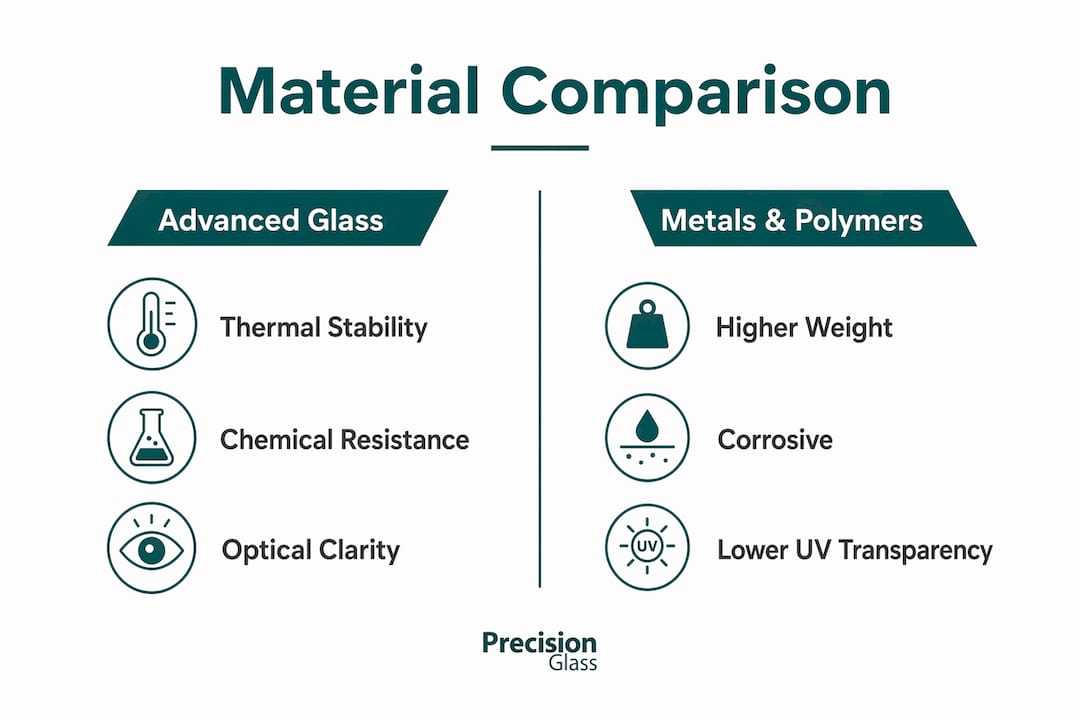
Advanced glass materials deliver a property combination that metals and polymers cannot replicate. Fused silica has a thermal expansion coefficient of just 0.55 × 10⁻⁶ per °C, superior chemical durability, and transmission spanning UV to infrared. That combination means a single material class can serve optical, structural, and chemical containment roles simultaneously.
The table below compares key properties across material classes relevant to high-precision engineering:
| Property | Advanced Glass (Fused Silica) | Aluminium Alloy | Engineering Polymer (PEEK) |
|---|---|---|---|
| Thermal expansion (× 10⁻⁶ /°C) | 0.55 | 23.6 | 47 |
| UV transmission | Broad (UV to IR) | None | Limited |
| Chemical resistance | Excellent | Moderate | Good |
| Surface roughness achievable | Below 10 nm | ~100 nm | ~500 nm |
| Compressive strength (MPa) | 700–900 | 400–500 | 100–200 |
Engineered glass compressive strength ranges from 700 to 900 MPa, with surface treatments and heat processing further improving structural suitability. That strength figure surprises many engineers who associate glass primarily with fragility. The tensile weakness of glass arises from surface flaws, not from the bulk material. Controlled polishing, toughening, and CNC finishing eliminate most of those flaws in precision components.
Chemical durability is equally significant. Glass resists acids, alkalis, and organic solvents at concentrations that would degrade most polymers within months. For medical device housings, optical windows in chemical reactors, or sensor covers in defence systems, that resistance directly translates to longer service life and lower replacement costs.
Pro Tip: When specifying glass for chemical environments, request a full impurity certificate alongside the standard dimensional drawing. Metallic contaminant levels affect both chemical stability and optical performance, particularly in UV applications.
How do advanced glass materials perform in aerospace and defence?
Aerospace and defence environments impose simultaneous demands that no single alternative material satisfies. Glass components in these sectors must withstand pressure differentials, vibration, radiation exposure, and thermal cycling, all while maintaining optical clarity and dimensional stability.
McDanel Advanced Materials engineers hermetically sealed glass windows for space missions, demonstrating that glass can maintain long-term performance under conditions that cause polymer seals to outgas and metal frames to distort. The hermetic seal integrity of glass-to-metal bonds is a specific advantage in vacuum and pressurised environments.
The advantages of glass materials in aerospace and defence include:
- Radiation resistance. Fused silica and specialty glass grades resist gamma and UV radiation without significant optical degradation, unlike most polymers which yellow and lose transmission within months of exposure.
- Thermal cycling stability. Low thermal expansion prevents dimensional shift across the temperature extremes of high-altitude flight or space orbit, preserving alignment in optical sensor assemblies.
- Weight reduction. Thin glass panels with high specific stiffness replace heavier metal covers in avionics housings and cockpit displays without sacrificing structural integrity.
- Hermetic sealing. Glass-to-metal seals in sensors, inspection systems, and lighting devices provide long-term leak-free performance in pressurised cabins and underwater defence systems.
- Optical precision. Ground and polished glass windows maintain sub-wavelength surface form accuracy, which is critical for targeting optics, LIDAR systems, and infrared imaging.
The emerging glass technologies being adopted in aerospace reflect a broader shift: engineers are specifying glass not as a passive cover but as an active functional component with defined optical and structural roles.
What makes advanced glass ideal for medical devices and UV applications?
Medical device and UV lamp applications impose the strictest purity requirements of any glass specification. The benefits of advanced glass in these sectors depend almost entirely on impurity chemistry rather than bulk geometry.
UV-grade fused silica with controlled OH content maintains high UV transmission and resists solarisation, directly extending lamp service life. The YT-2430 quartz tube from LUMIGLAS demonstrates stable UV output over extended operating periods because low metallic impurity levels prevent the photochemical reactions that cause optical darkening. That stability matters enormously in germicidal UV systems and phototherapy devices where output consistency is a regulatory requirement.
Key performance criteria for medical and UV glass specifications include:
- OH content control. Low-OH grades (below 10 ppm) are specified for UV lamp envelopes to minimise absorption at 185 nm and 254 nm wavelengths. High-OH grades suit deep UV spectroscopy where different transmission windows are required.
- Metallic impurity limits. Impurity chemistry including OH content and metallic contaminants critically affects UV-induced solarisation and optical degradation. Specifying maximum parts-per-billion levels for iron, copper, and aluminium is standard practice for UV-grade components.
- Dimensional consistency. Medical device housings require tight tolerances on wall thickness and concentricity to maintain consistent arc gap geometry in discharge lamps and uniform flow paths in microfluidic devices.
- Surface purity. Polished internal surfaces free from grinding residue prevent contamination of sterile fluid paths in diagnostic equipment.
Pro Tip: Always request OH-content certification alongside standard material certificates when specifying UV-grade fused silica. A grade mismatch between low-OH and high-OH material is invisible to dimensional inspection but will cause premature output degradation in service.
The importance of advanced glass in medical applications extends beyond UV lamps. Optical windows in endoscopes, cover glasses for implantable sensors, and substrates for microfluidic diagnostics all rely on the same combination of chemical inertness and optical precision.
What innovations in surface treatments improve automotive display glass?
Automotive display glass has become one of the most specification-intensive glass applications in volume manufacturing. Drivers and passengers interact with instrument clusters, infotainment screens, and head-up display combiners in highly variable lighting conditions, from direct sunlight to night driving with LED cabin lighting.
Corning’s SurfaceIQ anti-reflective treatment reduces automotive display glare and improves contrast, earning recognition at the CES 2026 Innovation Awards for in-vehicle entertainment display improvements. That recognition reflects a genuine engineering advance. Conventional anti-reflective coatings optimised for indoor use perform poorly under direct sunlight, where high ambient luminance overwhelms the contrast benefit.
The process for specifying and validating automotive display glass coatings follows a defined sequence:
- Define the lighting environment matrix. Specify performance requirements across direct sunlight (100,000 lux), overcast daylight (10,000 lux), and interior LED illumination (500 lux). A coating that passes indoor lab testing may fail the sunlight condition.
- Set haze and gloss targets. Anti-glare surface etching reduces specular reflection but introduces haze. Acceptance testing must account for how haze shifts perceived image sharpness under different LED spectral outputs.
- Validate contrast ratio at angle. Automotive displays are viewed at oblique angles from driver and passenger positions. Coating performance at 30 and 45 degrees from normal incidence must be measured, not assumed from on-axis data.
- Confirm durability against cleaning agents. In-vehicle surfaces are cleaned with alcohol-based products. The coating must maintain optical performance after repeated chemical exposure, verified by standardised abrasion and chemical resistance testing.
The automotive glass fabrication process at Precision Glasses incorporates these validation steps as standard, because a display glass component that fails in the field creates warranty and safety consequences that far outweigh the cost of thorough upfront testing.
How does glass function as a substrate for RF and optical packaging?
Glass substrates have become the preferred platform for millimetre-wave and sub-terahertz packaging, as well as co-packaged optics in data centre transceivers. The reasons are specific and quantifiable.
Glass substrates offer dielectric constants from 3.7 to 21, tunable coefficients of thermal expansion from 3 to 12 ppm/K, and surface roughness below 10 nm. Those three parameters together determine signal integrity at mmWave frequencies, dimensional stability during thermal cycling, and the precision achievable in photolithographic patterning.
The engineering trade-offs in glass substrate selection for RF packaging are:
- Dielectric constant selection. Lower dielectric constants reduce transmission line losses at high frequencies. Higher values enable compact antenna designs. Glass offers a wider tunable range than organic laminates.
- CTE matching. Tunable CTE allows glass to be matched to silicon dies or GaAs chips, reducing thermomechanical stress at solder joints during thermal cycling. Organic laminates cannot match silicon CTE without compromising electrical performance.
- Surface smoothness. Sub-10 nm roughness supports fine-pitch through-glass-via formation and waveguide coupling for co-packaged optics, where alignment tolerances are measured in hundreds of nanometres.
- Large-panel manufacturability. Glass panels scale to large formats more readily than silicon interposers, reducing per-unit cost at volume while maintaining the dimensional precision that organic laminates cannot achieve.
The choice of glass substrate in high-frequency RF systems is a system engineering decision balancing dielectric properties, manufacturability, and dimensional stability. Engineers who treat it as a commodity procurement decision routinely encounter signal integrity failures that trace back to substrate specification, not circuit design.
Key takeaways
Advanced glass materials outperform metals and polymers in demanding applications because they combine thermal stability, optical precision, chemical resistance, and tunable dielectric properties within a single manufacturable substrate.
| Point | Details |
|---|---|
| Thermal and optical superiority | Fused silica’s 0.55 × 10⁻⁶ /°C expansion and UV-to-IR transmission make it irreplaceable in precision optics. |
| Impurity specification matters | OH content and metallic contaminant levels determine UV transmission stability and solarisation resistance in service. |
| Aerospace demands hermetic integrity | Glass-to-metal sealed windows maintain optical clarity and structural integrity through radiation, vibration, and thermal cycling. |
| Automotive coatings need multi-environment testing | Anti-reflective treatments must be validated across sunlight, daylight, and interior LED conditions, not just laboratory benchmarks. |
| RF packaging requires tunable substrates | Glass dielectric constants from 3.7 to 21 and sub-10 nm surface roughness enable mmWave signal integrity that organic laminates cannot match. |
The specification decisions that actually determine outcomes
After years of working with engineers across defence, aerospace, and medical device programmes, the pattern I see most often is this: the glass material itself is rarely the problem. The specification is.
Teams invest considerable effort selecting the correct glass type, then submit drawings with generic material callouts such as “borosilicate glass to BS EN 1748.” That callout says nothing about OH content, metallic impurity limits, surface roughness after polishing, or acceptable subsurface damage depth. The supplier delivers a component that passes dimensional inspection and fails in service within three months.
The engineers who get this right treat glass specification the same way they treat electronic component qualification. They define the performance envelope first, then work backwards to material grade, impurity certificates, and acceptance test criteria. They involve their glass fabricator at the design stage, not after the drawing is released. That early collaboration consistently reduces iteration cycles and eliminates the most common failure modes before they reach prototype.
My honest view is that the importance of advanced glass in high-tech industries is still underestimated at the procurement level. Glass is frequently treated as a passive cover or window rather than a functional component with its own qualification requirements. The optical properties of glass are as precisely engineerable as the electrical properties of a semiconductor. Treating them with equivalent rigour produces equivalent results.
— Alexandra
How precision glasses supports your advanced glass specification
Precision Glasses designs, fabricates, and supplies custom glass components for defence, aerospace, medical device, and automotive programmes where specification accuracy and delivery reliability are non-negotiable.

Whether you are specifying UV-grade fused silica tubes for a medical lamp assembly, hermetically sealed windows for an avionics sensor, or anti-reflective display glass for an automotive instrument cluster, Precision Glasses brings meticulous fabrication and quality assurance to every component. Our precision glass solutions cover the full range of technical and optical glass types, with tailored support from initial specification through final inspection. Explore our sector-specific capabilities to find the right solution for your application.
FAQ
What is advanced glass and how does it differ from standard glass?
Advanced glass, also called engineered or technical glass, is manufactured to precise property specifications including controlled thermal expansion, defined optical transmission bands, and certified impurity levels. Standard float glass does not meet the dimensional, optical, or chemical purity requirements of aerospace, medical, or RF packaging applications.
Is advanced glass worth the cost premium over polymers?
The cost premium is justified when the application requires UV transmission, chemical resistance, thermal stability below 1 ppm/°C expansion, or surface roughness below 10 nm. Polymers degrade under UV exposure, outgas in vacuum, and cannot achieve the surface precision required for optical or RF substrates.
What glass grade should i specify for UV lamp applications?
Specify low-OH fused silica with certified metallic impurity levels for UV lamp envelopes. OH content and metallic contaminants directly determine solarisation resistance and long-term UV output stability.
How do glass substrates compare to silicon interposers for RF packaging?
Glass offers tunable CTE from 3 to 12 ppm/K and large-panel scalability that silicon interposers cannot match at equivalent cost. Silicon provides higher dimensional precision but at significantly greater expense and with limited panel size.
What testing is required for automotive display glass coatings?
Automotive display glass coatings require validation across multiple lighting environments including direct sunlight, overcast daylight, and interior LED conditions. Haze, gloss, contrast ratio at angle, and chemical resistance after cleaning agent exposure must all be measured against defined acceptance criteria.