

Automotive glass is defined by two primary construction methods: laminated safety glass and tempered glass, each engineered for specific vehicle locations and safety outcomes. Understanding the types of automotive glass is not optional for professionals handling repairs, replacements, or performance upgrades. Get the specification wrong and you risk compromising structural integrity, failing regulatory compliance, or triggering ADAS faults. This guide covers every major category of vehicle glazing, from standard tempered side windows to acoustic laminated front doors, with the regulatory and practical context you need to make the right call every time.
1. What are the main types of automotive glass?
Automotive glass differs from standard architectural glass primarily through additional processing for safety and strength, not through different base materials. The float glass used in buildings and the glass used in vehicles starts from the same silica composition. What separates them is what happens next in the manufacturing process.
The two primary categories are:
- Laminated glass: Two or more glass plies bonded together with a polyvinyl butyral (PVB) interlayer. On impact, the glass cracks but the PVB holds the shards in place, preventing penetration and ejection.
- Tempered glass: A single ply subjected to tightly controlled thermal cycles that create compressive stress layers. It is 4–5 times stronger than untreated glass and shatters into small, blunt fragments rather than sharp shards.
Both types are safety glass. The distinction lies in how they fail and where that failure mode is acceptable within a vehicle.
2. Laminated glass: construction, placement, and safety
Laminated safety glass has been the industry standard for windshields since before the Second World War. Its construction bonds two glass plies around a PVB interlayer under heat and pressure. The result is a composite that absorbs impact energy without allowing full penetration.
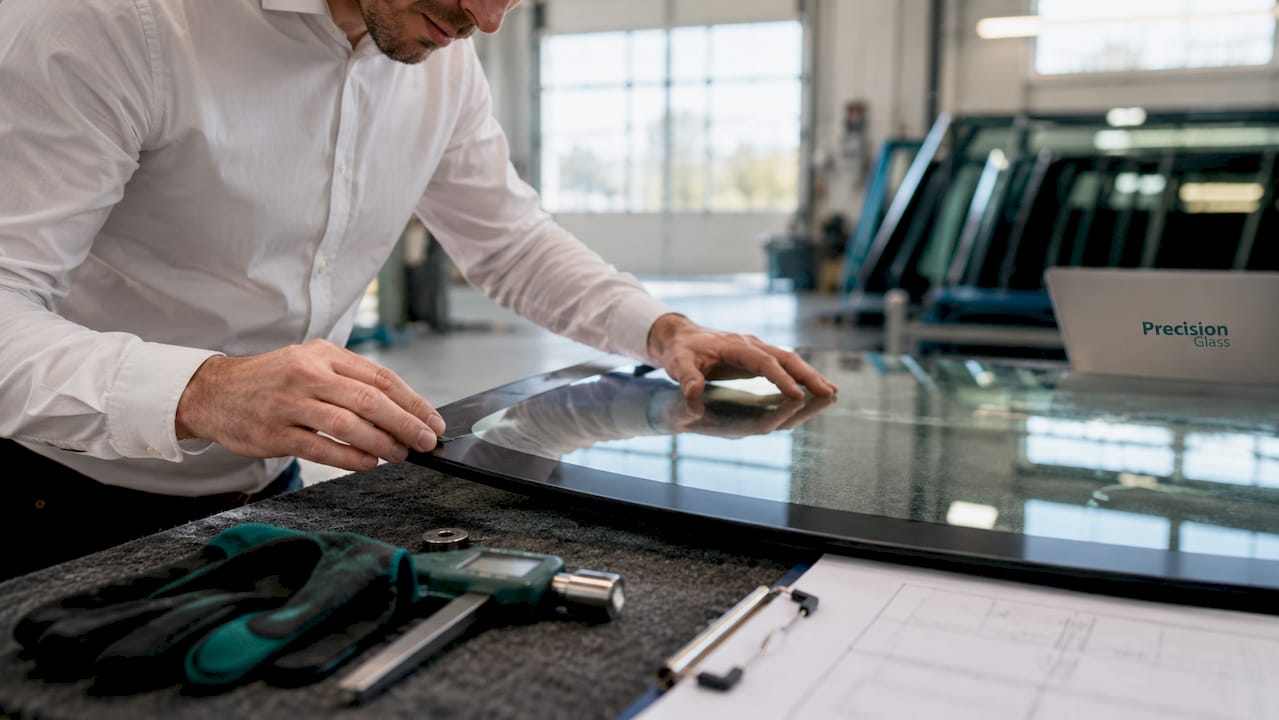
The windshield is the primary application. It must maintain structural integrity during a collision to support airbag deployment and prevent roof crush. A tempered windshield would shatter completely on impact, removing that structural contribution entirely. Panoramic sunroofs on modern vehicles, including those from BMW, Mercedes-Benz, and Volvo, also use laminated glass for the same ejection-mitigation reason.
Laminated glass also provides a secondary benefit: UV filtration. The PVB interlayer blocks the majority of ultraviolet radiation, reducing interior fade and occupant exposure. This is a manufacturing characteristic, not an aftermarket addition.
Pro Tip: When sourcing laminated replacement windshields, verify the PVB interlayer thickness. Acoustic and standard laminated units look identical from the outside but perform very differently in sound attenuation and replacement complexity.
3. Tempered glass: thermal processing and fragmentation behaviour
Tempered glass production involves heating the glass above 600°C and then rapidly cooling it with high-pressure air jets. This rapid quench creates a surface under compression and a core under tension. The result is a glass that resists bending and impact far better than annealed glass.
Tempered glass is used for side and rear windows as standard across passenger vehicles. When it breaks, it disintegrates into small, rounded granules rather than long, blade-like shards. This fragmentation pattern is intentional. It reduces laceration risk for occupants during a side impact or rollover.
The trade-off is that tempered glass cannot be cut or drilled after processing. All shaping, drilling for antenna feeds, and edge finishing must occur before the toughening cycle. This is a critical constraint for fabricators working on bespoke or replacement units. Any post-process modification causes immediate failure.
4. What specialty kinds of vehicle glass exist beyond the two main types?
Specialty automobile glass variations are built on the laminated or tempered base but incorporate additional features at the manufacturing stage. These are not aftermarket modifications. They are engineered into the glass during production, which is why substituting a standard unit for a specialty one is rarely straightforward.
The three most significant specialty categories are:
Privacy glass: Factory-tinted glass produced by adding metal oxides to the glass batch during melting. This is distinct from aftermarket window film, which is applied to the surface. Privacy glass has consistent tint through the full thickness of the pane and does not peel, bubble, or affect structural integrity. It is standard on rear side windows and tailgates across many SUV and MPV platforms.
Acoustic laminated glass: Uses a thicker PVB interlayer, or multiple interlayer plies, engineered to reduce sound transmission. The interlayer acts as a damping layer, absorbing vibration energy before it converts to interior noise. This type is increasingly common in luxury front doors and windshields from manufacturers including Audi, Jaguar Land Rover, and Lexus. Replacement complexity and cost are higher than for standard laminated units.
Heated glass: Incorporates either fine conductive wires embedded within the glass or a transparent conductive coating applied to the surface. Rear screens have used embedded wire heating for decades. Front windshield heating, as used in Ford’s QuickClear technology, uses a finer wire array that does not obstruct the driver’s field of view. Heated glass requires correct electrical connection during replacement; a standard unit cannot replicate this function.
Specialty glass features are embedded at manufacture, which limits aftermarket equivalence. Verify exact OEM specifications before ordering any replacement for a vehicle fitted with these systems.
5. How do safety standards shape automotive glass selection?
Regulatory compliance is not a background consideration for automotive glass. It is the primary constraint on every replacement decision in a professional context.
FMVSS No. 205 requires replacement glazing to meet the vehicle’s original glazing category requirements. This means a replacement windshield must match the optical quality, impact resistance, and structural classification of the OEM unit. Fitting a non-compliant unit creates liability exposure and may void the vehicle’s insurance cover.
Key compliance considerations include:
- Glazing category matching: Each vehicle zone (Zone A for the driver’s primary field of view, for example) has defined optical distortion limits. Replacement glass must meet these limits.
- Marking requirements: Compliant automotive glass carries a permanent mark identifying the manufacturer, glazing type, and applicable standards. Absence of this mark is a red flag.
- Insurance and liability: Fitting non-compliant glass invalidates many insurance policies and creates direct liability for the installer in the event of an injury claim.
ADAS calibration is a separate but equally critical requirement. Windshield replacement triggers ADAS recalibration needs because cameras and radar units are bonded to or aligned through the windshield. Even a visually perfect replacement unit may alter the mounting geometry enough to affect system performance.
Both static and dynamic calibration procedures may be required depending on the vehicle platform. This is not optional. It is a safety-critical step that must follow every windshield replacement on an ADAS-equipped vehicle.
6. How to choose the right car window glass option for your application
Vehicle location is the primary selection factor. The table below maps location to standard glass type and key considerations.
| Vehicle location | Standard glass type | Key considerations |
|---|---|---|
| Front windshield | Laminated | ADAS calibration, acoustic spec, heated option |
| Front side windows | Tempered (laminated on some premium models) | Ejection mitigation rules, acoustic upgrade availability |
| Rear side windows | Tempered or privacy glass | Factory tint spec, ejection mitigation |
| Rear screen | Tempered with heating | Heated element continuity, antenna integration |
| Panoramic sunroof | Laminated or tempered | Generation-dependent; verify OEM spec |
OEM versus aftermarket glass is a genuine decision point, not a cost-versus-quality binary. OEM glass is manufactured to the exact specification of the original unit, including any specialty features. Quality aftermarket glass from suppliers meeting FMVSS No. 205 and ECE R43 standards is acceptable for standard laminated and tempered applications. For acoustic, heated, or ADAS-integrated units, OEM or OEM-equivalent specification is the only safe choice.
Substituting tempered for laminated glass changes the failure mode entirely. A tempered windshield shatters on impact, removing the structural support the laminated unit provides. This is not a permissible substitution under any professional standard.
Pro Tip: Always cross-reference the vehicle’s VIN against the OEM parts catalogue before ordering. Glass specifications can vary within the same model year depending on trim level, production date, and regional market.
Key takeaways
Selecting the correct automotive glass type requires matching construction method, vehicle location, specialty features, and regulatory compliance simultaneously.
| Point | Details |
|---|---|
| Laminated glass is for windshields | Its PVB interlayer maintains structural integrity and prevents ejection on impact. |
| Tempered glass is for side and rear windows | Controlled fragmentation into blunt granules reduces laceration risk during side impacts. |
| Specialty features are factory-built | Acoustic, privacy, and heated glass cannot be replicated by fitting a standard replacement unit. |
| FMVSS No. 205 governs replacements | Every replacement unit must match the original glazing category to maintain compliance and insurance validity. |
| ADAS calibration is mandatory | Any windshield replacement on an ADAS-equipped vehicle requires professional recalibration of bonded sensors. |
Why I think most glass replacement errors are specification errors
The most common mistake I see in automotive glass work is not a fitting error. It is an ordering error. A technician sources a visually matching unit, fits it correctly, and then discovers the vehicle’s lane-keep assist is throwing warnings or the acoustic performance has degraded noticeably. The glass looks right. The problem is that it is not the right glass.
The shift towards acoustic laminated glass in premium front doors and windshields has accelerated significantly. Manufacturers including Audi, BMW, and Jaguar Land Rover now fit acoustic glass as standard across multiple model lines, not just flagship trims. The replacement market has not fully caught up. Many aftermarket catalogues still list a single laminated windshield for a given model without distinguishing between standard and acoustic variants.
My view is that the industry needs to treat acoustic specification with the same rigour it applies to ADAS integration. Both are invisible to the naked eye. Both have measurable consequences when the wrong unit is fitted. The difference is that ADAS faults announce themselves immediately. Acoustic degradation is subtler and often goes unreported by the customer.
The regulatory picture is also tightening. The 2026 Federal Register update to FMVSS No. 205 reinforces that replacement glazing must meet the original vehicle specification, not merely a generic safety standard. For professionals working across multiple markets, staying current with both US and ECE R43 requirements is not optional. It is the baseline.
My practical advice: build a specification verification step into every job workflow before the glass is ordered. Cross-reference the VIN, confirm the glazing zone, check for acoustic or heated variants, and confirm ADAS calibration requirements. That single step eliminates the majority of costly remakes and comebacks.
— Alexandra
Precision Glasses: engineered automotive glass solutions
Precision Glasses designs and fabricates custom automotive glass components to exact OEM and bespoke specifications for professional applications. Whether you are sourcing tempered side window units, laminated windshield assemblies, or specialty acoustic glass for a performance or luxury application, Precision Glasses delivers to precise tolerances with full quality assurance documentation.

Our glass fabrication processes cover the full range of automotive glazing types, including heated glass with embedded conductors and privacy glass with factory-integrated tinting. Every unit is produced under meticulous quality controls aligned with industry standards. Contact Precision Glasses to discuss your specification requirements and receive a tailored solution for your project.
FAQ
What is the difference between laminated and tempered automotive glass?
Laminated glass uses a PVB interlayer to hold shards together on impact and is used for windshields. Tempered glass is heat-treated to shatter into blunt granules and is used for side and rear windows.
Can tempered glass be used as a windshield replacement?
No. Substituting tempered glass for a laminated windshield changes the failure mode and removes the structural support required for airbag deployment and roof integrity. This substitution does not meet FMVSS No. 205 requirements.
What is acoustic laminated glass and where is it used?
Acoustic laminated glass uses a thicker or multi-ply PVB interlayer to dampen sound transmission. It is fitted as standard in the windshields and front door glass of many premium vehicles from manufacturers including Audi, Lexus, and Jaguar Land Rover.
Is ADAS calibration always required after a windshield replacement?
Yes, on any vehicle with cameras or radar bonded to or aligned through the windshield. ADAS recalibration after replacement is a safety-critical requirement, not an optional service.
What does FMVSS No. 205 require for replacement automotive glass?
FMVSS No. 205 requires that replacement glazing meets the same glazing category as the original unit. This covers optical quality, impact resistance, and structural classification for each vehicle zone.