Automotive glass in 2026 is defined as an active, multifunctional engineering platform rather than a passive protective barrier. The glass now manages acoustic comfort, heat load, structural integrity, and digital interfaces within a single laminated system. This shift is most pronounced in electric vehicles and premium cars, where every gram and every watt counts. The automotive glass trends 2026 professionals need to track span ultra-thin substrates, solar-integrated glazing, AI-controlled dimming, and a market now valued at USD 29.64 billion. Understanding these developments is no longer optional for engineers, OEM procurement teams, or materials researchers.
1. What are the top material innovations in automotive glass in 2026?
Ultra-thin laminated glass and polycarbonate composites are the two material shifts defining vehicle glazing this year. Both reduce weight without sacrificing structural performance, which directly extends EV range on a single charge.
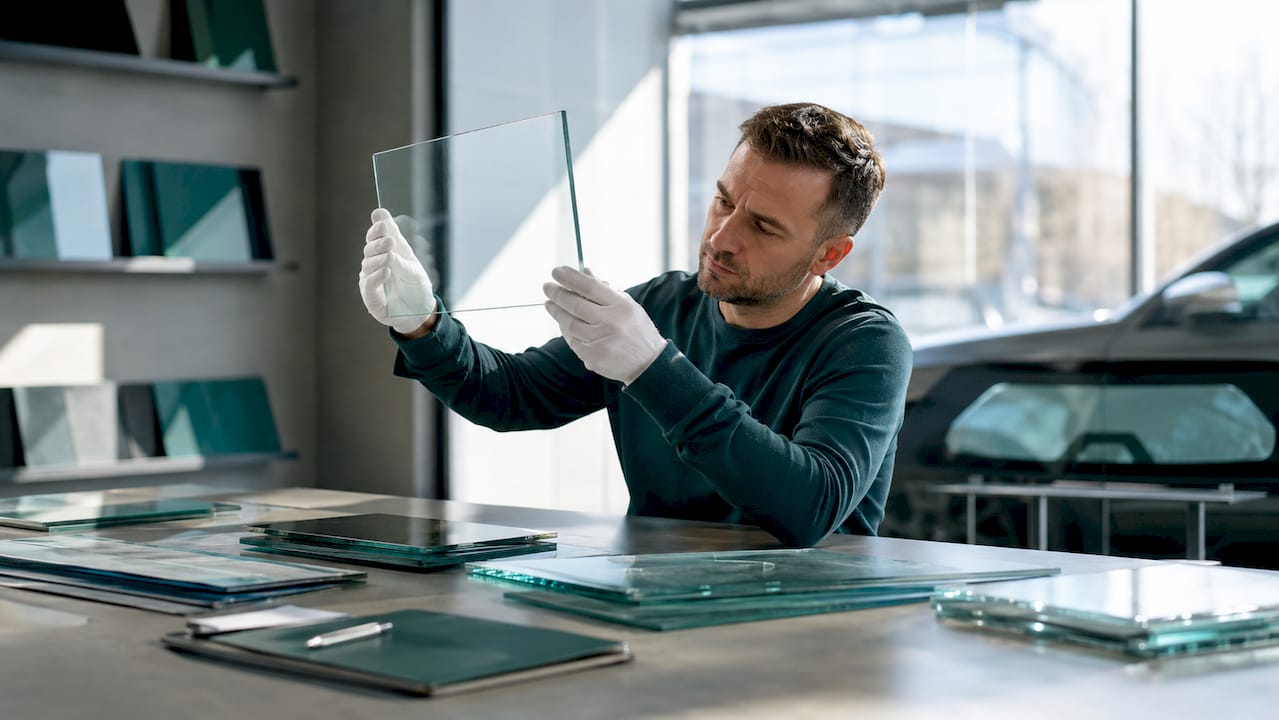
The most significant material development is the integration of perovskite solar cells into automotive glass. Semi-transparent variants achieve 7.6% efficiency, while opaque configurations reach 12%, with durability lasting up to 15,400 hours at 80% of initial efficiency. That lifespan makes them viable for production vehicles, not just concept cars.
Key material advances shaping the market include:
- Ultra-thin laminated glass at sub-2mm thicknesses, reducing glazing weight by up to 30% compared to conventional configurations
- Polycarbonate side windows, adopted by several premium OEMs for rear quarter panels where optical distortion tolerances are less critical
- Semi-transparent perovskite solar films, laminated directly into the glass stack to generate auxiliary power for HVAC and infotainment
- Acoustic interlayers from suppliers such as Eastman, which attenuate cabin noise in EVs that lack the masking effect of a combustion engine
- Spectrally selective coatings, blocking infrared radiation while maintaining visible light transmission above 70%
Pro Tip: When specifying polycarbonate for side glazing, require optical distortion testing to ECE R43 standards. Polycarbonate performs well structurally but can exhibit birefringence under thermal cycling if not correctly stabilised.
2. How are manufacturing techniques changing automotive glass production?
Cold bending is the dominant technique for producing 3D cover glass for instrument clusters and centre stacks in 2026. It is more cost-effective than hot forming because it avoids the energy-intensive furnace cycle required to shape glass at high temperatures.
The trade-off is yield. Cold bending large panels of 15 inches or more suffers an 18–22% yield loss due to optical distortion. That figure represents a significant cost burden at volume, and no supplier has yet published a definitive solution.
Key manufacturing challenges and responses in 2026
- Optical distortion in cold-bent panels. Yield losses of 18–22% on large-format glass are driving investment in inline interferometric inspection systems to catch defects earlier in the process.
- Demand surge for curved cover glass. Demand grew 40% year-on-year in Q1 2026, forcing suppliers to scale capacity rapidly while managing margin pressure.
- Price concessions to secure design wins. Suppliers accepted 15% price reductions on curved cover glass contracts, compressing margins across the supply chain.
- Asian manufacturer entry. New entrants from China and South Korea are bringing lower-cost production methods, accelerating technology diffusion but intensifying price competition.
- Inspection technology investment. Suppliers are adopting automated optical inspection and AI-assisted defect classification to reduce scrap rates on complex curved geometries.
| Manufacturing method | Cost profile | Yield challenge | Best application |
|---|---|---|---|
| Cold bending | Low to medium | 18–22% loss on large panels | Instrument clusters, centre stacks |
| Hot forming | High | Low, well-established | Windshields, complex curvatures |
| Flat lamination | Low | Minimal | Rear windows, simple glazing |
Pro Tip: For large-volume glass production, pair cold bending with real-time interferometric inspection rather than end-of-line sampling. Catching distortion at the bending stage reduces scrap cost by an order of magnitude.
3. What smart and dynamic features define the future of automotive glass?
Intelligent glazing is the fastest-growing segment within the broader vehicle glass market. The shift from static tinting to dynamic, sensor-integrated glass represents a fundamental change in how OEMs specify glazing systems.
AI-controlled liquid crystal dimming is the most commercially advanced smart glass technology in production today. Fuyao, in collaboration with XPENG, deployed AI dimming windshields in 2026 that adjust visible light transmission dynamically from 5% to 60%. The system responds to ambient light, driver gaze, and cabin temperature simultaneously.
Key smart features now entering production or late-stage development:
- AI-controlled liquid crystal dimming, replacing fixed-tint glass in premium EVs with dynamic light management
- HUD-wedge substrates, where the glass is ground to a precise wedge angle to eliminate double-imaging in head-up display systems
- Embedded ADAS sensor windows, requiring multi-stack films to balance lidar signal transparency, solar control, and UV blocking simultaneously
- Electrochromic roof panels, used in vehicles from Mercedes-Benz and BMW to replace mechanical sunblinds
- Photovoltaic laminated roofs, integrating solar generation with structural glazing in a single assembly
“Glass is no longer just a window. It is a climate control surface, an acoustic insulator, a structural member, and a digital interface — all at once.” — Eastman, via AutoTech Insight
The sensor integration challenge is particularly demanding. Simple single-layer coatings cannot satisfy the competing requirements of ADAS transparency, solar rejection, and UV protection. Engineers at Eastman and AGC are developing multi-layer film stacks specifically for this application, and the glass for sensors design space is now one of the most technically complex in the industry.
4. How is the market landscape shaping trends in vehicle glass 2026?
The global automotive glazing market is valued at USD 29.64 billion in 2026 and is projected to reach USD 39.89 billion by 2031 at a CAGR of 6.12%. That growth rate reflects sustained EV platform adoption and the rising content value of multifunctional glazing per vehicle.
The competitive structure is bifurcating. Premium suppliers such as Corning, AGC, and Saint-Gobain compete on optical performance, sensor compatibility, and smart glass integration. At the other end, BYD produces 1.5mm soda-lime glass for rear-seat screens at $4.80 per unit, which is 60% cheaper than Corning’s equivalent. That price point is capturing non-critical interior display applications at scale.
| Supplier tier | Representative companies | Price position | Target application |
|---|---|---|---|
| Premium | Corning, AGC, Saint-Gobain | High | Windshields, HUD, ADAS glazing |
| Mid-tier | Fuyao, Pilkington | Medium | OEM volume glazing, smart glass |
| Low-cost | BYD glass division | Low | Rear-seat screens, non-critical displays |
This bifurcation is forcing premium suppliers to reconsider their application strategies. Defending margin on non-critical interior glass against BYD’s pricing is not viable. The rational response is to concentrate on technically demanding applications where material science and optical precision create defensible differentiation.
Volume and cost efficiency now determine competitiveness as automotive glass moves from a niche engineering material toward a commodity in certain segments. Suppliers that cannot achieve scale in high-value applications face sustained margin compression.
5. What environmental and regulatory factors influence car glass innovations 2026?
Sustainability requirements are reshaping material selection and manufacturing processes across the automotive glass supply chain. These are not aspirational targets. They are design constraints that engineers must satisfy at the specification stage.
- Lightweight glazing mandates. European CO₂ fleet average targets require OEMs to reduce vehicle mass. Switching from conventional 4mm glass to 2mm laminated glass saves approximately 3–4 kg per vehicle, which is meaningful at fleet scale.
- Recycling regulations in Europe. The EU End-of-Life Vehicles Directive revision requires higher recycled content in new vehicles. Laminated glass with PVB interlayers is more difficult to recycle than monolithic glass, creating pressure on interlayer chemistry.
- Thermal management standards. Spectrally selective glass reduces solar heat gain, lowering HVAC energy demand in EVs by an estimated 5–8% in peak summer conditions. That directly extends driving range.
- Safety regulations for laminated glass. ECE R43 and FMVSS 205 mandate laminated construction for windshields in all markets. Emerging regulations in China and the EU are extending laminated requirements to side windows in certain vehicle categories.
- Circular economy incentives. Several European OEMs are piloting closed-loop glass recycling programmes with AGC and Pilkington to recover cullet from end-of-life vehicles for remelting into new automotive glass.
The intersection of thermal management and solar integration is particularly significant. A spectrally selective roof that also generates photovoltaic power addresses two regulatory pressures simultaneously, which explains why OEM interest in this technology is accelerating faster than the efficiency figures alone would justify.
Key takeaways
Automotive glass in 2026 is a multifunctional engineering system where material selection, manufacturing precision, and smart integration determine both vehicle performance and supplier competitiveness.
| Point | Details |
|---|---|
| Solar integration is production-ready | Perovskite solar cells in glass achieve 7.6–12% efficiency with 15,400-hour durability, making them viable for series production. |
| Cold bending yield losses remain unresolved | 18–22% yield loss on large curved panels is the primary cost challenge for cover glass manufacturers in 2026. |
| Market bifurcation is accelerating | BYD’s $4.80 rear-seat glass is 60% cheaper than premium equivalents, forcing premium suppliers to focus on technically demanding applications. |
| Smart glass is moving beyond luxury | AI-controlled dimming and embedded ADAS sensors are entering mainstream EV specifications, not just flagship models. |
| Regulatory pressure drives lightweight glazing | European CO₂ targets and recycling mandates are making ultra-thin laminated glass a compliance requirement, not just a performance choice. |
The part of this story most analysts are missing
The technical press covers solar glass efficiency and AI dimming in detail. What receives less attention is the cross-disciplinary collaboration problem sitting underneath all of it.
I have observed, across multiple projects involving precision glass components for demanding applications, that the hardest part of integrating sensors, solar films, and HUD optics into a single laminated system is not the individual technology. Each layer performs well in isolation. The difficulty is the interaction between layers under real-world thermal cycling, UV exposure, and mechanical stress.
OEMs are specifying glass systems that combine four or five functional requirements simultaneously. The glass supplier, the interlayer chemist, the sensor manufacturer, and the coating house are often working from separate specifications that were never reconciled at the system level. The result is delamination, optical drift, or sensor signal degradation that only appears after 18 months in service.
The suppliers who will win the technically demanding segment of this market are not necessarily those with the best individual technology. They are the ones who can manage the system integration process across disciplines. Fuyao’s collaboration with XPENG on AI dimming is a good example of what this looks like when it works. The glass maker and the vehicle maker co-developed the specification rather than working from separate briefs.
I think solar-integrated glass will become a standard feature on EV roofs within three years, not because the efficiency numbers are compelling on their own, but because the regulatory environment makes any passive roof panel increasingly difficult to justify. The photovoltaic roof solves two problems at once, and that is the kind of engineering argument that moves procurement decisions.
— Alexandra
How Precision Glasses supports advanced automotive glass development
Precision Glasses designs and fabricates precision-engineered glass components for the most demanding automotive applications, from HUD-ready substrates to sensor-compatible laminated assemblies. Our automotive glass fabrication process covers design, grinding, polishing, toughening, and quality assurance to exacting tolerances. We work directly with OEM engineering teams and Tier 1 suppliers to develop tailored solutions that meet optical, structural, and sensor integration requirements simultaneously. If you are specifying glass for ADAS-integrated windshields, electrochromic panels, or high-precision dashboard cover glass, explore our full range of capabilities or contact our technical team to discuss your project requirements.
FAQ
What is the automotive glazing market worth in 2026?
The global automotive glazing market is valued at USD 29.64 billion in 2026 and is projected to reach USD 39.89 billion by 2031 at a CAGR of 6.12%, driven by EV adoption and multifunctional glazing demand.
How efficient are solar-integrated car windows in 2026?
Semi-transparent perovskite solar cells integrated into automotive glass achieve 7.6% efficiency, with opaque variants reaching 12% and a durability of up to 15,400 hours at 80% of initial performance.
What is AI dimming glass in cars?
AI-controlled liquid crystal dimming glass adjusts visible light transmission dynamically from 5% to 60% in response to ambient light, driver gaze, and cabin temperature. Fuyao and XPENG deployed this technology in production vehicles in 2026.
Why do ADAS windshields require multi-stack films?
Simple single-layer coatings cannot simultaneously satisfy lidar signal transparency, solar heat rejection, and UV blocking. Advanced multi-stack film architectures are required to balance all three functions without compromising optical clarity or structural integrity.
What is causing yield losses in automotive cover glass production?
Cold bending of large glass panels (15 inches and above) causes optical distortion that results in 18–22% yield loss. Manufacturers are investing in inline interferometric inspection to detect and reject defective panels earlier in the production process.