UV-blocking glass is defined as glass engineered to absorb or reflect ultraviolet radiation across the 280–400 nm spectrum, preventing it from passing through to the other side. Standard clear glass offers almost no meaningful protection against UVA rays, which makes UV-filtering glass a critical specification in defence, medical, automotive, and conservation applications. Products such as laminated glass with SentryGlas® interlayers and UV-stabilised acrylics like Plexiglas UV100 represent the two main material families in this category. Understanding the difference between these options, and knowing how to verify their performance, is what separates a well-specified component from one that fails in service.
How does UV-blocking glass work?
UV-blocking glass filters ultraviolet radiation through three distinct mechanisms: absorption, reflection, and molecular interference. Each mechanism suits different material types and performance requirements.
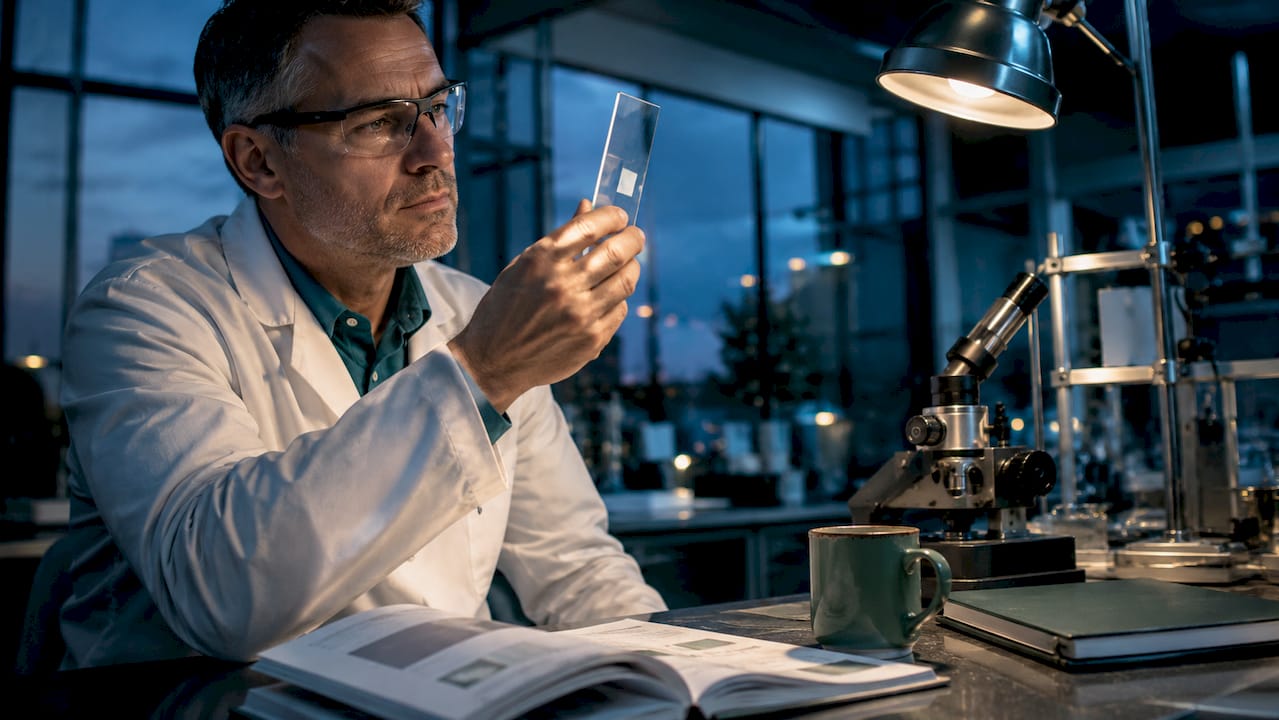
Absorption is the most common approach. UV-absorbing compounds are either embedded in the glass matrix during manufacture or applied as a surface coating. When UV photons strike these compounds, their energy converts to heat rather than passing through. Laminated glass uses plastic interlayers, typically polyvinyl butyral (PVB) or SentryGlas®, which absorb UV at the molecular level. Conservation-grade laminated glass with these interlayers blocks 99% or more of UV radiation, making it the standard choice for museum display cases and archival storage.
Reflection is used in low-emissivity (low-E) coatings. These thin metallic or oxide layers deposited on glass surfaces reflect both infrared and UV wavelengths back before they enter the building. Low-E glass UV control combines thermal and UV management in a single glazing unit, which is why it has become the default specification in energy-conscious architectural projects.
Molecular filtering applies to UV-stabilised polymers such as acrylic and polycarbonate. These materials contain UV-absorbing additives distributed throughout the substrate. The key distinction here matters for procurement:
- UV blocking means the material actively filters UV radiation to a defined attenuation level.
- UV resistant means the material withstands UV exposure without degrading. It does not necessarily block UV from passing through.
Verifying UV blocking requires spectral data at 315 nm for UVB and 365 nm for UVA. Marketing labels alone are not sufficient.
Pro Tip: Always request a spectral transmission curve from your supplier before approving a UV-blocking glass specification. A single graph showing transmission across 280–400 nm tells you more than any product description.
UV-blocking glass vs standard glass: how do they compare?
Standard soda-lime glass blocks most UVB but transmits 70–75% of UVA radiation. UVA penetrates deeper into skin tissue and is the primary driver of interior fading in fabrics, artwork, and flooring. The damage accumulates over months and years without any visible warning sign.
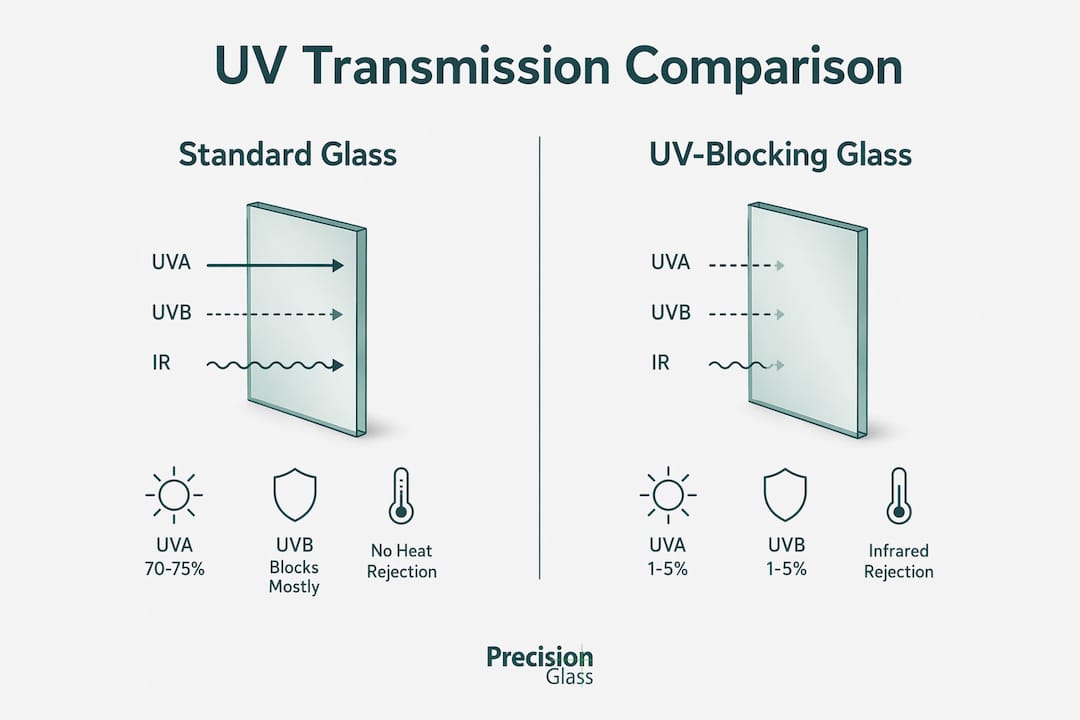
The table below compares UV transmission across three common glazing options.
| Glazing type | UVA transmission | UVB transmission | Notes |
|---|---|---|---|
| Standard clear glass | 70–75% | Low (most blocked) | Offers negligible UVA protection |
| UV-blocking glass | 1–5% | Less than 1% | 95–99% attenuation across 280–400 nm |
| Window film (retrofit) | Approximately 5% | Less than 1% | Reduces UVA from 70–75% down to 5% |
Retrofit window films close much of the gap with built-in UV-blocking glass, but they introduce adhesive layers that can delaminate, discolour, and reduce optical clarity over time. For applications where optical precision matters, such as medical imaging panels or sensor covers, a film is not an acceptable substitute for purpose-made UV-filtering glass.
Beyond UV control, high-performance UV-blocking glass integrated with low-E coatings also rejects infrared heat. This reduces solar heat gain, lowers cooling loads, and improves occupant comfort without sacrificing visible light transmission. The result is a single component that manages UV, heat, and glare simultaneously.
Pro Tip: If you are specifying UV-blocking glass for an interior where colour rendering matters, check the visible light transmission figure alongside the UV attenuation data. Some coatings introduce a slight tint that affects colour accuracy in medical or display applications.
Where is UV-filtering glass used across industries?
UV-protective window glass appears across a wider range of sectors than most engineers initially expect. The performance requirements differ significantly between applications, which is why material selection cannot be generalised.
Museum and conservation glazing. Laminated glass with PVB or SentryGlas® interlayers is the standard for display cases and gallery windows. The 99%-plus UV attenuation rate prevents photochemical degradation of pigments, textiles, and paper. Conservation institutions specify this glass by spectral performance, not by product name.
Automotive glazing. Laminated windshields block up to 98% of UVA, but tempered side and rear windows allow between 4% and 56% of UVA to pass through. This asymmetry means occupant UV exposure varies considerably depending on seating position and window type. Engineers specifying automotive glass components must account for this variation across the full glazing system.
Medical facilities and devices. UV-blocking glass protects patients and staff from incidental UV exposure in environments where UV light sources are used for sterilisation or diagnostics. It also shields sensitive optical sensors and detector arrays from UV-induced noise.
Electronics and sensor covers. UV-filtering glass protects photodetectors, CCD arrays, and display panels from UV-induced degradation. The role of glass in electronics extends to precision covers that must maintain optical clarity while blocking specific wavelength bands.
Architectural and residential glazing. UV-blocking glass for homes and commercial buildings reduces fading of furniture, flooring, and artwork. When combined with low-E coatings, it also contributes to building energy ratings.
Smart glass systems. High-quality smart glass using PDLC film technology blocks up to 99% of UV radiation in both transparent and opaque states. This consistency is a significant advantage over tinted glass, which only reduces UV when the tint is active.
The range of innovative glass applications across these sectors reflects how UV control has moved from a niche requirement to a standard performance parameter in precision engineering.
What technical factors matter when choosing UV-blocking glass?
Selecting the right UV-blocking glass requires more than checking a product datasheet. The following considerations apply to any serious specification process.
Confirm spectral performance at the correct wavelengths. Request transmission data at 315 nm (UVB) and 365 nm (UVA). A product described as “UV blocking” without spectral data is unverified. Spectral measurements at these wavelengths are the only reliable way to confirm attenuation claims.
Match the material to the operating environment. Laminated glass with SentryGlas® interlayers offers high mechanical strength and UV performance but limited flexibility for complex geometries. UV-stabilised acrylics are lighter and easier to form, but acrylics risk distortion above 80°C. Polycarbonate offers impact resistance but scratches more readily and requires hard coating for long-term optical clarity.
Assess the impact on visible light transmission. UV-blocking coatings and interlayers affect how much visible light passes through. In medical imaging or precision optical systems, even a small reduction in transmission or a shift in colour balance can affect performance. Check the visible light transmission figure against your application’s minimum requirement.
Consider thermal performance alongside UV control. Low-E coatings that provide UV blocking also affect the solar heat gain coefficient. In climates where passive solar heating is desirable in winter, a coating that blocks both UV and infrared may reduce heating efficiency. Specify the coating type and position within the glazing unit carefully.
Evaluate retrofit compatibility. If you are adding UV protection to an existing installation, window films offer a lower-cost option. However, films introduce optical distortion, adhesive degradation risk, and maintenance requirements that built-in UV-filtering glass avoids entirely. For precision applications, retrofit films are rarely the correct long-term solution.
Pro Tip: When comparing suppliers, ask for independent third-party test reports rather than in-house spectral data. ISO 9050 and EN 410 are the relevant European standards for solar and UV transmission in glazing. A supplier who references these standards is working to a verifiable benchmark.
Key takeaways
UV-blocking glass achieves 95–99% attenuation across both UVA and UVB bands, making it categorically different from standard glass, which transmits 70–75% of UVA radiation.
| Point | Details |
|---|---|
| Standard glass fails on UVA | Clear soda-lime glass transmits 70–75% of UVA, the primary cause of interior fading and skin damage. |
| Verify with spectral data | Always request transmission curves at 315 nm and 365 nm before approving a UV-blocking glass specification. |
| UV blocking differs from UV resistance | UV blocking filters radiation to a defined level; UV resistance only describes durability under UV exposure. |
| Material choice affects thermal performance | Low-E coatings combine UV and infrared control; acrylics risk distortion above 80°C in high-temperature environments. |
| Applications span multiple sectors | Automotive, medical, conservation, electronics, and smart glass all require UV-filtering glass with different performance parameters. |
Why the industry still gets UV-blocking glass wrong
The most persistent problem I encounter in UV-blocking glass specification is the conflation of UV resistance with UV blocking. These are not interchangeable terms, and treating them as such leads to components that survive UV exposure without actually protecting what is behind them. A polycarbonate cover that is UV resistant will not degrade in sunlight. It will, however, allow a substantial portion of UVA to pass through to the sensor, display, or occupant behind it.
The second issue is over-reliance on windshield performance data when specifying automotive glazing systems. The fact that laminated windshields block up to 98% of UVA is well known. What is less discussed is that side and rear windows can transmit up to 56% of UVA. For vehicle occupants who spend significant time in cars, this asymmetry represents a real and largely unaddressed exposure risk.
The third misconception is that smart glass eliminates the need for UV specification work. Smart glass that uses PDLC technology does block up to 99% of UV consistently, which is genuinely impressive. But the glazing system around it, including frames, seals, and secondary panes, still needs to be specified correctly. UV protection is a system property, not a single-component property.
My advice is straightforward. Treat UV-blocking glass as a precision optical component, not a commodity building material. Demand spectral data. Reference ISO 9050 or EN 410. And match the material to the thermal and mechanical environment it will operate in, not just the UV performance target.
— Alexandra
How Precision Glasses supports UV-blocking glass requirements
Precision Glasses designs and fabricates UV-blocking glass components for defence, aerospace, medical, automotive, and electronics applications. Every component is specified to verified spectral performance standards, with full traceability from material selection through to final quality assurance.
Whether you need conservation-grade laminated glass with SentryGlas® interlayers, UV-stabilised optical covers for sensor arrays, or technical glass solutions for demanding environments, Precision Glasses delivers to your exact specification. Our team works directly with engineers and procurement specialists to confirm material suitability, thermal limits, and optical performance before manufacture begins. Visit Precision Glasses to discuss your UV-blocking glass requirement with our technical team.
FAQ
What is UV-blocking glass, exactly?
UV-blocking glass is glass engineered to absorb or reflect ultraviolet radiation across the 280–400 nm spectrum. It achieves 95–99% attenuation of both UVA and UVB, compared to standard glass which transmits 70–75% of UVA.
Does standard window glass block UV rays?
Standard soda-lime glass blocks most UVB but transmits 70–75% of UVA radiation. UVA is the primary cause of interior fading and long-term skin damage through windows.
What is the difference between UV blocking and UV resistant?
UV blocking means a material actively filters UV radiation to a defined attenuation level. UV resistant means a material withstands UV exposure without degrading, but does not necessarily prevent UV from passing through.
How do I verify that a glass product genuinely blocks UV?
Request a spectral transmission curve showing performance at 315 nm (UVB) and 365 nm (UVA). ISO 9050 and EN 410 are the relevant European standards for solar and UV transmission in glazing.
Can smart glass block UV radiation?
High-quality smart glass using PDLC film technology blocks up to 99% of UV radiation in both transparent and opaque states, making it one of the most consistent UV-blocking glazing options currently available.