
Glass is the foundational medium in modern avionics, enabling integrated digital displays, advanced human-machine interfaces, and multifunctional sensor surfaces that analogue instruments cannot replicate. The term most engineers recognise is “glass cockpit,” the industry-standard label for flight decks where cathode ray tube or LCD panels replace mechanical gauges. Understanding why glass is vital for avionics means examining its material properties, its role in display integration, and the safety data that justifies its dominance. The Boeing 767 glass cockpit, introduced in 1981, was the first production aircraft to eliminate vacuum-pump-driven gyroscopes and the manual corrections they demanded every 15 minutes. That milestone set the trajectory for every glass-based avionics system that followed.
Why glass is vital for avionics display integration
Glass-based displays consolidate navigation, engine, and weather data onto a unified interface, replacing the scattered analogue gauges that forced pilots to scan across an entire instrument panel. The two primary display types are the Primary Flight Display (PFD), which presents attitude, airspeed, altitude, and heading, and the Multifunction Display (MFD), which overlays moving maps, traffic alerts, and engine telemetry. Together they give flight crews a single, coherent picture of aircraft state.
Data integration is the technical backbone of this consolidation. Modern glass cockpit systems cross-reference inputs from GPS receivers, magnetometers, and Attitude and Heading Reference Systems (AHRS) simultaneously. The ARINC 429 data bus, the long-standing standard for civil avionics communication, carries these signals between line-replaceable units in a modular architecture. That modularity means a failed display unit can be swapped without redesigning the entire suite.
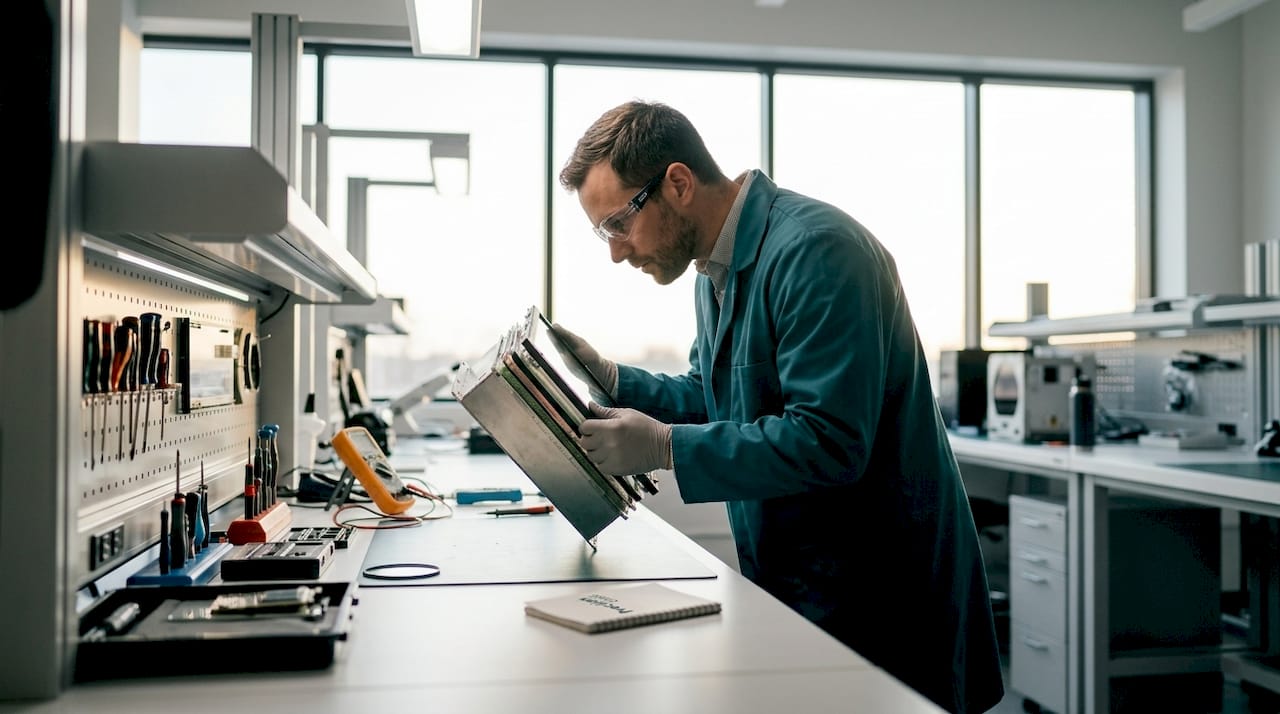
Head-Up Displays (HUD) extend the glass cockpit concept further. HUD combiner glass projects flight-critical symbology onto a transparent panel in the pilot’s forward line of sight, enabling “eyes-out” situational awareness during approach and landing. Military platforms have used this capability for decades; commercial aviation now treats it as a standard safety feature on wide-body aircraft.
Nanostructured coatings applied to display glass address two persistent engineering problems: glare from direct sunlight and electromagnetic interference from onboard electronics. Electromagnetic interference (EMI) shielding is embedded directly into the glass substrate, keeping display integrity intact even in high-RF environments. These are not cosmetic additions. They are load-bearing functional layers that determine whether a display remains readable and accurate under operational stress.
- PFD: presents attitude, airspeed, altitude, and heading in a single scan zone
- MFD: overlays maps, traffic, terrain, and engine data on one screen
- HUD combiner glass: projects symbology onto a forward-facing transparent panel
- Nanostructured coatings: reduce glare and maintain optical clarity across temperature ranges
- EMI shielding layers: protect display accuracy in high-radio-frequency environments
Pro Tip: When specifying display glass for a new avionics programme, confirm that EMI shielding is integrated at the substrate level rather than applied as a surface film. Surface films delaminate under thermal cycling; substrate-level shielding does not.
What material properties make glass suitable for avionics?
Glass in avionics is a multifunctional smart material, not a passive structural component. It must simultaneously manage thermal gradients, maintain optical transmission across a defined spectral range, resist mechanical shock, and suppress electromagnetic interference. No single glass formulation satisfies every demand, which is why aerospace programmes specify different glass types for different subsystems.
Thermal performance is the first filter. Cockpit glass faces temperature swings from below minus 50°C at cruise altitude to above 60°C on a sun-baked apron. Borosilicate and aluminosilicate formulations offer low coefficients of thermal expansion, reducing the risk of delamination at bonded interfaces. Optical glass used in HUD combiners requires even tighter refractive index tolerances, typically specified to four decimal places, because any variation shifts the projected symbology out of alignment.
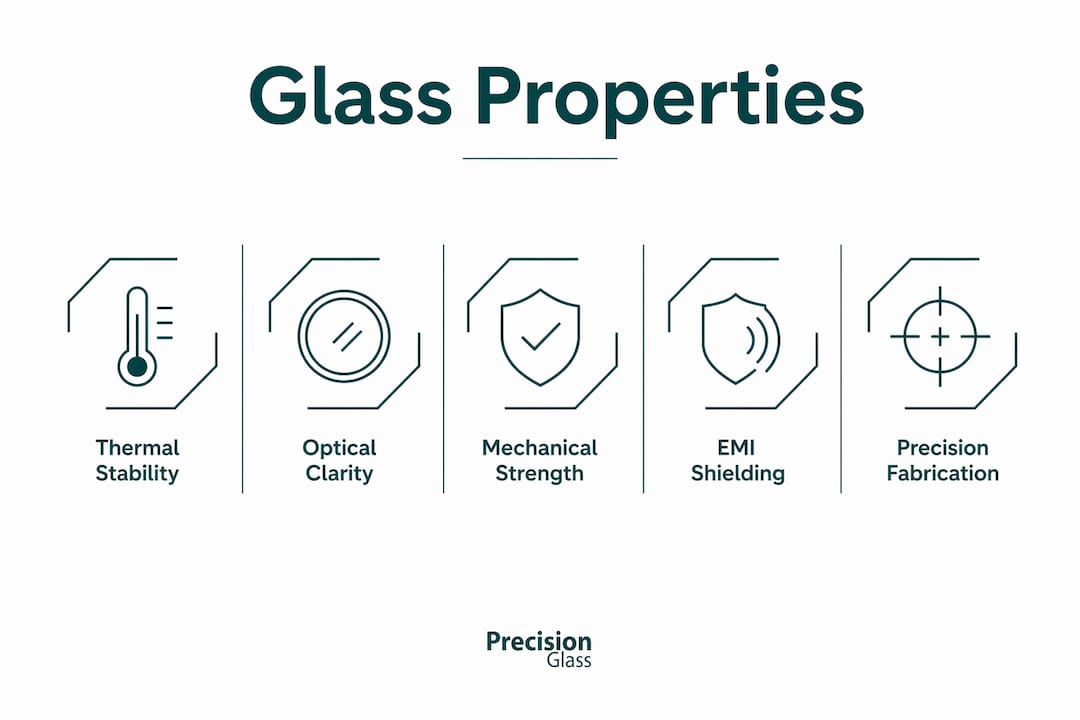
| Glass property | Avionics requirement | Engineering approach |
|---|---|---|
| Thermal stability | Withstand minus 50°C to plus 60°C cycling | Borosilicate or aluminosilicate formulations |
| Optical transmission | Consistent refractive index for HUD accuracy | Precision-melted optical glass, tight index tolerances |
| Mechanical strength | Resist bird strike and pressure differential | Chemically toughened or laminated glass |
| EMI shielding | Protect display electronics in high-RF environments | Conductive oxide coatings integrated at substrate level |
| Surface hardness | Resist abrasion from cleaning and gloved operation | Hard coating applied post-polishing |
Silicone and siloxane chemistry advances have produced hybrid glass-polymer composites that bond optical coatings to glass substrates with far greater adhesion than earlier epoxy-based systems. This matters for long-service-life platforms where coating integrity must survive thousands of pressurisation cycles. The nanostructured coating and EMI shielding innovations now entering production represent a shift from glass as a window to glass as an active system component.
Fabrication quality assurance is where many programmes encounter difficulty. Grinding and polishing to sub-micron surface flatness requires CNC-controlled lapping equipment and interferometric verification at each stage. A surface error of just a few nanometres on a HUD combiner introduces measurable symbology distortion. Precision Glasses applies meticulous quality assurance at every fabrication stage, from initial melting through final inspection, to meet the tolerances aerospace programmes demand.
Pro Tip: Specify your glass components using MIL-PRF-13830 or ISO 10110 drawing standards from the outset. Retrofitting tolerance callouts onto a design that was specified informally adds cost and schedule risk at qualification.
How do glass cockpits improve flight safety?
The safety case for glass cockpits is quantitative, not theoretical. Aviation safety data shows the fatal accident rate dropped from 0.05 to less than 0.002 per 100,000 flight hours between 1980 and 2026. That represents a 25-fold improvement in safety over the period that coincides directly with the widespread adoption of glass cockpit systems. Attributing all of that improvement to glass alone would be an overstatement, but the correlation is strong and the causal mechanisms are well understood.
The primary mechanism is cognitive load reduction. Analogue instrument panels require pilots to mentally integrate readings from six or more separate gauges during high-workload phases such as approach in instrument meteorological conditions. Glass cockpit PFDs present the same information in a single integrated display, freeing working memory for higher-level decision-making. That cognitive headroom is most valuable precisely when conditions are most demanding.
Glass cockpit systems also monitor hundreds of flight parameters simultaneously and generate text and aural alerts when any parameter approaches a limit. Traditional analogue instruments rely on a pilot noticing that a needle has entered a red arc. The difference in detection reliability is significant, particularly during night operations or high-workload phases when attention is divided.
Additional safety contributions from glass cockpit architecture include:
- Moving map displays with terrain and traffic overlays reduce controlled flight into terrain (CFIT) risk
- Integrated weather radar overlays on MFDs allow real-time route deviation without head-down chart work
- Synthetic vision systems render a three-dimensional terrain picture even in zero-visibility conditions
- Automated checklists displayed on glass panels reduce checklist-skipping errors under time pressure
- Redundant display channels allow continued safe operation if one display unit fails
One risk that glass cockpit adoption introduces is automation bias. Pilots who over-rely on automated systems can lose manual flying proficiency, creating a vulnerability when automation fails at a critical moment. Training programmes that reinforce analogue fundamentals alongside digital skills directly address this risk.
Design and maintenance considerations for glass avionics systems
Modular design is the defining characteristic of maintainable glass avionics architectures. Standardised data buses such as ARINC 429 allow individual line-replaceable units to be removed and replaced without reconfiguring the entire system. This reduces mean time to repair and keeps aircraft out-of-service time to a minimum, which has a direct impact on lifecycle cost.
Upgradability follows from modularity. A platform certified with a first-generation glass cockpit suite can accept new display units, updated software, and additional sensor inputs without structural modification, provided the data bus architecture was specified correctly at the outset. Programmes that locked in proprietary bus protocols in the 1990s have paid heavily for that decision in subsequent upgrade cycles.
Lifecycle cost analysis consistently favours glass over analogue for high-utilisation platforms. Analogue gyroscopes and vacuum pumps require scheduled overhaul at fixed intervals regardless of condition. Glass display units are monitored continuously and replaced on condition, reducing unnecessary maintenance events. The modular glass display architecture also means that a single failed component does not ground the aircraft while an entire instrument cluster is sourced.
Recommended design practices for glass avionics programmes:
- Specify ARINC 429 or ARINC 664 (AFDX) compliance from the initial architecture review to preserve future upgrade paths.
- Define display glass specifications using ISO 10110 or MIL-PRF-13830 to ensure supplier consistency across the supply chain.
- Mandate redundant display channels so that a single display failure does not remove primary flight information.
- Include automation bias mitigation in the pilot training syllabus from initial type rating through recurrent training.
- Establish a glass component inspection protocol that covers surface integrity, coating adhesion, and EMI shielding continuity at each scheduled maintenance interval.
Reliability architecture for glass avionics must account for the display glass itself, not just the electronics behind it. Surface delamination, coating degradation, and micro-fractures from thermal cycling are failure modes that electronic built-in test equipment does not detect. Physical inspection of glass surfaces at maintenance intervals remains a non-negotiable requirement.
Key takeaways
Glass is vital for avionics because it integrates flight-critical data, reduces pilot cognitive load, and delivers the material properties that no analogue instrument can match.
| Point | Details |
|---|---|
| Safety improvement | Fatal accident rates fell 25-fold between 1980 and 2026, coinciding with glass cockpit adoption. |
| Cognitive load reduction | PFDs consolidate multiple analogue readings into one display, freeing pilot attention for decisions. |
| Material demands | Avionics glass must meet thermal, optical, mechanical, and EMI requirements simultaneously. |
| Modular maintenance | ARINC 429-compliant architectures allow component replacement without full suite redesign. |
| Automation bias risk | Glass cockpit training must reinforce manual flying skills to prevent over-reliance on automation. |
Glass avionics: what two decades of engineering work has taught me
The most underestimated aspect of glass cockpit integration is not the electronics. It is the glass itself. Programmes routinely specify display units to exacting electronic standards and then treat the glass substrate as a commodity procurement item. That approach fails in service. I have seen HUD combiners returned from the field with symbology drift that traced directly to refractive index variation in the glass, not to any fault in the projection electronics.
The shift from analogue to glass cockpits also changed what pilots need from their training. The cognitive benefits are real and well documented, but the dependency they create is equally real. Pilots who trained exclusively on glass cockpits and then encountered a full display failure in IMC have described the experience as disorienting in a way that their analogue-trained colleagues did not. That is not an argument against glass. It is an argument for training programmes that treat manual proficiency as a non-negotiable foundation.
What excites me about the current generation of emerging glass technologies is the convergence of optical, thermal, and electromagnetic functions into a single substrate. We are moving from glass as a window to glass as a system. Nanostructured coatings that simultaneously manage glare, EMI, and anti-icing are already in qualification testing on military platforms. When those technologies reach commercial certification, the glass substrate will carry more functional load than the electronics it protects.
The engineers who will design those systems need to understand glass as a material with the same depth they bring to signal processing or structural analysis. Multidisciplinary collaboration between optical engineers, materials scientists, and avionics system architects is not optional at this level of integration. It is the only way to get the specification right from the start.
— Alexandra
Precision Glasses: technical glass for aerospace programmes
Aerospace programmes demand glass components that meet exacting tolerances across thermal, optical, and mechanical parameters simultaneously. Precision Glasses designs, fabricates, and supplies custom glass components for avionics, defence, and aerospace applications, from HUD combiner substrates to display cover glass and EMI-shielded panels.

Our technical glass products are engineered to meet MIL-PRF-13830 and ISO 10110 standards, with meticulous quality assurance at every stage from melting through final inspection. Whether you are specifying glass for a new avionics programme or upgrading an existing platform, Precision Glasses delivers tailored solutions with the precision and reliability your application requires. Speak to our engineering team about your specification requirements.
FAQ
What is a glass cockpit in aviation?
A glass cockpit replaces traditional analogue gauges with electronic display screens, typically LCD or OLED panels, that consolidate flight data onto Primary Flight Displays and Multifunction Displays. The Boeing 767, introduced in 1981, was the first production aircraft to use this architecture.
How does glass improve safety in avionics systems?
Glass cockpit systems monitor hundreds of flight parameters simultaneously and generate automated alerts, replacing the single-gauge red-arc monitoring of analogue instruments. Fatal accident rates dropped from 0.05 to less than 0.002 per 100,000 flight hours between 1980 and 2026.
What glass materials are used in avionics displays?
Avionics displays use borosilicate and aluminosilicate glass for thermal stability, precision-melted optical glass for HUD combiners, and chemically toughened or laminated glass for structural cover panels. Each formulation is selected to meet specific thermal, optical, and mechanical requirements.
What is automation bias in glass cockpit operations?
Automation bias occurs when pilots over-rely on glass cockpit systems and lose manual flying proficiency. Training programmes that reinforce analogue fundamentals alongside digital skills directly mitigate this risk.
How does ARINC 429 support glass cockpit maintenance?
ARINC 429 is the standard data bus for civil avionics communication. It enables modular glass display architectures where individual units can be replaced without redesigning the entire system, reducing lifecycle costs and aircraft downtime.
Recommended
- Why choose advanced glass materials: 2026 engineer’s guide – Precision Glass
- Glass selection process for electronics: 2026 guide – Precision Glass
- Glass in electronics: Performance, reliability and procurement insights – Precision Glass
- Advanced glass specifications: Guide for engineers and buyers – Precision Glass