
The touch display glass customization process is the methodical workflow of designing, prototyping, and manufacturing glass components tailored to precise technical and environmental requirements in industrial and technological settings. Engineers across medical, automotive, aerospace, and defence sectors rely on this process to achieve glass that meets exact optical, mechanical, and touch performance specifications. Precision Glasses applies this workflow across demanding applications where off-the-shelf glass simply cannot deliver the required durability or sensitivity. Understanding each stage, from material selection through to mass production and quality assurance, gives engineers the control they need to specify glass components with confidence and avoid costly late-stage redesigns.
What are the key prerequisites for the touch display glass customization process?
Material selection is the first and most consequential decision in any custom glass project. There is no universal technical glass; the choice between neutral borosilicate, borosilicate 3.3, and soda-lime glass determines chemical resistance, thermal performance, and long-term durability. Borosilicate 3.3 suits high-temperature or chemically aggressive environments, such as medical sterilisation equipment. Soda-lime glass works well in cost-sensitive applications where thermal cycling is minimal. Getting this decision wrong at the outset creates compounding problems through every subsequent stage of production.
Impact resistance specification follows material selection and must be grounded in IEC 62262 IK ratings rather than arbitrary thickness choices. Over-specifying thickness without reference to the correct IK rating degrades touch sensitivity and adds unnecessary weight. The IK rating defines the energy level the glass must withstand, which then informs the required thickness and structure. This standards-led approach prevents both under-engineering and over-engineering in equal measure.
Design specifications for custom touch screen glass typically cover size, thickness, shape, and edge finishing. Production supports sizes from 4.3 to 75 inches and thicknesses between 0.3 and 6 mm, giving engineers a wide working range for panel formats. Edge finishing options include polished, bevelled, and CNC-machined profiles, each affecting both aesthetics and mechanical stress distribution. Surface coatings, including AG (anti-glare), AR (anti-reflective), and AF (anti-fingerprint), address optical and tactile requirements specific to the operating environment.
- Material type: Choose between borosilicate 3.3, neutral borosilicate, and soda-lime based on chemical and thermal demands.
- IK impact rating: Define the IEC 62262 IK rating before specifying thickness to avoid performance trade-offs.
- Size and thickness: Confirm panel dimensions and thickness range early; changes after tooling creation incur significant cost.
- Surface coatings: Specify AG, AR, or AF coatings based on ambient lighting conditions and user interaction modes.
- Edge finishing: Select CNC-machined, polished, or bevelled edges to match mechanical and aesthetic requirements.
- Printing and branding: Logo printing and colour matching must be defined before mould creation.
Pro Tip: Request a glass selection guide from your manufacturer before finalising material specifications. Confirming chemical and thermal requirements in writing at this stage prevents costly material substitutions later in production.
How is custom touch glass produced from design to sample approval?
Translating a design brief into a validated physical sample is the most technically demanding phase of the process for glass customisation. Engineers submit detailed design files, including dimensional drawings and surface finish specifications, or provide physical samples for reverse engineering. The manufacturer then creates moulds and tooling tailored to the custom dimensions and shapes. Mould costs typically range from USD 200 to USD 800 per shape, and this investment is fixed regardless of subsequent order volume.
The sample fabrication sequence follows these steps:
- Design file review: The manufacturer checks dimensional drawings for manufacturability, flagging conflicts between thickness, edge profile, and coating requirements.
- Mould and tooling creation: Custom tooling is produced to the agreed dimensions. Any shape deviation at this stage propagates through the entire production run.
- Initial sample fabrication: A small batch of samples is produced using the approved tooling and specified materials.
- Multi-point inspection: Samples are checked against dimensional accuracy, surface defect criteria, colour match, and coating uniformity.
- Golden Sample agreement: One approved sample is designated as the quality benchmark and retained on-site as a fixed reference for all subsequent production.
- Client approval: The engineer signs off on the Golden Sample before mass production begins.
The Golden Sample is not a formality. It is the physical contract between manufacturer and buyer on what constitutes an acceptable product. Without it, quality disputes during mass production become subjective and difficult to resolve.
| Stage | Typical duration |
|---|---|
| Initial quote | 2–5 business days |
| Sample creation | 7–14 business days |
| Mass production | 4–8 weeks after approval |
| Total lead time | 6–10 weeks |
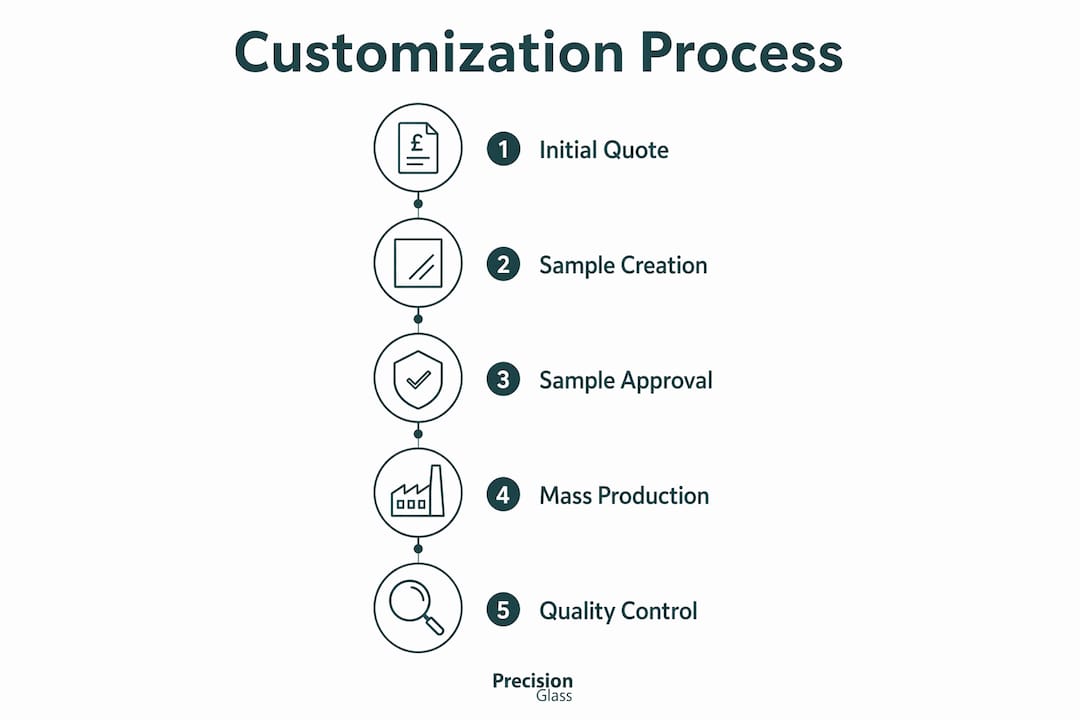
Lead times for custom glass manufacturing range from 6 to 10 weeks in total, covering sample creation and full production runs. Engineers who build this timeline into project schedules avoid the pressure that leads to skipped inspection steps.
Pro Tip: When evaluating samples, use a calibrated digital calliper for thickness measurements and a light box for surface defect detection. Document every measurement against the drawing tolerance before signing off. A checklist at this stage is the single most effective tool for preventing production disputes.

What does mass production and quality control look like?
Mass production of custom touch display glass begins with glass melting at temperatures between 1,400°C and 1,500°C, followed by forming, tempering, annealing, and cold-end finishing. Each stage carries its own defect risk. Forming introduces dimensional variance; tempering creates internal stress if cooling rates are inconsistent; annealing removes residual stress but requires precise temperature control. In-process quality checks at each stage maintain strict dimensional and defect standards throughout the run.
The quality control framework for a well-managed production run includes:
- Dimensional inspection: Thickness, length, and width checked against drawing tolerances at regular intervals.
- Surface defect detection: Visual and automated inspection for bubbles, cracks, scratches, and inclusions.
- Coating uniformity: AG, AR, and AF coatings verified for consistent coverage and optical performance.
- Colour and print verification: Printed logos and colour panels checked against the Golden Sample under standardised lighting.
- Pre-shipment inspection: Third-party inspection, costing approximately USD 200 to USD 400, is recommended for first production batches to verify conformance independently.
Third-party pre-shipment inspection on first production batches is the most cost-effective insurance an engineer can buy. A USD 300 inspection fee is negligible against the cost of receiving a non-conforming shipment of several thousand glass panels.
Customised packaging protects finished glass during international shipping and forms part of the production specification. Foam inserts, polybags, and carton specifications must align with the fragility and weight of the glass panels. Packaging failures during transit are a common and entirely preventable source of project delays.
| Quality checkpoint | Method | Defects targeted |
|---|---|---|
| Post-forming | Dimensional gauging | Thickness and size variance |
| Post-tempering | Stress birefringence test | Internal stress, warping |
| Post-coating | Optical transmission test | Coating gaps, haze |
| Pre-shipment | Third-party visual and dimensional | All defect categories |
Close communication with the manufacturer throughout production is the most effective mitigation for common issues such as batch-to-batch colour variation and coating adhesion failures. Engineers who establish a named contact at the factory and request weekly production reports catch problems before they affect the full batch.
How to integrate touch system requirements into glass customisation?
Touch performance depends on the glass working in concert with the underlying sensor technology. PCAP (projected capacitive) touch technology is the dominant standard for industrial touch panels, and the cover glass must be specified to transmit the capacitive signal without attenuation. Interface protocols such as USB HID and I2C define how the touch controller communicates with the host system, but the glass specification directly affects signal quality at the sensor layer.
Key integration considerations for engineers include:
- Glass thickness and capacitive transmission: Thicker glass reduces touch sensitivity. The IK rating must be met without exceeding the thickness threshold that degrades PCAP performance.
- Optical bonding: Bonding the cover glass directly to the display panel eliminates the air gap, improving optical clarity and mechanical durability. This is the preferred assembly method for outdoor and high-ambient-light environments.
- Coating compatibility with touch modes: AG coatings affect the surface texture and can alter touch response. Glove-compatible and wet-touch modes require specific surface roughness values that must be confirmed with the coating supplier.
- Mechanical mounting and stress distribution: Mounting features such as countersunk holes and recessed edges must be designed to distribute mechanical stress away from the active touch area.
- Environmental durability: Chemical exposure, temperature cycling, and impact resistance requirements must all be addressed in the glass specification before production begins.
Pro Tip: Specify the operating temperature range and any chemical exposure conditions in your initial design brief. Manufacturers can then select the correct glass substrate and coating system from the outset, rather than retrofitting solutions after sample failure.
For engineers working on glass for electronics applications, confirming PCAP compatibility with both the glass manufacturer and the touch controller supplier before tooling creation eliminates the most common source of integration failures. The glass and the sensor must be specified together, not sequentially.
Industrial components such as sight glass seals illustrate a broader principle that applies equally to touch display glass: the interface between glass and its surrounding assembly determines long-term reliability as much as the glass specification itself.
Key takeaways
The touch display glass customization process succeeds when material selection, IK-rated impact design, Golden Sample approval, and PCAP integration are addressed in sequence before mass production begins.
| Point | Details |
|---|---|
| Start with material selection | Choose between borosilicate 3.3, neutral borosilicate, and soda-lime based on thermal and chemical demands. |
| Design to IEC 62262 IK ratings | Specify impact resistance by IK rating first; thickness follows from that requirement, not the other way around. |
| Use the Golden Sample rigorously | Agree and retain a physical Golden Sample before production starts to resolve all quality disputes objectively. |
| Plan for a 6–10 week lead time | Build sample creation and production approval time into project schedules from the first planning meeting. |
| Integrate PCAP requirements early | Confirm touch sensor compatibility and coating specifications alongside glass design, not after sample failure. |
What I have learned from years of specifying custom touch glass
The single most common mistake I see engineers make is treating the glass specification as a secondary decision. They finalise the display module, the enclosure, and the touch controller, then ask for glass to fit whatever space remains. That sequence produces compromises at every stage.
The engineers who get this right start with the operating environment. They define the IK rating, the temperature range, and the chemical exposure conditions before they open a drawing tool. Material selection follows naturally from those constraints. The glass specification then drives the touch sensor selection, not the reverse.
I have seen projects delayed by weeks because a Golden Sample was approved informally, without a signed dimensional report, and the production batch arrived with thickness variance outside tolerance. The manufacturer had a different recollection of what was agreed. A retained, signed Golden Sample with a documented measurement report would have resolved that dispute in minutes rather than weeks.
The other lesson I would press on any engineer is the value of third-party pre-shipment inspection on first production batches. The cost is negligible. The protection it provides against receiving a non-conforming shipment is substantial. Treat it as a standard line item in your project budget, not an optional extra.
— Alexandra
Precision Glasses: tailored touch display glass for demanding applications
Precision Glasses delivers full-service custom glass manufacturing covering design consultation, prototyping, sample validation, and mass production for engineers across medical, automotive, defence, and electronics sectors.

Our manufacturing process adheres to IEC 62262 and other relevant industry standards, with documented quality assurance at every production stage. Engineers working on complex touch display projects can consult our specialists to define material selection, coating requirements, and PCAP integration from the outset. Visit Precision Glasses to discuss your project specifications with our technical team and receive a detailed quotation within 2–5 business days.
FAQ
What is the touch display glass customization process?
The touch display glass customization process is the structured workflow of specifying, prototyping, and manufacturing glass components to precise dimensional, optical, and mechanical requirements for industrial touch applications. It covers material selection, IK-rated impact design, sample validation, and mass production quality control.
How long does custom touch display glass take to produce?
Total lead time ranges from 6 to 10 weeks, including 7–14 business days for sample creation and 4–8 weeks for mass production after Golden Sample approval.
What glass materials are used in custom touch screen glass?
The three principal options are neutral borosilicate, borosilicate 3.3, and soda-lime glass. Material choice determines chemical resistance, thermal performance, and in-service durability, making it the first and most consequential decision in any custom project.
Why is the Golden Sample important in glass production?
The Golden Sample is a physical quality reference agreed by the manufacturer and buyer before mass production begins. It provides an objective benchmark for resolving any quality disputes during or after the production run.
How does glass thickness affect PCAP touch performance?
Thicker glass attenuates the capacitive signal from a PCAP sensor, reducing touch sensitivity. Engineers must balance the IEC 62262 IK impact rating requirement against the maximum thickness that still delivers acceptable touch response for the specified interaction modes.