
Optical components are physical elements that control, shape, and manipulate light to achieve high-precision outcomes in critical industrial applications. In aerospace, defence, and medical device engineering, these elements must meet exacting standards, including ISO 10110 for optical drawing tolerances, to perform reliably under demanding conditions. The term “optical components” covers a broad catalogue of glass and crystal elements, from lenses and prisms to isolators and beam splitters. Precision glass is the material of choice across most of these categories because its thermal stability, optical homogeneity, and surface quality directly determine system performance. Getting the selection right at the design stage prevents costly failures in the field.
1. What are the top 10 optical components for high-precision engineering?
The ten components listed here represent the core of any serious optical components specification list for aerospace, defence, and medical applications. Each entry covers function, key performance attributes, and the selection criteria that matter most in demanding environments.
2. Precision glass scales
Precision glass scales with 4µm or 20µm grating periods deliver nanometre-level repeatability in high-precision linear displacement systems used in semiconductor lithography and wire bonding. Metal scales cannot match this because their higher coefficient of thermal expansion introduces ripple errors during extended operation. Glass scales eliminate that drift, making them the correct choice wherever sub-micron positional accuracy is non-negotiable.
3. Optical isolators
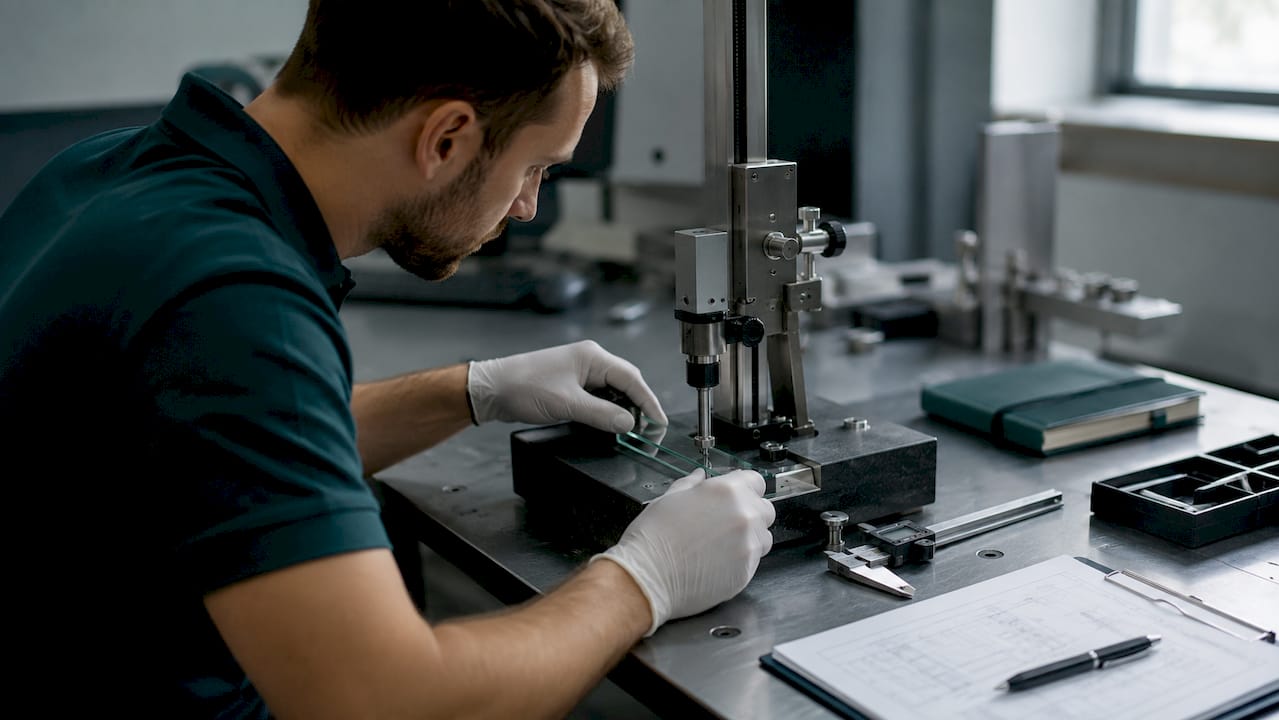
Optical isolators transmit light in one direction only, protecting laser sources from back-reflected beams that cause instability or damage. In high-power fibre laser systems, magneto-optic crystals such as potassium terbium fluoride reduce thermally induced effects, enabling kilowatt-class operation with improved beam quality. Dual-stage isolator designs raise isolation levels, though with a slight insertion loss trade-off that must be accounted for in the system budget.
Pro Tip: When specifying an isolator for a high-power application, request the thermally optimised coating specification alongside the isolation figure. A high isolation number with a poor thermal coating is a liability at elevated power levels.
4. Prisms
Prisms redirect, invert, or disperse light through internal reflection and refraction, depending on geometry. Right-angle, Porro, and Dove prisms each serve distinct functions in imaging, rangefinding, and spectroscopy. Selection criteria include angular tolerance, surface flatness, and the homogeneity of the glass blank, since any refractive index variation across the aperture degrades image quality in high-resolution systems.
5. Precision lenses
Lenses focus or collimate light and appear in virtually every optical subsystem, from medical endoscopes to missile guidance seekers. Aspheric lenses reduce the number of elements needed to correct aberrations, which matters in weight-critical aerospace assemblies. Surface form error, measured in fractions of a wavelength, is the primary quality metric; tolerances tighter than λ/10 are standard in defence-grade imaging systems.
6. Optical flats
Optical flats made from Zerodur or fused silica provide stable phase references and enable nanometre-level measurement accuracy. Their low coefficient of thermal expansion and high surface quality deliver sub-wavelength alignment tolerances for demanding optical instruments. Optical flats are indispensable as reference surfaces in interferometry and as calibration standards in metrology laboratories.
7. Optical filters
Filters select specific wavelength bands and reject others, controlling the spectral content of a beam. Bandpass, longpass, and notch filters each address different requirements in fluorescence imaging, laser line selection, and multispectral sensing. The key specification is out-of-band rejection; in medical fluorescence microscopy, rejection ratios exceeding six optical density units are common to prevent signal contamination. Precision Glasses produces filters to tight spectral and surface quality specifications for advanced photonics applications.
8. Optical circulators
Circulators route light sequentially between three or more ports, enabling bidirectional transmission over a single fibre without interference between channels. Fibre optic passive components of this type commonly operate across the 1260nm to 1650nm spectral range. Low insertion loss and high isolation between adjacent ports are the critical selection parameters for telecommunications and distributed sensing systems.
9. Beam splitters
Beam splitters divide an incident beam into two or more paths by partial reflection and transmission. Plate, cube, and pellicle configurations each offer different trade-offs between polarisation sensitivity, wavefront distortion, and physical compactness. In interferometric metrology and laser-based manufacturing, the splitting ratio and surface flatness of the beam splitter directly affect measurement accuracy and process repeatability.
10. Polarisers
Polarisers transmit light of one polarisation state and absorb or reflect the orthogonal state. Wire-grid, crystal, and thin-film polarisers cover different spectral ranges and power handling requirements. In defence electro-optic systems and medical polarimetry, extinction ratio is the governing specification; values above 10,000:1 are achievable with high-quality crystal polarisers.
11. Optical windows
Windows protect internal optical systems from the environment while transmitting the required spectral band with minimal distortion. Material choice depends on the spectral range: fused silica for ultraviolet, borosilicate for visible and near-infrared, and germanium or zinc selenide for thermal infrared. Scratch-dig surface quality, wedge angle, and anti-reflection coating performance are the three parameters engineers must specify precisely for windows in aircraft sensors or surgical instruments.
How material properties affect optical component performance
Thermal expansion coefficient mismatch between optical components and their mounts causes stress, birefringence, and wavefront distortion. Ultra-low expansion materials like Zerodur mitigate these issues by matching the expansion behaviour of adjacent structural elements. Proper material pairing is not optional in precision assemblies; it is the foundation of long-term stability.
Optical homogeneity determines how uniformly light travels through a glass blank. Variations in refractive index across the aperture introduce phase errors that degrade wavefront quality. For metrology-grade components, homogeneity specifications of better than 1 part per million across the clear aperture are achievable with selected fused silica or Zerodur blanks.
Specifying ultra-low expansion glass like Zerodur or fused silica for both the optical element and its mounting interface is the single most effective step an engineer can take to prevent thermally induced wavefront distortion in a precision assembly. Material pairing at the design stage costs nothing; correcting stress birefringence in a fielded system costs everything.
The advantages of precision glass over alternative materials include superior chemical stability, the ability to achieve sub-nanometre surface roughness through polishing, and a wide range of available refractive indices. These properties make precision glass the dominant material across the optical components catalogue for aerospace, defence, and medical applications.
Advanced manufacturing and metrology for tight tolerances
Producing high-precision glass components requires fabrication and measurement to work together, not sequentially.
Picosecond laser ablation. Picosecond laser processing sublimates glass without heating the surrounding material, avoiding thermal stress and micro-cracking. Edge chipping as low as 2µm is achievable, reducing post-process polishing requirements and extending component service life.
Magnetorheological finishing (MRF). MRF uses a magnetically stiffened fluid carrying abrasive particles to remove material with sub-micron control. The process corrects mid-spatial-frequency errors that conventional polishing cannot address, making it the preferred finishing method for aspheric and freeform surfaces.
In-process interferometry. Integrated interferometric metrology during polishing corrects errors in real time, achieving tolerances that post-process inspection alone cannot verify. This approach improves yield and reduces the risk of discovering out-of-tolerance parts after full fabrication cost has been incurred.
ISO 10110 compliance. ISO 10110 defines the drawing notation for optical elements, covering surface form, material quality, and coating requirements. Specifying components to this standard gives manufacturers unambiguous targets and gives procurement teams a clear basis for acceptance testing.
| Technique | Primary benefit | Typical tolerance achieved |
|---|---|---|
| Picosecond laser ablation | No thermal damage | Edge chip ≤ 2µm |
| Magnetorheological finishing | Sub-micron form correction | Surface figure < λ/20 |
| In-process interferometry | Real-time error correction | Sub-micron dimensional control |
Pro Tip: Specify in-process interferometry as a contractual requirement, not a supplier option. Suppliers who integrate metrology during polishing consistently deliver better first-article results than those who rely on final inspection alone. This is worth including in your glass tolerances specification from the outset.
For aerospace applications, tolerancing in aerospace parts follows the same discipline: define the tolerance at the design stage, verify it in process, and document it for qualification. Optical fabrication is no different.
Selecting passive optical components for fibre, laser, and imaging systems
Passive optical components require no power to function, but their performance parameters must be matched precisely to the system they serve.
Key selection parameters for passive components include:
- Insertion loss. The signal power lost as light passes through the component. Values below 0.5 dB are standard for high-performance isolators and circulators in telecommunications.
- Return loss. The ratio of reflected power to incident power, expressed in decibels. High return loss (above 50 dB) prevents reflections from destabilising laser sources.
- Isolation. The degree to which backward-propagating light is suppressed. Isolation above 30 dB is the minimum for most laser protection applications.
- Polarisation-dependent loss (PDL). Variation in insertion loss with polarisation state. Low PDL is critical in coherent communication systems and polarimetric sensing.
- Spectral range. Components must cover the operating wavelength band with consistent performance. The IEC 61300 series defines standard measurement methods for fibre optic passive components, providing a common basis for supplier qualification.
Applications drive the weighting of these parameters. In high-power laser systems, thermal management of the isolator crystal dominates the design. In distributed fibre sensing, low insertion loss across a wide spectral range takes priority. In medical imaging, polarisation control and spectral selectivity determine diagnostic capability.
For teams moving from concept to prototype, an industrial prototyping guide covering simulation and tolerance prediction is a practical reference before committing to fabrication.
Key takeaways
Precision glass is the defining material for high-performance optical components because its thermal stability, optical homogeneity, and surface quality directly determine system accuracy in aerospace, defence, and medical applications.
| Point | Details |
|---|---|
| Material pairing prevents distortion | Specify Zerodur or fused silica for both components and mounts to avoid thermally induced wavefront errors. |
| In-process metrology improves yield | Integrate interferometry during polishing to correct errors in real time rather than discovering them at final inspection. |
| Passive component parameters must match the system | Insertion loss, isolation, return loss, and PDL must be specified against the actual operating conditions, not generic catalogue values. |
| ISO 10110 and IEC 61300 define the baseline | Use these standards as the contractual foundation for optical component drawings and passive component qualification. |
| Picosecond laser processing protects structural integrity | Cold ablation achieves edge chipping below 2µm, extending component life and reducing polishing cost. |
Why I think most engineers underestimate mounting design
After fifteen years working with precision optical systems, the failure mode I see most often is not a bad lens or a substandard coating. It is a perfectly specified optical element destroyed by a poorly designed mount.
Simulation software like ZEMAX can predict light propagation effects and perform rigorous tolerancing across spectral regions from EUV to THz before a single component is fabricated. Most teams use it for the optics. Far fewer use it to model the stress induced by the mount under thermal cycling. That gap is where systems fail.
The uncomfortable truth is that a Zerodur flat specified to λ/20 surface figure will perform to λ/4 if it is bonded into an aluminium housing without accounting for the expansion mismatch. The glass did not fail. The system design did. Specifying the right glass component design process from the outset, including mount material and bonding method, is as important as the optical specification itself.
My recommendation: treat mounting and environmental analysis as part of the optical design review, not as a mechanical afterthought. The engineers who do this consistently deliver systems that pass qualification on the first attempt.
— Alexandra
Precision Glasses: tailored optical glass for critical applications

Precision Glasses designs, fabricates, and supplies custom optical glass components for aerospace, defence, and medical device applications. Our capabilities span ultra-low expansion glass, precision polishing to sub-wavelength tolerances, and integrated metrology support throughout the fabrication process. Every component we produce is built to meet the exact specifications your application demands, with full traceability and quality assurance at each stage. Whether you need optical windows, filters, scales, or bespoke assemblies, our team works with you from initial design through to delivery. Visit our technical glass range to see our full product catalogue, or contact us directly to discuss your requirements.
FAQ
What are optical components?
Optical components are physical elements, such as lenses, prisms, filters, and beam splitters, that manipulate the properties of light including direction, intensity, polarisation, and spectral content. They are used in aerospace, defence, medical, and industrial systems where precise light control is required.
Why does precision glass outperform metal in optical applications?
Precision glass offers a lower and more stable coefficient of thermal expansion than most metals, eliminating dimensional drift that causes measurement errors and optical distortion. Its surface can also be polished to sub-nanometre roughness, which metal cannot match.
What is ISO 10110 and why does it matter?
ISO 10110 is the international standard that defines drawing notation for optical elements, covering surface form, material quality, and coating requirements. Specifying components to ISO 10110 gives manufacturers unambiguous fabrication targets and gives procurement teams a clear acceptance basis.
How does in-process interferometry improve optical component quality?
Integrating interferometric metrology during polishing allows real-time error correction, achieving sub-micron dimensional control that post-process inspection alone cannot verify. This reduces scrap rates and improves first-article acceptance.
What parameters matter most when selecting fibre optic passive components?
Insertion loss, return loss, isolation, and polarisation-dependent loss are the four primary parameters. The IEC 61300 series defines standard measurement methods for these values, providing a consistent basis for supplier qualification and system integration.