Low-iron glass is a high-clarity glass manufactured with substantially reduced iron oxide content, typically around 0.01% ferric oxide compared to roughly ten times that amount in standard plate glass. That reduction eliminates the characteristic greenish tint visible in ordinary clear glass, particularly at edges and in thicker panes. The result is a material with up to 91% internal light transmission, colour-neutral aesthetics, and consistent optical performance across varying thicknesses.
Key characteristics at a glance:
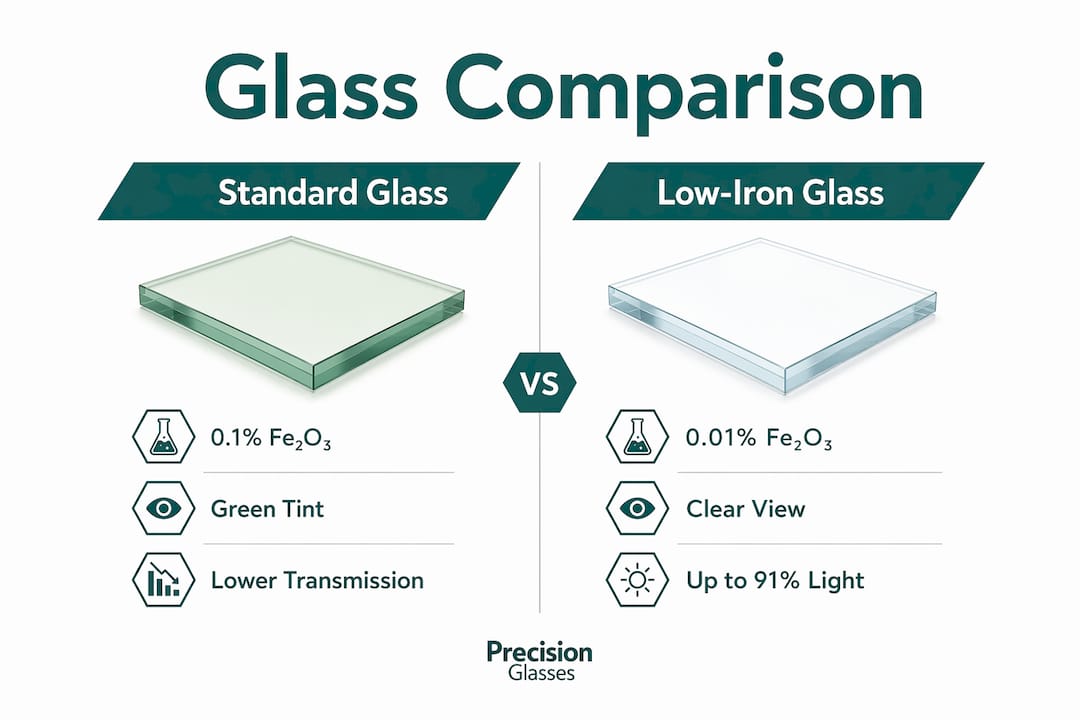
- Iron oxide content: approximately 0.01% ferric oxide, versus around 0.1% in standard glass
- Light transmission: up to 91%, higher than typical standard clear glass transmission.
- Colour neutrality: no green tint; edges appear clear or reflect surrounding colours
- Post-production treatments: compatible with tempering, laminating, and coating processes
- Typical applications: structural glazing, solar panels, display cases, aquariums, architectural facades
How does low-iron glass differ from standard clear glass?
The most visible difference is colour. Standard float glass contains iron impurities that produce a distinctly green tint, most obvious at cut edges or when viewed through thicker panes. Low-iron glass contains roughly 90% less iron than standard plate glass, which is why it appears almost colourless by comparison.
That tint is not merely cosmetic. In layered or thick glazing systems, the green cast accumulates with each additional pane, progressively distorting colour fidelity and reducing clarity. For a frameless glass wall or a display case with coloured interlayers, standard glass simply cannot maintain the neutral appearance the design requires.
| Property | Standard clear glass | Low-iron glass |
|---|---|---|
| Ferric oxide content | about 0.1% | about 0.01% |
| Light transmission | typical for standard glass | up to 91% for low-iron glass |
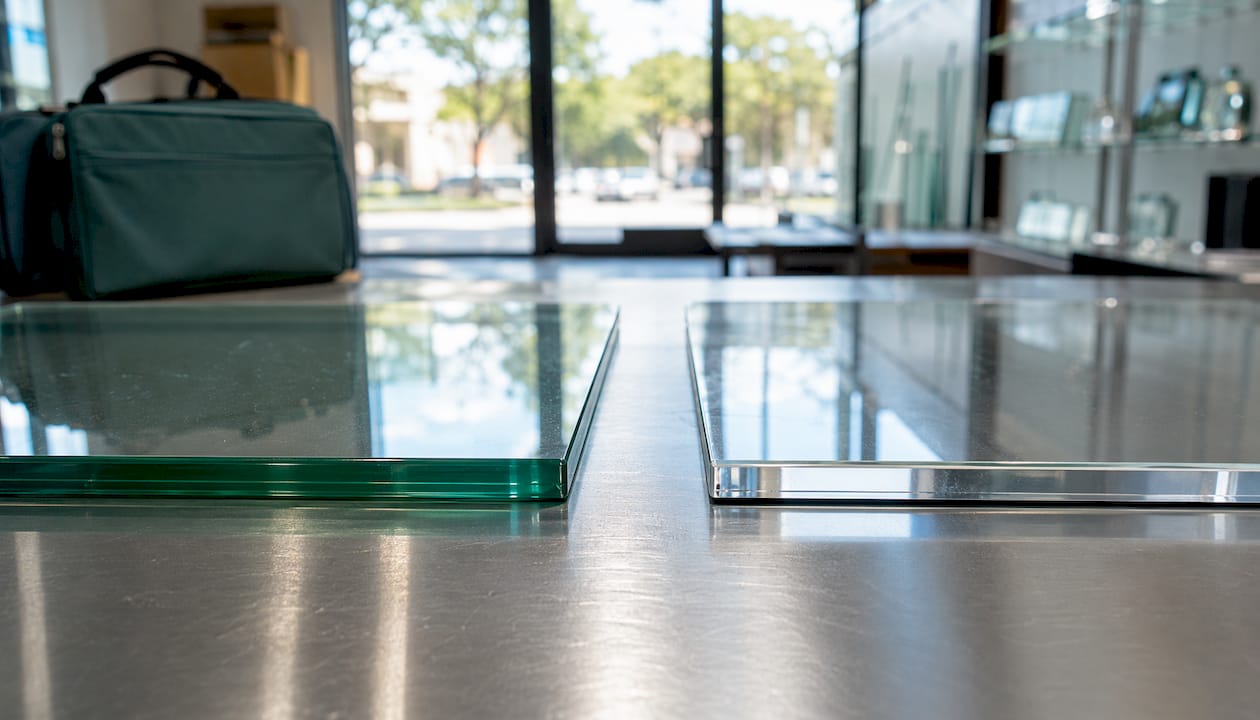
| Edge colour | Dark green or black | Colour-neutral or reflective |
| Visible tint | Green, especially in thick panes | None |
| Sandblasted finish | Greenish-grey cast | Pure white |
| Suitability for coloured interlayers | Limited | High |
The sandblasted finish difference is particularly telling. Sandblasting low-iron glass produces a pure white frosted surface, whereas the same process on standard glass yields a murky greenish-grey cast. For privacy screens or decorative architectural features, that distinction determines the final aesthetic entirely.
How low-iron glass is manufactured
Low-iron glass production begins with raw material selection. Manufacturers source low-iron silica sand with tightly controlled iron content, since the base sand is the primary source of ferric oxide contamination. The float glass process then proceeds with this purified feedstock, melting the batch at high temperature and floating the molten glass across a tin bath to produce a flat, uniform ribbon.
Key production steps and controls:
- Raw material screening: silica sand is selected or processed to minimise iron content before batching
- Controlled melting: furnace conditions are managed to prevent iron reintroduction from refractory materials or contamination
- Float forming: molten glass flows across a tin bath, producing consistent thickness and flatness
- Annealing: the glass ribbon passes through a controlled cooling lehr to relieve internal stress
- Quality inspection: optical checks confirm the absence of tint, bubbles, and surface defects
- Post-production processing: the finished sheet undergoes tempering or laminating as required, identical to standard glass
Low-iron glass is not inherently stronger than standard glass. Its structural performance depends on the same tempering and laminating treatments applied to any float glass product.
Where is low-iron glass used in practice?
Low-iron glass is the preferred choice wherever colour accuracy, visual neutrality, or maximum light transmission determines the success of a project. Its applications span structural glazing, exhibition cases, solar panels, and decorative furniture surfaces.
- Structural glazing and facades: frameless glass walls and curtain walling systems benefit from the absence of green tint, particularly where multiple panes meet at visible edges, making the composition of the glass type essential for durable frames
- Solar panels: higher light transmission means more solar energy passes through the cover glass, improving photovoltaic and thermal collector efficiency
- Display cases and retail: jewellery, museum exhibits, and high-end retail displays require glass that does not alter the perceived colour of the contents
- Aquariums: large-volume tanks use low-iron glass so viewers see fish and coral in accurate colour rather than through a green filter
- Architectural furniture: glass tabletops, shelving, and balustrades look cleaner and more refined without the green edge tint
- Coloured interlayer glazing: when laminated with coloured or printed interlayers, low-iron glass allows the interlayer colour to read true rather than shifted by the glass itself
- Privacy screens: sandblasted low-iron glass delivers a clean white finish for partitions and shower enclosures
Pro Tip: When specifying glass for a project that mixes thicknesses, use low-iron glass throughout. The green tint in standard glass intensifies with thickness, so mixing the two creates mismatched colour tones across an installation.
What are the main benefits of low-iron glass?
The core advantage is optical: passive solar gain increases because more unfiltered solar energy passes through the glass, which benefits both natural warming in buildings and the efficiency of photovoltaic systems. Beyond energy performance, the benefits are primarily visual and practical.
- Superior colour neutrality: no green cast means displayed objects, interlayers, and adjacent materials appear in their true colours
- Higher light transmission: up to 91% versus the 85–87% typical of standard glass, delivering noticeably brighter interiors
- Consistent appearance across thicknesses: the tint does not accumulate, so a 19mm pane looks as neutral as a 6mm one
- Cleaner edge aesthetics: edges reflect surrounding colours rather than appearing dark green or black, which matters in frameless installations
- Compatibility with all standard treatments: tempering, laminating, coating, and CNC work all apply without modification
How to identify low-iron glass on site
The simplest test is to look at the edge of the glass at an angle. Standard glass edges appear distinctly green or dark green, especially in panes thicker than 6mm. Low-iron glass edges appear colour-neutral, picking up the colour of whatever surface lies behind them rather than casting their own tint.
Additional identification methods:
- Edge comparison: hold a piece of standard glass alongside the suspect pane; the colour difference at the edge is immediately apparent
- Transmitted light: place a white card behind the glass and view it straight on; standard glass adds a greenish cast, low-iron glass does not
- Manufacturer markings: most low-iron glass carries an etched or printed mark from the manufacturer, often including a product name or specification code
- Certification documentation: reputable suppliers provide a product data sheet confirming ferric oxide content and light transmission values
- Sandblasted areas: if any portion has been sandblasted, low-iron glass will appear white, standard glass grey-green
Cost considerations for low-iron glass
Low-iron glass carries a price premium over standard float glass, reflecting the higher cost of purified raw materials and tighter production controls. The premium varies by supplier, thickness, and order volume, but architects and specifiers generally treat it as a deliberate upgrade rather than a standard substitution.

For projects where visual neutrality is non-negotiable, such as museum display cases or high-end architectural facades, the cost difference is absorbed into the specification without question. For large-scale glazing where standard glass would perform adequately, the premium requires justification. Consulting a specialist glass selection guide before finalising a specification helps avoid over-specifying on cost-sensitive elements.
Typical thickness and dimensions available
Low-iron glass is available in the same standard thickness range as conventional float glass, typically from 3mm up to 19mm or beyond for specialist applications. Standard sheet sizes follow float glass conventions, with large-format sheets available for curtain walling and structural glazing projects.
Thicker panes, from 10mm upwards, are where low-iron glass delivers its most visible advantage. At those thicknesses, the green tint in standard glass becomes pronounced enough to affect the entire visual character of an installation. For architectural glass uses requiring laminated units, low-iron glass is available as the substrate for both the inner and outer plies.
Energy efficiency and environmental considerations
Low-iron glass contributes directly to energy-efficient building design by maximising the amount of solar radiation that enters a space. Higher light transmission reduces reliance on artificial lighting during daylight hours, and the increased passive solar gain can lower heating demand in colder months.
In photovoltaic applications, the cover glass accounts for a measurable portion of energy losses in a solar panel. Using low-iron glass as the cover reduces those losses, improving overall panel output. The glass itself is fully recyclable at end of life, consistent with standard float glass, and its production does not introduce additional environmental burdens beyond the raw material purification step.
Maintenance and care for low-iron glass
Low-iron glass requires no specialist maintenance regime beyond standard glass care. Its optical clarity does, however, make surface contamination more visible than on tinted or standard glass, so regular cleaning is advisable in high-visibility installations.
Recommended practices:
- Clean with a mild, non-abrasive glass cleaner and a lint-free cloth or squeegee
- Avoid abrasive pads or harsh chemical solvents, which can damage any coatings applied to the surface
- For exterior installations, a hydrophobic coating applied during fabrication reduces water spotting and simplifies routine cleaning
- Inspect edges and sealants periodically, particularly in structural glazing applications, to maintain weathertightness
UK standards and certifications for low-iron glass
In the United Kingdom, low-iron glass used in construction must comply with the same British Standards as standard float glass. BS EN 572 covers the basic properties of soda lime silicate glass, including dimensional tolerances and optical quality. Where the glass is toughened, BS EN 12150 applies; for laminated safety glass, BS EN ISO 12543 governs performance requirements.
Specifiers should request a Declaration of Performance from the supplier, confirming compliance with the relevant harmonised European standard under the Construction Products Regulation. For solar applications, the cover glass may also need to meet IEC 61215 or IEC 61646 requirements as part of the photovoltaic module certification.
What to consider when specifying low-iron glass for architectural projects
Specification decisions for low-iron glass go beyond simply selecting a product. The following considerations apply to most architectural and engineering projects:
- Consistency across the installation: specify low-iron glass for all visible panes in a single installation to avoid tonal mismatches caused by mixing it with standard glass
- Thickness and layering: thicker or multi-layered glazing accumulates green tint in standard glass, making low-iron the only viable choice above certain thicknesses
- Edge treatment and visibility: in frameless or minimal-frame systems, the edge colour is a design element; specify low-iron glass where edges are exposed
- Interlayer compatibility: confirm that the interlayer supplier has tested their product with low-iron glass substrates, as some adhesive interlayers behave differently on ultra-clear surfaces
- Coating compatibility: anti-reflective, solar control, and self-cleaning coatings are all available on low-iron substrates; confirm availability with your fabricator
- Lead times: low-iron glass may carry longer lead times than standard stock glass, particularly for large-format or specialist thicknesses; factor this into project programmes
Technical insights on low-iron glass from Precision Glasses
At Precision Glasses, we work with low-iron glass across defence, aerospace, medical device, and architectural applications where optical performance is a specification requirement, not a preference. The material’s 91% light transmission and colour neutrality make it the substrate of choice when standard glass would introduce unacceptable colour shift or transmission loss.
Low-iron glass is not simply a clearer version of standard float glass. Its reduced ferric oxide content fundamentally changes its optical behaviour, making it the correct material choice for any application where colour fidelity, maximum light transmission, or neutral edge aesthetics are part of the performance specification. Selecting it on the basis of appearance alone underestimates its technical contribution to a system.
| Property | Standard float glass | Low-iron glass |
|---|---|---|
| Ferric oxide content | about 0.1% | about 0.01% |
| Light transmission | typical for standard glass | up to 91% for low-iron glass |
| Edge appearance | Dark green to black | Colour-neutral |
| Sandblasted finish | Greenish-grey | Pure white |
| Passive solar gain | Moderate | High |
| Suitability for coloured interlayers | Limited | Recommended |
Our fabrication process applies the same meticulous quality assurance to low-iron substrates as to any precision glass component: controlled cutting, CNC work, polishing, toughening, and laminating to exact client specifications. For projects requiring technical glass solutions with verified optical properties, we provide full material traceability and documentation as standard.
Key takeaways
Low-iron glass achieves up to 91% light transmission by reducing ferric oxide content to approximately 0.01%, making it the technically correct choice for any application where colour fidelity and optical clarity are specification requirements.
| Point | Details |
|---|---|
| Composition difference | Low-iron glass contains roughly 90% less iron oxide than standard plate glass. |
| Light transmission | Achieves up to 91% internal light transmission, compared to 85–87% for standard glass. |
| Tint accumulation | Green tint in standard glass intensifies with thickness; low-iron glass remains neutral at any thickness. |
| Post-production compatibility | Low-iron glass accepts tempering, laminating, and coating treatments identically to standard glass. |
| Specification priority | Specify low-iron glass consistently across an installation to prevent visible colour mismatches between panes. |
Recommended
- Materials in glass: a guide for engineers and developers – Precision Glasses
- Advanced glass specifications: Guide for engineers and buyers – Precision Glass
- High-performance glass explained for engineers – Precision Glass
- Glass engineering basics: Foundations for high-precision sectors – Precision Glass