
Annealed glass is standard float glass that has been slowly cooled through a controlled thermal process to relieve internal stresses built up during forming. It is not heat-strengthened or tempered, which means it retains its natural, unstressed molecular structure and breaks into large, sharp fragments rather than small, blunt pieces. That single characteristic defines both its strengths and its limitations across construction, manufacturing, and precision engineering.
Key characteristics at a glance:
- Produced from float glass via controlled slow cooling in an annealing lehr
- No surface compression, unlike toughened or heat-strengthened glass
- Can be cut, drilled, edged, and polished after manufacture
- Breaks into large, sharp shards, so it is not classified as safety glass
- Serves as the base substrate for lamination, toughening, and optical coating processes
- Offers superior optical uniformity, making it the preferred choice for precision instruments and labware
How is annealed glass made?
The annealing process addresses a fundamental problem in glassmaking: rapid cooling of molten glass generates internal stresses that weaken the material and can cause spontaneous fracture. Glass annealing resolves this by reheating the formed glass to just above its annealing point, then cooling it slowly and uniformly through a defined temperature window.
At the annealing point, the glass viscosity drops to a level where internal stresses relax by microscopic flow within minutes. The glass is held at this temperature until stress relief is uniform throughout the piece. It is then cooled gradually through the strain point, below which stress relaxation) effectively stops. Cooling too quickly through this window reintroduces permanent stresses.
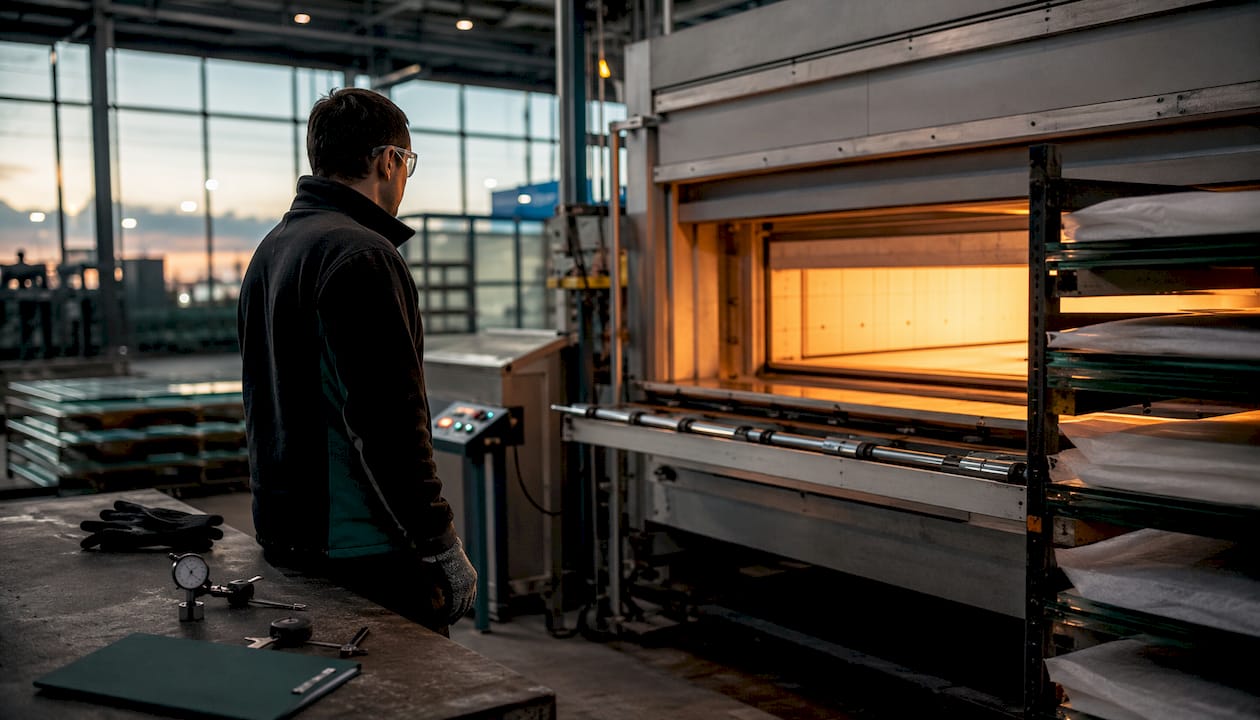
At industrial scale, this takes place in an annealing lehr: a long, tunnel-like furnace through which glass travels on a conveyor at a precisely controlled rate. The cooling profile is not generic.
- Glass type, composition, and thickness all determine the correct cooling rate
- Thicker pieces require slower cooling to prevent temperature gradients across the cross-section
- The annealing schedule must be tailored to each product to avoid residual stress
- Reannealing refers to reprocessing already-formed glass that has developed stress, using the same controlled cooling method
- Poorly annealed glass is prone to cracking under small thermal or mechanical shocks, and may fail spontaneously
The precision of the annealing schedule directly determines the durability and reliability of the finished product.
Annealed glass vs toughened glass: key differences
Toughened (tempered) glass starts as annealed glass, then undergoes rapid quenching from high temperature. This creates compressive stress at the surface and tensile stress in the core, producing a product that is up to five times stronger than annealed glass and shatters into small, relatively blunt fragments when broken.
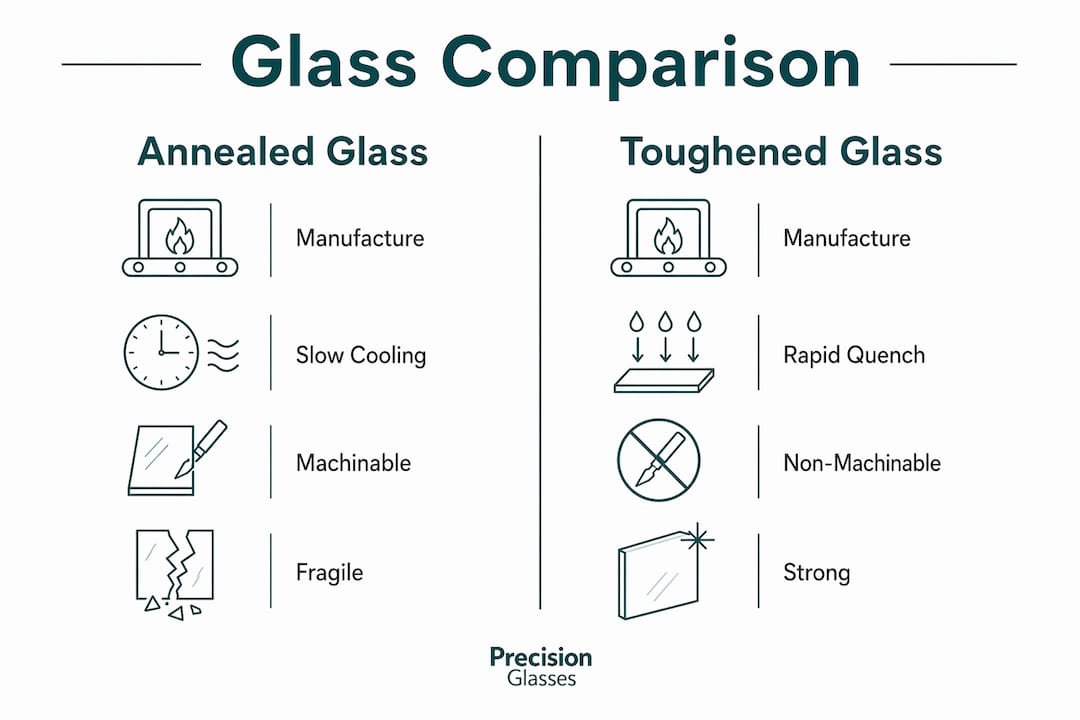
| Property | Annealed glass | Toughened glass |
|---|---|---|
| Manufacturing process | Slow, controlled cooling in a lehr | Rapid quenching after reheating |
| Surface compression | None | High compressive stress at surface |
| Mechanical strength | Lower | Up to five times higher |
| Breakage pattern | Large, sharp shards | Small, blunt fragments |
| Post-production processing | Can be cut, drilled, polished | Cannot be cut or drilled after toughening |
| Typical applications | Windows, labware, optical components | Doors, facades, vehicle glazing, safety glazing |
The inability to cut or machine toughened glass after processing is a critical distinction for engineers. Any drilling, edging, or shaping must be completed on the annealed blank before toughening. For applications requiring tight dimensional tolerances or optical coatings applied after shaping, annealed glass is the only viable starting point. You can read more about tempered glass properties and where each type fits best.
Where annealed glass is the right choice
Annealed glass suits applications where fabrication flexibility, optical clarity, or cost efficiency outweigh the need for impact resistance. It is not appropriate where UK building regulations require safety glazing, such as in critical locations defined under BS 6206 and Approved Document N.
Common applications include:
- Standard window glazing in low-risk locations where safety glazing is not mandated
- Laboratory glassware and scientific instruments, where optical homogeneity and chemical resistance matter more than mechanical toughness
- Cabinet and display glass, including shelving and furniture panels in non-critical positions
- Optical components such as lenses, prisms, and filters, where the unstressed structure supports precise coatings and grinding
- Mirrors and decorative glass, where post-production polishing and cutting are required
- Architectural glass used as a lamination substrate, where the annealed sheet is bonded with interlayers before installation
- Electronic and medical device components, where tight tolerances and surface quality are paramount
The decision to use annealed glass should account for the location, likely impact loads, and whether the application falls within a safety-critical zone under UK regulations. Where safety glazing is required, laminated or toughened glass is the correct specification. For glass selection guidance across industrial applications, the choice of base material has downstream consequences for every subsequent process.
Handling annealed glass safely and identifying it on site
Annealed glass presents a genuine laceration hazard when broken. Its fracture pattern produces long, irregular shards with sharp edges, which is why it is not classified as safety glass under UK standards.
Practical safety considerations:
- Always wear cut-resistant gloves and eye protection when handling or cutting annealed glass
- Store sheets vertically in padded A-frames to prevent edge chipping and stress concentration
- Avoid placing annealed glass in locations subject to thermal cycling without adequate edge clearance, as temperature gradients can cause thermal fracture
- Annealed glass carries no mandatory safety marking distinguishing it from toughened glass; identification typically requires checking documentation or using a polarised light viewer to detect stress patterns (toughened glass shows characteristic stress birefringence; annealed glass does not)
- Under UK building regulations, glazing in critical locations must meet BS EN 12600 impact performance requirements, which annealed glass generally does not satisfy
Pro Tip: When specifying glass for a project, always request a material certificate confirming the glass type and annealing standard. On site, a polarised light filter held against the glass will reveal the stress pattern in toughened glass; the absence of that pattern indicates annealed glass.
Why annealing precision matters: the Precision Glasses perspective
At Precision Glasses, we work with annealed glass daily across defence, aerospace, medical, and electronics applications. The material’s value is frequently underestimated by those who focus solely on mechanical strength.
Annealed glass is not a weaker alternative to toughened glass. It is the necessary starting state for any glass that requires precision machining, optical coating, or lamination. Without meticulous annealing, the substrate carries hidden residual stresses that compromise every subsequent process, from CNC grinding to anti-reflection coating deposition. The annealing schedule is where quality is either built in or permanently lost.
That perspective shapes how we approach every commission. The annealing schedule must be matched to the specific glass composition, thickness, and end use. For optical components destined for medical imaging or defence optics, the tolerance for residual stress is near zero. Annealed glass also forms the starting substrate for complex optical coatings and lamination processes where manufacturing tolerances are tight.
Common sizes and thicknesses in the UK market
Annealed float glass in the UK is available in a wide range of standard thicknesses, typically from 2mm through to 25mm, with 4mm, 6mm, 10mm, and 12mm being the most commonly stocked sizes for construction and industrial use. Thinner sheets (2mm–3mm) are used in picture framing, display cases, and laboratory applications. Thicker formats (15mm–25mm) appear in structural glazing, aquariums, and specialist industrial components.
Standard sheet sizes follow the metric system, with common stock sizes including 3,210mm × 2,250mm and 3,300mm × 2,140mm, though cut-to-size supply is standard practice across UK glass merchants and fabricators. For precision engineering applications, custom dimensions are the norm rather than the exception, with tolerances specified to fractions of a millimetre. Understanding machining tolerances is particularly relevant when annealed glass blanks are being prepared for optical or electronic components.
Recycling and the environmental profile of annealed glass
Annealed glass is one of the most recyclable industrial materials available. Float glass, including annealed sheet, is 100% recyclable and can be remelted indefinitely without loss of quality. In the UK, cullet (recycled glass) is routinely incorporated into new float glass production, reducing the energy required for melting and lowering raw material consumption.
The environmental case for annealed glass is strengthened by its longevity. Properly annealed glass, free of residual stress, resists spontaneous fracture and thermal shock, meaning it lasts longer in service and generates less waste over a building or product’s lifetime. End-of-life glass from construction projects can be collected and returned to the float glass production cycle, provided it is free of coatings or lamination layers that would contaminate the melt. Separating coated or laminated glass from clear annealed sheet at the point of disposal is therefore good practice for any UK contractor or manufacturer managing glass waste.
Key takeaways
Annealed glass is the foundational glass product: slowly cooled to remove internal stress, fully machinable, and the essential starting point for toughening, lamination, and precision optical processing.
| Point | Details |
|---|---|
| Definition and base state | Annealed glass is float glass slowly cooled to relieve internal stresses, with no surface compression. |
| Fabrication advantage | It can be cut, drilled, edged, and polished, unlike toughened glass which cannot be processed after quenching. |
| Strength comparison | Toughened glass is up to five times stronger, but annealed glass offers superior optical uniformity. |
| Safety classification | Annealed glass is not safety glass; it breaks into large, sharp shards and does not meet BS EN 12600 in critical locations. |
| Industrial role | It serves as the substrate for lamination, toughening, and optical coating across defence, medical, and electronics sectors. |