
What is a display cover in precision industrial applications?
A display cover is a precision-engineered glass component that protects and enhances high-tech screens in aerospace, defence, medical, and electronics applications. It is not a passive shield. It actively maintains optical clarity, enables touch sensitivity, and supports sensor integration under demanding conditions.
Standard thickness for electronic-grade cover glass typically falls within a moderate range, with dimensional tolerances maintained precisely. Chemically strengthened variants balance toughness with fracture resistance, and light transmittance typically exceeds 90%, with advanced anti-reflective coatings improving clarity.
Key technical facets at a glance:
- Thickness range: varies according to application
- Dimensional tolerance: maintained tightly through advanced cutting techniques
- Surface hardness: chemically strengthened substrates offer high scratch resistance
- Light transmittance: generally high with options to enhance clarity through coatings
- Strengthening method: chemical ion-exchange or tempering processes employed according to requirements
Precision Glasses specialises in supplying custom cover glass components to UK industrial and governmental clients, with full design-to-delivery capability across these sectors.
Which materials and coatings suit your application?

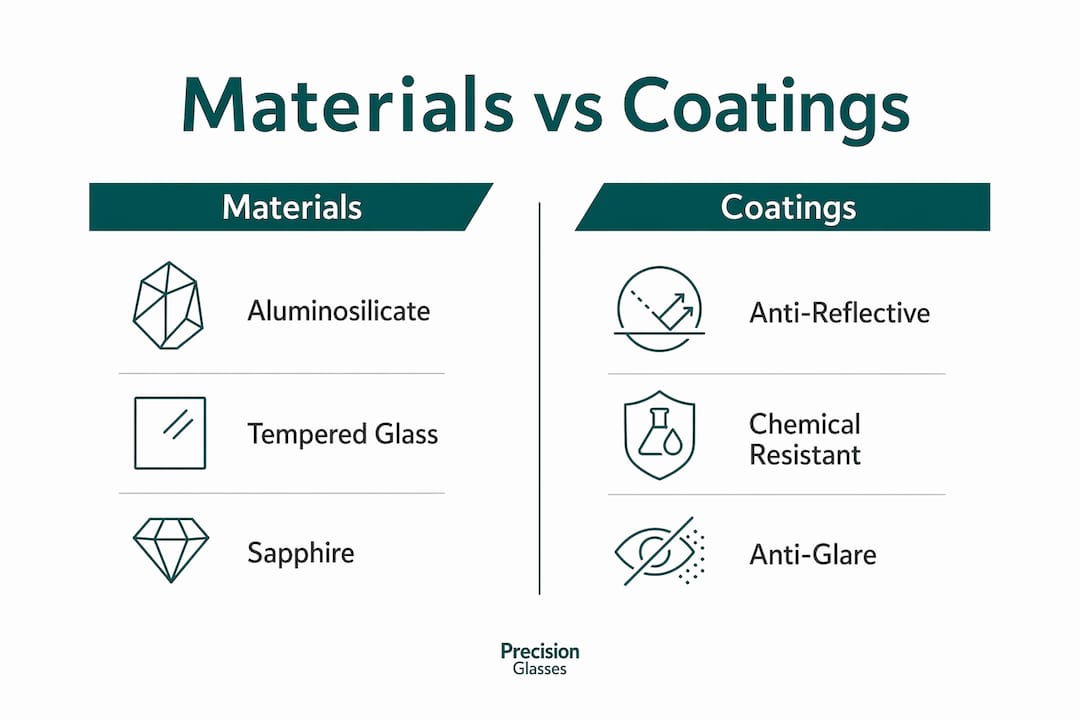
Substrate choice governs the balance between scratch resistance, toughness, and cost. Aluminosilicate glass offers high toughness through ion-exchange strengthening, making it the preferred choice for defence and medical displays. Sapphire provides extreme scratch resistance but carries a higher cost and greater process complexity, so it is typically reserved for premium or safety-critical instrumentation. Soda-lime glass suits lower-stress indoor applications where cost is the primary constraint.
Functional coatings are equally consequential. Anti-reflective, anti-fingerprint, and anti-glare coatings address glare, smudging, and readability in bright or outdoor environments. Anti-bacterial coatings are specified for surgical and clinical displays where surface hygiene is a regulatory requirement.
- AR (anti-reflective): maximises light transmission; critical for outdoor and aerospace displays
- AF (anti-fingerprint): oleophobic layer repels oils; ideal for high-touch industrial panels
- AG (anti-glare): diffuses ambient light; reduces eye strain in factory control environments
- AB (anti-bacterial): inhibits microbial growth; specified for medical and cleanroom settings
Pro Tip: Match your coating to the operating environment first. An AR coating optimised for sunlight readability will behave differently under fluorescent factory lighting. Specify the primary lighting condition in your design brief.
Chemical strengthening depth must be carefully controlled. Excessive ion-exchange depth increases surface compressive stress but raises the risk of spontaneous fracture, so the depth of layer must be balanced against the intended load profile.
How does procurement work for custom glass components?
Lead times are frequently underestimated because custom tooling, CNC machining, laser cutting, and vacuum deposition of coatings each add sequential stages to the production schedule. Minimum order quantities and lead times vary with project complexity; design-phase samples are generally available but supplied at cost.
Working with a specialist from the outset shortens the overall timeline. Precision Glasses operates a structured design, fabrication, and delivery process that accounts for tooling requirements before production begins, reducing the risk of costly schedule overruns.
Design and integration considerations for high-precision covers
Early-stage collaboration with detailed technical drawings, including cutout positions, edge finishing specifications, and sensor placements, directly reduces production iterations. A drawing that specifies a camera aperture or proximity sensor window at the outset avoids rework at the tooling stage. You can follow a structured approach to this using Precision Glasses’ glass component design guide.
Optical bonding with optically clear adhesive eliminates the air gap between the cover glass and the display beneath, removing internal reflections and improving both sunlight readability and impact resistance. This is particularly important for aerospace cockpit displays and outdoor instrumentation. Opaque silk-screen masking on the bezel area hides internal mounts and non-active display zones, with ink adhesion tested to Grade 4B for durability in bezel-less designs.
Edge finishing options include polished, bevelled, safety-chamfered, and 2.5D curved profiles, each affecting both the tactile quality of the assembly and its structural integrity under shock loading.
What standards and certifications apply to display covers?
Cover glass for defence and aerospace applications in the UK must align with MIL-SPEC and DEF STAN frameworks governing optical clarity, mechanical strength, and environmental resistance. Medical display covers are subject to IEC 60601-1 electrical safety standards and must withstand repeated cleaning with aggressive disinfectants without coating degradation. For defence-specific fabrication requirements, sovereign engineering partners operating within UK supply chains can provide additional compliance support.
Ink adhesion, optical inspection for zero surface defects, and chemical resistance testing are standard quality assurance steps. Precision Glasses applies meticulous quality assurance throughout fabrication, with full traceability for components supplied to regulated sectors. Details of the testing regime are available on the Precision Glasses quality page.
How do environmental conditions affect display cover performance?
A system-first design approach that accounts for temperature range, chemical exposure, humidity, and UV loading from the outset prevents field failures in high-stakes environments. Cover glass for automotive dashboards must tolerate thermal cycling from sub-zero to over 85°C. Aerospace and naval applications add vibration, shock, and salt-spray resistance to the specification.
Coating durability under repeated chemical cleaning is a particular concern in medical and food-processing environments. Anti-bacterial and oleophobic coatings must retain adhesion after hundreds of disinfection cycles, which is why adhesion grade testing forms part of the qualification process.
Industry-specific applications: from medical devices to aerospace
Medical imaging displays require 98% light transmittance for colour-accurate diagnostic output, flat cleanable surfaces, and autoclave-compatible edge sealing where surgical environments demand it.
Aerospace and defence cockpit displays rely on optical bonding and chemically strengthened aluminosilicate to survive vibration, rapid pressure changes, and direct sunlight. The defence glass optimisation process at Precision Glasses addresses these requirements directly.
Automotive dashboard and HUD covers combine anti-glare coatings with high thermal tolerance, while industrial control panels in factory environments prioritise vandal resistance and chemical cleaning compatibility. Each sector demands a tailored specification; a single off-the-shelf product cannot serve all four.
Precision Glasses: custom display cover glass for UK industry
Precision Glasses delivers precision-engineered custom display cover glass to aerospace, defence, medical, and electronics clients across the UK. Where a standard supplier offers a catalogue product, Precision Glasses works from your technical drawings, specifying the substrate, coating stack, edge finish, and sensor cutouts your application actually requires. The result is a component that integrates cleanly into your assembly without costly rework. To discuss your project and receive a tailored quotation, contact Precision Glasses directly through glassprecision.com.
Key takeaways
Precision-engineered display cover glass combines chemically strengthened substrates, functional coatings, and meticulous fabrication to meet the optical, mechanical, and environmental demands of aerospace, defence, medical, and electronics applications.
| Point | Details |
|---|---|
| Standard thickness and tolerance | Electronic-grade cover glass generally adheres to a precise thickness range with tight tolerances and high transmittance suitable for demanding applications. |
| Material selection matters | Aluminosilicate suits high-toughness defence and medical use; sapphire is reserved for extreme scratch-resistance requirements. |
| Coatings are application-specific | AR, AF, AG, and AB coatings each address a distinct operational environment; specify by primary use condition. |
| Early design collaboration saves time | Detailed drawings with cutouts and edge specs provided at the outset reduce production iterations and schedule risk. |
| Precision Glasses | Supplies fully custom cover glass components to UK industrial and governmental clients, from design through to delivery. |