
What is telecommunications glass and why does it matter?
Telecommunications glass is precision-engineered glass designed to transmit, manage, and control optical and electromagnetic signals in high-stakes industrial applications. This is not commodity glazing. It is a specialised category of optical communication materials, engineered to exacting tolerances for sectors where signal integrity, environmental resilience, and regulatory compliance are non-negotiable.

The industries that depend on it span defence, aerospace, medical devices, automotive systems, lighting, and electronics. Each demands different combinations of optical clarity, dielectric performance, and mechanical durability. Getting the glass specification wrong does not simply degrade performance. It can cause irreparable structural stress and signal loss that precision machining alone cannot correct.
Key characteristics that define telecommunications glass include:
- Optical clarity and transmission: Low insertion loss, high extinction ratio, and controlled polarisation for reliable data transfer across optical components
- Dielectric properties: Precise dielectric constants and low loss tangent to support high-speed, low-latency wireless communication, including autonomous vehicle safety systems
- Thermal stability: Matched coefficients of thermal expansion using materials such as borosilicate and Neoceram to prevent component stress
- Environmental durability: Resistance to moisture, mechanical stress, and flame, with jacket and structural design matched to installation conditions
- RF transparency: Signal-permeable glazing for urban environments where insulated glass creates Faraday cage effects that block mobile frequencies
- Custom coatings: Anti-reflective, bandpass, and RF-enabling surface treatments applied to micro-prisms, ball lenses, and capillaries
- Standards compliance: Adherence to UK and EU certification requirements, including CE marking for insulating glass units
Precision Glasses, alongside global specialists such as AGC Glass Europe and Nippon Electric Glass, supplies bespoke glass fiber technology components that meet these demands across the full range of sectors above.
Table of Contents
- Technical properties, fabrication, and how to select the right supplier
- Precision Glasses: your UK partner for custom telecom glass components
- Key takeaways
Technical properties, fabrication, and how to select the right supplier
Optical and electromagnetic performance
Precision optical components such as micro-capillaries, micro-prisms, and ball lens units require high extinction ratios, low insertion loss, and custom anti-reflective coatings to achieve reliable, high-volume data transfer. Nippon Electric Glass produces glass polarisers and Micro Capillary™ components from borosilicate glass, chosen specifically because its polishing characteristics match silica optical fibres for physical contact connections.
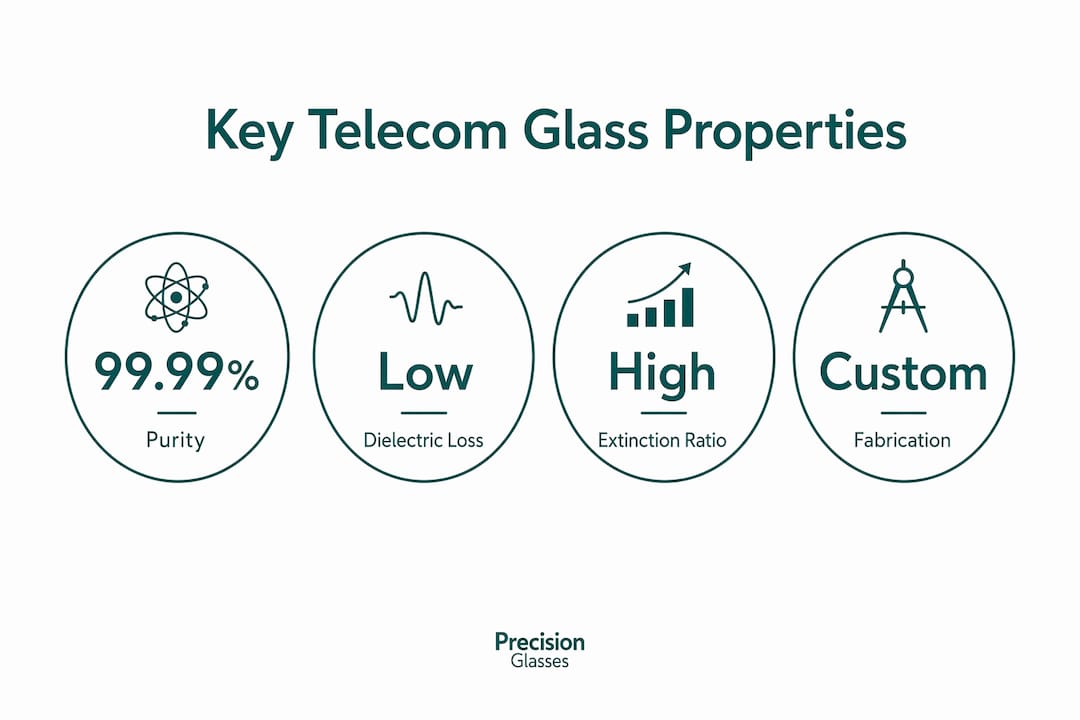
On the electromagnetic side, telecom glass solutions must deliver precise dielectric constants and a low loss tangent. This is particularly pressing as big data and AI workloads drive demand for faster, lower-latency wireless links.
Urban deployment challenges and RF-transparent glazing
High-efficiency insulated glass acts like a Faraday cage, blocking mobile frequencies in modern buildings. AGC Glass Europe’s WAVETHRU product reduces signal attenuation through glass by a factor of 10 to 100 depending on frequency band, while retaining thermal insulation properties. The complementary WAVEATTOCH transparent glass antenna was successfully tested with T-Mobile in Prague, supporting 4G bands at 1,800 MHz and 2,100 MHz with minimal visual impact on the building facade.
Laser-processed glazing takes a different approach. Schollglas GEWE-com® connect technology modifies insulating glass coatings so that mobile signal passage increases by more than 100 times, while the thermal insulation coefficient remains almost unchanged. No repeater hardware is required, and the solution is compatible with future mobile standards without further glazing modifications.
Pro Tip: When specifying RF-transparent glazing for a new build or retrofit, confirm whether the solution is frequency-agnostic. Laser-processed coatings like GEWE-com® connect work across current and future mobile standards without requiring hardware upgrades.
Fibre optic cable glass: matching material to environment
The environment dictates both glass type and cable architecture for fibre optic infrastructure. Outdoor installations require moisture-blocking gel or absorbent tape, UV-resistant polyethylene jackets, and often armoured protection against rodents or mechanical stress. Indoor cables prioritise flame-retardant jackets and flexibility. Single-mode glass fibre achieves losses as low as 0.19 dB/km at 1,550 nm for long-distance applications, while standard multimode fibre is suited to shorter campus or building runs.
The latest hollow core double nested antiresonant nodeless fibres represent a significant advance. Research published in Nature Photonics reports optical loss below 0.1 dB/km at 1,550 nm across a 66 THz bandwidth, with transmission speeds 45% higher than conventional silica fibres. This technology is moving from laboratory to commercial consideration.
Advanced glass types and emerging technologies
Semiconductor-core fibres, where a crystalline semiconductor core is drawn within a glass cladding, open the door to optoelectronic and nonlinear optical applications not possible with standard silica. Silicon is the most studied core material, given its transparency at telecom wavelengths. Active photonic fibres now integrate light modulation and detection within the fibre itself, shifting glass fiber technology from passive transmission to active network components.
Material selection at the design stage is where most projects succeed or fail. A mismatch in thermal expansion between core and cladding introduces residual stress that degrades both optical and mechanical performance. Neoceram, a glass-ceramic with thermal expansion properties close to quartz glass, is commonly specified for coupler cases and cover glass in optical fibre assemblies.
Quality assurance, testing, and UK compliance
Telecommunications glass components must pass rigorous testing before deployment. For insulating glass units used in RF-transparent facades, CE marking under the relevant EU construction products framework is a baseline requirement. Fibre optic cable standards such as OM1 through OM4 for multimode and OS1/OS2 for single-mode define performance thresholds for attenuation, bandwidth, and transmission distance. Clients specifying custom components should request documented test data against these standards, not just supplier declarations.
Lead times for bespoke fabrication vary with complexity. Standard precision components typically move through design, fabrication, and quality assurance within agreed project schedules. Highly specialised items, such as custom-doped active glass or multi-layer coated assemblies, require longer lead times due to material sourcing and process validation. Pricing reflects raw material grade, coating complexity, machining tolerances, and batch size. Clients ordering at volume generally achieve better unit economics, but low-volume prototype runs are feasible with the right fabrication partner.
Precision Glasses works through a structured process of design consultation, fabrication, and delivery, with quality assurance built into each stage and compliance with UK and EU standards maintained throughout.
Precision Glasses: your UK partner for custom telecom glass components
When your project demands glass that performs to specification in a defence system, a medical device, or a 5G-ready building facade, the fabrication partner you choose determines the outcome.

Precision Glasses designs, fabricates, and delivers custom precision glass components for the UK’s most demanding industrial and government clients. From optical components with anti-reflective coatings to RF-transparent glazing and thermally stable fibre assemblies, we work to your exact specification, with quality assurance and standards compliance at every stage. Our manufacturing workflow covers melting, grinding, polishing, toughening, CNC work, and coating, supported by skilled professionals who understand the technical requirements of defence, aerospace, medical, automotive, lighting, and electronics applications.
Contact Precision Glasses to discuss your specification and receive a tailored quotation for your next telecommunications glass project.
Key takeaways
Telecommunications glass requires precisely matched optical, electromagnetic, and mechanical properties; no single material or coating suits every application.
| Point | Details |
|---|---|
| Material matching is critical | Mismatched thermal expansion between core and cladding causes irreparable stress and signal degradation. |
| RF-transparent glazing solves urban connectivity | Laser-processed coatings can increase mobile signal passage by more than 100 times while preserving thermal insulation. |
| Fibre loss benchmarks are advancing | Hollow core fibres now achieve optical loss below 0.1 dB/km over a bandwidth of up to 66 THz, with 45% higher transmission speeds than silica fibres. |
| Standards compliance is non-negotiable | UK and EU clients must verify CE marking, fibre standards (OM1–OS2), and documented test data before deployment. |
| Precision Glasses delivers bespoke solutions | Custom design, fabrication, and quality-assured delivery for defence, aerospace, medical, and electronics clients across the UK. |