
For UK OEM engineers and procurement officers, the correct specification is custom, optically bonded, certified marine display glass manufactured to IMO performance expectations, IEC 60945 environmental test requirements, and ABS or UK MCA class rules. Off-the-shelf consumer panels consistently fail in maritime environments; professional-grade, marine-specific designs are the only reliable path for bridge and machinery displays.

Marine display glass is a precision cover glass or bonded optical window fabricated to marine EMC and environmental test standards for direct OEM integration into navigational and control displays. It is not aquarium glass, not a protective housing retrofit, and not a standard industrial panel. ECDIS-grade applications demand compliance evidence, batch-level traceability, and third-party test reports before acceptance.
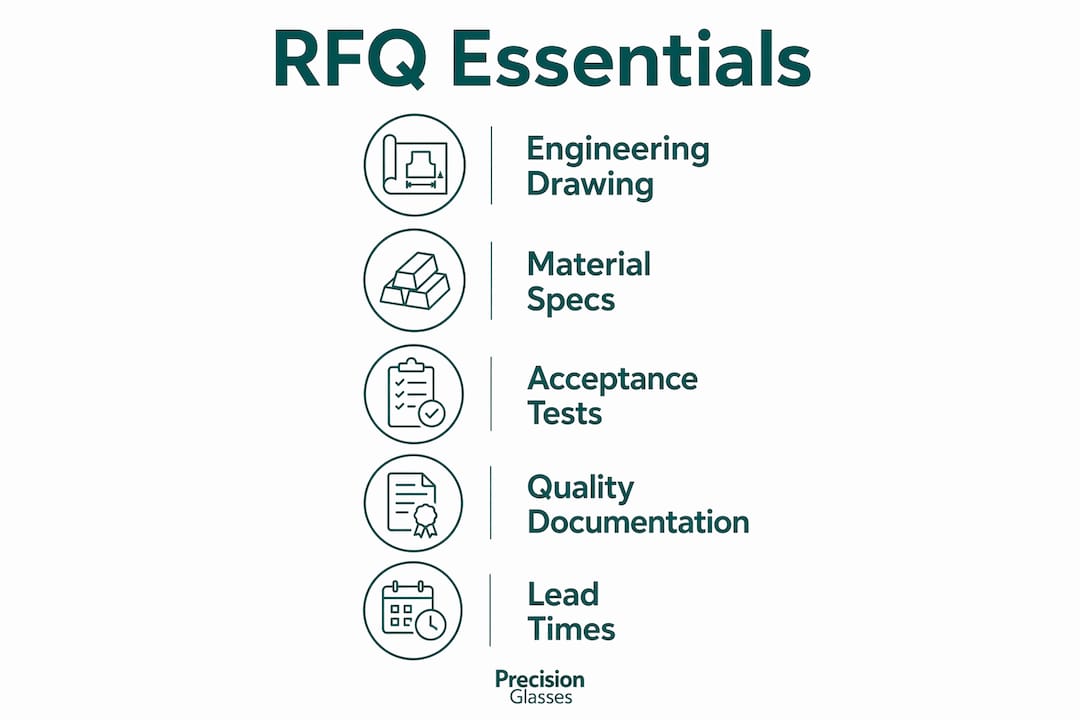
Start your RFQ with these three items:
- Dimensioned CAD drawing with tolerances, cutouts, and edgework callouts
- Target optical specification (transmission %, haze %, reflectance %, luminance handling)
- Required certifications and acceptance tests (IEC 60945, IMO/ECDIS, ABS, UK MCA)
Precision Glasses supplies custom marine display glass with optical bonding, chemically strengthened glass, ceramic printing, EMI coatings, and batch-level traceability. Request a prototype or sample to begin your qualification process.
Table of Contents
- What should your marine display glass RFQ include?
- Critical technical specifications for marine display glass
- How do maritime hazards change your glass requirements?
- Which glass types, coatings, and processes suit marine displays?
- Mounting, cutouts, and touch integration: avoiding late-stage rework
- What QA documents and inspections should you require?
- What lead times and costs should you plan for?
- Maintenance, field repair, and lifecycle planning
- Why Precision Glasses is a UK supplier for marine display glass
- Key takeaways
- What the conventional wisdom on marine glass gets wrong
- Get a quote, prototype, or sample from Precision Glasses
- Key standards and reference documents for UK procurement teams
What should your marine display glass RFQ include?
A vague RFQ produces vague quotations and late-stage surprises. Procurement teams should treat the checklist below as a minimum; suppliers who cannot respond to each item in full are not qualified for marine OEM work.
Core RFQ items:
- Dimensioned engineering drawing (CAD, PDF) with datum surfaces, feature control frames, and all cutout/hole positions
- Material specification: glass type (chemically strengthened, tempered, low-iron), nominal thickness, and hardness target
- Optical tolerances: total visible light transmission (%), haze (%), reflectance (%), and any polarisation-sensitive requirements
- Coating specifications: anti-reflective (single or multi-layer), anti-glare (chemical etch), oleophobic, EMI conductive, ceramic print areas
- Edgework and corner radii: minimum corner radius, edge finish (ground, polished, bevelled), and CNC tolerance bands
- Touch integration notes: bonding adhesive compatibility, connector routing, potting requirements
- Environmental acceptance tests required: salt spray (ASTM B117 or equivalent), vibration (marine spectrum), thermal cycling, humidity soak, IP ingress test
- Standards and certificates required: IEC 60945, IMO/ECDIS performance expectations, ABS rules, UK MCA guidance
- Deliverables: prototype lead-time, sample charge policy, quantity breakpoints, tooling/fixture ownership, warranty terms
| RFQ Item | Minimum Requirement |
|---|---|
| Engineering drawing | CAD file with GD&T callouts |
| Material | Chemically strengthened or tempered glass, specified grade |
| Optical metrology | Transmission, haze, reflectance report per batch |
| Coatings | Specification sheet per coating layer |
| Environmental tests | Salt spray, vibration, thermal cycling reports |
| Certifications | IEC 60945, IMO/ECDIS, ABS, UK MCA as applicable |
| Traceability | Batch-level certificate of conformity |
| Prototype policy | Lead-time, NRE/tooling terms, sample charge |
Acceptance test artefacts must accompany the first article and every production lot. Suppliers who cannot provide optical metrology reports and batch-level traceability should be removed from the shortlist.
Critical technical specifications for marine display glass
Concrete target values give your engineering team an objective basis for supplier evaluation and acceptance testing. The figures below reflect published marine display practice and are suitable as starting points; your application may require tighter tolerances.
| Parameter | Example Target Value | Procurement Note |
|---|---|---|
| Visible light transmission | — | Specify per coating stack |
| Haze | ≤ 0.5% | Require spectrophotometry report |
| Reflectance | ≤ 1% per surface (AR) | Critical for bridge readability |
| Peak luminance handling | 1,500 cd/m² | Sunlight-readable threshold |
| Surface hardness | 7H (pencil hardness) | Specify in coating acceptance criteria |
| Glass thickness | 3–6 mm (cover glass) | Driven by panel size and IP housing |
| Flatness tolerance | — | Interferometry verification required |
| Operating temperature | −20°C to +70°C | Confirm with bonding adhesive supplier |
| IP rating (front face) | IP ingress test certificate required | IP66/NEMA4 is the bridge standard. |
| CNC hole tolerance | ±0.1 mm | State on drawing; verify first article |
Key specification decisions:
- Specify chemically strengthened glass (ion-exchanged) for cover glass where scratch resistance and post-fabrication CNC work are both required
- Tempered glass offers higher surface compression but cannot be cut or drilled after tempering; plan cutouts before the toughening stage
- Anti-glare treatment (chemical etch) reduces specular reflection at the cost of slight haze increase; balance against transmission target
- Display cover glass selection should account for the full optical stack, including bonding adhesive refractive index
How do maritime hazards change your glass requirements?
Vessels expose displays to a combination of stresses that no single consumer-grade panel is designed to survive long-term. Each hazard maps directly to a specification or test requirement.
Primary hazards and their specification consequences:
- Salt-laden air: accelerates coating degradation and promotes corrosion at seals; requires salt spray testing to ASTM B117 and oleophobic or hard-coated surfaces
- Persistent humidity and condensation: without optical bonding, the air gap between cover glass and LCD becomes a condensation trap; optical bonding eliminates this risk entirely
- High solar load: direct sun on a bridge display demands ≥ 1,500 cd/m² luminance handling and multi-layer AR coatings to maintain contrast
- Thermal shock: cold seawater spray onto a sun-heated panel creates rapid thermal gradients; specify thermal cycling tests across the full operating range
- Continuous vibration: engine and sea-state vibration fatigues adhesive bonds and connector seals; require vibration test reports to a marine spectrum profile
- Mechanical impact: crew contact and equipment handling demand tempered or chemically strengthened glass with a minimum 7H surface hardness
Acceptance pack requirement: every delivery lot must include salt spray test report (ASTM B117 or equivalent), vibration test evidence to a marine spectrum, thermal cycling data across −20°C to +70°C, and IP ingress test certificate. Accepting a lot without these documents creates an unquantified warranty risk.
Which glass types, coatings, and processes suit marine displays?
Glass material options
Chemically strengthened (ion-exchanged) glass is the preferred cover glass for most marine display applications. It tolerates post-fabrication CNC work, delivers high surface hardness, and maintains optical flatness. Tempered glass provides higher bulk strength but must be fully machined before toughening. Low-iron alkali-lime glass is appropriate where maximum visible transmission is the priority and mechanical demands are moderate.
For very large viewing panels, bonded acrylic blocks can reach sizes unavailable to glass and offer impact flexibility, but their scratch resistance and long-term optical stability are inferior to glass for instrument displays. Acrylic is appropriate for structural viewing windows, not precision navigational displays.
Optical bonding
Optical bonding removes the air gap between cover glass and display module, delivering up to a 90% reduction in internal reflections, eliminating internal condensation, and increasing impact resistance. For bridges and exposed helm stations, it is effectively mandatory. The bonding adhesive must be specified for refractive index match, UV stability, and operating temperature range.
Pro Tip: Specify near-infrared and visible transmission curves, plus polarisation-sensitive metrics, in your optical metrology requirements. Some display technologies are sensitive to polarisation state; discovering this after bonding is expensive.
Coatings and surface finishes
- Anti-reflective (single or multi-layer): reduces surface reflectance to ≤ 1% per surface
- Anti-glare (chemical etch): diffuses specular reflection; specify haze increase limit
- Oleophobic: protects touch surfaces from fingerprint contamination and salt residue
- EMI conductive coating: required where the glass must form part of the display’s EMC shielding
- Ceramic printing: used for masking, branding, and connector area marking; specify print resolution and adhesion test
Fabrication processes
CNC waterjet and laser cutting achieve tight positional tolerances on cutouts and holes. Edge grinding and lapping control flatness and remove sub-surface damage. Low-stress heat treatments preserve dimensional stability after coating. For glass fabrication processes that affect final tolerances, require first-article dimensional reports against the drawing.
Mounting, cutouts, and touch integration: avoiding late-stage rework
Integration failures on OEM projects almost always trace back to tolerances and assembly details that were not called out on the drawing at the right time.
- Mounting tolerances: allow 0.3–0.5 mm clearance between glass edge and housing rebate; specify gasket compression zone and clamp force limits to avoid stress concentrations at corners
- Corner radii: minimum 2 mm internal corner radius on cutouts; tighter radii concentrate stress and increase fracture risk during assembly
- Hole tolerances: specify ±0.1 mm on hole diameter and position; thread inserts for load-bearing fixings must be bonded, not tapped directly into glass
- Thermal expansion: glass and aluminium housings have different coefficients of thermal expansion; design the mounting system to accommodate differential movement across the operating temperature range
- Touch integration: bonding adhesive must be compatible with the touch controller stack’s optical requirements; route connectors before bonding and confirm potting compound compatibility with the adhesive
- EMI/grounding: if an EMI conductive coating is specified, the grounding path must be designed into the housing interface at the drawing stage, not retrofitted
Drawing callouts should include datum surfaces, feature control frames for flatness and parallelism, and explicit notes on which surfaces are optically active.
What QA documents and inspections should you require?
- Certificate of conformity covering material grade, dimensions, and coating specification, with batch number
- Optical metrology report (spectrophotometry): transmission, haze, and reflectance per batch, measured against drawing tolerances
- Temper/strength certificate confirming surface compression or ion-exchange depth
- Coating specification sheet for each applied layer, including adhesion test result
- Third-party test reports: salt spray (ASTM B117), vibration (marine spectrum), thermal cycling (−20°C to +70°C), and IP ingress test
- Visual inspection record against agreed cosmetic acceptance criteria (scratch/dig specification, bubble limits, coating uniformity)
- First-article inspection report with dimensional measurements against drawing, including flatness (interferometry) and CNC feature positions
Sampling plan guidance: prototype lots — 100% inspection; first-article lots — full dimensional and optical check on all units; production lots — AQL sampling per ISO 2859-1, with optical metrology on a defined sample per batch.
Rejection clauses should specify the disposition process (return, rework, or scrap) and require a corrective action report for any out-of-tolerance batch. Traceability records must be retained for the agreed warranty period. Precision Glasses’s quality systems support batch-level traceability and third-party test coordination.
What lead times and costs should you plan for?
- Tooling and fixture creation: 2–4 weeks for first-off CNC programmes and optical bonding fixtures
- Prototype fabrication and optical bonding: 3–5 weeks from approved drawing
- Third-party test scheduling: 2–4 weeks for salt spray, vibration, and thermal cycling; plan this in parallel with prototype review
- Sample approval and first-article inspection: 1–2 weeks
- Production lot: 4–8 weeks from first-article approval, depending on batch size and coating queue
Major cost drivers: optical bonding adds process time and adhesive material cost; custom cutouts and tight CNC tolerances increase machining time; multi-layer AR coatings require sequential deposition runs; small-batch premiums apply below standard quantity breakpoints.
Practical cost reduction: consolidate cutout features to reduce CNC setups; agree on standard thickness and coating stacks across product variants; order prototype and first-article quantities together to reduce fixture amortisation cost.
Maintenance, field repair, and lifecycle planning
Routine maintenance checks:
- Visual inspection of glass surface and seals at each scheduled service interval
- Check for coating degradation (haze increase, delamination at edges) annually or after severe weather events
- Inspect connector seals and gasket compression; replace gaskets at manufacturer-recommended intervals
Cleaning: use only pH-neutral, non-abrasive cleaners on AR and oleophobic coatings. Avoid ammonia-based products, which attack AR coatings, and abrasive cloths, which scratch oleophobic layers. Confirm permitted cleaning agents with the coating supplier before issuing maintenance instructions.
Field repair: in-situ repair of bonded glass assemblies is not practical; the standard field repair is module replacement. Maintain a spare-parts inventory sized to vessel type and operational profile. For vessels on extended deployments, carry at least one complete glass module per display position.
Lifecycle planning: specify warranty terms at procurement stage, including coverage for coating delamination and seal failure. Plan glass module replacement at the same interval as the display module it is bonded to, unless the glass can be debonded and rebonded without damage to the optical stack.
Why Precision Glasses is a UK supplier for marine display glass
Precision Glasses manufactures custom precision glass components for marine, defence, aerospace, medical, and electronics OEMs from the UK. For marine display applications, the relevant capabilities include:
- Custom optical bonding: full bonding service with adhesive selection, refractive index matching, and curing validation
- Chemically strengthened glass: ion-exchanged cover glass fabricated to drawing, with strength certificates
- Ceramic printing: masking, marking, and connector area printing to specification
- EMI conductive coatings: integrated into the glass stack at fabrication stage
- CNC cutouts and edgework: tight-tolerance machining with first-article dimensional reports
- Batch-level traceability: certificate of conformity and optical metrology report with every delivery lot
- Third-party testing coordination: salt spray, vibration, thermal cycling, and IP ingress test scheduling
Precision Glasses works to advanced glass specifications and supports prototype runs, sample optical metrology, and specification review before commitment to production tooling.
Key takeaways
Custom, optically bonded, certified marine display glass with batch-level traceability and third-party test reports is the only specification that reliably meets IMO, ECDIS, ABS, and UK MCA requirements for bridge and machinery displays.
| Point | Details |
|---|---|
| Specify optical bonding | Bonding eliminates internal condensation and reduces internal reflections by up to 90%. |
| Require test artefacts | Demand salt spray, vibration, thermal cycling, and IP ingress reports with every delivery lot. |
| Use concrete optical targets | Specify reflectance ≤ 1% and 1,500 cd/m² luminance handling. |
| Avoid off-the-shelf panels | Consumer displays cannot withstand marine vibration, humidity, or maintenance demands. |
| Precision Glasses | Supplies custom optically bonded marine display glass with batch traceability and prototype availability. |
What the conventional wisdom on marine glass gets wrong
The most persistent mistake in marine display procurement is treating the glass as a passive protective layer rather than an active optical component. Engineers who specify “toughened glass, 4 mm, AR coated” and leave it there are writing half a specification. The bonding adhesive refractive index, the coating stack sequence, the CNC tolerance on connector cutouts, and the thermal expansion allowance in the mounting design all determine whether the assembly performs at sea or fails within eighteen months.
The second mistake is deferring third-party test scheduling until after prototype approval. Salt spray and vibration testing takes weeks; if it is not in the project plan from day one, it becomes the critical path item that delays certification. Specify the tests in the RFQ, agree on the test house at contract stage, and run testing in parallel with first-article review.
Optical bonding is sometimes treated as optional for cost reasons. On a bridge display exposed to direct sun and sea spray, it is not optional. The condensation risk alone justifies it; the contrast and impact resistance gains are additional. Designers who specify bonding from the outset avoid the expensive retrofit conversation six months into a programme.
Get a quote, prototype, or sample from Precision Glasses
Precision Glasses gives UK OEM engineers and procurement teams a direct route from specification to qualified marine display glass, without the delays of multi-tier supply chains. Supply your CAD drawing and target optical specification, and we will return a detailed quotation covering material, optical bonding, coatings, CNC work, and third-party test coordination. Prototype runs are available with full optical metrology reports and batch-level certificates of conformity, so your qualification process starts with real data, not vendor claims.

To request a prototype, sample, or specification review, visit Precision Glasses or go directly to our technical glass page to submit your requirements. We will confirm lead times, NRE/tooling terms, and sample charge policy in the first response.
Key standards and reference documents for UK procurement teams
Use these standards and bodies as the authority references in your RFQ acceptance criteria and drawing notes.
- IMO (International Maritime Organization): sets performance standards for navigational equipment including ECDIS; MSC resolutions define display performance expectations for bridge systems
- ECDIS (Electronic Chart Display and Information System): IMO/IHO performance standard for navigational displays; defines luminance, contrast, and colour requirements for chart display
- IEC 60945: the primary environmental and EMC test standard for maritime navigation and radio communication equipment; covers temperature, humidity, vibration, shock, salt mist, and EMC
- ABS (American Bureau of Shipping): class rules for marine electrical and electronic equipment; ABS type approval is widely accepted by international flag states including UK-flagged vessels
- UK MCA (Maritime and Coastguard Agency): the UK flag state authority; references IMO instruments and IEC standards for equipment approval on UK-registered vessels
- ASTM B117: standard practice for salt spray (fog) testing; specify in acceptance criteria for coatings and seals
- ISO 2859-1: attribute sampling system for acceptance inspection; use for production lot sampling plans
Recommended
- Display cover glass: the 2026 guide for industrial sectors – Precision Glasses
- Why choose advanced glass materials: 2026 engineer’s guide – Precision Glass
- Display glass explained: precision, performance and industry solutions – Precision Glass
- Advanced glass specifications: Guide for engineers and buyers – Precision Glass