For surgical and diagnostic displays, specify chemically strengthened aluminosilicate glass with an AR/AF coating stack and request optical bonding capability from your supplier. For patient kiosks and rugged industrial HMIs, ultra-clear low-iron glass or thermally tempered soda-lime with an anti-glare surface is often sufficient, provided chemical resistance is validated against your cleaning protocol.
Before you shortlist materials, confirm these four things with any prospective supplier:
- Chemically strengthened aluminosilicate (0.5–3 mm): the first choice for bedside monitors, surgical displays, and any PCAP touch interface requiring precision and disinfectant resistance.
- Ultra-clear (low-iron) glass: preferred where diagnostic colour fidelity matters and standard soda-lime’s greenish tint would compromise display accuracy.
- Borosilicate glass: the right call for high thermal-cycling environments, thanks to its low coefficient of thermal expansion (3.3 × 10⁻⁶/K), making it suitable for portable diagnostic instruments.
- Corning Gorilla Glass / AGC Dragontrail: branded chemically strengthened aluminosilicates worth referencing in datasheets, though regional manufacturers such as Precision Glasses can supply equivalent formulations with more flexible CNC processing and lower minimum order quantities.
Your first supplier conversation should request: chemical-compatibility data for your exact disinfectants, AR/AF coating transmittance specs, optical-bonding capability confirmation, and a sample panel for validation. Standards to anchor your specification: IEC 60601 for medical electrical equipment mechanical design, ISO 13485 for quality management.
Table of Contents
- What glass types and grades are used in medical and industrial display cover glass?
- Which coatings and surface finishes should you specify for medical and industrial displays?
- How does glass choice affect PCAP and other touch sensor performance?
- What processing and customisation capabilities matter for your display glass project?
- What standards and tests should you specify for medical display glass?
- How to choose the right display glass: a prioritised specification checklist
- Engineering trade-offs that matter: optical bonding, tint, and strengthening methods
- Key takeaways
- Why supplier capability matters as much as material choice
- Precision Glasses: technical support for medical and industrial display projects
- Authoritative datasheets, standards, and further reading
What glass types and grades are used in medical and industrial display cover glass?
Material choice is the single decision that cascades into every downstream trade-off: touch accuracy, sterilisation tolerance, optical fidelity, and manufacturability. Getting it right at the outset saves significant rework during design validation.
Chemically strengthened aluminosilicate
This is the workhorse of medical display glass. Ion-exchange strengthening drives potassium ions into the surface, creating a deep compressive layer that resists both scratching and impact without the micro-distortions that thermal tempering introduces. Aluminosilicate is available in thin formats from 0.5 mm to 3 mm, resists alcohol and hydrogen peroxide, and is the standard substrate for PCAP touch panels in clinical environments. Corning Gorilla Glass and AGC Dragontrail are the two most widely cited branded versions; both are chemically strengthened aluminosilicates, and both appear frequently in supplier datasheets as reference materials.
Thermally tempered glass
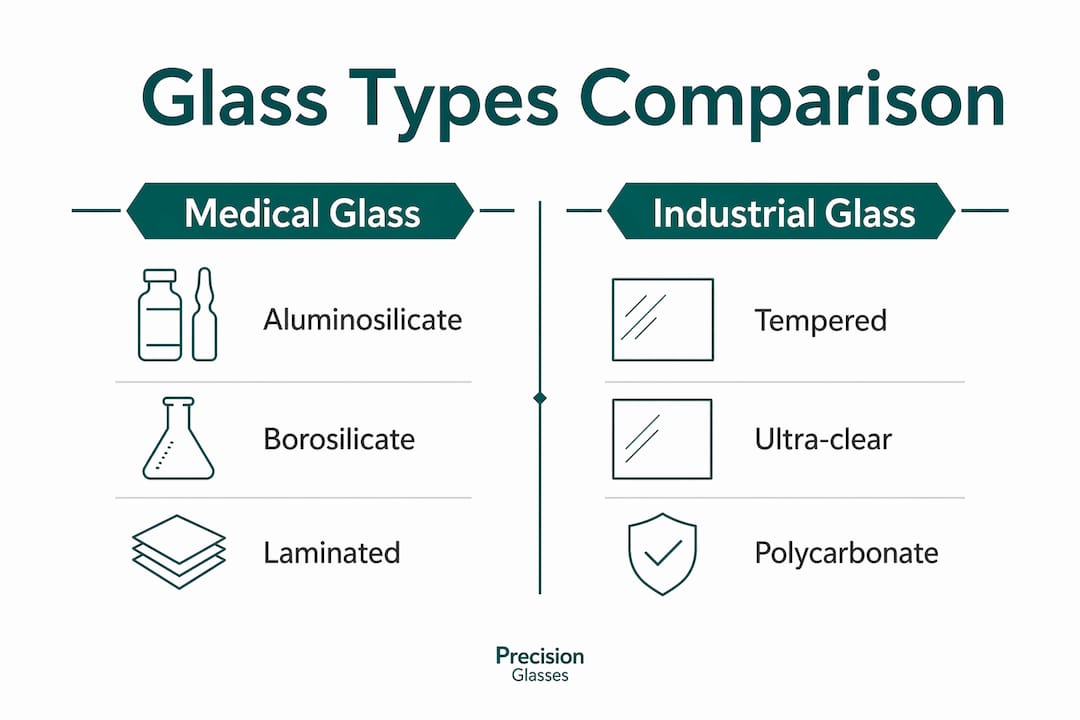
Thermal tempering heats glass to near its softening point and then quenches it rapidly, producing high surface compression. It delivers strong impact resistance and is cost-effective for larger panels, but the process can introduce surface waviness and micro-distortions. For rugged industrial panels where PCAP precision is not critical, thermally tempered glass is a practical choice. Where touch accuracy matters, it is not.
Ultra-clear (low-iron) glass
Standard soda-lime glass contains iron oxides that produce a visible greenish tint, which is problematic for diagnostic colour fidelity. Low-iron variants reduce iron content to below 0.01%, achieving visible-light transmission above 91% and a neutral colour rendering. Specify this for diagnostic imaging monitors, pathology displays, and any application where colour accuracy is a clinical requirement.
Borosilicate glass
Borosilicate’s defining characteristic is its low coefficient of thermal expansion (3.3 × 10⁻⁶/K), which makes it resistant to stress fractures during rapid temperature swings. It is the preferred substrate for portable diagnostic instruments and high-precision imaging devices where thermal cycling is a design constraint. Optical transmission is stable across a broad wavelength range, making it a reliable choice where spectral consistency matters.
Laminated safety glass
Two glass plies bonded with an interlayer (typically PVB or ionoplast) that holds fragments in place on breakage. Relevant where patient safety standards require contained failure modes, such as in floor-standing kiosks or large-format clinical information displays. Adds weight and thickness, so it is rarely the first choice for handheld or portable devices.
Hard-coated optical polycarbonate
Not glass, but worth including as a comparative reference. Hard-coated polycarbonate with a 7H+ surface treatment offers extreme impact resistance and is machinable without specialist CNC equipment. Its limitations are real: it does not match glass on long-term scratch resistance or optical clarity, and it requires UV stabilisation for outdoor use. It suits harsh-impact environments where glass breakage is a primary risk.
Material comparison table
| Material | Typical thickness (mm) | Surface hardness | Compressive layer | Optical transmission | Low CTE | Best for |
|---|---|---|---|---|---|---|
| Chemically strengthened aluminosilicate | 0.5–3 | 7 Mohs | Deep (DOL 25–50 µm) | >85% | No | Surgical/diagnostic monitors, PCAP bedside panels |
| Thermally tempered soda-lime | 3–10 | 7 Mohs | Shallow surface | >85% | No | Rugged industrial panels, large kiosk covers |
| Ultra-clear (low-iron) soda-lime | with a thickness suitable for diagnostic imaging and colour-critical displays | |||||
| Borosilicate | 0.5–5 | 7 Mohs | None (unless chemically strengthened) | >85% | Yes (3.3 × 10⁻⁶/K) | Portable diagnostics, thermal-cycling environments |
| Laminated safety glass | 5–10 (combined) | Substrate-dependent | Substrate-dependent | >85% | No | Floor-standing kiosks, large clinical displays |
| Hard-coated polycarbonate | 1–5 | 7H+ (coating) | N/A | >85% | No | Extreme-impact industrial enclosures |
Which coatings and surface finishes should you specify for medical and industrial displays?
Coatings are where optical performance, cleanability, and durability intersect, and where specification errors are most costly to correct after tooling. Each coating family addresses a different failure mode.
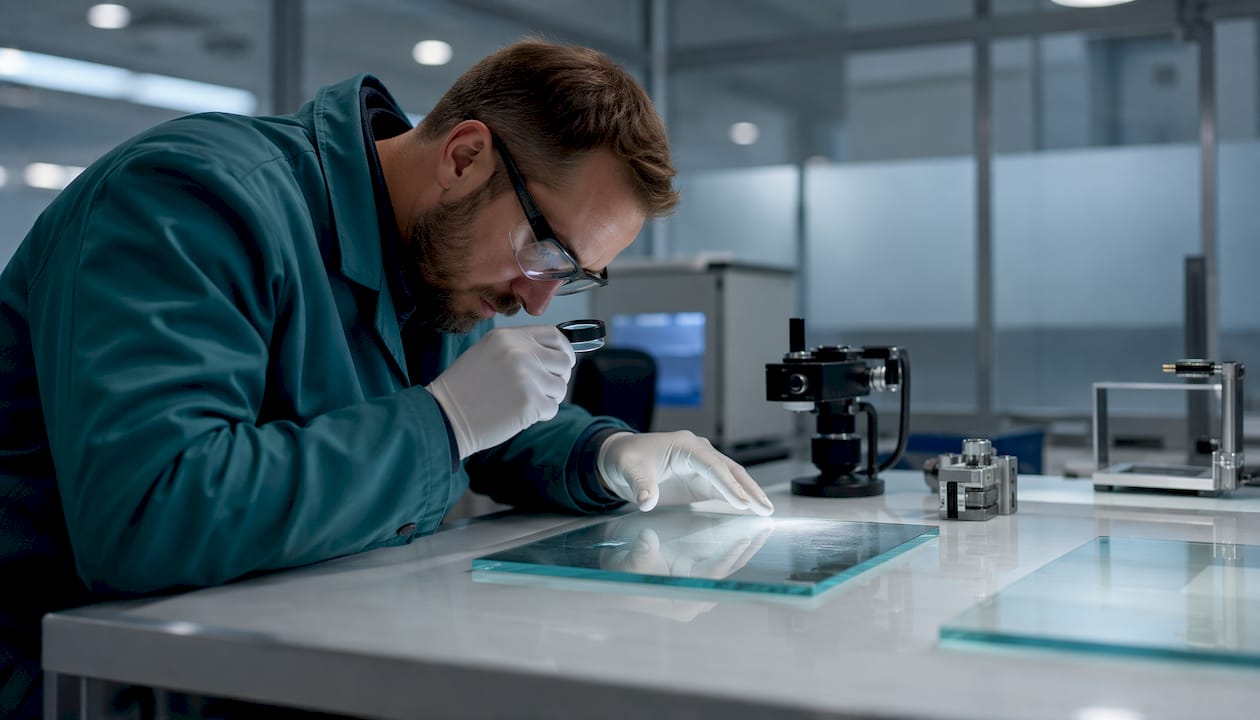
Anti-reflective (AR) coatings
AR coatings use thin-film interference to suppress surface reflections. A well-specified AR stack can push visible transmittance above 99%, compared with the >85% typical of uncoated optical glass. The trade-off is durability: multi-layer AR stacks are susceptible to delamination under aggressive chemical cleaning cycles, so you must validate the coating against your exact disinfectant and wipe protocol before committing to production.
Anti-glare (AG) surface treatment
AG is an etched or deposited surface texture that scatters incident light, reducing specular reflection. It introduces controlled haze, which softens glare but also reduces contrast and perceived sharpness. For surgical monitors in high-ambient-light theatres, the haze penalty is often unacceptable. For outdoor industrial HMIs or patient-facing kiosks under mixed lighting, AG is frequently the more practical choice.
Anti-fingerprint (AF) / oleophobic coatings
Fluoropolymer-based AF coatings reduce surface energy, making fingerprints easier to wipe away and reducing smear visibility. They are standard on any touch interface. The limitation is wear: AF coatings thin with repeated cleaning, particularly with alcohol-based hospital disinfectants. Specify a minimum coating thickness and request accelerated wipe-cycle data (typically 5,000–10,000 wipe cycles) before approving a supplier’s coating.
Antimicrobial coatings
Silver-ion or copper-based antimicrobial coatings are increasingly specified for patient-facing surfaces. They reduce surface microbial load between cleaning cycles but are not a substitute for disinfection protocols. Confirm compatibility with your facility’s cleaning agents, as some antimicrobial coatings degrade under quaternary ammonium compounds.
Hard coatings and scratch resistance
Diamond-like carbon (DLC) and silicon-oxide hard coatings increase surface hardness beyond the substrate’s native Mohs rating. They are relevant for industrial operator panels subject to abrasive contact. Hard coatings can affect touch sensitivity if applied at excessive thickness, so coordinate specification with your touch controller vendor.
Recommended coatings by application:
- Surgical monitors: AR + AF; prioritise low haze and high transmittance; validate against IPA and hydrogen peroxide wipe cycles.
- Bedside touch panels: AR + AF + antimicrobial; confirm wipe-cycle durability with your infection-control team’s preferred disinfectant.
- Patient kiosks: AG or AR + AF depending on ambient lighting; antimicrobial coating strongly recommended.
- Rugged industrial HMIs: AG + hard coat; UV-stable formulation for outdoor panels.
Pro Tip: In mixed hospital lighting, where both direct overhead fluorescence and window glare are present, AR + AF consistently outperforms AG. AG’s haze reduces perceived contrast under fluorescent light, whereas AR preserves sharpness while controlling specular reflection. Specify AG only where ambient light is predominantly directional and uncontrolled.
How does glass choice affect PCAP and other touch sensor performance?
Touch sensor integration is where material decisions made early in the design process create problems late in validation. The interactions between cover glass properties and sensor performance are well understood, but frequently underestimated in early-stage specifications.
Chemically strengthened glass is preferred for high-precision PCAP because the ion-exchange process produces a flat, distortion-free surface. Thermal tempering, by contrast, can introduce micro-distortions that reduce touch accuracy across the panel, particularly near edges where tempering stress gradients are highest. For a surgical display where touch accuracy is a patient-safety consideration, this distinction is not trivial.
Glass thickness directly affects PCAP signal strength. Thicker cover glass attenuates the capacitive field between finger and sensor electrode, reducing sensitivity. Most PCAP controllers are calibrated for cover glass in the 0.7–3 mm range; anything above 4 mm typically requires custom firmware tuning or a different sensor architecture. Dielectric properties of the glass also matter: aluminosilicate and borosilicate have different permittivity values, and your touch controller vendor should confirm compatibility before you finalise the substrate.
Oleophobic AF coatings have a measurable effect on touch feel but a negligible effect on capacitive signal. The concern is coating uniformity: an uneven AF layer can create localised variations in surface energy that affect glide feel and, in extreme cases, touch registration consistency. Request coating uniformity data from your supplier.
Glass bow and flatness are underappreciated integration variables. A panel with excessive bow will create air gaps when laminated to a sensor film, introducing optical artefacts and touch dead zones. Specify flatness tolerance (typically ≤0.1 mm over 300 mm) and confirm it is measured post-strengthening, not on the raw blank.
Integration tests to run with your touch controller vendor:
- Touch accuracy maps at 25 °C, 0 °C, and 60 °C to confirm thermal stability.
- Noise immunity testing with medical equipment (electrosurgical units, infusion pumps) operating nearby.
- Laminated vs optically bonded stack comparison to confirm bonding adhesive does not introduce dielectric interference.
- Edge-accuracy testing within 5 mm of panel borders, where tempering stress is highest.
For engineers specifying touch-integrated panels, the touchscreen glass selection guide from Precision Glasses covers sensor-glass interaction criteria in detail.
What processing and customisation capabilities matter for your display glass project?
Fabrication capability determines what is manufacturable at acceptable cost and lead time. Understanding the process chain helps you design for manufacturability from the outset, rather than discovering constraints during supplier review.
The standard cover glass process follows a defined sequence: cutting from sheet → CNC shaping and drilling → edge grinding and polishing → chemical strengthening → screen printing → AR/AF coating application. Tight machining tolerances of ±0.02 mm are achievable at the CNC stage, and cleaning steps between each phase are mandatory before coating adhesion can be guaranteed.
Manufacturing capabilities and tolerances
| Capability | Typical tolerance / limit | Lead time impact |
|---|---|---|
| CNC profile cutting | ±0.02 mm | Low |
| Drilled hole diameter | ±0.02 mm | Low |
| Hole-to-edge clearance | Minimum 1× hole diameter | Design constraint |
| Edge grinding / polishing | Ra ≤ 0.1 µm achievable | Medium |
| Chemical strengthening | DOL 25–50 µm (aluminosilicate) | Medium (batch process) |
| Screen printing | ±0.1 mm registration | Low |
| AR/AF coating | Batch; 5–10 working days typical | High (longest step) |
| Optical bonding | Panel-size dependent | High |
Chemical strengthening is a batch process, which means it introduces a fixed lead-time increment regardless of quantity. AR and AF coating are similarly batch-constrained. For projects with tight timelines, these two steps are where schedule risk concentrates.
Aluminosilicate is more machinable than borosilicate for complex CNC profiles and bespoke cutouts. Borosilicate’s lower thermal expansion makes it more prone to micro-cracking during aggressive drilling if feed rates are not carefully managed. For medical kiosks requiring multiple cutouts (camera apertures, speaker grilles, connector ports), aluminosilicate is generally the more forgiving substrate.
What to send your supplier for a meaningful technical review:
- Dimensioned CAD drawing with all cutout positions, tolerances, and edge-finish requirements.
- Glass stack specification: substrate, thickness, strengthening method, coating sequence.
- Surface finish requirements: Ra values, flatness tolerance, bow limit.
- Cleaning and disinfectant protocol: list of agents, concentration, contact time, and cycle frequency.
- Target volumes and required lead time, including any phased delivery requirements.
For gasket and sealing design around bonded or framed display panels, EPDM sight glass seals are a practical reference for engineers specifying enclosure integration. Minimum order quantities vary significantly between global consumer-grade suppliers and regional precision manufacturers. Custom aluminosilicate formulations from regional manufacturers can offer flexible CNC processing without the high MOQs often associated with brands such as Corning Gorilla Glass.
For a detailed walkthrough of the fabrication process and tolerance expectations, Precision Glasses’ glass fabrication guide covers each production step with application-specific notes.
What standards and tests should you specify for medical display glass?
Compliance is not a box-ticking exercise. In a clinical environment, a cover glass that degrades under repeated disinfection or fails an impact test during device certification can delay market entry by months. Specify the right tests upfront and demand documented evidence from suppliers.
Relevant standards
IEC 60601 governs the mechanical design of medical electrical equipment. For display glass, the relevant clauses address mechanical strength, resistance to cleaning agents, and protection against ingress. Your glass supplier does not need to be IEC 60601-certified, but the materials and coatings they supply must be validated against the test conditions the standard specifies.
ISO 13485 is the quality management standard for medical device supply chains. A supplier holding ISO 13485 certification has documented processes for traceability, batch testing, and non-conformance management. This matters when you need to demonstrate supply chain control to a notified body.
IEC 62262 / IK ratings define impact resistance for enclosures. IK10 is the highest rating, corresponding to 20 J impact energy. For floor-standing kiosks and industrial operator panels, specifying IK10-compatible glass thickness and edge treatment is standard practice.
MIL-STD-810 thermal shock cycling is widely used by industrial HMI manufacturers to validate materials across operational ranges of −40 °C to +85 °C. Even where MIL-STD-810 is not a contractual requirement, the test protocol is a useful acceptance criterion for any display glass used in non-climate-controlled environments.
Chemical and sterilisation resistance
Request ASTM D1308 immersion test data for any coating or substrate you are considering. This standard covers resistance to liquids including acids, alkalis, and solvents, and is the most widely used method for validating chemical-barrier coatings in industrial and medical contexts. Pass criteria to specify: no visible haze increase, no delamination, no surface crazing after 24-hour immersion.
Medical glass must be validated against the specific disinfectant cycles used at the clinical site. Some glasses develop haze or become brittle after repeated exposure to quaternary ammonium compounds or accelerated hydrogen peroxide. Request accelerated wipe-cycle data (minimum 5,000 cycles) with your exact cleaning agent at the concentration and contact time your infection-control protocol specifies.
For devices that require autoclaving, note that standard chemically strengthened aluminosilicate is not autoclave-compatible at 134 °C steam cycles. Borosilicate is the substrate of choice where steam sterilisation is a requirement.
Supplier question set
Ask every prospective supplier to provide:
- ISO 13485 certificate and scope of certification.
- Batch test reports for surface hardness, DOL, and optical transmission.
- Chemical resistance data for your specific disinfectants (not generic alcohol resistance).
- Long-term coating adhesion data: cross-hatch adhesion before and after 5,000 wipe cycles.
- Traceability documentation: glass batch number, strengthening batch, coating lot.
How to choose the right display glass: a prioritised specification checklist
Work through these decisions in order. Skipping ahead to cost before resolving optical and touch requirements is the most common source of late-stage redesign.
Define the application class and optical fidelity requirement. Surgical and diagnostic displays need high colour accuracy: specify ultra-clear or aluminosilicate, and confirm the display’s colour space requirements (sRGB, DCI-P3, or DICOM GSDF). Patient kiosks and industrial HMIs have more latitude on colour rendering but may have higher ambient-light challenges.
Confirm touch architecture and accuracy requirements. If PCAP is specified, chemically strengthened aluminosilicate is the default substrate. Confirm cover glass thickness with your touch controller vendor before finalising the stack. If resistive touch is used, glass flatness and bow are the critical variables.
Map sterilisation and chemical resistance requirements. List every cleaning agent used at the deployment site, including concentration and contact time. Request compatibility data for each agent against both the substrate and the coating. For autoclaved instruments, switch to borosilicate.
Specify mechanical and environmental requirements. Define the impact class (IK rating), operational temperature range, and whether the device will be used outdoors. For thermal-cycling environments, borosilicate’s low CTE is a material advantage. For IK10 panels, confirm glass thickness and edge treatment with your supplier.
Assess manufacturability and cost/lead time. Complex CNC profiles, multiple cutouts, and tight tolerances on thin aluminosilicate add cost and lead time. Simplify geometry where possible. Confirm MOQs early: global branded substrates carry higher MOQs than regional precision suppliers.
RFQ template outline — send this to your supplier:
- Drawing: dimensioned CAD with all cutouts, tolerances, and edge-finish callouts.
- Glass stack: substrate material, thickness, strengthening method, coating sequence.
- Optical requirements: minimum transmission, maximum haze, tint specification.
- Touch specification: PCAP or resistive, cover glass thickness range, flatness tolerance.
- Chemical resistance: list of disinfectants, concentrations, and cycle frequency.
- Certifications required: ISO 13485, IEC 60601 test evidence, IK rating.
- Target volumes: prototype quantity, pilot run, production volume.
- Required lead time and any phased delivery schedule.
Run in-field pilot tests with a minimum of 10 sample panels before committing to production tooling. Acceptance criteria should include: touch accuracy within ±1 mm across the full panel at operating temperature, no visible haze after 500 disinfectant wipe cycles, and no delamination after 500 hours at 85% relative humidity.
For a structured approach to glass selection, Precision Glasses’ glass selection guide provides application-specific heuristics that complement this checklist.
Engineering trade-offs that matter: optical bonding, tint, and strengthening methods
These are the decisions that separate a display that performs reliably in a clinical environment from one that passes bench testing and fails in deployment.
Optical bonding and its effect on display performance
Optical bonding eliminates the air gap between cover glass and display module, which has three measurable consequences. First, it improves sunlight readability and contrast by removing the reflective interface at the air gap. Second, it prevents condensation forming inside sealed units, which is a significant reliability concern in environments with temperature cycling between cold storage and warm clinical spaces. Third, it increases the mechanical rigidity of the display stack, which can improve drop resistance.
The cost and lead time of optical bonding are real considerations. It adds a process step with its own yield risk, particularly on large panels or complex geometries. For a detailed assessment of bonding methods and adhesive options, the glass bonding technology guide from Precision Glasses covers the trade-offs between LOCA (liquid optically clear adhesive) and OCA (optically clear adhesive) film approaches.
Tint effects and diagnostic colour fidelity
Standard soda-lime glass contains iron oxides that produce a greenish tint visible particularly at panel edges and in transmitted light. For a diagnostic imaging display calibrated to DICOM GSDF, this tint introduces a systematic colour error that cannot be fully corrected by display calibration alone. Ultra-clear low-iron glass eliminates this by reducing iron content to below 0.01%, achieving neutral colour rendering across the visible spectrum. The cost premium over standard soda-lime is modest; the clinical risk of specifying the wrong material is not.
Tempering vs chemical strengthening: the precision touch trade-off
Thermal tempering and chemical strengthening both increase surface compression, but they do so through different mechanisms with different consequences for touch accuracy. Thermal tempering produces a shallow compressive layer and can introduce surface waviness detectable by interferometry. Chemically strengthened glass achieves a deeper compressive layer (depth of layer, or DOL, of 25–50 µm in aluminosilicate) without the thermal distortion. For high-precision PCAP, chemically strengthened glass avoids tempering-induced micro-distortions that would otherwise reduce touch accuracy near panel edges.
Pro Tip: Validate your chosen material and coating combination against the exact disinfectants and cycling protocol used at your target clinical site before design freeze. Request accelerated wipe and immersion data from your supplier using your specific cleaning agent at the concentration and contact time your infection-control team specifies. Generic alcohol-resistance data is not sufficient evidence for a medical device submission.
Key takeaways
Chemically strengthened aluminosilicate is the correct default for surgical and diagnostic displays; every other material choice is a deliberate trade-off against that baseline.
| Point | Details |
|---|---|
| Material by application | Aluminosilicate for surgical/diagnostic and PCAP panels; borosilicate for thermal-cycling and autoclave environments; ultra-clear for colour-critical diagnostics. |
| Coating priorities | AR + AF for surgical monitors; add antimicrobial for bedside touch panels; AG + hard coat for rugged outdoor HMIs. |
| Touch compatibility | Specify chemically strengthened glass for PCAP; confirm cover glass thickness with your touch controller vendor; demand post-strengthening flatness data. |
| Testing to insist on | ASTM D1308 immersion data, accelerated wipe-cycle results with your exact disinfectant, MIL-STD-810 thermal shock for industrial panels, ISO 13485 certification from your supplier. |
| Precision Glasses | Send your dimensioned CAD, glass stack specification, disinfectant list, and target volumes to Precision Glasses for a technical review and sample panel quotation. |
Why supplier capability matters as much as material choice
The projects that run into trouble at validation are rarely the ones that chose the wrong glass family. They are the ones that chose the right material but worked with a supplier whose coating process was not validated against medical disinfectants, whose CNC tolerances were insufficient for the cutout geometry, or whose quality documentation could not satisfy a notified body’s audit.
From our experience at Precision Glasses, the most common failure modes are: AR coating delamination after 200–300 disinfectant wipe cycles (caused by inadequate surface preparation before coating deposition), touch dead zones near drilled holes (caused by insufficient hole-to-edge clearance in the original design), and condensation inside sealed units (caused by specifying air-gap assembly rather than optical bonding). Each of these is avoidable with the right supplier conversation at the right stage of the project.
To give you an accurate technical review and quotation, we need: your dimensioned CAD file, the full glass stack specification, the list of disinfectants and cleaning protocols used at your deployment site, the certifications your device submission requires, and your target volumes for prototype, pilot, and production. With that information, we can confirm material suitability, coating compatibility, and manufacturing feasibility before you commit to tooling.
Precision Glasses holds quality management processes aligned with ISO 13485 expectations and has supplied precision glass components across medical device, defence, aerospace, and industrial sectors. Our quality and certification information is available for review as part of supplier qualification.
Precision Glasses: technical support for medical and industrial display projects
Precision Glasses supplies custom cover glass for medical device displays and industrial HMIs, with capabilities spanning custom cutting, CNC shaping, chemical strengthening, AR/AF coating, optical bonding, and traceable batch testing. For engineers who need a supplier that can take a project from material selection through to validated sample panels, we offer engineering review at the quotation stage, not after order placement.
To start a technical review, send us the following:
- Dimensioned CAD drawing with all cutout positions, tolerances, and edge-finish requirements.
- Glass stack specification: substrate, thickness, strengthening method, coating sequence.
- Disinfectant and cleaning protocol details: agents, concentrations, and cycle frequency.
- Required certifications: ISO 13485 evidence, IEC 60601 test data, IK rating.
- Target volumes: prototype, pilot run, and production quantities with required lead times.
We aim to return a technical review and indicative quotation within five working days of receiving a complete specification package. Sample panels are available for validation testing prior to production commitment. Visit glassprecision.com to submit your enquiry, or go directly to our technical glass products page to review available substrates and fabrication services.
Authoritative datasheets, standards, and further reading
Engineers finalising specifications should consult primary sources directly. The following are the most relevant documents and standards pages for medical and industrial display glass specification.
- Felix Glass medical display optical glass datasheet: covers aluminosilicate and borosilicate properties including thickness ranges, DOL, CTE, and chemical resistance data. Use this to cross-check supplier claims on hardness and disinfectant compatibility.
- Boyd Corporation: display module cover glass types: clear overview of material families including tint effects in soda-lime glass. Useful for early-stage material shortlisting.
- Orient Display: introduction to cover glass: explains the standard manufacturing process flow and machining tolerances. Reference this when reviewing supplier process documentation.
- Winson Optics: industrial HMI cover glass: covers IK10 impact ratings, operational temperature ranges, MIL-STD-810 validation, and ASTM D1308 chemical resistance testing. The most comprehensive single reference for rugged HMI specification.
- Truly USA: display glass cover lens types: covers optical bonding benefits and strengthening options. Use for bonding specification and BOM planning.
- GeSight: display cover glass materials and processes: focused treatment of chemically strengthened vs thermally tempered glass and PCAP compatibility. Essential reading before finalising touch stack specification.
- IEC 60601 standard: the EU Medical Device Regulation (MDR 2017/745) references IEC 60601 for medical electrical equipment. Download the relevant parts from your national standards body (BSI in the UK).
- DICOM standard: for diagnostic imaging displays, DICOM GSDF (Grayscale Standard Display Function) defines the luminance response your display must achieve. Glass transmission and tint directly affect calibration accuracy.
- PMC: display technology in medical devices: peer-reviewed reference on display performance requirements in clinical settings. Useful for justifying optical specification decisions in design history files.
Recommended
- Glass selection tips for industry: a practical guide – Precision Glass
- Display cover glass: the 2026 guide for industrial sectors – Precision Glasses
- How to design touch screen glass: engineer’s guide – Precision Glasses
- Display glass explained: precision, performance and industry solutions – Precision Glass