

For display cover glass, specify chemically strengthened low-iron aluminosilicate with a minimum compressive stress layer; for sensor windows and optical paths, specify fused silica or borosilicate to the relevant scratch-dig grade; for 2.5D/3D IC packaging, specify glass interposers with TGVs fabricated at sub-30 µm positional accuracy. Before you issue an RFQ, take these steps:
- Prepare fully dimensioned engineering drawings with explicit callouts for thickness tolerance (in micrometres), flatness, hole positional accuracy, and edge finish.
- Request a design-for-manufacturability (DFM) review from your supplier before drawings are frozen — early DFM collaboration demonstrably reduces costly post-design changes.
- Specify batch-level traceability and material data sheets (MDS) as mandatory deliverables, not optional extras.
- Ask for a metrology pack with your first prototype batch: CMM data, optical flatness report, and scratch-dig measurement.
Precision Glasses is a UK-capable supplier covering prototyping through volume supply across all of these glass categories, with batch traceability and DFM support built into the process.
Pro Tip: Lock your coating sequence and hole positions before requesting chemical strengthening. Changing either after strengthening has been specified typically restarts the qualification process entirely.

Table of Contents
- Where is custom glass used in electronic devices?
- Which glass family should you specify for your application?
- What manufacturing capabilities and tolerances should you require?
- Which coatings and strengthening methods should you specify?
- A practical supplier specification checklist for procurement teams
- What quality documentation should you demand from a supplier?
- What does the research say about advanced glass procurement?
- Key takeaways
- Why the specification stage is where most electronics glass programmes fail
- Precision Glasses: UK-capable glass components for electronics
- Useful sources and further reading
Where is custom glass used in electronic devices?
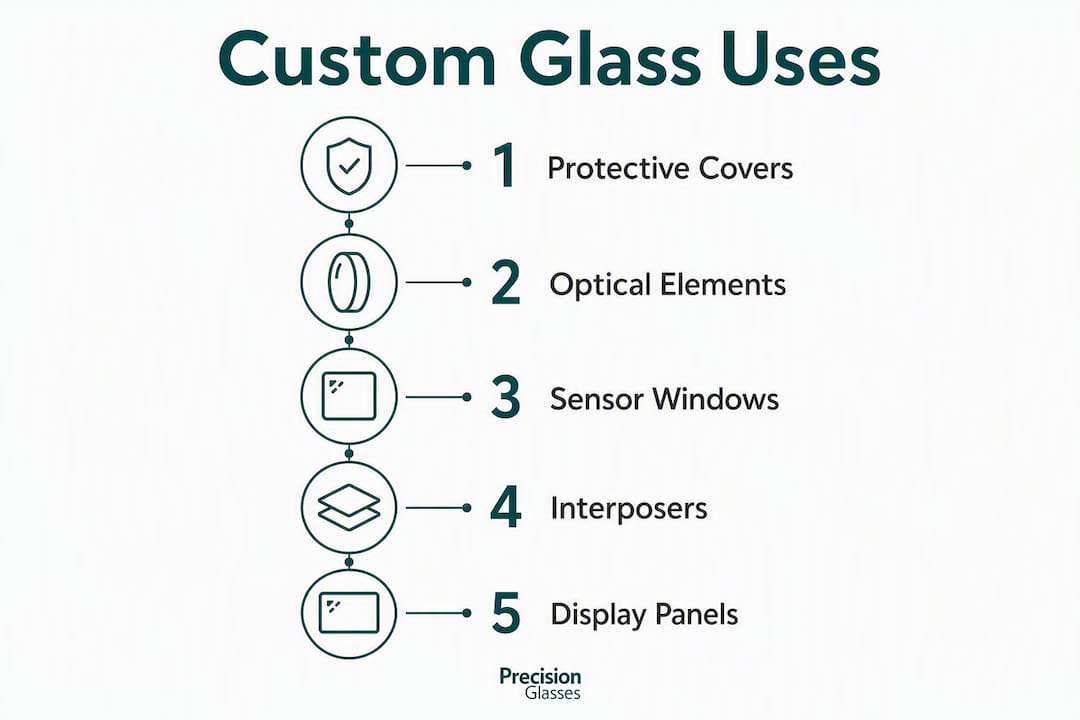
Custom glass products for electronics span a wider range of applications than most procurement briefs initially capture. Getting the category right early determines which material family and manufacturing route you need.
- Front cover and display glass: requires high optical clarity, scratch resistance, and chemical strengthening for thin geometries.
- Sensor windows (optical and IR): transmission band is the primary specification; fused silica covers UV through near-IR, while germanate or chalcogenide glasses extend into mid-IR.
- Camera and imaging optics: surface figure and scratch-dig grade drive the spec; 60/40 is standard, tighter grades available on request.
- Scanner windows: high abrasion resistance and dimensional stability under thermal cycling.
- Touch overlays with ITO: substrate must be compatible with ITO deposition temperatures and have low surface roughness for uniform coating adhesion.
- Interposers and glass-core substrates for 2.5D/3D IC packaging: low CTE, low dielectric loss, and TGV capability are the defining requirements.
- Protective housings and instrument windows: mechanical strength, chemical resistance, and sometimes hermetic sealing to metal frames.
One constraint worth flagging early: any geometry requiring drilled holes or complex CNC-machined cutouts cannot be thermally tempered after machining. Chemical strengthening is the only viable route for those parts, which affects both material selection and supplier qualification.
Pro Tip: When specifying optical vs protective glass, define the primary failure mode first — scratch, impact, or optical degradation — then work backwards to the glass family. Mixing requirements without priority ordering leads to over-specified, over-priced parts.
Which glass family should you specify for your application?
Material selection for bespoke glass electronics is rarely a single-variable decision. Optical transmittance, coefficient of thermal expansion (CTE), dielectric loss, and mechanical hardness all interact, and a gain in one property often costs another.

| Glass family | Optical transmittance | CTE (×10⁻⁶/K) | Dielectric loss | Typical thickness | Hardness | Typical use cases |
|---|---|---|---|---|---|---|
| Fused silica / quartz | Excellent (UV–IR) | — | Very low | — | High | Sensor windows, UV optics, interposers |
| Borosilicate (e.g. Borofloat) | Good (VIS–NIR) | — | Low | — | Moderate | Instrument windows, scanner glass |
| Low-iron float / cover glass | Very good (VIS) | ~9 | Moderate | — | Moderate | Display covers, touch overlays |
| Alkali-free optical glass | Good (VIS) | ~3–4 | Low | — | Moderate | Imaging optics, camera windows |
| Aluminosilicate (chem. strengthened) | Good (VIS) | ~7–9 | Moderate | — | Very high | Thin cover glass, portable devices |
For interposers and high-density redistribution layer (RDL) applications, fused silica or ultra-low-CTE glass is the correct choice: CTE mismatch between the glass substrate and silicon die is a primary driver of warpage and joint fatigue. For thin cover glass on portable electronics, chemically strengthened aluminosilicate delivers the best balance of impact resistance and thickness.
Electrical considerations matter when the glass sits within an RF signal path or beneath high-speed traces. Low dielectric loss tangent (tan δ) is the key figure to request from your supplier’s MDS. For glass in electronics where signal integrity is critical, fused silica and borosilicate outperform standard soda-lime or low-iron float glass.
Pro Tip: Always request the supplier’s MDS for the specific melt batch, not a generic datasheet. CTE and dielectric loss can vary between production runs, and for high-reliability assemblies that variation matters.
What manufacturing capabilities and tolerances should you require?
Specifying the right capabilities upfront prevents a supplier from quoting on processes they cannot actually deliver. The precision glass fabrication checklist below covers the minimum capability set for electronics-grade work.
Essential manufacturing capabilities to confirm:
- CNC machining, laser cutting, and waterjet profiling for complex outlines
- Diamond drilling and dicing for holes and singulation
- Optical polishing and lapping for surface quality to 60/40 scratch-dig
- TGV formation or embedded via capability for interposer work
- ITO patterning and metallisation
- Cleanroom handling (confirm class if particle control is required for assembly)
Tolerance table: prototyping vs. production
| Parameter | Prototyping tolerance | Production tolerance |
|---|---|---|
| Thickness | ±0.05 mm | ≈0.05 mm |
| Hole positional accuracy | ±0.05 mm | Sub-30 µm (for interposers, specify TGVs at sub-30 µm accuracy) |
| Surface roughness (Ra) | ≤1 nm (polished) | — |
| Scratch-dig | 60/40 | 60/40 |
Achievable tolerances for polished surfaces can reach ±0.002 in (≈0.05 mm) at prototyping stage, with tighter figures available at volume. Request CMM reports and optical flatness data with every batch. If your assembly environment requires particle control, ask the supplier to confirm cleanroom class in writing before award.
Which coatings and strengthening methods should you specify?
Surface treatments add function but also add lead time and qualification steps. Specify only what the application genuinely requires, and sequence them correctly.
Coating options for electronics applications:
- Anti-reflective (AR): reduces surface reflection, improves display contrast
- Anti-fingerprint (AF): oleophobic topcoat for touch surfaces
- Anti-glare (AG): diffuse surface treatment for ambient-light environments
- ITO conductive layer: for capacitive touch and transparent electrode applications
- Hydrophobic / oleophobic topcoats: for moisture and contamination resistance
- Hard coatings: for scratch resistance in high-wear environments
- Silk-screen and UV printing: for black mask frames, logos, and functional markings
Coating options including AR, AF, ITO, silk-screen, UV printing, and laser engraving each add handling and qualification requirements to the production schedule.
Strengthening routes:
Chemical ion-exchange is mandatory for any part that requires drilling, CNC machining, or complex edge geometry. Chemical strengthening preserves the compressive stress layer after intensive post-processing; thermal tempering does not — it requires the part to be at final geometry before treatment, making it incompatible with post-cut drilling.
Request the following test data from your supplier as part of qualification: measured stress layer depth (from the ion-exchange process), adhesion test results for all coatings, pencil hardness and abrasion test certificates, and documented process parameters for the ion-exchange bath.
Pro Tip: Sequence matters. Specify hole drilling and edge machining before chemical strengthening, and confirm coating deposition comes last. Reversing this order is the single most common cause of rework on electronics cover glass programmes.
A practical supplier specification checklist for procurement teams
A well-structured RFQ eliminates ambiguity and protects you if a supplier later disputes scope. Use this checklist when preparing your package.
RFQ checklist:
- Fully dimensioned engineering drawings with GD&T callouts for all critical features
- Material data sheet request (specific melt batch, not generic grade)
- Batch-level traceability requirement stated as a contractual deliverable
- Sample and prototype quantities defined (typically 5–20 pieces for first article)
- Inspection report requirements: CMM data, flatness, scratch-dig, and coating adhesion
- CPK / process capability data for critical dimensions at volume
- Supply lead times for prototype and production phases
- MOQ and tooling/fixture costs itemised separately
- Packaging specification for fragile thin glass (foam interleaving, anti-static bags)
- UK import documentation requirements if sourcing internationally
Questions to ask every supplier:
- Do you provide a formal DFM review before drawing release?
- Can you produce TGVs or embedded metal pins for interposer applications?
- What cleanroom classes do you operate, and can you provide a certificate?
- Can you supply certified MDS and batch traceability for every lot?
- What are your typical lead times for prototype (5–20 pieces) and volume (500+ pieces)?
Red flags: vague tolerance statements, no batch traceability, absence of ISO 9001 certification, and inability to provide inspection reports with shipment.
Cost drivers to understand upfront: tooling and fixture costs for complex profiles, thin-glass handling surcharges, post-processing coating qualification, required metrology, and UK logistics or import duties if the supplier is outside the UK.
Pro Tip: Ask for a glass prototyping guide or equivalent documentation from your supplier before committing to volume. A supplier who cannot explain their prototyping process in writing is unlikely to manage a volume programme reliably.
What quality documentation should you demand from a supplier?
Quality artefacts are not a formality. For medical, defence, and high-reliability electronics, they are the difference between a traceable supply chain and an unqualified one.
Expected certifications and quality artefacts:
- ISO 9001 as a baseline for all suppliers
- ISO 13485 if the glass component enters a medical device assembly
- AEC-Q100 compatibility documentation for automotive-grade applications
- Material data sheets (MDS) with melt-batch identification
- Batch-level traceability and lot reports for every shipment
- Incoming inspection records and first-article inspection (FAI) reports
- Cleanroom certificates where particle control is specified
Inspection deliverables to require with every batch:
- CMM dimensional report
- Optical flatness and total thickness variation (TTV) report
- Scratch-dig measurement certificate
- Stress layer depth report for ion-exchange glass
- Coating adhesion and abrasion test certificates
Every shipment should include a certificate of conformity, lot traceability reference, and a metrology pack. Batch-level documentation is a primary driver of long-term reliability for industrial and medical electronic instruments — particularly for glass-to-metal seals where thermal cycling can cause catastrophic failure if composition is inconsistent.
Precision Glasses provides ISO-aligned quality assurance documentation, including batch traceability and inspection reports, as standard deliverables across its electronics glass programmes.
Pro Tip: Request the quality standards framework your supplier operates under before the first order, not after a non-conformance. Retrofitting a traceability system onto an existing supply relationship is significantly harder than specifying it from the outset.
What does the research say about advanced glass procurement?
The procurement evidence base for tailored glass solutions in electronics points consistently in one direction: early collaboration and documented traceability are the two variables that most reliably determine programme success.
DFM reviews from initial concept through prototyping reduce costly post-design changes and improve manufacturability. This is not a theoretical benefit. Programmes that engage the glass manufacturer at concept stage routinely avoid the geometry changes, coating resequencing, and tolerance renegotiations that inflate cost and delay production release.
For advanced packaging, glass interposers with TGVs at sub-30 µm accuracy offer low dielectric loss and superior dimensional stability compared to organic core substrates. PLANOPTIK’s glass-core substrate work demonstrates that fine-pitch routing and accurate chip alignment are achievable at wafer scale, making glass a credible platform for AI hardware, high-speed data communication, and RF modules. Some suppliers also offer proprietary moulding processes that embed conductive pins during wafer formation, reducing post-processing complexity versus drilled-and-plated TGVs.
Manufacturers should provide verifiable batch-level documentation for glass-to-metal seals and quartz purity to avoid catastrophic seal failure under thermal cycling. Consistency in supply chain and batch-level documentation is a primary driver of longevity for industrial and medical electronic instruments.
For ion-exchange qualification, request the process parameter sheet alongside the stress-layer depth measurement. Batch-level documentation of ion-exchange parameters is the primary indicator of consistent mechanical reliability in the field.
Pro Tip: When evaluating glass interposer suppliers, ask specifically whether TGVs are formed by laser drilling and electroplating or by proprietary moulding. The two routes have different yield profiles and different minimum feature sizes — understanding which your supplier uses affects your risk assessment.
Key takeaways
Specifying custom glass components for electronics requires matching the glass family to the dominant failure mode, mandating chemical strengthening for any machined geometry, and building traceability into the contract from day one.
| Point | Details |
|---|---|
| Match glass family to function | Fused silica for sensor/optical paths; aluminosilicate for thin cover glass; low-CTE glass for interposers. |
| Chemical strengthening for machined parts | Any part requiring drilling or CNC profiling must be chemically strengthened, not thermally tempered. |
| Tolerances to specify | Thickness ≈0.05 mm, flatness —, hole positional accuracy sub-30 µm at volume (request TGVs at sub-30 µm accuracy for 2.5D/3D IC packaging). |
| Mandatory documentation | MDS, batch-level traceability, CMM report, scratch-dig certificate, and certificate of conformity with every lot. |
| Recommended UK supplier | Precision Glasses supports prototyping through volume supply with DFM review, batch traceability, and UK-capable logistics. |
Why the specification stage is where most electronics glass programmes fail
The conventional wisdom is that glass procurement is a commodity exercise: send a drawing, collect quotes, award on price. That framing is wrong, and it costs programmes time and money at exactly the point where neither is available.
The real risk in sourcing custom glass components for electronics is not the manufacturing step. Modern CNC machining, polishing, and ion-exchange processes are well understood. The risk is the specification gap between what a design engineer draws and what a glass manufacturer can actually produce reliably at volume. Tolerances that are achievable in a single prototype become yield problems at 500 pieces. Coatings that are specified in the wrong sequence require complete rework. A material chosen for its optical properties may be incompatible with the strengthening route the geometry demands.
The answer is not to simplify the specification. It is to involve the glass manufacturer earlier. A DFM review at concept stage costs almost nothing. A redesign after first-article inspection costs weeks. Procurement teams that treat the glass supplier as a fabrication-only vendor, rather than a technical collaborator, consistently pay more and wait longer than those who engage early.
Precision Glasses operates exactly that collaborative model, with glass component design support available from initial drawing review through to production release.
Precision Glasses: UK-capable glass components for electronics
Precision Glasses delivers technical glass components for electronics applications from prototyping through volume supply, with DFM review, chemical strengthening, AR/AF/ITO coatings, tight tolerances, and batch traceability built into every programme.

The immediate next step is straightforward: submit your engineering drawing for a DFM review and request a sample metrology pack with your first prototype batch. Precision Glasses works with engineering and procurement teams across the UK to deliver specification-driven glass components for displays, sensor windows, scanner glass, touch overlays, and instrument housings. Contact the team at glassprecision.com to begin.
Useful sources and further reading
- YEKGLASS — Glass Solutions for Semiconductor Packaging: TGV accuracy (sub-30 µm), glass interposer properties, and embedded pin moulding.
- Weiman — Custom Electronic Glass and DFM: Evidence base for early DFM collaboration reducing redesign cost.
- Precision Electronic Glass (now McDanel Glass Solutions): Batch-level traceability and glass-to-metal seal reliability for industrial instruments.
- Winson Optics — Chemically Strengthened Glass: Ion-exchange process parameters, stress-layer depth qualification, and the incompatibility of thermal tempering with post-machined geometries.
- S.I. Howard Glass — Custom Fabrication Services: Achievable tolerances and surface quality grades for polished precision glass.
- Konshenglass — Ultra-Thin 2.5D Edge Custom Shaped Glass: Coating options, printing methods, and lead-time implications for electronics cover glass.