
For precision components, “high temperature resistant” means a part can sustain its dimensional, mechanical, and optical properties at a defined continuous service temperature (CST) in a specified atmosphere, not merely survive a brief thermal spike. The governing metrics are CST, duty cycle, and atmosphere. When requesting quotations, state all five of the following immediately:
- Continuous service temperature and maximum spike temperature
- Heating and cooling rates, plus number of thermal cycles
- Operating atmosphere (oxidising, reducing, or inert)
- Mechanical loads at temperature (static, dynamic, creep)
- CTE requirement and any optical or dimensional tolerances
Precision Glasses supplies custom precision glass components to defence, aerospace, medical, and industrial clients across the UK, working to ISO-quality processes with full batch traceability and material data sheets on every order.
Table of Contents
- What does “high temperature resistant” actually mean for your component?
- Which heat resistant materials suit precision components?
- What must your specification include for a custom glass component?
- What tests should you require before accepting delivery?
- When should you specify precision glass rather than ceramics or alloys?
- Precision Glasses: custom high-temperature glass components for demanding applications
- Key takeaways
- A practitioner’s perspective on specification pitfalls
- Useful technical references
What does “high temperature resistant” actually mean for your component?
The distinction between spike resistance and continuous service temperature is where most specification errors originate. A material may survive a 1,200°C flash without fracturing yet fail structurally after 500 hours at 800°C. CST is the governing figure for any part in sustained service.
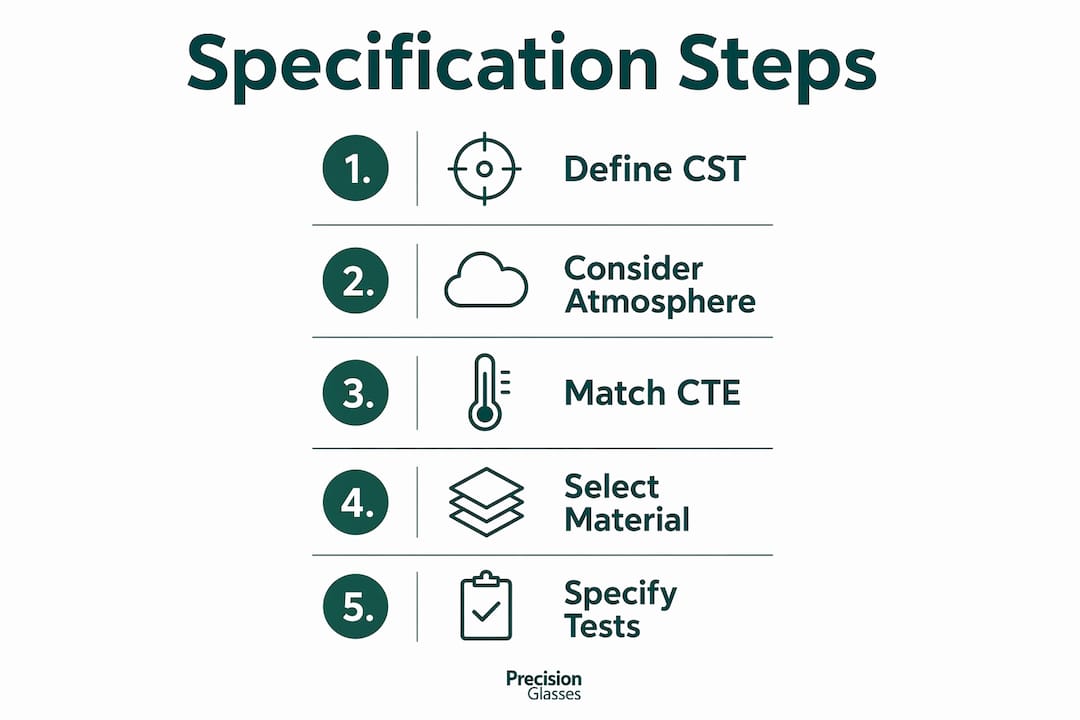
Atmosphere compounds this. A refractory metal with a melting point above 2,000°C can oxidise rapidly in air at a fraction of that temperature. Oxidation-driven failure is frequently the silent cause of premature component loss, not thermal overload. Specifying “high temperature” without naming the atmosphere leaves the supplier unable to select the correct material.
Pro Tip: Always request performance data in your actual operating atmosphere, not vacuum or inert-gas data. A supplier quoting melting point alone has not answered your specification question.
Engineers must require the following from any supplier at the RFQ stage:
- Confirmed CST in the stated atmosphere, with duration
- Heating and cooling rates (°C/min) and total cycle count
- Atmosphere composition, including any corrosive species or particulate load
- Relevant test reports, not just material certificates
Which heat resistant materials suit precision components?
Matching thermal stability, CTE, and environmental resistance to the assembly requirements matters more than chasing the highest theoretical temperature rating. The four material classes relevant to precision components are summarised below.
Glass classes. Borosilicate glass is reliable to around 450–500°C continuous service. Fused silica (quartz) extends to ~900°C continuous in controlled conditions, with some datasheets citing use to 1,200°C under specific loads and atmospheres. Sapphire glass is listed at maximum use temperatures up to ~1850°C, with strict caveats on atmosphere and mechanical load according to material tables. Glass-ceramics such as Schott ROBAX® offer a CTE of approximately 0 ± 0.5 × 10⁻⁶/K across 20–700°C, making them the preferred choice where thermal cycling and tight dimensional stability coexist.

Technical ceramics. Silicon nitride (e.g. Kyocera SN282A) retains bending strength in the hundreds of MPa at 1,200–1,400°C and offers low thermal expansion. Silicon carbide withstands heating above 1,000°C in air with good creep resistance. Alumina is cost-effective to around 1,600°C but has lower thermal shock resistance than silicon nitride or SiC.
Refractory alloys. Tungsten, molybdenum, and tantalum have melting points above 2,000°C, but their practical continuous service in air is limited by oxidation and recrystallisation. Recent materials research reports advanced ductile refractory alloys achieving ~100 MPa at 2,400°C while remaining formable at room temperature, which is changing design trade-offs for loaded structural parts.
High-performance polymers. PEEK functions well at 260°C for extended periods; SABIC ULTEM™ (PEI) offers a glass transition of ~217°C. Both are useful for lower-temperature seals and housings but are not candidates for the service ranges above.
Glass is the preferred solution when the application demands optical clarity, tight tolerances, chemical resistance, or electrical insulation at temperatures up to ~900°C. Ceramics take over for loaded structural parts above that threshold; sapphire glass may be specified at higher temperatures (up to ~1850°C), but strict atmosphere and load caveats apply. Refractory alloys are used for extreme mechanical loads in inert or controlled atmospheres.
Explore engineered glass types for a detailed breakdown of glass classes and their industrial service envelopes.
What must your specification include for a custom glass component?
A complete specification prevents redesign and schedule slips. The checklist below covers the minimum fields for a compliant RFQ for a custom precision glass component.
Temperature data
- CST (°C), maximum spike (°C), and duration at each condition
- Heating rate (°C/min), cooling rate (°C/min), and total cycle count
Atmosphere
- Oxidising, reducing, or inert; partial pressures if relevant
- Presence of corrosive species (halogens, sulphur compounds), humidity, or particulate load
Mechanical and assembly data
- Static and dynamic loads at operating temperature
- Mounting method, contact materials, and clamping forces
- Dimensional tolerances, surface finish, and optical requirements (transmission, flatness, parallelism)
- Permissible creep or deflection over service life
Traceability and certification
- Material data sheets (MDS) and batch test reports
- ISO certificate of conformity; aerospace or defence approvals where applicable
- Delivery documentation: certificate of conformity, dimensional inspection report, thermal test records
Pro Tip: Send a dimensioned drawing with your RFQ, even at concept stage. Suppliers can flag CTE mismatch or mounting stress risks before fabrication begins, saving weeks of redesign.
For guidance on optical glass design and tolerancing, Precision Glasses provides pre-RFQ technical consultation.
What tests should you require before accepting delivery?
Specifying tests at the RFQ stage, not after delivery, is what separates a compliant part from an expensive surprise. Hot strength and creep resistance must be verified under load, not inferred from room-temperature data sheets.
| Test | Method / Criteria | Minimum Requirement |
|---|---|---|
| Thermal cycle testing | Ramp to CST at specified rate; hold; cool; repeat | No cracking, dimensional shift within tolerance, strength retention ≥ design minimum |
| High-temp mechanical (bending/tensile) | Four-point bend at CST testing or equivalent | Strength value at temperature, not room-temperature proxy |
| Creep test | Sustained load at CST for agreed duration | Deflection within permissible limit stated in specification |
| Atmospheric/oxidation exposure | Exposure in stated atmosphere at CST for agreed hours | No surface degradation, mass loss within agreed limit |
| Batch traceability | MDS, certificate of conformity, dimensional report | Supplied with every delivery batch |
For specialist thermal system components, ION Precision Products offers specialist component sourcing that can complement a glass procurement programme.
When should you specify precision glass rather than ceramics or alloys?
The decision turns on five drivers: optical requirement, continuous temperature, thermal cycling severity, mechanical load, and atmosphere.
- Optical or viewport requirement + CST below ~900°C: specify fused silica or glass-ceramic. Precision glass delivers tight tolerances, optical coatings, and chemical resistance that ceramics cannot match economically.
- High thermal cycling + near-zero CTE required: glass-ceramics (CTE ≈ 0 × 10⁻⁶/K) outperform standard borosilicate and most ceramics for dimensional stability across repeated cycles.
- Structural load at CST above ~1,000°C: silicon nitride or silicon carbide ceramics are the practical choice. Refractory alloys suit extreme loads in inert atmospheres.
- CST above ~1,500°C in air: refractory alloys require protective coatings or atmosphere control; ceramics such as alumina or SiC remain viable without additional protection.
- Cost and lead time sensitive, CST below 500°C: borosilicate glass with standard CNC machining offers the shortest lead time and lowest cost.
| Application driver | Precision glass | Technical ceramic | Refractory alloy |
|---|---|---|---|
| Optical clarity / viewport | Best | Not recommended | Not recommended |
| CST ≤ 900°C, tight tolerance | Best | Suitable | Not recommended |
| CST 900–1,400°C, loaded | Suitable (fused silica/sapphire) | Best | Suitable |
| CST > 1,400°C, structural load | Suitable (sapphire glass up to ~1850°C with caveats) | Best | Best (inert atm.) |
| Thermal cycling, near-zero CTE | Best (glass-ceramic) | Suitable | Not recommended |
| Chemical resistance, insulation | Best | Suitable | Not recommended |
Procurement note: custom precision glass components typically require 4–8 weeks from confirmed specification to delivery for standard geometries; complex optical or coated parts may require 10–14 weeks. Ceramics and refractory alloy components often carry longer lead times due to sintering and machining constraints. Plan procurement accordingly and engage suppliers at the specification stage, not after design freeze.
Review advanced glass materials guidance for further decision support on glass versus alternative material classes.
Precision Glasses: custom high-temperature glass components for demanding applications

Precision Glasses fabricates custom optical and functional glass components for defence, aerospace, medical, and industrial clients across the UK, with capabilities that directly address high-temperature service requirements. Our offer covers fused silica and glass-ceramic windows, chemically strengthened and coated glass, CNC-machined technical glass to tight tolerances, and full batch traceability with material data sheets and certificates of conformity on every order.
Every project begins with a technical review of your specification: CST, atmosphere, CTE requirements, optical needs, and certification obligations. We support clients through the full process from glass fabrication to final inspection, with testing documentation matched to your procurement requirements. For aerospace and defence programmes, we work to the approval and traceability standards your contracts demand.
To start, send us your specification or drawing with the five RFQ fields listed in this guide. Typical response time for a technical review is two working days. Request a quote or technical consultation directly at glassprecision.com.
Key takeaways
Continuous service temperature, atmosphere, and CTE matching are the three non-negotiable inputs for any high-temperature precision glass specification.
| Point | Details |
|---|---|
| State CST, not spike temperature | Continuous service temperature governs material selection; spike data alone is insufficient for a compliant specification. |
| Specify atmosphere explicitly | Oxidising conditions disqualify many refractory metals and change glass and ceramic behaviour; always name the atmosphere in your RFQ. |
| Match CTE to the assembly | Glass-ceramics with CTE ≈ 0 × 10⁻⁶/K suit high-cycle applications; mismatched CTE causes mounting stress and premature failure. |
| Require test data at temperature | Demand four-point bend, creep, and thermal cycle results at CST, not room-temperature proxies, before accepting delivery. |
| Precision Glasses | Supplies custom high-temperature glass components with batch traceability, MDS, and testing support for UK defence, aerospace, and industrial clients. |
A practitioner’s perspective on specification pitfalls
The most common mistake we see is a specification that states a maximum temperature without naming the atmosphere or the duty cycle. A part rated for 900°C in an inert atmosphere may degrade within weeks in an oxidising furnace environment. The material has not failed; the specification was incomplete.
CTE mismatch is the second recurring issue. Engineers select a glass with the right thermal rating but overlook the expansion coefficient of the adjacent metal frame. The result is mounting stress that fractures the component on the third or fourth thermal cycle, not the first, which makes the root cause harder to diagnose. Matching CTE across the assembly, not just selecting a glass that survives the peak temperature, is what produces a long-service part.
The practical remedy for both problems is to engage the supplier before design freeze. When Precision Glasses receives a specification with atmosphere, duty cycle, and assembly context included, we can flag risks at the drawing stage rather than after the first batch fails acceptance testing. That conversation costs nothing and routinely saves weeks.
Useful technical references
| Source | What it covers | Relevance to specification |
|---|---|---|
| Top Seiko heat resistance guide | Continuous operating temperatures for glass, ceramics, and metals by atmosphere | Use to verify realistic CST values for fused silica, sapphire, and quartz |
| Kyocera SN282A silicon nitride datasheet | Bending strength at 1,200–1,400°C, thermal conductivity, CTE | Reference when comparing silicon nitride against glass for loaded parts |
| Kanthal Super HT datasheet | Oxidation behaviour and atmosphere guidance for high-temperature materials | Cite when specifying atmosphere requirements and oxidation test criteria |
| Nature: ductile refractory alloys | ~100 MPa at 2,400°C; hot strength and creep as primary design drivers | Use when evaluating alloy alternatives for extreme-load applications |
| Polyonics heat-resistant materials guide | Balanced selection criteria: thermal stability, CTE, environmental resistance | Supports the case for matched-property selection over maximum temperature rating |
| SAMaterials high-temperature materials | Refractory metal properties and atmospheric limitations | Reference for tungsten, molybdenum, and tantalum service constraints |
| Precision Glasses quality page | ISO-quality processes, batch traceability, testing and certification | Cite when procurement documentation and supplier approval criteria are being defined |