
In this guide, “optical plastic” refers to precision optical glass components manufactured to tight tolerances for safety-critical OEM applications. This is Precision Glasses’ sense of the term, and it is the only sense covered here. Before contacting any supplier, have the following ready:
- Operating envelope: temperature range, pressure cycling profile, and chemical exposure.
- Optical requirements: surface quality (scratch-dig), wavefront error, and required spectral range.
- Standards and traceability: target material classification (DIN 7079, DIN 7080, or USP Type I) and whether batch-level traceability records are mandatory for your application.
Key takeaways
Precision optical glass components require a complete, standards-referenced specification to deliver consistent performance and pass regulatory audit in safety-critical OEM applications.
| Point | Details |
|---|---|
| Define the operating envelope first | Temperature range, pressure cycling, and chemical exposure determine material selection before any other decision. |
| Specify material and standard explicitly | Reference DIN 7079, DIN 7080, or USP Type I on the PO to prevent material substitution. |
| Require test evidence and batch traceability | Dimensional reports, certificates of conformity, and lot numbers are mandatory for safety-critical supply. |
| Choose fused glass or armour for hazardous service | Fused construction to DIN 7079 or external shielding reduces thermal shock and impact failure risk. |
| Precision Glasses as your supplier | Precision Glasses supplies bespoke optical glass components with batch traceability, DIN-compliant materials, and full inspection documentation. |
Table of Contents
- What does this guide cover, and what does it leave out?
- How do you choose the right optical glass material?
- Which component types and protection strategies should you specify?
- What specification fields must your RFQ include?
- What are the most common failure modes, and how do you mitigate them?
- Procurement checklist for precision optical glass components
- Why Precision Glasses meets these requirements
- How does optical glass compare with optical plastic materials?
- What environmental and operational limits apply to optical glass?
- Where are precision optical glass components preferred over polymer optics?
- How should you clean and handle precision optical glass components?
- How do you evaluate a supplier of precision optical glass components?
- The specification gap is where programmes fail
- Precision Glasses: request a specification review or RFQ
- Sources
What does this guide cover, and what does it leave out?
This guide covers precision optical glass components for OEM and safety-critical industrial use: fused sight windows, sensor windows, display and lens assemblies, level gauges, flow indicators, and associated coatings, testing, and traceability requirements. It is written for engineering managers and procurement officers placing specification-driven orders.
It does not cover polymer optics. PMMA, polycarbonate moulded lenses, and similar plastic optics materials serve a different audience with different performance constraints. The distinction matters for procurement because glass and polymer optics differ fundamentally in temperature tolerance, chemical resistance, and the traceability standards regulators accept. Specifying the wrong category in an RFQ creates quoting ambiguity and, in hazardous service, genuine safety risk.
How do you choose the right optical glass material?
Material selection for precision optical components comes down to four variables: thermal expansion coefficient, chemical resistance, mechanical strength, and optical homogeneity. Borosilicate is the workhorse of industrial optical glass. Its lower coefficient of thermal expansion and higher chemical resistance compared with soda-lime glass make it the default choice for chemical and pharmaceutical sight glass applications, as the Sight Glass Application Handbook confirms. Fused silica (vitreous silica) steps in where borosilicate reaches its limits: it offers superior UV transparency and exceptional thermal shock resistance, making it the preferred material for high-energy laser windows and UV sensor applications. Sapphire sits at the top of the hardness scale and resists abrasion that would destroy any glass, but its cost and brittleness under bending loads mean it is reserved for applications where nothing else survives.

The Swift Glass industrial selection guide provides a useful overview of how vitreous silica, soda-lime, and sodium borosilicate families map to application requirements.
Pro Tip: Specify the minimum DIN or USP classification and require batch traceability on the purchase order. Vague “optical grade” language gives suppliers room to substitute materials that meet no defined standard.
Which component types and protection strategies should you specify?
Precision optical glass components take several forms, each suited to a different industrial role. Flat fused windows seal reactor vessels and pressure vessels where optical access is needed without compromising containment. Bullseye flow indicators sit inline in pipework to give operators a direct visual check of flow. Tubular level glasses show liquid levels in tanks and columns. Sensor windows protect photodetectors, scanners, and imaging systems from process environments. Aspheric lenses and custom lens assemblies serve aerospace targeting, medical imaging, and defence optics.
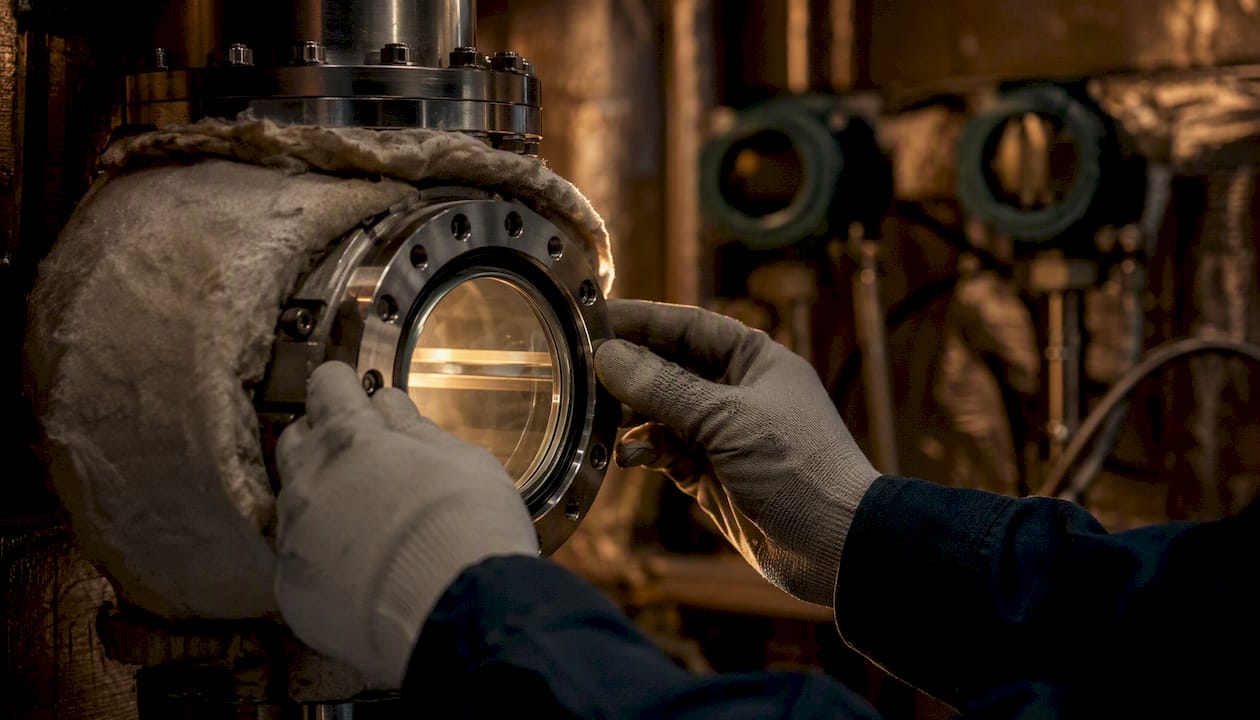
Protection strategy depends on the installation environment. AIChE guidance on glass in hazardous service identifies fused glass as the strongest option: a metal ring imposes radial compression on the glass disc, increasing bending tolerance and producing a controlled fracture mode rather than sudden shatter. Where fused glass is impractical, double-paned assemblies and external polycarbonate shields are accepted mitigations.
Key protection options to specify:
- Fused glass construction: preferred for pressure-cycling and thermal-shock environments.
- Double-paned assemblies: secondary containment for hazardous fluids.
- Polycarbonate or steel shields: external armour for exposed installations subject to impact or plant traffic. See optical vs protective glass for guidance on when to prefer each.
- O-ring and gasket arrangements: specify seal material compatibility (e.g. EPDM for chemical service; see sight glass EPDM seal options) and vacuum-failure protection.
- Welded flanges: eliminate gasket leak paths in high-pressure or cryogenic service.
What specification fields must your RFQ include?
A supplier cannot quote accurately without a complete specification. Missing fields lead to substituted materials, incorrect tolerances, and failed acceptance tests. The table below lists the mandatory fields for any precision optical glass RFQ.
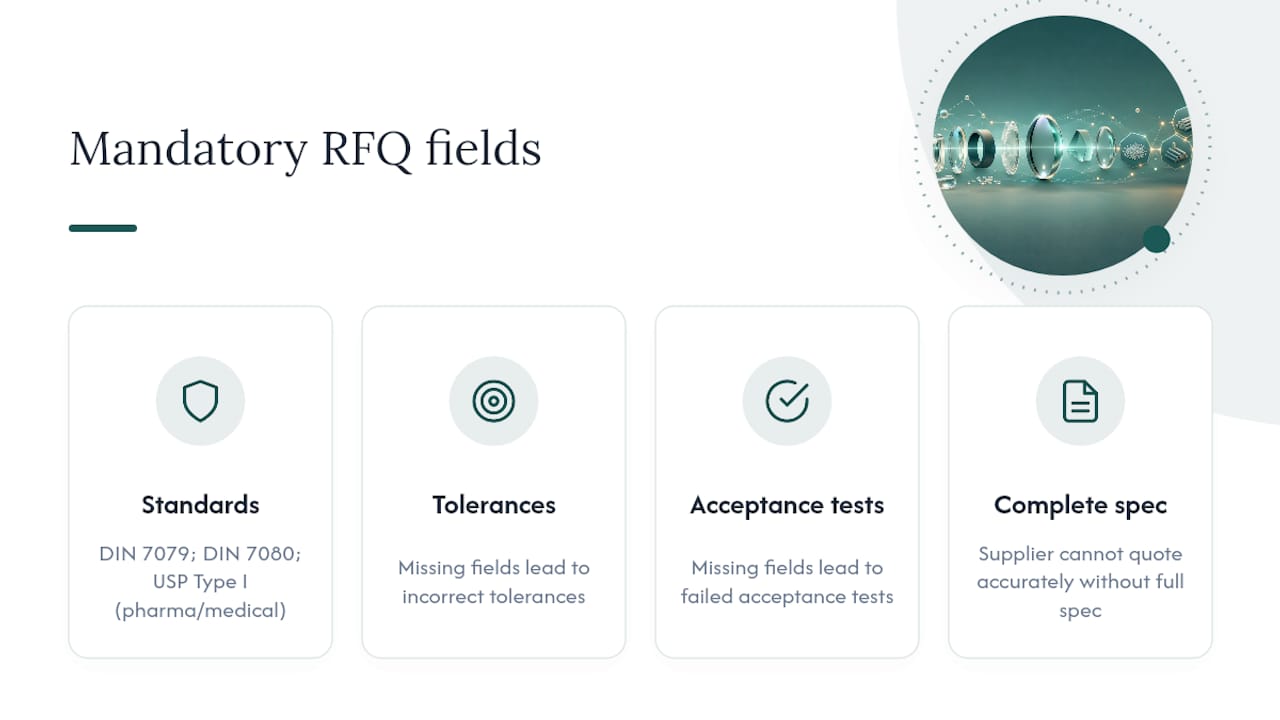
DIN 7079 governs fused-glass sight glass fusion and thermal properties; DIN 7080 sets the borosilicate quality benchmark. For pharmaceutical and medical applications, USP Type I classification is the relevant pharmacopoeia standard for borosilicate glass containers and components.
What are the most common failure modes, and how do you mitigate them?
AIChE’s analysis of glass in hazardous service identifies thermal shock, pressure cycling fatigue, impact, chemical corrosion, and stress from uneven mounting as the primary failure mechanisms for sight glasses and flow indicators. Each has a practical mitigation.
- Thermal shock: specify borosilicate or fused silica; define maximum allowable temperature ramp rate in the operating procedure.
- Pressure cycling fatigue: require fused glass construction to DIN 7079; document the design pressure and cycle count in the RFQ.
- Impact and abrasion: specify polycarbonate shields or steel armouring for exposed installations; consider manufacturing safety management protocols for plant environments.
- Chemical corrosion: match glass family to the process chemistry; borosilicate resists most acids and alkalis, but hydrofluoric acid attacks all glass.
- Mounting stress: require the supplier to confirm gasket compression limits and flange flatness tolerances; avoid over-torquing.
Pro Tip: For bespoke designs in hazardous service, require documented failure-mode analysis and evidence of pressure and thermal cycling tests before accepting the first production batch.
Procurement checklist for precision optical glass components
| Item | Why it matters | Minimum acceptable entry |
|---|---|---|
| Material and standard | Prevents substitution | Borosilicate DIN 7080 |
| Dimensional tolerances | Controls fit | — diameter; — thickness |
| Surface quality | Controls scatter and cosmetics | Scratch-dig 60-40 |
| Coating specification | Defines spectral performance | AR or IR coating with measured R% |
| Acceptance tests | Defines pass/fail | Dimensional report, CoC, pressure test |
| Batch traceability | Enables audit and recall | Lot number and melt batch on delivery note |
| Lead time and packaging | Manages programme risk | Confirmed lead time; individual wrapping |
Sample spec snippet for an RFQ:
*Material: Borosilicate glass to DIN 7080. Dimensions: diameter and thickness tolerances suitable for the application. Surface quality: scratch-dig 60-40 per MIL-PRF-13830. Edge: chamfer 0.3 mm ×45°. Batch traceability: lot number and certificate of conformity required.
Tooling and mould costs are a significant up-front investment in precision pressing but become cost-effective at volume. Sapphire and fused silica carry a material premium over borosilicate. Coating complexity and the number of inspection stages are the other main cost drivers; define them precisely to get comparable quotes.
Why Precision Glasses meets these requirements
Precision Glasses supplies bespoke optical and technical glass components across aerospace, defence, medical, automotive, and electronics applications. Capabilities include:
- CNC-machined technical glass to tight dimensional tolerances.
- Advanced coatings across UV to IR spectral ranges.
- Batch-level traceability with full lot documentation and certificates of conformity.
- Components compliant with DIN 7079 and DIN 7080, with documentation aligned to USP Type I where required.
- Pressure and thermal cycling testing protocols as part of the standard QA process.
Precision Glasses’ quality and traceability processes are designed specifically for safety-critical OEM procurement, where a missing certificate or an undocumented material substitution can halt a production line or fail a regulatory audit.
How does optical glass compare with optical plastic materials?
The term “optical plastic” is widely used in the open market to describe polymer optics: PMMA, polycarbonate, and cyclic olefin copolymers such as Zeonex. For OEM procurement in safety-critical applications, understanding where glass outperforms these materials is a specification decision, not a preference.
Glass offers superior thermal stability, chemical resistance, and long-term dimensional stability. Polymer optics absorb moisture, which shifts refractive index and degrades optical performance over time. Glass does not. At temperatures above roughly 120°C, most optical polymers soften or deform; borosilicate glass remains stable well beyond that threshold.
Cost and weight tell a different story. Polymer optics are lighter and can be injection-moulded to complex shapes at high volume, which makes them attractive for consumer electronics and automotive lighting where weight and unit cost dominate. For applications where performance, chemical resistance, and regulatory traceability are the governing criteria, glass is the correct specification.
What environmental and operational limits apply to optical glass?
Borosilicate glass tolerates continuous service temperatures up to approximately 500°C and resists most industrial chemicals, including strong acids and alkalis. Fused silica extends that range to around 1,000°C and adds UV transparency down to approximately 150 nm, making it the material of choice for UV sensor windows and laser optics. Chemically strengthened glass, produced by an ion-exchange process, offers improved surface compressive stress and impact resistance at moderate temperatures, which suits display glass and touch-screen applications.
Moisture absorption is negligible for all glass types, unlike polymer optics. UV resistance is inherent in fused silica and can be enhanced in borosilicate through coating. These characteristics make glass the default for outdoor sensor windows, marine optics, and any application where long-term optical stability under environmental exposure is required.
Where are precision optical glass components preferred over polymer optics?
Glass is the specified material in applications where polymer optics cannot meet the performance or regulatory requirements. Aerospace and defence optical systems require dimensional stability over wide temperature ranges and resistance to solvents used in maintenance. Medical devices and pharmaceutical process equipment require USP Type I borosilicate glass for biocompatibility and chemical inertness. Industrial process sight glasses in chemical plants require the thermal and chemical resistance that only glass provides. Scientific instrumentation and laser systems require the UV transparency and refractive index homogeneity that fused silica delivers.
Polymer optics remain appropriate for consumer-facing applications: camera lenses in smartphones, automotive interior lighting, and low-cost imaging modules. The glass component design guide from Precision Glasses covers the design considerations that determine which material is correct for a given OEM application.
How should you clean and handle precision optical glass components?
Handle glass components with clean, lint-free gloves at all times. Skin oils etch polished surfaces and degrade coatings. Store components individually wrapped in acid-free tissue or foam, never stacked. For cleaning, use an optical-grade solvent (isopropanol or acetone) applied with a lint-free cloth in a single dragging stroke; never scrub. For AR-coated surfaces, confirm with the supplier which solvents are compatible before cleaning, as some coatings are sensitive to ketones.
In service, inspect sight glasses and sensor windows at each planned maintenance interval for surface pitting, crazing, or edge chipping. Any visible damage is a replacement trigger, not a monitor-and-continue situation, particularly in pressure or hazardous-fluid service.
How do you evaluate a supplier of precision optical glass components?
A credible supplier for safety-critical optical glass components should demonstrate: ISO 9001 certification as a baseline quality management standard; documented capability to supply to DIN 7079 and DIN 7080; batch-level traceability with lot numbers and certificates of conformity on every delivery; in-house dimensional inspection and surface quality verification; and a clear process for handling non-conformances and corrective actions.
Capacity and delivery reliability matter as much as technical capability. Ask for lead-time commitments in writing, confirm whether tooling is held in-house or subcontracted, and request references from comparable OEM programmes. A supplier who cannot provide a sample material datasheet and a representative certificate of conformity before order placement is not ready for safety-critical supply.
The specification gap is where programmes fail
The most consistent problem in precision optical glass procurement is not material quality. It is under-specified RFQs. When a buyer writes “optical grade glass” without a material designation, a surface quality criterion, or a defined acceptance test, every supplier interprets the requirement differently. The resulting quotes are incomparable, the first-article inspection fails, and the programme slips.
The fix is straightforward: use the specification fields and sample snippet in this guide as a starting template, add your operating envelope, and require DIN 7079 or DIN 7080 compliance plus batch traceability on the purchase order. That single discipline change eliminates most of the ambiguity that causes delays and re-orders.
Precision Glasses: request a specification review or RFQ

Precision Glasses works directly with engineering managers and procurement officers to turn operating requirements into fully specified, traceable glass components. Whether you need a material and test datasheet, a sample batch with full traceability documentation, or a reviewed RFQ before you go to tender, the team can respond quickly with the technical detail your programme requires. Components are supplied with certificates of conformity, lot-level traceability, and documented inspection records as standard. To start, visit the optical components page and submit your application details or request a specification review.