
For visible light at the Fraunhofer d line (587.6 nm), glass refractive indices typically range from about 1.458 for fused silica to values characteristic of dense flint types. Borosilicate glasses generally range near 1.470 to 1.472, while common soda-lime and crown glasses fall between about 1.50 and 1.54. BK7, a common optical crown glass, measures around 1.5168.
Refractive index (n) describes how much a material slows and bends light compared with a vacuum. It’s the single number that governs how a lens curves, how a window distorts, and how much chromatic spread you’ll fight in a lens stack.
A few numbers worth pinning to memory:
- Fused silica: ≈1.458
- Borosilicate (Pyrex, BOROFLOAT®): ranges typically near 1.470–1.472
- Soda-lime / crown glass: ranges typically near 1.50–1.54
- BK7: ≈1.5168
- Flint glass: covers a range including values up to approximately 1.925
These figures shift with wavelength, temperature, and the specific batch composition, so treat any single quoted value as a reference point rather than a guarantee for your material.
Key Takeaways
Refractive index is a wavelength-specific measurement, not a fixed constant, and every specification must state the measurement wavelength alongside the numeric value to be usable.
| Point | Details |
|---|---|
| Always quote wavelength | State the reference wavelength (typically the d line, 587.6 nm) alongside any index value on a spec sheet. |
| Match index with Abbe number | Pair refractive index with Abbe number in every RFQ to control chromatic aberration properly. |
| Use Sellmeier for accuracy | Calculate n(λ) from published Sellmeier coefficients rather than a single catalogue figure when precision matters. |
| Request batch data for critical parts | Ask suppliers for batch-measured optical constants and traceability on tight-tolerance or chromatic-critical assemblies. |
| Know the crown/flint trade-off | Higher index generally means lower Abbe number, so choose glass family based on the compactness versus colour-correction priority. |
Table of Contents
- Understanding glass refractive index: the physics behind the number
- How do dispersion and the Abbe number affect lens choice?
- What are typical refractive index values for common glass types?
- How do you measure the refractive index of glass accurately?
- How does refractive index change your optical design specifications?
- Worked Sellmeier examples: BK7 and fused silica compared
- A practitioner’s view on specifying glass correctly
- Where to find reliable refractive index data
- Frequently asked questions
- Sources
Understanding glass refractive index: the physics behind the number
Refractive index isn’t a fixed property stamped onto a material like a serial number. It’s a wavelength-dependent response to how light interacts with the electrons in the glass network, and understanding that mechanism is what separates someone reading a datasheet from someone who can actually specify glass correctly.
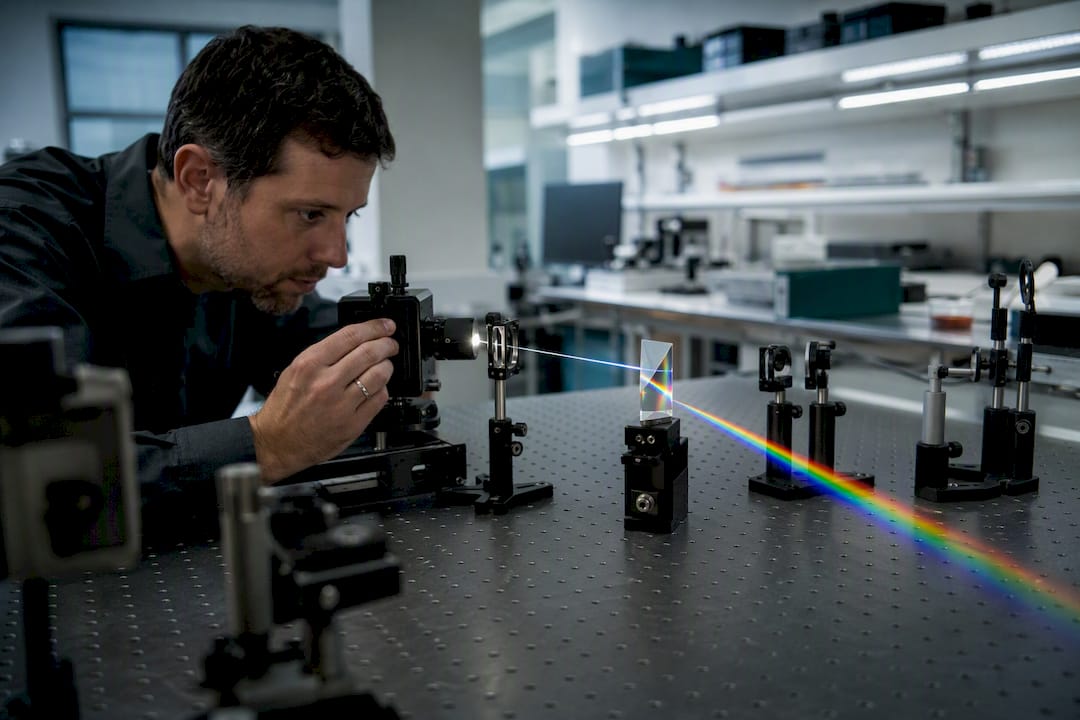
The full picture involves a complex refractive index, written as n + ik. The real part, n, is what most engineers mean when they say “refractive index” and it governs how much light bends. The imaginary part, k, is the extinction coefficient, and it describes how much light gets absorbed as it travels through the material. For most optical glasses in the visible band, k is close to zero, which is exactly why they’re transparent. Where k rises, you start losing transmission and the glass looks tinted or opaque.
These two properties aren’t independent. The Kramers–Kronig relations link a material’s absorption spectrum to its dispersion curve mathematically, meaning that wherever a glass absorbs strongly (typically in the ultraviolet), its refractive index also changes fastest nearby. That’s why the UV-absorption edge of a glass tells you almost everything about how steeply n will vary across the visible band.
The dominant driver: electronic absorption transitions, mostly in the ultraviolet, account for the vast majority of the n minus 1 term at visible wavelengths, according to dispersion analysis of glass optical behaviour. Everything else, including small vibrational and infrared contributions, is a minor correction on top of that.
Because n depends on wavelength, engineers need a formula that predicts n(λ) across the working spectrum rather than a single quoted point. That’s what the Sellmeier equation does. It’s an empirical dispersion relation, built from a small set of coefficients (typically three B and three C terms) fitted to measured data, and it reproduces a glass’s index curve with far more accuracy than a simple linear approximation.
Three relationships are worth knowing cold:
- The refractive index definition: n = c/v, the ratio of light’s speed in vacuum to its speed in the medium.
- The complex index: n + ik, where k governs absorption and transmission loss.
- The Sellmeier equation: n²(λ) = 1 + Σ [Bᵢλ² / (λ² − Cᵢ)], the standard dispersion formula used across the glass industry, with coefficients published on databases such as RefractiveIndex.INFO.
Reference measurements are almost always quoted at specific Fraunhofer lines: the d line (587.6 nm, helium), the C line (656.3 nm, hydrogen), and the F line (486.1 nm, hydrogen). These three points anchor the Abbe number calculation you’ll meet in the next section, and they’re the standard against which every manufacturer datasheet should be checked.
How do dispersion and the Abbe number affect lens choice?
The Abbe number (Vd) measures how much a glass’s refractive index changes across the visible spectrum, and it’s calculated as Vd = (nd − 1) / (nF − nC). A high Abbe number means low dispersion, so colours stay tightly focused; a low Abbe number means high dispersion, so blue and red light separate more and chromatic aberration gets worse.
This is where the trade-off engineers wrestle with daily becomes explicit: within most glass families, refractive index and dispersion move in opposite directions, and that relationship is near-linear across composition families. Push the index up and the Abbe number tends to fall. That’s not a coincidence of the periodic table, it’s a direct consequence of how electronic band gaps control both properties simultaneously.
That trade-off is exactly why optical glass splits into two broad families:
- Crown glasses (like BK7): higher Abbe number, lower refractive index, wide electronic band gap, better colour correction.
- Flint glasses: lower Abbe number, higher refractive index, narrower band gap, more dispersion, but often more bending power per unit thickness.
Lens designers pair a crown element with a flint element to build an achromatic doublet, cancelling chromatic aberration by exploiting the fact that the two glasses disperse light differently while contributing complementary focusing power. A single crown or flint element alone can never do this; the pairing is the whole trick. Precision Glasses’ Abbe value chart sets out how these numbers stack up across common optical glass types if you need a fast comparison.
Pro Tip: Reach for a higher-index flint glass when you’re constrained on physical space and need more optical power from a thinner element. Reach for a low-dispersion crown glass when colour fidelity matters more than compactness, such as in imaging optics or scientific instrumentation where chromatic blur would ruin the measurement.
Choosing glass by refractive index alone, without checking the Abbe number against your chromatic aberration budget, is one of the most common specification errors in early-stage lens design.
What are typical refractive index values for common glass types?
Every optical glass type occupies a fairly narrow index band, and knowing where each one sits saves a lot of back-and-forth with suppliers. The figures below are quoted at or near the Fraunhofer d line (587.6 nm), which is the industry-standard reference wavelength.
These ranges are drawn from standard optics reference material and cross-checked against manufacturer catalogue values. Fused silica sits at the lower end of refractive indices because its silicon dioxide network has a wide electronic band gap and minimal UV absorption extending into the visible range, supporting its utility deep into the ultraviolet where other glasses begin absorbing.
Borosilicate types like BOROFLOAT® have refractive indices slightly higher than fused silica and are widely used in sight glasses, lighting components, and instrumentation windows due to their exceptional thermal shock resistance. Flint glass contains heavier elements (historically lead oxide, now other high-index formers) that increase the refractive index significantly, though this is accompanied by higher dispersion.
One caveat that matters more than most people expect: catalogue values represent typical production, not your specific batch. Manufacturer melts vary, and for genuinely critical optics you should request batch-specific measured data rather than relying on the published nominal figure alone. Precision Glasses’ guide to glass material selection walks through how to map these typical values onto real component requirements.
How do you measure the refractive index of glass accurately?
Three practical routes exist for getting reliable optical-constant data, and each suits a different stage of a project.
- Manufacturer datasheets and published Sellmeier coefficients. For catalogue glasses like BK7 or fused silica, published coefficients on databases such as RefractiveIndex.INFO give you n(λ) to high accuracy without any lab work at all. This is the fastest and cheapest route, and it’s fine for early design and simulation.
- Prism or Becke line refractometry. A prism spectrometer measures the minimum deviation angle of light passing through a precision-ground prism sample, giving a direct, highly accurate n value at each test wavelength. The Becke line method is a simpler comparative technique, useful for quick identification of a glass type against a set of known immersion oils, but it lacks the precision needed for lens design specification.
- Spectroscopic ellipsometry. This measures the change in polarisation state of light reflected from a surface, and it’s the method of choice when you need the full complex index (n and k) across a broad spectral range, including into the UV or IR where absorption becomes significant.
Whichever method you use, the resulting number is meaningless without its context. Always record the measurement wavelength (or wavelengths, ideally the d, C, and F lines at minimum), the sample temperature, surface polish and parallelism, the angle of incidence used, and the instrument model with its stated uncertainty. A refractive index quoted without a wavelength is close to useless for design work.
Pro Tip: Commission measured optical constants rather than relying on catalogue numbers whenever the component sits in a tight tolerance chain, an achromatic assembly, or any application where chromatic performance directly affects the end result. For everything else, published Sellmeier coefficients are perfectly adequate and far cheaper.
How does refractive index change your optical design specifications?
Refractive index isn’t an abstract material constant sitting in a table. It dictates the physical curvature a lens surface needs to hit a given focal length: a higher-index glass achieves the same optical power with a shallower, less aggressive curve, which usually means thinner elements, fewer surfaces prone to aberration, and easier manufacturing tolerances on curvature.

Dispersion, driven by that same index but measured through the Abbe number, determines how much your lens groups need correcting for colour. A single high-index element concentrates more optical power in less material, but pairing it against a wide chromatic spread can force you into more complex multi-element groups just to hold focus steady across the visible band.
Composition also drives transmission windows and coating behaviour. Fused silica’s wide band gap gives it excellent UV transmission where borosilicate and soda-lime glasses fall away. Thermal expansion coefficient, tied closely to composition, dictates how a coating or bonded assembly will survive temperature cycling in the field, particularly relevant for aerospace and automotive dashboard optics that see genuine thermal extremes.
When drafting an RFQ for precision glass components, specify at minimum:
- Target refractive index and tolerance, with the reference wavelength stated explicitly.
- Abbe number requirement if chromatic performance matters.
- Surface figure, parallelism, and wedge tolerances.
- Required transmission window and any coating specification.
- Thermal and mechanical environment the part must survive.
- Batch traceability and certification requirements for critical applications.
Skipping the wavelength on a quoted index, or omitting Abbe number where colour correction matters, are the two most common reasons a “correct” glass turns out wrong once it’s in the assembly. Precision Glasses’ optical components resources cover how these specification items translate into manufactured parts.
Worked Sellmeier examples: BK7 and fused silica compared
The Sellmeier equation turns published coefficients into an exact n(λ) curve, and running the numbers makes the dispersion difference between glass types concrete rather than abstract.
- BK7, using coefficients published on RefractiveIndex.INFO, gives n ≈ 1.5308 at 486.1 nm (F line) and n ≈ 1.5143 at 656.3 nm (C line).
- Fused silica, run through the same Sellmeier form with its own published coefficients, gives n ≈ 1.4631 at 486.1 nm and n ≈ 1.4564 at 656.3 nm.
Across that same F to C line span, BK7’s index shifts by roughly 0.0165, while fused silica shifts by only about 0.0067, roughly two and a half times less. That numerical gap is the Abbe number difference made visible.
That’s the practical payoff of learning the formula: two glasses with broadly similar visible-light appearance produce meaningfully different chromatic behaviour once you push them through a real optical path. When a client sends us a lens spec quoting only a nominal index with no wavelength or tolerance attached, we ask for the Sellmeier coefficients or the full transmission curve before quoting. Report optical constants as a wavelength-tagged table or the Sellmeier coefficient set, never a single bare number.
A practitioner’s view on specifying glass correctly
The single most expensive mistake we see is a spec sheet quoting “n = 1.52” with no wavelength attached. That number could mean three different glasses depending on where in the spectrum it was measured, and by the time the mismatch shows up, the part is already machined.
Batch variation is the second trap. Catalogue values describe typical production, not your specific melt. For any assembly where chromatic performance or tight focal tolerances matter, request batch-measured optical constants rather than trusting the nominal datasheet figure.
Our recommendation is straightforward: treat refractive index and Abbe number as a matched pair in every RFQ, state the reference wavelength explicitly, and ask your supplier for traceability data on critical runs. Precision Glasses builds batch-level certification into projects across medical, defence, and aerospace optics precisely because a single undocumented index shift can cascade through an entire assembly.
Where to find reliable refractive index data
For raw coefficients and wavelength tables, RefractiveIndex.INFO remains the standard open reference, covering Sellmeier data for BK7, fused silica, and most catalogue optical glasses. The IOP conference paper on glass dispersion explains the physics behind why index and dispersion correlate within glass families, and Edmund Optics’ optical glass application note gives practical design guidance pairing index with Abbe number.
For specification support, Precision Glasses’ optical properties technical guide and component design walkthrough cover how to turn these reference numbers into a working RFQ.
Frequently asked questions
What is a typical refractive index for glass?
Most optical glasses have refractive indices within a range spanning from around 1.45 to values characteristic of dense flint glasses at the Fraunhofer d line (587.6 nm). BK7, a common optical crown glass, has an index near 1.5168.
Does borosilicate glass have a higher refractive index than soda-lime glass?
No. Borosilicate typically measures near 1.470 to 1.472, which overlaps or is similar to common soda-lime glass indices often found near 1.50 to 1.52. Borosilicate’s main advantage is thermal shock resistance, not optical index.
Why does refractive index change with wavelength?
Electronic absorption transitions, mostly in the ultraviolet, dominate how a glass’s index behaves at visible wavelengths, and the Kramers–Kronig relations link that absorption spectrum mathematically to the dispersion curve. That’s why the Sellmeier equation, built on empirical fitting rather than a single constant, is needed to predict n across a working spectral range.
What’s the difference between crown and flint glass?
Crown glasses have a higher Abbe number (lower dispersion) and a lower refractive index, while flint glasses have a lower Abbe number (higher dispersion) and a higher refractive index. Designers pair the two in achromatic doublets to correct chromatic aberration.
How is refractive index measured in a laboratory?
Common methods include prism minimum-deviation refractometry, the Becke line technique for quick comparative checks, and spectroscopic ellipsometry for full complex-index measurement across broad spectral ranges. Each measurement should record wavelength, temperature, and instrument uncertainty alongside the result.
Sources
- Materials (optics) — refractive indices (University optics handout)
- Refractive index of glass and its dispersion for visible light — IOP Conference