
Fire glazing, in this context, means precision‑engineered high‑temperature and protective glass supplied to OEMs for equipment operating in extreme thermal or hazardous conditions. It is not building fire‑rated glazing for doors, windows or partitions. If you are specifying fire glazing for defence, aerospace, medical or industrial equipment, your immediate task is threefold:
- Define the material family (fused silica, borosilicate, or a glass‑ceramic) against the actual thermal exposure your part will see.
- Set the minimum verification evidence you will accept, including proof test data and batch traceability.
- Anchor acceptance criteria to a recognised standard, such as the NASA Standard for design and verification of windows, glass and ceramics, or EN 3861 for thermally tempered glass.
Precision Glasses works to exactly this brief: engineered glass components built to defined thermal and mechanical criteria, not off‑the‑shelf stock reclassified for a harsher job.
Key Takeaways
Fire glazing performance depends on matching material family and treatment to real thermal exposure, then demanding qualification, proof test and traceability evidence before acceptance.
| Point | Details |
|---|---|
| Define scope precisely | Fire glazing here means OEM protective glass, not building fire‑rated glazing systems. |
| Match material to thermal duty | Fused silica, borosilicate and glass‑ceramics each suit different temperature and shock profiles. |
| Demand qualification evidence | Require a qualification article, proof test report and flaw mapping before accepting parts. |
| Insist on interlayer traceability | Laminated glazing needs a serialized interlayer code, since standard PVB fails high‑heat duty. |
| Choose a documented supplier | Precision Glasses supplies batch‑traceable, qualification‑ready fire glazing for defence, aerospace and medical OEMs. |
Table of Contents
- What fire glazing covers, and what it does not
- Which material family suits high‑temperature glazing?
- What design and test evidence should a fire glazing specification demand?
- What should a fire glazing RFQ checklist include?
- How do you judge a fire glazing supplier’s manufacturing capability?
- How should you inspect fire glazing components once installed?
- Why standards discipline beats supplier reassurance
- Get a specification review for your fire glazing project
- Where to find the standards behind this guide
- Frequently asked questions about fire glazing
- Sources
What fire glazing covers, and what it does not
This guide covers OEM precision components: sensor windows, optical glass, protective covers and laminated assemblies built to survive elevated temperature, thermal cycling or hazardous exposure inside equipment. It does not cover fire‑rated glazing for buildings, which is a separate product category governed by construction fire codes.
The intended readers are engineering managers running design and verification, and procurement officers enforcing specification and RFQ requirements. Suppliers responding to your bids should be able to hand over material test certificates, a qualification article report, and proof test data as standard deliverables. This applies across aerospace, defence, medical devices, automotive electronics and industrial instrumentation, wherever a glass component sits between hazardous conditions and a sensitive system.
Which material family suits high‑temperature glazing?
Material choice drives everything downstream, from thermal margin to lead time. Fused silica handles the widest thermal range and resists thermal shock better than almost any other optical material, which makes it the default for sensor windows exposed to rapid heating and cooling. Borosilicate glass costs less and machines more easily, suiting enclosures and instrumentation windows with moderate thermal duty. Glass‑ceramics sit between the two, offering near‑zero thermal expansion for applications where dimensional stability under heat matters more than raw temperature ceiling.
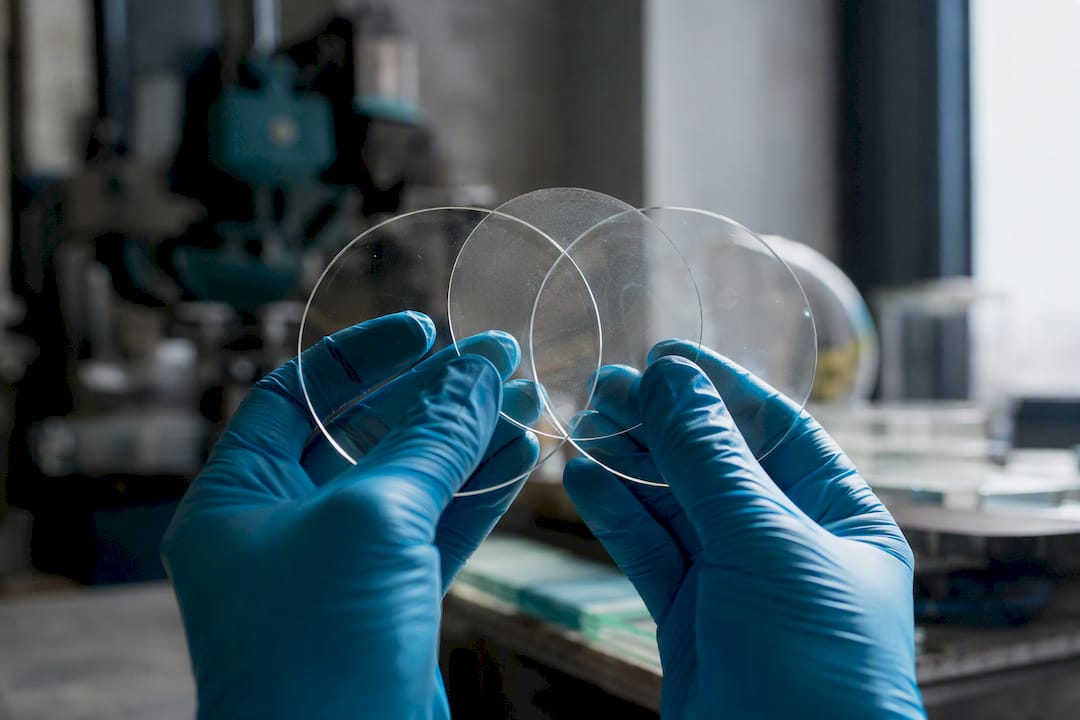
Tempering method matters as much as base material. Heat tempering increases mechanical strength through controlled cooling, while chemical tempering achieves surface compression through ion exchange, a route EN 3862:2013 specifies for chemically tempered soda‑lime aerospace transparencies. For laminated assemblies, the interlayer choice is where many specifications quietly fail: standard PVB is not rated for sustained high‑temperature exposure typical of aerospace conditions, and aerospace laminate interlayers require serialized traceability precisely because of this risk.
| Material / treatment | Typical thermal limit | Main benefit | Main limitation |
|---|---|---|---|
| Fused silica | very high thermal tolerance and strong shock resistance | best thermal shock performance | higher cost, longer lead time |
| Borosilicate | moderate thermal tolerance | cost‑effective, machinable | lower temperature limit than fused silica |
| Glass‑ceramic | high thermal tolerance and dimensional stability | near‑zero thermal expansion | limited optical grades available |
| Heat‑tempered soda‑lime | aerospace grade glass per EN 3861 | high mechanical strength | less shock tolerance than fused silica |
| Chemically tempered soda‑lime | aerospace grade glass per EN 3862 | surface compression and optical clarity | strength limits determined during qualification |
Pro Tip: Ask every laminate supplier for the interlayer’s batch traceability code before you approve a drawing. If they cannot produce it on request, assume the interlayer has not been qualified for your thermal exposure, whatever the datasheet claims.
What design and test evidence should a fire glazing specification demand?
A drawing that only states dimensions and material grade leaves too much to interpretation. Specify these test methods and metrics directly in the RFQ:
- Modulus of rupture (MOR) measured under representative loading conditions.
- Static fatigue characterisation across the expected service life.
- Initial design flaw depth, requiring the supplier to provide the basis for that assumption in writing.
- Proof testing on every unit or a statistically valid sample set, not just the qualification article.
- Combined‑load qualification testing including thermal cycling and mechanical stress, not single‑factor tests alone.
NASA STD 5018 treats glass and ceramics as brittle materials requiring the same rigour as structural metals in flaw‑critical applications, which is why it defines qualification articles as identical in form, fit and function to production hardware. It also requires inspection methods capable of detecting flaws equal to or larger than the initial design flaw depth, with any flaw exceeding that depth mapped and assessed after proof testing.
A supplier that cannot state the basis for its assumed flaw depth, or produce a flaw map after proof testing, has not actually qualified the part. It has simply tested one sample and hoped the rest match.
Reference the exact standards by number and edition in your contract, not just by description. PREN 2155‑15 defines the thermal stability test methods relevant to high‑heat glazing qualification, and pairing it with NASA STD 5018 or EN 3861 in the pass/fail clause removes most room for supplier interpretation.
What should a fire glazing RFQ checklist include?
A checklist copied straight into your specification document saves weeks of clarification emails during bidding. Start with the physical and material fields:
- Material family and grade (fused silica, borosilicate, glass‑ceramic, tempered soda‑lime).
- Thickness and dimensional tolerances, referenced to a recognised standard such as EN 3001.
- Optical requirements: light transmittance, haze limit, distortion tolerance.
- Thermal exposure rating and duration (continuous and transient).
- Interlayer specification and traceability code, if the part is laminated.
- Tempering or chemical strengthening method and process reference.
- Surface finish, coatings and any functional treatments.
- Edge treatment and mounted assembly interface requirements.
Then demand the paperwork that proves those fields were actually met:
- Qualification article report, showing the tested unit matched production hardware.
- Proof test report with sample size, test factors and pass/fail thresholds stated.
- MOR and static fatigue data supporting the design life claimed.
- Material test certificates (MTC) with batch traceability back to raw stock.
- Inspection reports including flaw maps, not summary pass statements.
- ISO or AS9100 quality certification evidence where the application demands it.
On the operational side, lead times for custom high‑temperature glass typically run longer than commodity glazing because tempering, chemical strengthening and qualification testing each add distinct process steps; build this into your programme schedule early rather than discovering it at RFQ close. Cost drivers worth negotiating include batch size, optical grade tightness and whether a qualification article is a one‑off charge or amortised across the order. Retention samples from each production batch give you a fallback if an in‑service failure needs root‑cause investigation later. The advanced glass specification guide sets out example clause language if you want a starting template.
How do you judge a fire glazing supplier’s manufacturing capability?
Capability claims are easy to print on a website; process evidence is not. Look for in‑house tempering and chemical strengthening rather than outsourced subcontracting, since traceability tends to break down at each handoff between facilities. CNC edge machining, optical polishing, coating application and controlled bake cycles for thermal conditioning should all sit under one roof or one auditable chain of custody, a point covered in more depth in Precision Glasses’ fabrication process overview.
The real signal is documentation, not marketing copy. Ask directly: can the supplier produce a qualification article and its flaw map on request? Do they instrument every proof test and retain the raw data, or only a summary certificate? A supplier with documented QA processes and inspection intervals will answer both questions without hesitation, because the records already exist.
Pro Tip: During supplier audits, ask to see one flaw map from a real production batch, not a sanitised example from a brochure. How they respond tells you more about their quality culture than any certificate on the wall.
How should you inspect fire glazing components once installed?
Inspection does not end at delivery. In‑service parts need inspection methods sensitive enough to detect flaws equal to or larger than the initial design flaw depth, and mounted assemblies should allow in‑situ inspection access, such as edge lighting or a viewing port, rather than requiring full disassembly for every check.
Build a lifecycle checklist around these triggers:
- Scheduled inspection intervals set at the design stage, not decided ad hoc after installation.
- Mandatory re‑inspection after handling, transport or any suspected impact event.
- Remnant life assessment using fracture‑mechanics methodology when a new flaw is detected.
- Every flaw mapped and logged against the batch traceability code, so a pattern across units becomes visible.
Retain every proof test report alongside its inspection history. When a component is pulled from service years later, that paired record is what lets you tell a genuine wear trend from an isolated defect.
Why standards discipline beats supplier reassurance
Most fire glazing failures in OEM equipment do not come from a bad batch of glass. They come from a specification that never forced the supplier to prove anything beyond a datasheet claim. The conventional approach, treating high‑temperature glass procurement like ordering a commodity component with a temperature rating attached, misses that glass is a brittle material with flaw‑driven failure modes. A part can pass a casual visual check and still carry a subsurface flaw well past its design limit.
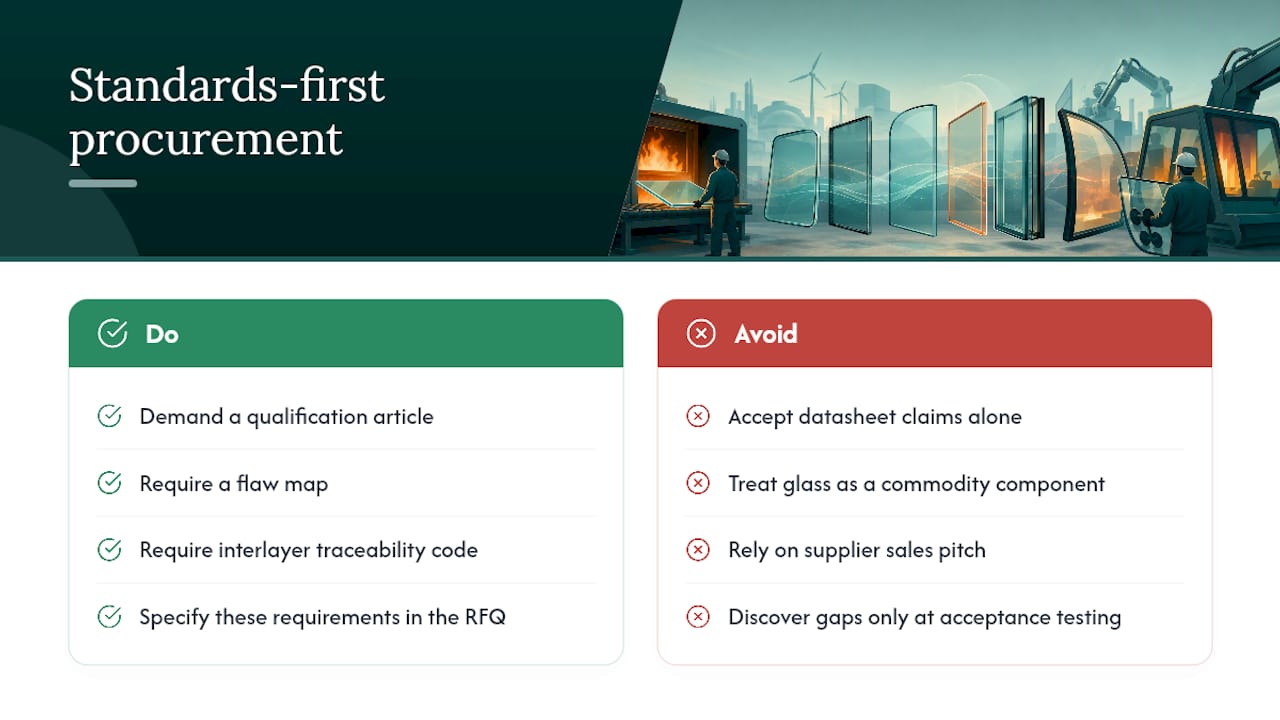
What the standards actually support is blunt: demand the qualification article, demand the flaw map, demand the interlayer traceability code if the part is laminated. None of that is bureaucratic overhead. It is the only evidence that separates a component genuinely qualified for your thermal duty from one that merely resembles it on paper. Engineering managers who push this discipline into the RFQ stage, rather than discovering gaps during acceptance testing, consistently avoid the costliest failure mode of all: a part that fails in service after the paperwork already said it should not.
Prioritise the traceability chain first, the test reports second, and the supplier’s sales pitch last. That ordering is what the standards themselves reward.
Get a specification review for your fire glazing project
Specifying high‑temperature glass against NASA and EN standards is exacting work, and Precision Glasses builds to exactly that discipline. Capabilities include custom precision fabrication, full batch traceability, qualification‑article production, high‑temperature laminate assembly and advanced protective coatings, all documented so your acceptance testing has real records behind it, not just a supplier’s word.

If you are drafting an RFQ, submit it with the checklist fields from this guide already filled in and Precision Glasses will return a specification review against your exact thermal and mechanical requirements. If you already have a qualification article requirement in your contract language, request proof test data alongside your quote so procurement and engineering can sign off together. Start by reviewing Precision Glasses’ technical glass capabilities or head straight to the main capabilities page to scope your project.
Where to find the standards behind this guide
Append the exact standard number and edition to your specification, and require test reports written against it, rather than a general reference to “aerospace grade.”
- NASA STD 5018, for glass and ceramic design and verification.
- EN 3861 and EN 3862, for tempered and chemically tempered aerospace transparencies.
- SAE AMS‑G‑25871A, for laminated aircraft glazing and interlayer traceability.
- PREN 2155‑15, for thermal stability test methods.
Frequently asked questions about fire glazing
Is fire glazing the same as fire‑rated building glass?
No. This guide covers precision OEM components for equipment operating in high‑heat or hazardous conditions, not fire‑rated glass used in doors, windows or partitions under building fire codes.
Which material family should I specify first?
Start with your actual thermal exposure profile. Fused silica suits rapid thermal cycling and the highest temperature ceilings, borosilicate suits moderate, cost‑sensitive applications, and glass‑ceramics suit uses where dimensional stability under heat matters most.
What documents should I require from every fire glazing supplier?
A qualification article report, a proof test report with stated sample size and test factors, material test certificates with batch traceability, and inspection reports including flaw maps rather than summary pass statements.
How often should installed fire glazing components be inspected?
Set inspection intervals at the design stage and trigger re‑inspection after any handling, transport or suspected impact event, mapping every detected flaw against the batch traceability code.
Why does interlayer traceability matter for laminated glazing?
Standard PVB interlayers often cannot survive sustained high‑temperature exposure, so a serialized traceability code confirms the correct high‑temperature interlayer was actually used, not just specified.
Sources
- STRENGTH DESIGN AND VERIFICATION CRITERIA FOR GLASS, CERAMICS, AND WINDOWS IN HUMAN SPACE FLIGHT APPLICATIONS
- Introduction to laminated glass interlayers — NPSA