
Salt fog testing is an accelerated, standardised chamber test used chiefly as a comparative screening and quality-control tool. It exposes materials, coatings, or finished parts to an atomised salt mist and measures how corrosion develops over a set number of hours. What it does not do, and this is the point most specification writers get wrong, is predict real-world service life with any precision.
We treat it here as what the standards themselves say it is: a comparative method, not a crystal ball. Before setting up a programme, check the specific requirements in three governing documents:
- ASTM B117 — the baseline neutral salt spray apparatus practice
- ISO 9227 — the international equivalent, widely referenced in European and Asian specifications
- ASTM G85 — modified and cyclic variants for tougher correlation needs
TL;DR:
- Salt fog testing using ASTM B117, ISO 9227, or ASTM G85 is for comparison and quality control, not precise life prediction.
- Maintaining a 5% salt solution with pH 6.5–7.2 at 35°C and fallout of 1.0–2.0 mL per 80 cm²/hour ensures valid, reproducible results.
- Variants like cyclic regimes or acid salts (AASS, CASS) better simulate real degradation modes than continuous neutral fog.
- Proper chamber design, inert materials, nozzle placement, and contamination control are crucial for consistent, credible results.
- Laboratory testing should be paired with field or cyclic tests when accurate service life prediction is necessary.
Table of Contents
- What salt fog testing is and where it fits in a QC programme
- Which standard governs your test, and why the variant matters
- Chamber design and the environmental controls that decide reproducibility
- Preparing salt solution and monitoring the parameters that keep results valid
- Preparing specimens and rating what the fog leaves behind
- How to run a salt fog test from warm-up to final report
- Why hours in a chamber never equal years in service
- Setting realistic acceptance criteria and corrective action paths
- Handling precision glass components through a salt fog programme
- When salt fog testing still earns its place in 2026
- Key Takeaways
- Sources
What salt fog testing is and where it fits in a QC programme
The method works by atomising a 5% sodium chloride solution into a fine mist inside a sealed chamber held at a controlled temperature, then leaving test specimens exposed for a fixed period. Corrosion that would take months or years in ambient conditions shows up in days, because the salt concentration and humidity are far higher than anything a part meets outdoors.
That acceleration makes salt fog testing well suited to coating quality control, process verification, and batch acceptance decisions, where the question is simply “did this batch perform the same as the last one that passed?” It is far less suited to answering “how long will this part last on a ship deck in the Atlantic?”
Labs running these tests vary by sector. In-house QA teams at coating and plating shops run daily or weekly panels against a fixed acceptance duration. Third-party test laboratories handle qualification runs for new suppliers or new processes. OEM quality engineers in aerospace, defence, and marine electronics specify the test as one gate among several, rarely the only one.
Pro Tip: If a specification only cites hours of NSS exposure with no cyclic or field-correlation requirement, ask why. A single-mode test tells you almost nothing about how a part behaves under freeze-thaw, UV, or mechanical flexing in service.
Which standard governs your test, and why the variant matters
Four documents cover almost every salt fog programme you will encounter, and each answers a different question.
- ASTM B117 describes the neutral salt spray (NSS) apparatus practice: continuous fog, neutral pH, no acid or wet-dry cycling. It is the default reference for most commercial coating specifications, but the standard itself states it is intended for comparative testing, not for forecasting field life.
- ISO 9227 runs in parallel internationally, covering NSS, acetic acid salt spray (AASS), and copper-accelerated acetic acid salt spray (CASS) under one document, and it is the one you will see referenced most often outside North America.
- ASTM G85 covers the modified and cyclic procedures, including acetic acid and cyclic sequences developed for aluminium alloys and painted systems where continuous fog does not reproduce real degradation modes.
- AASS and CASS accelerate corrosion further through acidification and, for CASS, elevated temperature with added copper chloride, which suits anodised aluminium, decorative chrome, and some electroplated finishes where NSS alone runs too slowly to be practical for production timelines.
Choose the variant that matches the failure mode you actually care about, not the one that is cheapest to run.
Chamber design and the environmental controls that decide reproducibility
A salt fog chamber is only as good as its plumbing and its air. Chamber walls, ducting, and specimen supports need to be inert materials, typically glass, PVC, or specific coated composites, because any reactive metal in the fog path contaminates the salt mist and skews every specimen downstream.
Nozzle placement and count decide fog uniformity across the chamber volume, and poor coverage is one of the most common causes of inconsistent results between runs. Compressed air feeding the atomiser has to be free of oil and grease contamination, filtered before it reaches the nozzle, since a trace of oil on a specimen surface can mask or accelerate corrosion in ways that have nothing to do with the coating under test.
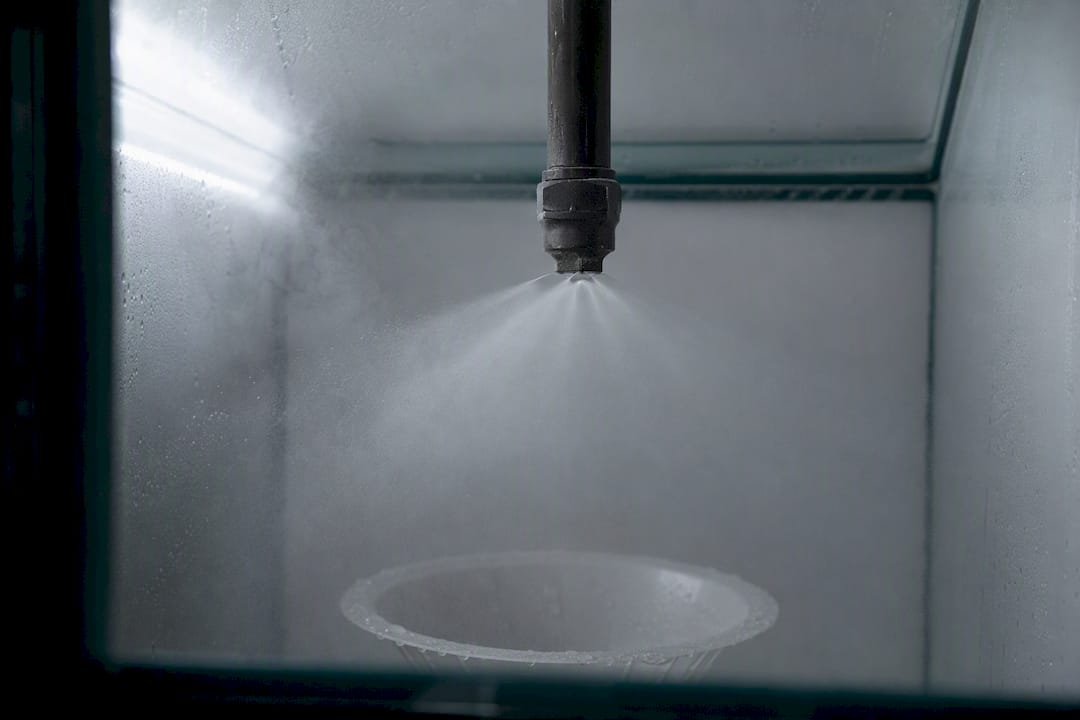
Fallout measurement is where most labs either earn or lose credibility. ASTM B117 sets the acceptable range at 1.0 to 2.0 mL per 80 cm² per hour, averaged over a minimum collection period.
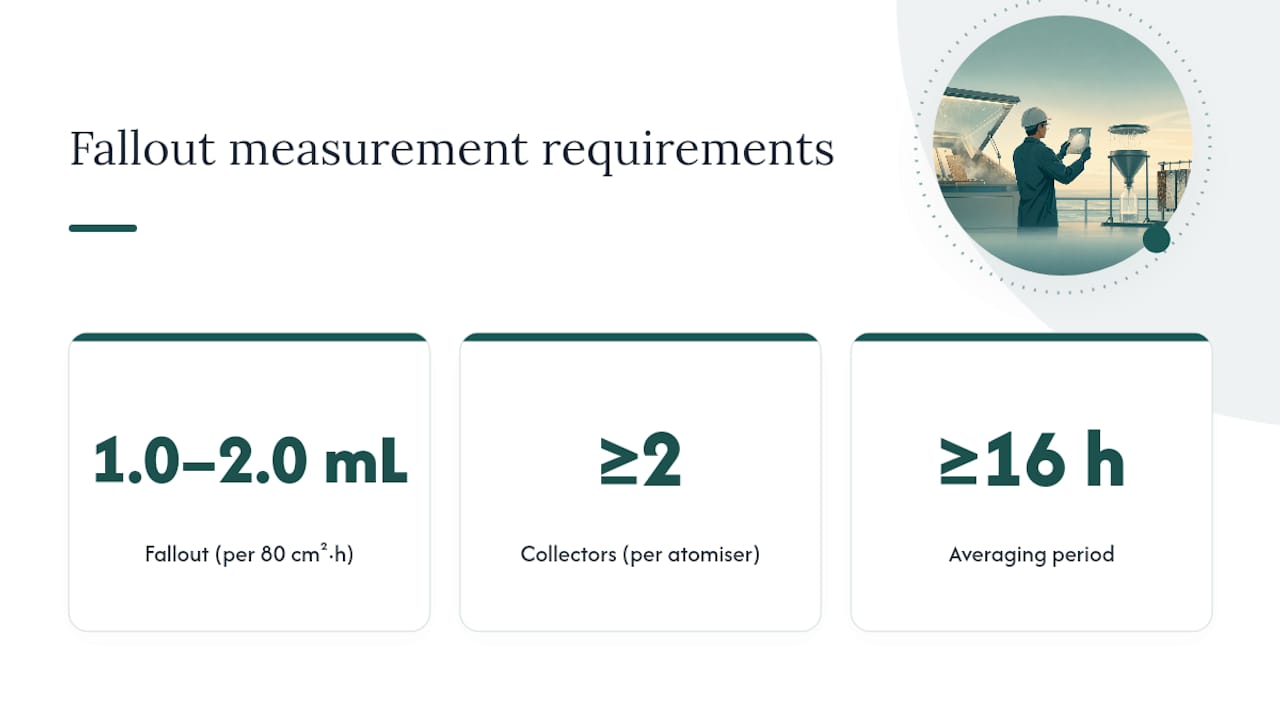
Fallout, in numbers: at least two clean collector funnels sit per atomiser, one near the nozzle and one at the far end of the chamber, with results averaged over a minimum of 16 hours before you can call the fog uniform.
Temperature control matters just as much. NSS conditions call for 35°C ±2°C, and any droplets condensing on the chamber lid and dripping onto specimens introduce localised over-wetting that has nothing to do with genuine fog exposure, so ceiling drip is a defect worth chasing down before you trust a single result.
Preparing salt solution and monitoring the parameters that keep results valid
Getting the chemistry right is not glamorous work, but it is where most reproducibility problems start. A precise process, followed the same way every time, is what separates a defensible test record from a disputed one.
- Weigh reagent-grade sodium chloride to make a 5% solution by mass, mixed with deionised or distilled water, never tap water, because dissolved minerals in tap water introduce uncontrolled variables into the corrosion mechanism.
- Check the salt source carries no anti-caking agents. These additives can act as corrosion inhibitors, and their presence has skewed more than one lab’s results without anyone noticing until the data stopped matching a known-good baseline.
- Measure the pH of the collected solution, targeting 6.5 to 7.2, adjusting with dilute hydrochloric acid or sodium hydroxide as needed to bring it back into range.
- Log pH, specific gravity, and fallout volume daily, not weekly. Drift in any of the three is usually the first sign that a nozzle is clogging or a reservoir needs recharging.
Pro Tip: Keep a running chart of daily pH and specific gravity readings pinned near the chamber. A slow drift over ten days is far easier to catch on a chart than in a spreadsheet nobody opens until the report is due.
Preparing specimens and rating what the fog leaves behind
Specimen handling before the test starts often determines whether the results mean anything at all. Clean parts thoroughly to remove handling oils and residues, and condition them per the relevant specification before loading, since surface contamination introduces the same false signals as a dirty chamber.
- Scribe test panels where the specification calls for it, cutting through the coating to bare substrate, because scribe creep tells you how well a coating resists undercutting corrosion at a breach point, which blanket exposure alone will not reveal.
- Position specimens at the angle the governing standard specifies, typically 15 to 30 degrees from vertical, with enough spacing between panels to stop drip-off from one part contaminating the one below it.
- Rate rust creep from a scribe using ASTM D1654 and rate blistering with ASTM D714, both of which give a numeric scale rather than a subjective pass or fail call.
- Photograph every specimen at removal and again after any cleaning step, because a written rating without a photographic record is difficult to defend months later in a supplier dispute.
How to run a salt fog test from warm-up to final report
A test is only as trustworthy as its documentation trail. Skip a verification step and you will not be able to prove the run was valid if a customer challenges the result later.
- Warm the chamber and verify fallout across all collector positions before loading any specimens, confirming uniform mist coverage.
- Calibrate temperature probes, the pH meter, and any hygrometers against a known reference before the run starts.
- Prepare the salt solution fresh, check pH and specific gravity, and fill the reservoir to the level that will last the planned exposure without a mid-test top-up.
- Load specimens with permanent identification tags and a written orientation map, so nobody has to guess which panel was where after the run.
- Record temperature, pH, specific gravity, and fallout volume daily, alongside any maintenance events such as nozzle cleaning or reservoir refills.
- At completion, rinse specimens gently, dry them without abrasion, photograph, apply the rating standards, and compile the full log into a signed report.
| Daily check | Target range | Action if out of range |
|---|---|---|
| Chamber temperature (NSS) | 35°C ±2°C | Recalibrate probe, check heater/thermostat |
| Collected solution pH | 6.5–7.2 | Adjust with dilute acid or alkali, re-test |
| Fallout rate | 1.0–2.0 mL/80 cm²/hr | Inspect and clean nozzles, reposition collectors |
| Specific gravity | Per solution spec | Check dilution, verify solution age |
Why hours in a chamber never equal years in service
The single most common misuse of salt fog data is treating exposure hours as a direct stand-in for calendar years. ASTM B117 itself is explicit that the method exists for comparative testing between similar systems, not for forecasting how long a coated part will survive on a real structure.
A part that passes a neutral salt spray test for a given duration has demonstrated relative performance against a defined benchmark. This does not correspond to any fixed period of real-world corrosion resistance, because the acceleration factor between chamber and field is not a fixed, transferable number.
Warning signs that a programme is misapplying the test include specifications that quote salt fog hours as a marketing claim, engineers comparing results across two labs running different fallout rates as if they were identical, and procurement teams rejecting a coating based on a single failed panel with no retest.
- When field correlation genuinely matters, layer in cyclic corrosion testing or real-world field exposure racks alongside the chamber data.
- Treat a single test failure as an investigation trigger, not a final verdict. Check the batch, the fixturing, and the chamber logs before condemning a coating process.
- Modified regimes under ASTM G85, including alternating wet and dry cycles, tend to track real degradation modes more closely than continuous fog for aluminium and painted assemblies.
Setting realistic acceptance criteria and corrective action paths
Production specifications lean on salt fog testing as a gatekeeping tool, not a design validation exercise. A common example is a 96-hour NSS requirement for certain pretreated and painted parts, chosen because 96 hours reliably separates a properly pretreated batch from one with process drift, not because 96 hours maps onto any specific field life.
- Sample a fixed number of panels per production lot, tied to the quality standards that govern your pretreatment and coating line.
- When a panel fails, isolate whether the cause is chemistry, application thickness, or chamber variability before reworking or scrapping the batch.
- Log every result against lot number and process parameters, since traceability is what turns a single failure into a useful process signal instead of an isolated incident.
- Retain photographic and numeric rating records for the audit period your customer contract specifies, typically several years for aerospace and defence work.
Handling precision glass components through a salt fog programme
Glass parts bring their own fixturing risks into a salt fog chamber. A clamp that would barely mark a metal bracket can chip or stress-fracture an optical edge, so mounts need to distribute load evenly and avoid point contact on coated or polished surfaces.
- Fixture optical and protective glass on padded or contoured supports, never rigid metal clamps directly on an edge.
- Inspect post-exposure for coating adhesion loss, edge chipping, and any change in optical clarity, not just visible rust, since glass assemblies fail differently to metal ones.
- Cross-reference batch traceability records against the test report, a practice detailed further in our hermeticity testing guide, so a chamber result always ties back to a specific production run.
When salt fog testing still earns its place in 2026
Salt fog testing remains one of the cheapest, fastest screening tools available, and that is precisely why it persists despite its well-documented limits. It works best as an early filter, catching a bad pretreatment batch or a supplier’s process drift before parts ever reach assembly.
Insist on modified or cyclic regimes the moment a part’s service environment involves genuine wet-dry cycling, UV, or mechanical flexing. Speed is only useful when the result actually tells you something about the risk you are trying to manage.
— Alexandra
Get specification support for glass components going into corrosion testing
Precision Glasses gives engineering teams a shortcut past the guesswork that often creeps into corrosion specifications for optical and protective glass. Rather than discovering mid-programme that a component’s edge finish or coating was never suited to salt fog exposure, you can get specification input before fabrication starts, from a team that fabricates the parts and understands how they behave under chamber conditions.

We review drawings and test requirements against our quality systems and supply production-ready technical glass components with batch-level traceability built in, so your corrosion test report and your fabrication record tell the same story when an auditor asks. If you are drafting an RFQ that includes salt fog or cyclic corrosion acceptance criteria, request a specification consultation with our engineering team before you finalise the document.
Key Takeaways
Salt fog testing under ASTM B117 or ISO 9227 works as a fast, low-cost comparative screening tool, but hours of exposure never translate directly into years of real-world service life.
| Point | Details |
|---|---|
| Test purpose | Use salt fog testing for comparative screening and batch QC, not field-life prediction. |
| Core parameters | Maintain 5% NaCl, pH 6.5–7.2, 35°C ±2°C, and fallout of 1.0–2.0 mL/80 cm²/hr. |
| Standard variants | Choose NSS, AASS, CASS, or cyclic ASTM G85 regimes based on the failure mode being tested. |
| Interpretation discipline | Pair chamber results with cyclic or field testing whenever real-world correlation matters. |
| Glass component handling | Precision Glasses supports specification review and supplies traceable glass parts built to withstand chamber testing. |
Sources
- Standard Practice for Operating Salt Spray (Fog) Apparatus (ASTM B117)
- Salt Spray Test (ASTM B117) Explained: Procedure, Ratings, and Limits
- Operating Salt Spray (Fog) Apparatus (ASTM B117 extract)
- The Limitations of ASTM B117 Salt Spray (Fog) Testing (industry article)
Recommended
- Hermeticity testing: methods, standards and selection guide – Precision Glasses
- Marine display glass for OEMs: specification & RFQ guide – Precision Glasses
- Precision glass measurement methods: the engineer’s guide – Precision Glasses
- Glass tolerances explained for engineers: 2026 guide – Precision Glass