Choose anti-glare (AG) glass when you need to control wide-angle reflections and stand up to heavy handling; choose anti-reflective (AR) glass when the priority is near-invisible glazing and maximum image clarity. Before you sign off on either, ask your supplier for two numbers: haze percentage for AG, and reflectance percentage plus visible light transmission (LT%) for AR. Those two figures tell you more about real-world performance than any marketing sheet.
- AG glass: request haze % and gloss units
- AR glass: request reflectance % (single and double-sided) and LT%
- Hybrid AG+AR: request both, plus a sample panel under your actual lighting
Precision Glasses fabricates both etched AG and sputtered AR coatings in-house, so the specification conversation and the manufacturing conversation happen with the same team.
Key Takeaways
Anti-glare glass suits durability-led, wide-angle glare control, while anti-reflective glass suits applications demanding near-invisible clarity and maximum light transmission.
| Point | Details |
|---|---|
| Match technology to function | Use AG for durability and wide-angle glare control; use AR for clarity and colour fidelity. |
| Demand the right test data | Request haze % and gloss units for AG, reflectance % and LT% for AR. |
| Watch for coating quality | Dense sputtered AR layers resist abrasion far better than porous sol-gel coatings. |
| Reserve hybrids for mission-critical work | Combine AG and AR only where both readability and low reflectance are essential. |
| Work with a single-source manufacturer | Precision Glasses supplies etched AG, sputtered AR and hybrid stacks with full test documentation in-house. |
Table of Contents
- Anti-glare vs anti-reflective glass: the mechanisms explained
- AG vs AR in numbers: haze, reflectance and the trade-offs that matter
- Matching anti-glare or anti-reflective glass to your application
- Writing a spec sheet that actually protects you
- Durability and maintenance: what holds up in the field
- How lighting and environment change anti-glare performance in practice
- Comparing the real costs of AG and AR glass
- Standards and certifications worth checking before you order
- Anti-glare glass and energy efficiency: an underrated connection
- Sources
Anti-glare vs anti-reflective glass: the mechanisms explained
Anti-glare glass works by disrupting the mirror-like flatness of the surface. Etching or a particulate coating creates a micro-texture that scatters incoming light in many directions instead of reflecting it back as a sharp image. That scattering shows up on a datasheet as haze (the percentage of transmitted light deflected more than 2.5 degrees from the incoming beam) and gloss units, measured on a gloss meter. Higher haze means softer reflections but also a slight loss of image sharpness behind the glass.
Anti-reflective glass takes a completely different route. It applies ultra-thin coating layers, often multiple oxide layers only nanometres thick, tuned so reflected light waves cancel each other out through destructive interference. Done well, this pushes reflectance down to roughly 1% or less on double-sided AR coatings, while pushing visible light transmission up to around 98–99%.
- AG scatters light through surface texture; measured by haze % and gloss units.
- AR cancels reflected light through thin-film interference; measured by reflectance % and LT%.
- Manufacturing choice matters too: etched AG becomes part of the glass itself, while AR is a deposited coating stack, often applied to a low-iron substrate when colour neutrality is critical.
AG vs AR in numbers: haze, reflectance and the trade-offs that matter
Specification sheets rarely disagree on the physics, but they disagree constantly on thresholds, and that gap is where most procurement mistakes happen. AR glass is judged almost entirely on reflectance and transmission, because scattering isn’t the goal at all.
Reflectance below 1% on double-sided AR coatings is the benchmark serious suppliers should be hitting, according to sourcing guidance from Hexad Glass. Anything meaningfully above that on a “premium” AR quote is worth questioning.
The trade-offs surface as specific visual artefacts, not vague quality complaints:
- Sparkle: a grainy shimmer caused by interaction between AG surface texture and a display’s pixel grid, common on high-resolution touch panels with the wrong haze level.
- Ghosting: faint secondary images caused by incomplete reflectance suppression on AR coatings, often from a single-sided coating being used where double-sided was needed.
- Blurriness on precision displays: a direct consequence of specifying AG haze too high for the pixel density involved. Getting the mechanism wrong here isn’t a cosmetic issue, it’s a functional failure.
Before accepting a panel, request the full test package: spectral transmittance across 380–780 nm, a reflectance curve, ISO 9211-4 abrasion test results, and gloss/haze measurements from a calibrated instrument, not a supplier’s internal estimate. If a datasheet only quotes a single transmission figure with no curve, ask why.
Matching anti-glare or anti-reflective glass to your application
Different environments punish the wrong choice in different ways, so the application should drive the spec, not the other way round.
- Choose AR for museum vitrines, high-end retail cabinets and optical instruments, anywhere colour fidelity and near-invisible glazing matter more than surface toughness. Architectural glazing suppliers increasingly specify AR coatings on windows and viewing panels specifically because they preserve unobstructed sightlines that untreated glass can’t match.
- Choose AG for outdoor kiosks, wayfinding signage, spandrel panels and high-touch retail or industrial displays. These surfaces face constant fingerprints, cleaning cycles and wide-angle sun exposure, conditions where an etched surface’s durability outperforms a coating designed primarily for optical clarity.
- Choose hybrid AG+AR only where both properties are genuinely mandatory. Drive-thru order screens and outdoor high-contrast signage are the classic cases: readability from odd angles in bright daylight matters as much as the loss of reflectance. It’s the costlier route, combining an etched or textured surface with a sputtered AR layer, so reserve it for applications where budget can absorb it and a lesser spec would create a real functional problem.
Writing a spec sheet that actually protects you
Procurement teams lose more time chasing incomplete datasheets after the order than they’d ever spend front-loading the request. Build the RFQ around documented evidence, not supplier assurances.
- Spectral transmittance curve across 380–780 nm, not a single transmission number
- Haze % and gloss units for AG, measured by a named calibrated instrument
- Reflectance % for AR, specified as single-sided or double-sided
- ISO 9211-4 abrasion test results, plus tempering or chemical strengthening certificates
- Maximum panel dimensions the coating or etch process supports, and confirmation of lamination compatibility
Size and process constraints catch buyers out more often than optical specs. Etching and sputtering both have practical panel-size ceilings, and tempering after coating can alter reflectance slightly, so confirm the sequence: is the glass toughened before or after the AR layer goes on?
Two red flags deserve particular attention. First, a panel that arrives with visibly higher haze than the quoted spec, often the sign of an inconsistent etching batch. Second, a “premium” AR coating that scratches under light handling. That usually means a porous sol-gel coating rather than a dense sputtered layer, and sol-gel AR films are known to be more vulnerable to abrasion than their sputtered counterparts.
Pro Tip: Always request a physical sample panel under your actual installation lighting before committing to a production run. A datasheet reflectance curve tells you the physics; a sample under your specific fixtures tells you what your customers will actually see.
Durability and maintenance: what holds up in the field
Etched AG is part of the glass surface itself, not a layer sitting on top of it, which is why it resists delamination even after years of heavy contact. That makes it the more forgiving choice for exterior kiosks, high-touch retail displays and industrial control panels, where a coated surface would eventually show wear at contact points.
AR coatings need closer scrutiny before they ever leave the factory. Ask suppliers about sputter density, layer count and hardness testing, because a coating’s resistance to scratching depends almost entirely on how it was deposited, not just its chemical formula.
A dense, sputtered multi-layer AR stack holds up to routine cleaning and incidental contact far better than a soft, porous sol-gel coating, even when both quote a similar reflectance figure on paper.
Maintenance routines should match the surface type:
- Use only manufacturer-approved cleaning agents; abrasive cloths or ammonia-based cleaners can degrade both etched and coated surfaces over time.
- Inspect AR-coated panels periodically for micro-scratching under raking light, where hairline wear shows up long before it’s visible head-on.
- Expect etched AG surfaces to hold their optical performance for the practical life of the glass, since there is no coating layer to wear through.
Buyers weighing durability against upfront cost can review process detail in Precision Glasses’ guide to optimising glass durability, which covers finishing and tempering choices relevant to both AG and AR products.
How lighting and environment change anti-glare performance in practice
A haze % that performs beautifully in a climate-controlled showroom can behave very differently outdoors. Direct sunlight hitting an AG surface at a low angle, early morning or late afternoon, produces far more visible scattering than the same panel under diffuse indoor lighting, simply because there’s more raw light energy to redistribute.
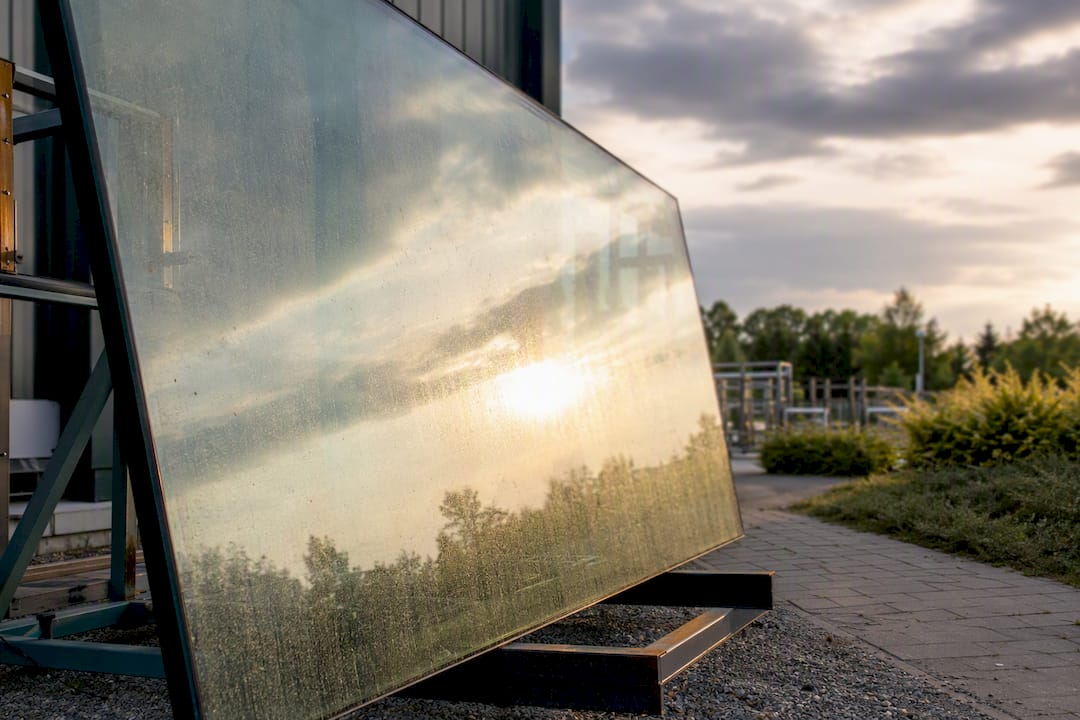
AG doesn’t eliminate reflected light; it redistributes it. That’s precisely why AG tends to outperform AR outdoors, where you can’t realistically cancel the sun’s intensity through thin-film interference alone, but you can spread it across a wider angle so it stops forming a blinding hotspot.
Indoor environments favour AR for a different reason. Fluorescent or LED panel lighting, especially in retail and museum settings, creates predictable, near-vertical reflection angles that a well-tuned AR coating can suppress almost completely. That’s why AR performs so consistently under gallery lighting but can struggle outdoors, where reflectance suppression alone can’t handle the sheer brightness of direct sun.
Humidity and temperature cycling matter for the coating stack itself, not just the optics. Sputtered AR layers deposited in a controlled vacuum environment tend to resist the micro-cracking that can develop in coatings applied under less rigorous process control, particularly in installations exposed to daily thermal swings, such as unshaded facades or vehicle glazing.
Orientation planning is worth doing before the glass is even ordered. A north-facing museum vitrine has fundamentally different lighting demands to a west-facing retail window catching afternoon sun, and the AG or AR spec should reflect that rather than defaulting to whatever was used on the last project.
Comparing the real costs of AG and AR glass
Cost conversations around anti-glare glass usually start in the wrong place: unit price per panel, rather than total cost across the product’s service life. Etched AG typically carries a lower per-panel premium than AR because the process modifies the existing glass surface rather than adding a separate deposition step. That makes it a comparatively economical route to glare control at scale, particularly for large architectural runs or signage networks.
AR coating costs scale with complexity. Hybrid AG+AR stacks combine both cost bases, which is exactly why they’re reserved for applications where the performance genuinely justifies it.
The cost calculation that actually matters is lifecycle cost, not sticker price. A cheap sol-gel AR coating that needs replacing after visible scratching within a few years costs more over a decade than a properly sputtered coating specified correctly the first time. Etched AG’s resistance to delamination plays into the same logic: fewer replacement cycles offset a marginally higher initial spec in high-traffic applications.
Volume and panel size also swing the numbers. Large-format architectural glazing benefits from economies of scale that a one-off instrument window never will, so buyers ordering at volume should push suppliers for tiered pricing tied to batch size, not just per-square-metre rates quoted for small runs.
Standards and certifications worth checking before you order
Anti-glare glass sits at the intersection of optical performance and structural safety, so credible suppliers should be able to produce documentation on both fronts. The abrasion resistance of AG and AR surfaces is commonly assessed against ISO 9211-4, the standard covering durability testing of optical coatings, and pencil hardness testing offers a quick, if blunt, secondary check on coating toughness.
Tempering and chemical strengthening certificates matter just as much as optical data, particularly for architectural and industrial applications where the glass also carries a structural or safety load. A supplier quoting an impressive haze % on an untempered panel destined for a public-facing kiosk hasn’t actually answered the question that matters for that application.
Spectral transmittance data should be presented as a curve across the 380–780 nm visible range, not a single averaged figure, because AR coatings in particular can show uneven performance across that band, dipping at certain wavelengths even when the average transmission looks strong. Ask for the curve, not the summary statistic.
There’s no single universal certification scheme that covers every anti-glare application worldwide, so the practical approach is to request the specific test reports relevant to your sector: abrasion, tempering, and spectral performance, rather than relying on a supplier’s general quality claims. Buyers working across regulated sectors such as medical devices or aerospace should also confirm batch-level traceability documentation alongside the optical test data, since compliance audits in those industries typically expect both.
Anti-glare glass and energy efficiency: an underrated connection
Anti-glare and anti-reflective treatments don’t just change how glass looks, they influence how buildings and devices manage light and heat. AR-coated architectural glazing raises visible light transmission, which means interiors can rely on natural daylight for longer stretches of the day before artificial lighting kicks in. That’s a modest but real contribution to a building’s overall energy profile, particularly in glazing-heavy facades and atria.
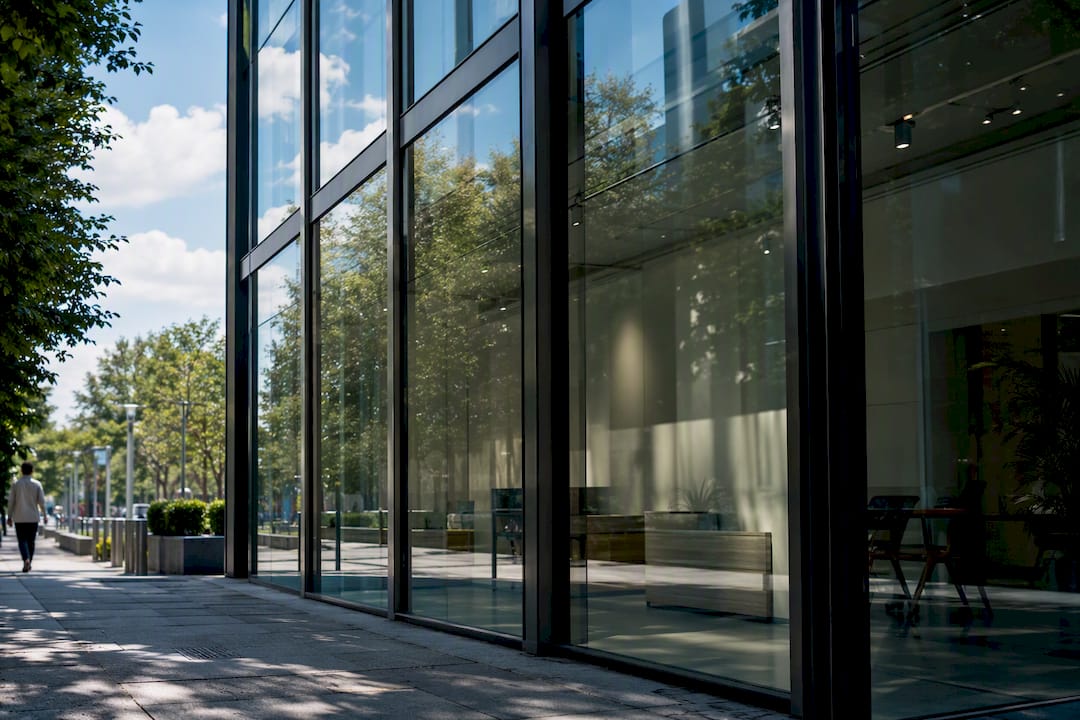
AG glass plays a different role. By controlling glare rather than maximising transmission, it can reduce reliance on blinds, tinting or supplementary shading devices that would otherwise be needed to make a bright interior usable, devices that themselves often reduce daylight penetration and increase artificial lighting demand.
Display technology tells a similar story. Screens and kiosks fitted with effective anti-glare or anti-reflective covers often run at lower backlight brightness settings, because the display doesn’t need to fight through glare or reflectance to stay legible. Lower brightness settings translate directly into lower power draw across a fleet of outdoor or retail displays running continuously.
Manufacturing choices matter here too. Etched AG requires no additional coating materials beyond the base glass, while AR coatings do carry an embedded material and energy cost in their production, sputtering equipment runs in controlled vacuum conditions. Buyers weighing sustainability alongside performance should factor that production footprint against the in-service energy savings AR delivers through higher transmission, rather than treating either technology as automatically the “greener” option.
A short recommendation for engineers and buyers
Start with the functional requirement, clarity or wide-angle readability, then request spectral and haze data plus a sample panel. Save hybrid stacks for displays where nothing less will do.
— Alexandra
Get a sample panel and spec review from Precision Glasses
Precision Glasses fabricates both etched AG and sputtered AR coatings under one roof, along with tempering, chemical strengthening and full test documentation, so you’re not stitching together specs from three different vendors to get a panel that actually meets your acceptance criteria.
That matters most when a project needs a hybrid AG+AR stack, where coordinating an etch process and a coating process across separate suppliers is where timelines and tolerances usually go wrong. Our technical glass range covers both approaches, backed by batch-level traceability for buyers in regulated sectors such as medical devices, defense and aerospace. Reviewing anti-glare and anti-reflective options against a project brief also benefits from seeing how comparable manufacturers apply glare control to legibility-critical products, such as stainless steel screens used in bright environments.
If you’re at the specification stage now, send us your transmittance and haze targets and request a sample panel or QA certificate set before committing to a production run. Get in touch through Precision Glasses to start that conversation and receive an application-specific quotation.
Sources
- Anti-Glare Vs. Anti-Reflective Glass: What’s The Difference? (A B2B Sourcing Guide) – Hexad Glass
- Windows with an anti-reflective coating: what is it and why do you need them? – Aluprof
- Interference (optical primer) – Olympus Life Science