
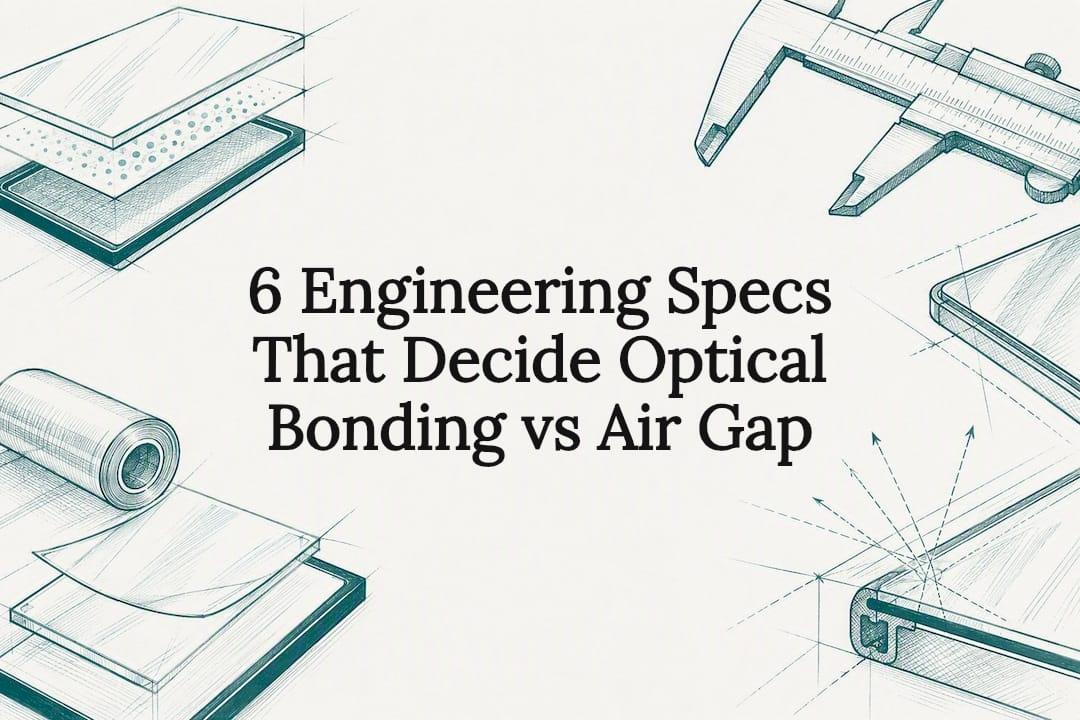
Optical bonding is generally the right call when a display must stay readable in bright light, resist moisture, or survive vibration without shifting internally. Air gap construction remains a sound, lower-cost choice for indoor products where field serviceability and budget matter more than sunlight contrast. The sections below explain the physics behind that split and what to put in your specification either way.
TL;DR:
- Optical bonding significantly reduces internal reflections, improving sunlight readability, contrast, and view angles compared to air gap displays.
- Bonded stacks seal out dust and moisture naturally, while air gaps require additional gaskets and are more vulnerable to internal fogging and debris ingress.
- Bonding increases front stack stiffness and touch accuracy by eliminating parallax and flex, but it makes repairs difficult once the layers are fused into a single module.
- The choice of adhesive type—OCA for flat surfaces or LOCA for complex geometries—affects process complexity, defect control, and compatibility with coatings.
- Air gap construction remains advantageous for designs prioritizing serviceability, mechanical isolation, and lower initial costs, especially in moderate or indoor environments.
Table of Contents
- What is optical bonding vs air gap construction?
- Why optical bonding improves contrast, sealing, and structural stiffness
- When does an air gap remain the better engineering choice?
- OCA vs LOCA: which bonding material and process should you specify?
- How does bonding affect repair, warranty, and long-term reliability?
- Precision Glasses’s approach to bonded and sealed display glass
- Which construction should you specify for your next project?
- What the theory misses in practice
- Get sealed, bonding-ready display glass specified right the first time
- Sources
- FAQ
What is optical bonding vs air gap construction?
An air gap display stack has two or three separate layers, cover lens, optional touch sensor, and LCD, held apart by a frame or bezel with only air between them. Optical bonding replaces that air layer with a transparent adhesive that fills the entire gap and fuses the layers into one optical unit.
The difference matters because every material boundary reflects light. Light crossing from glass into air, and then from air back into glass, bounces at each interface, scattering ambient light back towards the viewer and washing out contrast. Optical bonding fills that gap with adhesive so light travels through a single, continuous refractive path with far fewer surfaces to reflect from. That is the entire physical basis for optical bonding’s sunlight readability advantage.
Air gaps introduce a second, less obvious problem: parallax. When a finger touches the cover lens, the touch coordinate has to be interpreted through however many millimetres of air sit between the lens and the sensing layer beneath it. Bonded stacks eliminate that offset, which is why touch response on bonded assemblies tends to feel more direct.
The trade-offs break down across six dimensions engineers actually specify against:
- Optical clarity and internal reflection: bonding wins decisively; air gap loses roughly 4% of transmitted light per uncoated air interface it removes.
- Durability and ingress protection: bonding seals out dust and condensation by design; air gap needs separate gaskets to achieve the same protection.
- Serviceability and rework: air gap wins easily; bonded stacks usually become a single non-serviceable module.
- Process complexity and yield: air gap is simpler and more forgiving; bonding demands cleanroom control and bubble-free lamination.
- Thermal behaviour and ageing: bonding removes an insulating air layer that can trap heat; air gap keeps components thermally isolated but exposed to internal fogging.
- Cost impact: air gap costs less per unit and at low volume; bonding’s premium narrows at scale but rarely disappears.
Why optical bonding improves contrast, sealing, and structural stiffness
Filling the gap does three distinct jobs at once, and each one shows up in a measurable engineering outcome rather than a marketing claim.
First, it kills internal reflection. With no air boundary between cover glass and display, there is no surface for stray light to bounce off before it reaches the panel, which is why bonded displays hold contrast in direct sunlight where an equivalent air-gap unit washes out. Second, the cured adhesive is a solid, contiguous seal. It physically excludes the moisture and airborne particulate that otherwise migrate into an air gap and condense against the cool inner face of the cover lens overnight, a familiar fogging problem in outdoor kiosks and vehicle dashboards. Third, bonding stiffens the front stack mechanically. The cover lens, adhesive, and touch sensor behave as one laminated composite rather than three loosely constrained plates, which reduces flex under touch pressure and improves apparent touch precision.
Statistic callout: Removing the internal air gap can improve light transmission and viewing angle while eliminating trapped condensation, a combination that full-surface optical bonding delivers by eliminating internal interfaces altogether.
- Reduces perceived glare and improves contrast under high ambient light.
- Prevents internal condensation and dust ingress across the sealed area.
- Increases stiffness of the front optical stack, reducing flex-related touch errors.
- Can support heat dissipation by removing an insulating air layer, though this must be verified per material system.
When does an air gap remain the better engineering choice?
Air gap construction is not a compromise you settle for. It is the correct answer whenever the product’s risk profile favours flexibility over peak optical performance. A deliberate air gap suits designs where the display must stay removable, where mechanical isolation between components is required, or where the optical requirement is genuinely moderate, such as an indoor control panel under diffuse office lighting.
Cost is the most immediate driver. Air-gap assemblies skip the adhesive material, the lamination fixturing, the cure cycle, and the optical inspection step that bonding demands, which keeps both bill-of-materials cost and process time down. That matters most at low-to-mid production volumes where amortising a bonding line’s setup cost is hard to justify.
Serviceability is the second driver, and it is often decisive:
- Field technicians can swap a cracked cover lens or a failed touch sensor without discarding the whole assembly.
- Mechanical isolation between layers absorbs vibration and differential thermal expansion better than a rigid bonded laminate, useful in high-vibration industrial or vehicle-mounted equipment.
- Warranty and repair logistics stay simpler because each layer is still a discrete spare part.
- Indoor, lower-ambient-light environments rarely need the contrast boost bonding provides, so the trade-off costs you performance you were never going to use.
OCA vs LOCA: which bonding material and process should you specify?
Two adhesive families dominate optical bonding, and they behave differently enough to change your process plan, not just your bill of materials.
- OCA (optically clear adhesive film) is a preformed film laminated between layers under controlled pressure. Avnet’s material comparison notes it suits flat, planar assemblies where consistent thickness and repeatable lamination matter more than covering complex geometry.
- LOCA (liquid optically clear adhesive) is dispensed as a liquid, then cured, usually under UV light. Planar’s technical FAQ confirms LOCA uses silicone gel or urethane chemistries that cure to affix the cover glass to the LCD without changing the display’s operating temperature.
- Cure and bubble control are the main process risks with LOCA: shrinkage during UV cure and trapped air both create visible defects, mitigated with dam-and-fill dispensing, vacuum lamination, and cleanroom handling.
- Coating compatibility needs checking early. Anti-reflective and anti-glare coatings on cover glass can interact unpredictably with certain adhesive chemistries, so request compatibility data before committing to a supplier’s standard formulation.
- Inspection criteria belong in your acceptance test: optical uniformity, maximum bubble diameter and count, edge void limits, and adhesion pull tests all need numeric pass/fail thresholds, not a visual “looks fine” sign-off.
Pro Tip: Specify your bubble and particle tolerance in the drawing, not the process spec. If it only lives in a supplier’s internal work instruction, you have no leverage when a batch arrives with visible defects that technically passed their own line.
Large or non-planar cover lenses often force the LOCA route because film lamination becomes impractical, a trade-off worth flagging early in the design because it raises contamination control requirements later.
How does bonding affect repair, warranty, and long-term reliability?
Once you bond a display stack, the cover lens, touch sensor, and LCD stop being three spare parts and become one module. That single fact should drive your spares strategy and warranty terms before you commit to a bonding process, because a scratched cover lens on a bonded unit usually means scrapping the whole front stack rather than swapping one component.
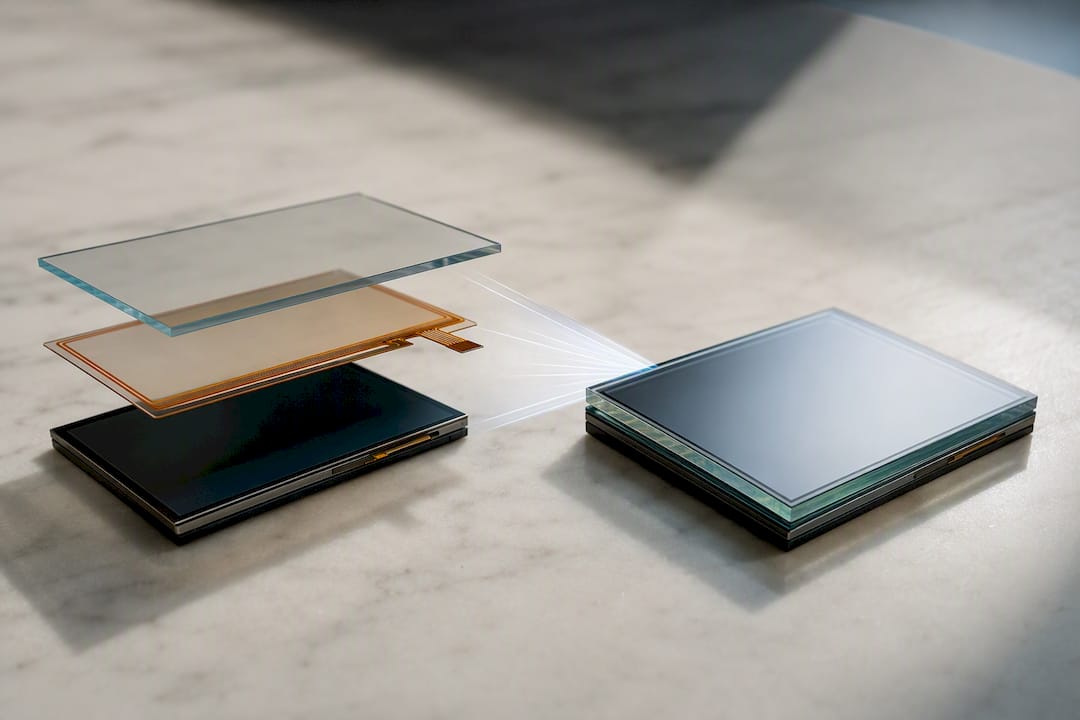
Design-for-service does not have to disappear entirely. Building in a validated perimeter joint or a documented rework process lets you recover bonded assemblies, though it raises process control requirements and repair cost on every unit built that way.
Your acceptance test plan should specify, with numeric thresholds where possible:
- Optical uniformity across the bonded area, checked against a defined luminance variance.
- Maximum bubble diameter and particle count per unit area.
- Adhesion strength via pull or peel testing at the bonded interface.
- Thermal cycling to reveal delamination or yellowing before the product ships, since UV exposure and heat cycling are the two dominant ageing failure modes in outdoor and automotive installations.
Statistic callout: Removing internal air layers can enhance heat dissipation and reduce solar-ageing effects, though the effect depends heavily on adhesive chemistry and needs verifying against your specific thermal profile rather than assumed by default.
Precision Glasses’s approach to bonded and sealed display glass
Specialized manufacturers fabricate display glass, sensor windows, and protective cover glass for medical, defense, aerospace, automotive, and electronics applications where the choice between optical bonding and air gap construction has real consequences downstream. Our glass bonding technology guide walks through process controls in more depth, and our optical bonding adhesives selection guide covers OCA and LOCA handling requirements engineers can reference when writing a specification.
Before awarding a bonding contract to any supplier, ask for:
- Material data sheets for the specific adhesive, not a generic family sheet.
- Documented cure profiles, including UV dose and time for LOCA systems.
- Inspection records showing bubble, void, and particle counts from recent production runs.
- Environmental test reports covering thermal cycling and UV exposure relevant to your deployment.
Substrate choice also affects bonding integrity where a rigid frame or backing material is involved. If your assembly includes a structural composite frame, the G10 vs FR4 material comparison is worth reviewing, since thermal expansion mismatch between a frame material and a bonded glass stack can stress the adhesive joint over repeated thermal cycles.
Which construction should you specify for your next project?
Run three questions before you commit to a stack: does the product need outdoor or high-ambient-light readability, does the field service model require swapping a cover lens or sensor independently, and does your production volume justify bonding’s added process cost?
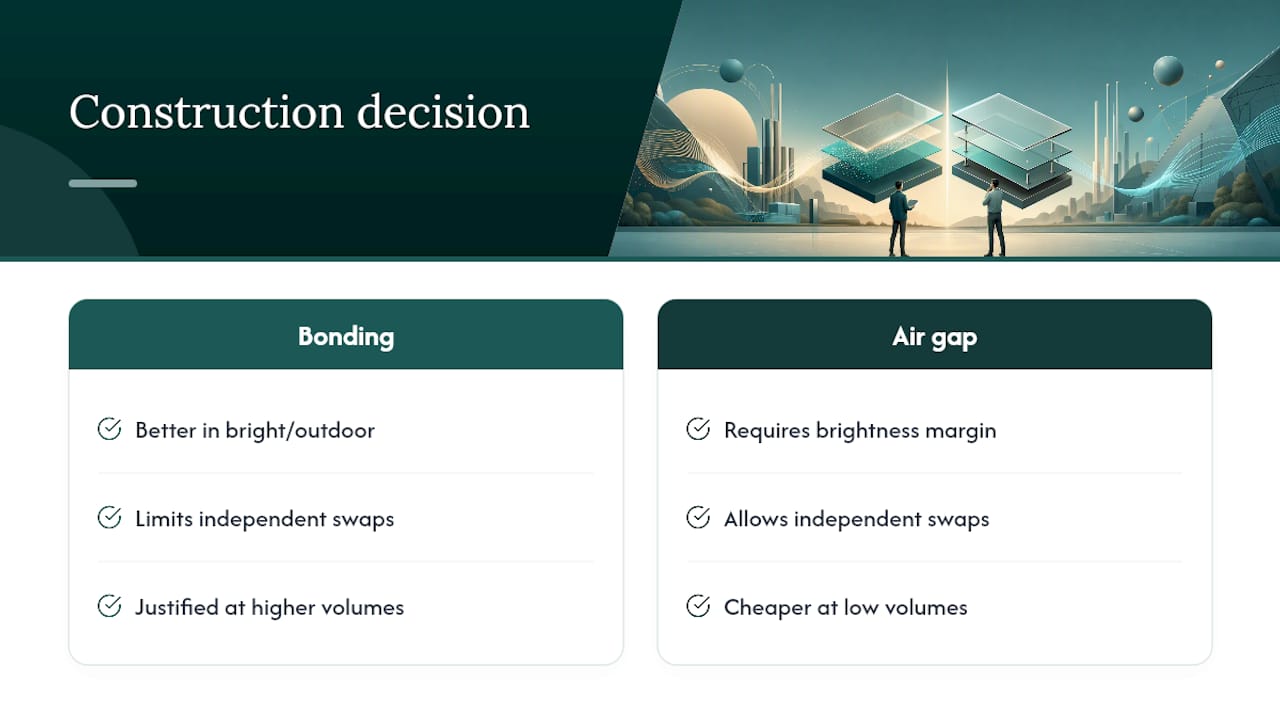
If optical bonding wins that test, specify the adhesive family, maximum bubble and particle counts, cure method, and inspection acceptance criteria directly in the drawing. If air gap wins, build in edge seals against dust and moisture, keep a brightness margin for ambient light conditions, and preserve genuine service access rather than a sealed bezel that only looks removable.
What the theory misses in practice
The optical case for bonding is airtight on paper. Fewer interfaces, less internal reflection, better contrast in bright light. What the conventional advice underplays is how much that theoretical gain depends on process discipline that most specifications never nail down. A bonded assembly with poor bubble control or inconsistent adhesive thickness can look worse than a well-built air-gap unit, because you have traded a known, easily inspected air layer for a variable, harder-to-inspect adhesive layer.
The gap between “optical bonding is superior” and “this specific bonded unit performs better” is entirely down to whether the engineer specified numeric acceptance criteria, internal reflection thresholds, bubble counts, adhesion pull values, rather than trusting a supplier’s visual sign-off. That is the piece worth prioritising first, before debating adhesive chemistry or cure method. Get the test plan right and the material choice mostly takes care of itself.
Where I would push back hardest on default thinking is the assumption that air gap is always the “safe, cheap” fallback. It carries its own long-term risk in sealed enclosure design, condensation and dust ingress do not announce themselves until months into deployment, by which point the warranty claims are already stacking up.
— Alexandra
Get sealed, bonding-ready display glass specified right the first time
Choosing between optical bonding and air gap construction only gets you halfway there. The cover glass itself, its coatings, edge finish, and dimensional tolerance, determines whether either bonding process actually performs the way the theory promises. Precision Glasses fabricates custom optical glass windows, sensor windows, and display cover glass to the tight tolerances that bonded assemblies demand, with batch-level traceability so your acceptance testing has a documented material history behind it.
If you are specifying a sealed, sunlight-readable display for a medical device, vehicle dashboard, or outdoor instrument, our touchscreen glass selection guide for engineers is a practical starting point for matching coating and substrate choices to your bonding process. Get in touch through Precision Glasses with your drawing and environmental requirements, and we will help you specify glass that suits the construction method you choose, bonded or air gap alike.
Sources
- EIZO: What is optical bonding?
- Christie Digital: The top 5 benefits of optical bonding (PDF)
- Planar: Optical bonding FAQ (PDF)
- JasperEle: HMI optical bonding vs air gap design guide
FAQ
What is an optical bonding display?
An optical bonding display is a screen assembly where the cover glass, touch sensor, and LCD are fused with a transparent adhesive instead of separated by an air gap, which reduces internal reflection and prevents condensation between the layers.
What is optical contact bonding?
Optical contact bonding is another term for the same process: filling the gap between display layers with a cured adhesive, typically OCA film or LOCA liquid, to create one continuous optical path rather than distinct glass-air-glass boundaries.
Does optical bonding change a display’s operating temperature?
No. Planar’s technical documentation confirms that bonding with silicone gel or urethane adhesives does not alter the display’s operating temperature, though thermal cycling should still be verified during acceptance testing.
Is air gap construction ever more durable than optical bonding?
Air gap can offer better mechanical isolation in high-vibration assemblies since the layers are not rigidly fused, but it needs separate gaskets and seals to match the dust and moisture protection that bonding provides inherently.
Can a bonded display still be repaired in the field?
Usually not without significant cost, because bonding turns separate service parts into one module; a validated perimeter joint or documented rework process can preserve some repairability, but it adds process cost.