Cover glass for touchscreens typically carries a datasheet claim of 6H to 9H, corresponding to roughly Mohs 5 to 7, but that figure alone tells you little. The metric that matters for procurement is Knoop hardness (HK) reported with its test load. Hardness governs scratch resistance, not the coating wear, sealing, and bonding quality that usually decide when a display actually fails in the field.
TL;DR:
- Knoop hardness with defined test load is the most reliable metric for comparing cover glass scratch resistance, not the Mohs or pencil hardness scale.
- Proper testing standards, lab accreditation, and detailed test parameters are essential when evaluating supplier claims of glass hardness and durability.
- Coatings such as oleophobic or anti-reflective layers wear out faster than the glass and should be specified with abrasion cycle data and contact angle thresholds.
- Thicker glass enhances impact resistance but can compromise touch sensitivity unless firmware and bonding methods are properly tuned.
Table of Contents
- What is touch cover glass hardness, and what determines it?
- How do you test glass hardness, and which scale should you trust?
- How does strengthening change hardness and fracture behaviour?
- Do surface coatings affect real-world scratch resistance?
- What glass thickness balances durability and touch sensitivity?
- What limits touchscreen life more than glass hardness?
- What should you request from suppliers before signing off on cover glass?
- Why system-level reliability beats headline hardness numbers
- Get Knoop-tested cover glass built to your specification
- Sources
- FAQ
What is touch cover glass hardness, and what determines it?
Cover glass hardness is a measure of how much the surface resists localised deformation from a point load, whether that’s a fingernail, a keyring, or grit trapped under a stylus. Two variables set the number you see on a datasheet: the base glass chemistry, and whether it has been chemically or thermally strengthened afterwards.
Soda-lime glass is the cheapest and most widely available option, with typical Mohs hardness around 5 to 6. It works for low-cost consumer enclosures but rarely appears in demanding industrial or medical touch applications because it chips more readily under edge impact.
Aluminosilicate glass (often called alkali aluminosilicate) is the workhorse of premium cover glass. Supplier literature commonly places it in the Mohs ~5 to 7 range once chemically strengthened, with some product literature citing top-layer hardness as 6H or higher for specific display modules.
A few points worth flagging before you take any datasheet number at face value:
- Vendor “H” ratings borrowed from pencil hardness testing were designed for coatings and paints, not structural glass, so a 9H claim on a screen protector is not directly comparable to a 9H claim on cover glass.
- Mohs is a scratch-order scale, not a measured force, so it’s useful for quick comparison but poor for engineering tolerance work.
- The only figure that gives you a reproducible, load-specific number is Knoop microhardness, which is why serious procurement conversations move there quickly.
Glass durability in engineering touches on how these material choices ripple through the entire assembly, not just the top surface. It’s worth reading before you commit to a chemistry.
How do you test glass hardness, and which scale should you trust?
Knoop indentation hardness is the standard engineers should ask for when comparing cover glass options. ASTM C730 defines the method: an elongated diamond indenter is pressed into the glass surface under a controlled load, and the resulting indentation is measured to calculate the HK value.
Knoop is preferred over Vickers for thin, brittle substrates because its shallow, elongated indent produces less radial cracking than the square Vickers pyramid, which matters when you’re testing glass measured in fractions of a millimetre. Mohs, by contrast, only tells you which material scratches which. It has no load value attached and cannot be used for pass/fail engineering acceptance criteria.
When you request test evidence from a supplier, insist on these details:
- The HK value paired with its applied load (for example, HK500), never a bare number.
- The number of valid indents used to calculate the reported average.
- The test standard referenced, ideally ASTM C730 or an equivalent ISO Knoop protocol.
- Confirmation the testing lab holds ISO/IEC 17025 accreditation, so measurement uncertainty is documented rather than assumed.
Pro Tip: If a supplier quotes hardness as “9H” with no load, standard, or lab named, treat it as marketing copy rather than engineering data. Ask them to resubmit with a Knoop report before you build a comparison matrix.
How does strengthening change hardness and fracture behaviour?
Strengthening doesn’t meaningfully raise the surface hardness of the glass itself. What it changes is how the glass fails under bending or impact, which matters more for most touch applications than the Knoop number alone.
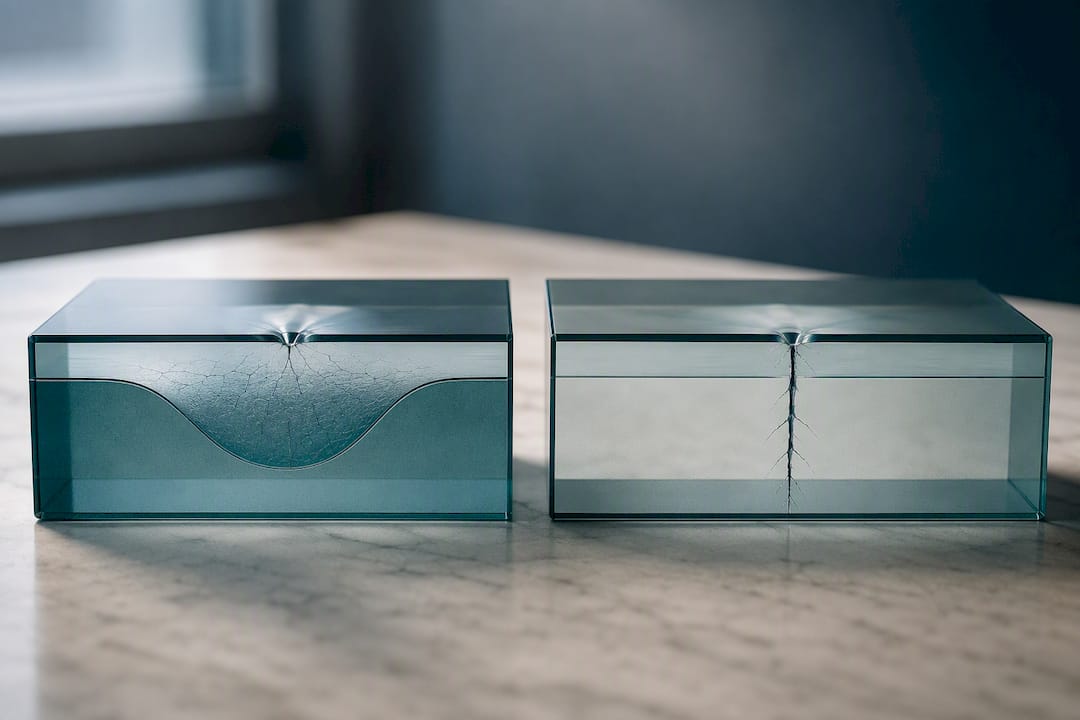
Chemical strengthening (ion exchange) submerges the glass in a potassium nitrate bath, swapping smaller sodium ions in the surface for larger potassium ions. This creates a compressive layer typically 40 to 100 microns deep, which resists crack propagation and significantly improves bending and impact resistance without adding thickness.
Thermal tempering heats the glass and rapidly cools the surface, locking in compressive stress through a different mechanism. It’s cheaper for thicker panels but changes the fragmentation pattern on failure, shattering into small pieces rather than sharp shards.
- Choose chemically strengthened aluminosilicate for thin, handheld, or wearable devices where you need impact resistance without adding mass.
- Choose thermal tempering for thicker industrial panels where cost matters more than minimising thickness.
Chemically strengthened glass: guide for engineers goes deeper into bath chemistry and layer depth if you’re specifying this process for the first time.
Do surface coatings affect real-world scratch resistance?
Coatings, not the glass underneath, usually decide how a touch panel looks and feels after months of handling. Anti-fingerprint (oleophobic), anti-reflective, and anti-glare coatings sit a few nanometres thick on top of the strengthened glass, and they wear faster than the substrate ever will.
To specify coating life properly, request:
- Abrasion cycle data using Taber or ISO 9211-4 style testing rather than a single pencil-hardness pass.
- Contact angle thresholds before and after abrasion, since oleophobic performance drops as the coating wears even when the glass beneath looks fine.
- Cleaning cycle equivalence, so you can translate lab cycles into an estimated real-world service interval.
Pro Tip: A single “H” scratch test tells you nothing about coating longevity under repeated alcohol wipes. Ask for abrasion cycle counts alongside the hardness figure, or you’re only getting half the durability picture.
Avoid the Taber Only Trap covers why relying on one abrasion method alone can mislead your acceptance criteria.
What glass thickness balances durability and touch sensitivity?
Thicker glass generally means better impact resistance, but it comes at a cost to optical clarity and touch responsiveness if the controller isn’t tuned to match.
- Wearables: typically 0.3 to 0.5mm, prioritising weight and flexibility over raw impact resistance.
- Handheld devices: commonly 0.5 to 0.7mm, balancing drop resistance with touch controller sensitivity.
- Industrial HMIs: often 1.0 to 3.0mm or thicker, where robustness against tools and heavy impact outweighs weight concerns.
Thicker glass increases the distance between the finger and the sensing layer, which projected capacitive touch (PCT) controllers must compensate for through firmware tuning. Bonding method matters here too: an air gap is cheaper but introduces glare and reduces sensitivity at greater thickness, while optical adhesive bonding preserves clarity and touch response but adds cost and process complexity. How to design touch screen glass covers these bonding trade-offs in more detail.
What limits touchscreen life more than glass hardness?
Moisture ingress, UV exposure, and adhesive degradation typically wear out a touch assembly long before the glass substrate shows meaningful abrasion. Coatings and seals are the weak link, not the hardness number on the spec sheet.
Evidence from touchscreen longevity studies backs this up: environmental factors like heat, humidity, and ingress commonly degrade adhesives and coatings well ahead of the glass itself, while PCT sensors underneath remain electrically accurate through extremely high touch counts.
Statistic callout: Practical durability data shows PCT touch sensors continue registering accurate input across millions of touch cycles, while the surrounding seals and coatings are the components most likely to fail first, according to longevity testing reported by Touch Screen Guru.
For long-life systems, prioritise:
- IP-rated sealing appropriate to the deployment environment (washdown, outdoor, marine).
- Thermal cycling tests that stress adhesive bonds across the expected operating range.
- Adhesion pull tests on optical bonding layers, not just cosmetic inspection.
What should you request from suppliers before signing off on cover glass?
A procurement checklist saves you from discovering gaps after production tooling is committed. Build your RFQ around these items:
- Knoop hardness report referencing ASTM C730 or an equivalent ISO standard, with HK value and applied load stated explicitly (for example, 560 HK100).
- Lab accreditation and measurement uncertainty, confirming ISO/IEC 17025 status rather than an in-house claim.
- Coating abrasion cycle data, including the test method used and contact angle thresholds before and after cycling.
- IP rating and sealing method, matched to the environment the device will actually operate in.
- Optical bonding acceptance criteria, including polarised-light inspection to catch adhesive stress patterns that cause mura defects.
- Sample lot testing plan, with witness testing during early production runs rather than relying solely on pre-production samples.
Example starting thresholds for discussion, not universal specification: HK500 minimum for consumer-grade aluminosilicate, 40 to 100 micron compressive layer depth for chemically strengthened parts, and abrasion cycle counts matched to expected cleaning frequency over the product’s service life.
Pro Tip: Request witness testing on your first production lot, even if the supplier’s qualification samples passed. Batch-to-batch variation in ion exchange bath chemistry can shift compressive layer depth more than most engineers expect.
Touchscreen glass selection guide for engineers walks through how to weigh these criteria against your specific application constraints.
Why system-level reliability beats headline hardness numbers
The industry’s obsession with hardness ratings misses the point. A 9H claim with no load or standard behind it tells you nothing useful, while a modest HK500 result backed by proper coating abrasion data tells you everything. Focus negotiating energy on sealing, coating cycles, and controller tuning alongside the hardness figure, not instead of it. Use the checklist above when you’re comparing supplier quotes, and don’t accept a datasheet number without the test parameters behind it.
— Alexandra
Get Knoop-tested cover glass built to your specification
Most suppliers hand you a hardness claim and expect you to take it on faith. Some suppliers provide chemically strengthened and coated cover glass alongside test evidence such as ASTM C730 Knoop hardness results and coating abrasion cycle data on request.
Suppliers may support RFQs with sample test reports, production witness testing, and batch-level traceability rather than a single marketing datasheet. If you’re ready to move past vendor “H” claims and get real Knoop data behind your next cover glass order, request a specification review on our technical glass page and we’ll walk you through what test evidence to expect for your application.
Sources
- How Long Do Touchscreens Last? A Complete Longevity Guide – Touch Screen Guru
- C730 Standard Test Method for Knoop Indentation Hardness of Glass
- The anatomy of a modern touchscreen panel – LuphiTech
FAQ
What hardness should a screen protector be?
Most screen protectors marketed to consumers claim 6H to 9H on the pencil hardness scale, but this measures resistance to a graded pencil tip, not a load-specific Knoop value, so it doesn’t translate directly to engineering specifications.
What is the toughest phone screen glass?
Toughness in cover glass comes primarily from chemical strengthening rather than raw hardness. Ion exchange processing creates a compressive surface layer typically 40 to 100 microns deep, which is what actually improves impact and bend resistance.
What is the hardest screen protector you can get?
Vendor “H” ratings above 9H exist in the marketplace, but without a stated test load and standard, these figures are marketing claims rather than verifiable Knoop hardness data. Request an ASTM C730 report if hardness comparison matters for your application.
Does tempered glass affect touch sensitivity?
Thicker tempered or strengthened glass increases the distance between a finger and the capacitive sensing layer, which can reduce raw touch sensitivity unless the projected capacitive controller is retuned to compensate for the added thickness.
How is glass hardness actually measured for engineering purposes?
Knoop indentation testing under ASTM C730 is the accepted method for thin, brittle cover glass, reporting a load-specific HK value rather than a comparative scratch scale like Mohs.